Correo Electrónico
 DNINFOA - SIA
 Bibliotecas
 Convocatorias
 Identidad U.N.


Publicado
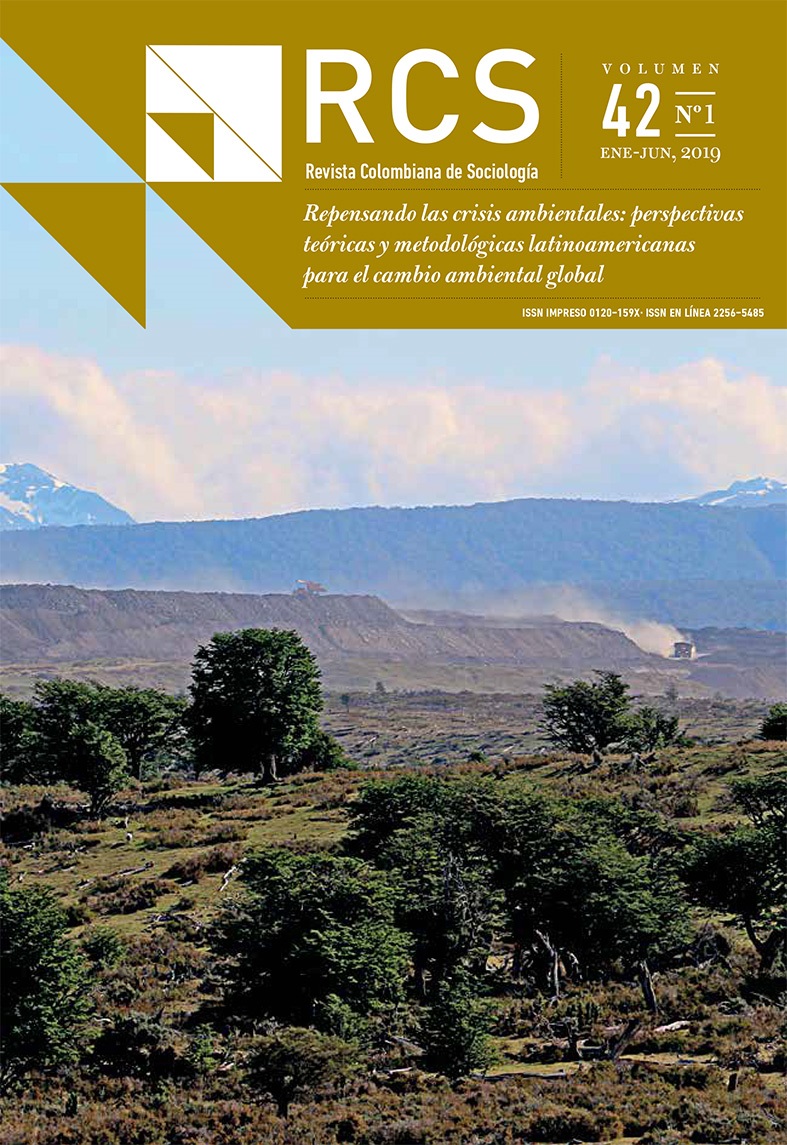
Pensar la sustentabilidad desde América Latina. Retrospectiva del discurso académico a partir de un análisis bibliométrico entre 1970 y 2012
Thinking Sustainability from Latin America. A Retrospective Look at Academic Discourse Based on a Bibliometric Analysis between 1970 and 2012
Pensar a sustentabilidade na América Latina. Retrospectiva do discurso acadêmico a partir de uma análise bibliométrica entre 1970 e 2012
DOI:
https://doi.org/10.15446/rcs.v42n1.73141Palabras clave:
América Latina, análisis histórico, cambio ambiental global, desarrollo sostenible, discursos académicos, pensamiento ambiental latinoamericano, redes de citas, sustentabilidad (es)Latin America, historical analysis, global environmental change, sustainable development, academic discourses, Latin American environmental thought, citation networks, sustainability (en)
América Latina, análise histórica, desenvolvimento sustentável, discursos acadêmicos, mudança ambiental global, pensamento ambiental latino-americano, redes de citações, sustentabilidade (pt)
Ante las evidencias de una crisis ambiental global de origen antrópico, la comunidad científica ha sido interpelada para diseñar colectivamente una transición hacia la sustentabilidad socioecológica. Este artículo propone caracterizar los discursos académicos sobre la sustentabilidad en América Latina, a partir de un análisis de la red de citas de una muestra de 93 intelectuales latinoamericanos que han participado en estos debates entre 1970 y 2012. Esta revisión de redes de citas se complementa con un análisis cualitativo del contenido del pensamiento de los autores más influyentes. Empíricamente, el estudio proporciona una cartografía y un análisis sistemático de la participación de los académicos latinoamericanos en las reflexiones globales sobre la sustentabilidad socioecológica.
La investigación está secuenciada en tres grandes periodos: el primero se extiende desde 1970, con la emergencia de las preocupaciones ambientales modernas, hasta 1987, año marcado por la publicación del Informe Brundtland. Un segundo periodo (1987-2002) corresponde al momento de institucionalización global de la idea de desarrollo sostenible, hasta la Conferencia de Johannesburgo, donde los acuerdos de Río perdieron su influencia sobre las prioridades políticas globales. El tercer periodo va del 2003 al 2012, año de la Cumbre Rio+20.
Durante estos cuarenta años, el campo académico de la sustentabilidad en el subcontinente se ha estructurado gradualmente. Se observa, por una parte, la participación de América Latina y la intensificación del campo de estudio con el paso del tiempo. Por otra parte, se identifican los actores y las subredes más importantes, así como las instituciones que han acogido los proyectos, los equipos y programas de investigación que han tenido un papel crucial en la composición de un pensamiento ambiental latinoamericano. Los resultados de la investigación también muestran que muchos discursos académicos son más bien críticos, dado que apelan a una transformación profunda de las sociedades actuales, y que están construidos en sinergia con ciertos movimientos sociales que luchan por la justicia y la sustentabilidad socioambiental.
Faced with evidence of an anthropic global environmental crisis, the scientific community has been called on to design collectively a transition toward socio-ecological sustainability. The objective of this article is to describe academic discourses on sustainability in Latin America, on the basis of the analysis of the citation network of a sample of 93 Latin American intellectuals that have participated in these debates between 1970 and 2012. This review of citation networks is supplemented with a qualitative analysis of the contents of the thought of the most influential authors. Empirically, the study provides a cartography and a systematic analysis of the participation of Latin American intellectuals in global reflections on socio-ecological sustainability.
The research covers three great periods: the first goes from 1970, when modern environmental concerns arise, to 1987, the year of publication of the Brundtland Report. The second period (1987-2002) begins with the moment when the idea of sustainable development was institutionalized and ends with the Johannesburg Conference, in which the Rio agreements ceased to influence global political priorities. The third period extends from 2003 to 2012, year of the Rio+20 Summit.
These forty years have seen the gradual structuring of the academic field of sustainability in the subcontinent. On the one hand, the study observes Latin America's participation and the intensification of the field of study over time. On the other hand, it identifies the most important actors and subnetworks, as well as the institutions that have hosted the research projects, teams, and programs that have played a crucial role in shaping Latin American environmental thought. The findings of our research also show that many academic discourses are rather critical, calling for a profound transformation of current societies, and that those discourses have been developed in synergy with certain social movements that are struggling for justice and socio-environmental sustainability.
Diante as evidências de uma crise ambiental global de origem antrópica, a comunidade científica vem sendo interpelada a desenhar coletivamente uma transição à sustentabilidade socioecológica. Este artigo propõe caracterizar os discursos acadêmicos sobre a sustentabilidade na América Latina a partir de uma análise da rede de citações de uma amostra de 93 intelectuais latino-americanos que participaram desses debates entre 1970 e 2012. Esta revisão de redes de citações é complementada com uma análise qualitativa do conteúdo do pensamento dos autores mais influentes. Empiricamente, o estudo proporciona uma cartografia e uma análise sistemática da participação dos acadêmicos latino-americanos nas reflexões globais sobre a sustentabilidade socioecológica.
A pesquisa está sequenciada em três grandes períodos: o primeiro compreende desde 1970, com a emergência das preocupações ambientais modernas, até 1987, ano marcado pela publicação do Relatório Brundtland. Um segundo período (1987-2002) corresponde ao momento de institucionalização global da ideia de desenvolvimento sustentável, até a Conferência de Johanesburgo, onde os acordos do Rio perderam sua influência sobre as prioridades políticas globais. O terceiro período vai de 2003 a 2012, ano da Conferência Rio+20.
Durante esses quarenta anos, o campo acadêmico da sustentabilidade no subcontinente foi estruturado gradualmente. Observam-se, por um lado, a participação da América Latina e a intensificação do campo de estudo com o passar do tempo. Por outro lado, são identificados os atores e as sub-redes mais importantes, bem como as instituições que acolheram os projetos, as equipes e os programas de pesquisa que têm um papel crucial na composição de um pensamento ambiental latino-americano. Os resultados da pesquisa também mostram que muitos discursos acadêmicos são críticos, tendo em vista que apelam a uma transformação profunda das sociedades atuais e que estão construídos em sinergia com certos movimentos sociais que lutam pela justiça e pela sustentabilidade socioambiental.
Referencias
Acosta, A. (2008). El buen vivir, una oportunidad por construir. Ecuador Debate, (75), 33-48. Consultado el 27 de mayo del 2018 en http://repositorio.flacsoandes.edu.ec/handle/10469/4162
Adams, W. M. (2001). Green development: environment and sustainability in the Third World. London and New York: Routledge.
Agarwal, A., Durairajanayagam, D., Tatagari, S., Esteves, S. C., Harlev, A., Henkel, R. y Bashiri, A. (2016). Bibliometrics: tracking research impact by selecting the appropriate metrics. Asian Journal of Andrology, 18(2), 296-309. DOI: https://doi.org/10.4103/1008-682X.171582
Bajoit, G., Houtart, F. y Deuterme, B. (eds.) (2012). América Latina: ¿un giro a la izquierda? Caracas: Laboratorio Educativo.
Barnosky, A. D., Hadly, E. A., Bascompte, J., Berlow, E. L., Brown, J. H., Fortelius, M. y Smith, A. B. (2012). Approaching a state shift in Earth’s biosphere. Nature, 486(7401), 52-58. DOI: https://doi.org/10.1038/nature11018
Beck, U. (2015). Ecological politics in an age of risk. Londres: Polity Press.
Beling, A. E., Gómez, F. y Vanhulst, J. (2014). Del Sumak Kawsay al Buen Vivir: filosofía andina como base para una racionalidad ambiental moderna. En C. M. Gómez (ed.), La religión en la sociedad postsecular. Transformación y relocalización de lo religioso en la modernidad tardía (pp. 159-212). Bogotá: Centro de Estudios Teológicos y de las Religiones (CETRE), Universidad del Rosario.
Beling, A. E., Vanhulst, J., Demaria, F., Rabi, V., Carballo, A. E. y Pelenc, J. (2018). Discursive synergies for a ‘great transformation’ towards sustainability: pragmatic contributions to a necessary dialogue between human development, degrowth, and buen vivir. Ecological Economics, (144), 304-313. DOI: https://doi.org/10.1016/j.ecolecon.2017.08.025
Bellis, N. D. (2009). Bibliometrics and citation analysis: from the science citation index to cybermetrics. Lanham: Scarecrow Press.
Bettencourt, L. M. A. y Kaur, J. (2011). Evolution and structure of sustainability science. Proceedings of the National Academy of Sciences, 108(49), 19540-19545. DOI: https://doi.org/10.1073/pnas.1102712108
Blühdorn, I. (2007). Sustaining the unsustainable: Symbolic politics and the politics of simulation. Environmental Politics, 16(2), 251-275. DOI: https://doi.org/10.1080/09644010701211759
Borgatti, S. P. y Everett, M. G. (2006). A Graph-theoretic perspective on centrality. Social Networks, 28(4), 466-484. DOI: https://doi.org/10.1016/j.socnet.2005.11.005
Bourdieu, P. (1976). Le champ scientifique. Actes de la Recherche en Sciences Sociales, 2(2), 88-104. DOI: https://doi.org/10.3406/arss.1976.3454
Bourdieu, P. (1997). Les usages sociaux de la science: pour une sociologie clinique du champ scientifique. Paris: INRA editions.
Castro, C. J. (2004). Sustainable development mainstream and critical perspectives. Organization & Environment, 17(2), 195-225. DOI: https://doi.org/10.1177/1086026604264910
Castro Herrera, G. (2000). La crisis ambiental y las tareas de la historia en América Latina. Papeles de Población, (24), 37-61. Consultado el 23 de mayo del 2018 en http://www.redalyc.org/articulo.oa?id=11202403
Chakrabarty, D. (2000). Provincializing Europe: poscolonial thought and historical difference. Princeton: Princeton University Press.
Comisión Mundial sobre Medio Ambiente y Desarrollo (CMMAD) (1987). Nuestro futuro común. Madrid: Alianza.
Connelly, S. (2007). Mapping sustainable development as a contested concept. Local Environment, 12(3), 259-278. DOI: https://doi.org/10.1080/13549830601183289
Crutzen, P. J. (2002). Geology of mankind. Nature, 415(6867), 23-23. DOI: https://doi.org/10.1038/415023a
Crutzen, P. J. y Stoermer, E. (2000). The “Anthropocene”. Global Change Newsletter, (41), 17-18.
Cubillo-Guevara, A. P., Vanhulst, J., Hidalgo-Capitán, A. L. y Beling, A. E. (2018). Entstehung, Institutionalisierung und Veränderung der lateinamerikanischen Diskursen zu Buen Vivir. Peripherie, 4(149). Consultado el 15 de noviembre del 2018 en https://www.researchgate.net/publication/324539270_Die_lateinamerikanischen_Diskurse_zu_buen_vivir_Entstehung_Institutionalisierung_und_Veranderung
Cuevas, H., González, F. y Paredes, J. P. (2018). Editorial: Neoliberalización y ciudadanía(s) en el Sur global. Polis, 17(49), 5-25. DOI: https://doi.org/10.4067/S0718-65682018000100005
Da Costa Ferreira, L., Barbosa, S. R. C. S., Hoefel, J. L. de M., Guimarães, R., Floriani, D. y Tavolaro, S. B. F. (2006). Environmental issues, interdisciplinarity, social theory and intellectual production in Latin America. Ambient. soc., 9(2). DOI: http://dx.doi.org/10.1590/S1414-753X2006000200001
Dag Hammarskjöld. (1975). ¿What now? Dag Hammarskjöld Report on Development and international cooperation. Prepared for the Seventh Special Session of the United Nation General Assembly, Dag Hammarskjöld.
De Castro, F., Hogenboom, B. y Baud, M. (eds.). (2016). Environmental Governance in Latin America. New York: Springer.
Dryzek, J. S. (1997). The politics of the Earth: environmental discourses. Oxford: Oxford University Press.
Escobar, A. (1992). Imagining a PosDevelopment Era? Critical Thought, development and social movements. Social Text, (31/32). DOI: https://doi.org/10.2307/466217
Escobar, A. (1995). Encountering development: the making and unmaking of the third world. Princeton. Princeton University Press.
Escobar, A. (2004). Other worlds are (already) possible: self-organization, complexity, and post-capitalist cultures. J. Sen y P. Waterman, World Social Forum: challenging empires. New Delhi: Viveka Foundation.
Estenssoro, F. (2014). Historia del debate ambiental en la política mundial, 1945-1992: la perspectiva latinoamericana. Santiago de Chile: Instituto de Estudios Avanzados, Universidad de Santiago de Chile.
Freire Vieira, P., Ribeiro, M. A., Messias Franco, R. y Caporali Cordeiro, R. (eds.). (1998). Desenvolvimento e Meio Ambiente no Brasil: A Contribuição de Ignacy Sachs. Porto Alegre/Florianópolis: Palotti/APED.
Garretón, M. A. (2002). La transformación de la acción colectiva en América Latina. Revista de la Cepal, (76), 7-24. Consultado el 23 de mayo del 2018 en https://www.cepal.org/es/publicaciones/10797-la-transformacion-la-accion-colectiva-america-latina
Gligo, N. (2006). Estilos de desarrollo y medio ambiente en América Latina, un cuarto de siglo después. Santiago de Chile: Cepal, División de Desarrollo Sostenible y Asentamientos Humanos.
Gudynas, E. (2011). Buen Vivir: germinando alternativas al desarrollo. América Latina en movimiento. Quito: Agencia Latinoamericana de Información.
Gudynas, E. y Acosta, A. (2011). El Buen Vivir más allá del desarrollo. Revista Qué Hacer, DESCO, (181), 70-81. Consultado el 23 de mayo del 2018 en http://www.dhl.hegoa.ehu.es/ficheros/0000/0709/4.El_buen_vivir_mas_all%C3%A1_del_desarrollo.pdf
Hackmann, H., Moser, S. C. y Clair, A. L. S. (2014). The social heart of global environmental change. Nature Climate Change, 4(8), 653-655. DOI: https://doi.org/10.1038/nclimate2320
Harzing, A. W. (2007). Publish or perish [Windows]. Consultado el 25 de abril del 2018 en http://harzing.com/pop.htm
Herrera, A. Ó., Scolnick, H., Chichilinsky, G., Gallopin, G., Hardoy, J., Mosovich, D. y Talavera, L. (1976). Catastrophe or new society?: a Latin American world model. Ottawa: International Development Research Centre.
Heyd, T. (2004). Themes in Latin American environmental ethics: community, resistance and autonomy. Environmental Values, 13(2), 223-242. DOI: https://doi.org/10.3197/0963271041159859
Heyd, T. (2005). Sustainability, culture and ethics: models from Latin America. Ethics, Place and Environment, 8(2), 223-234. DOI: https://doi.org/10.1080/13668790500237385
Hopwood, B., Mellor, M. y O’Brien, G. (2005). Sustainable development: mapping different approaches. Sustainable Development, 13(1), 38-52. DOI: https://doi.org/10.1002/sd.244
IPCC. (2014). Fifth Assessment Report on Climate Change.
Intergovernmental Panel on Climate Change. Consultado el 15 de noviembre del 2018 en http://www.ipcc.ch/report/ar5/wg2/
IPCC. (2018). Global warming of 1.5 °C (special report). Intergovernmental Panel on Climate Change. Consultado el 15 de noviembre del 2018 en http://www.ipcc.ch/report/sr15/
Jacobs, M. (1999). Sustainable development: a contested concept. In A. Dobson (ed.), Fairness and Futurity: essays on environmental sustainability and social justice (pp. 21-45). Oxford: Oxford University Press.
Jouzel, J. y Larrouturou, P. (2017). Pour éviter le chaos climatique et financier. Paris: Odile Jacob.
Latour, B. (2005). La science en action: introduction à la sociologie des sciences. Paris: La Découverte.
Leff, E. (1994). Ecología y capital: racionalidad ambiental, democracia participativa y desarrollo sustentable. Ciudad de México: Siglo XXI.
Leff, E. (2004). Racionalidad ambiental: la reapropiación social de la naturaleza. Ciudad de México: Siglo XXI.
Leff, E. (2010). Pensamiento ambiental latinoamericano: patrimonio de un saber para la sustentabilidad. Environmental Ethics, 34(suplemento), 97-112. DOI: enviroethics201234Supplement58
Lélé, S. M. (1991). Sustainable development: A critical review. World Development, 19(6), 607-621. DOI: https://doi.org/10.1016/0305-750X(91)90197-P
Lindsey, D. (1980). Production and citation measures in the sociology of science: the problem of multiple authorship. Social Studies of Science, 10(2), 145-162. DOI: https://doi.org/10.1177/030631278001000202
Lubchenco, J. (1998). Entering the Century of the environment: a new social contract for science. Science, 279(5350), 491-497. DOI: https://doi.org/10.1126/science.279.5350.491
Lubchenco, J. (2015, mayo). Delivering on science’s social contract. Conference presented at the Michigan Meeting on Academic Engagement in Public and Political Discourse, University of Michigan.
McNeill, J. R. (2001). Something new under the sun: an environmental history of the Twentieth-Century World. New York: W. W. Norton y Company.
Meadows, D. H., Meadows, D. L., Randers, J. y Behrens, W. W. (1972). The limits to growth: a report for the Club of Rome’s project on the predicament of mankind. New York: Universe Books.
Mehta, M. D. y Ouellet, E. (1995). Environmental sociology: theory and practice. New York: Captus Press.
Mesarović, M. D.,y Pestel, E. (1974). Mankind at the turning point: the second report to the Club of Rome. Research and Documentation Papers: Economic Series N.° 1. Consultado el 23 de abril del 2018 en http://aei.pitt.edu/42190/
Oreskes, N. y Conway, E. M. (2014). The collapse of western civilization: a view from the future. New York: Columbia University Press.
PNUMA. (2017). GEO 6: Perspectiva del Medio Ambiente Mundial. Evaluación Regional para América Latina y el Caribe, Ciudad de México.
Quental, N. y Lourenço, J. (2012). References, authors, journals and scientific disciplines underlying the sustainable development literature: a citation analysis. Scientometrics, (90), 361-381. DOI: https://doi.org/10.1007/s11192-011-0533-4
Quental, N., Lourenço, J.y Nunes da Silva, F. (2011). Sustainable development policy: goals, targets and political cycles. Sustainable Development, (19), 15-29. DOI: https://doi.org/10.1002/sd.416
Ripple, W. J., Wolf, C., Newsome, T. M., Galetti, M., Alamgir, M., Crist, E. y Laurance, W. F. (2017). World Scientists’ warning to humanity: a second notice. BioScience, 67(12), 1026-1028. DOI: https://doi.org/10.1093/biosci/bix125
Rist, G. (2001). Le développement: histoire d’une croyance
occidentale. Paris: Les Presses de Sciences Po.
Rozzi, R. (2012). South American environmental philosophy: ancestral amerindian roots and emergent academic branches. Environmental Ethics, (34), 343-365. DOI: 10.5840/enviroethics201234436
Sachs, I. (1974a). Ambiente y estilos de desarrollo. Comercio Exterior, 24(4), 360-368.
Sachs, I. (1974b). Ecodesarrollo: un aporte a la definición de estilos de desarrollo para América Latina. Estudios Internacionales, 7(25), 57-77. DOI: 10.5354/0719-3769.2011.17549
Sachs, I. (ed.) (1974c). Medio ambiente y desarrollo: estrategias para el tercer mundo. Economía Política, (41), 5-164.
Sachs, I. (1982). Ecodesarrollo, desarrollo sin destrucción. Ciudad de México: El Colegio de México, Programa sobre Desarrollo y Medio Ambiente.
Schneidewind, U., Singer-Brodowski, M. y Augenstein, K. (2016). Transformative science for sustainability transitions. In H. Günter Brauch, Ú. Oswald Spring, J. Grin y J. Scheffran (eds.), Handbook on sustainability transition and sustainable peace (pp. 123-136). New York: Springer, Cham. DOI: https://doi.org/10.1007/978-3-319-43884-9_5
Schubert, A. y Láng, I. (2005). The litterature aftermath of the Brundtland report “Our common future”. A scientometric study based on citations in science and social science journals. Environment, Development and Sustainability, (7), 1-8. DOI: https://doi.org/10.1007/s10668-003-0177-5
Secretaría del Convenio sobre la Diversidad Biológica (2014). Perspectiva Mundial sobre la Diversidad Biológica 4. Evaluación a mitad de período sobre los avances en la implementación del Plan Estratégico para la Diversidad Biológica 2011-2020. Montreal: Secretaría del Convenio sobre la Diversidad Biológica.
Seoane, J., Taddei, E. y Algranati, C. (2006). Las nuevas configuraciones de los movimientos populares en América Latina. En A. Boron y G. Lechini (eds.), Política y movimientos sociales en un mundo hegemónico. Lecciones desde África, Asia y América Latina (pp. 227-250). Buenos Aires: Clacso.
Servigne, P. y Stevens, R. (2015). Comment tout peut s’effondrer. Petit manuel de collapsologie à l’usage des générations présentes. Paris: Le Seuil.
Steffen, W., Broadgate, W., Deutsch, L., Gaffney, O. y Ludwig, C. (2015). The trajectory of the Anthropocene: The Great Acceleration. The Anthropocene Review, 2(1), 81-98. DOI: https://doi.org/10.1177/2053019614564785
UNESCO e International Social Science Council (ISSC). (2013). World Social Science Report 2013: Changing Global Environments. Ciudad: UNESCO.
UN Environment (2016). Informes GEO Global Environmental Outlook. Nairobi: UN Environment.
Vanhulst, J. (2015). El laberinto de los discursos del Buen Vivir: entre Sumak Kawsay y socialismo del siglo XXI. Polis. Revista Latinoamericana, 14(40), 233-261.
Vanhulst, J. y Beling, A. E. (2013a). Buen Vivir: la irrupción de América Latina en el campo gravitacional del desarrollo sostenible. REVIBEC - Revista Iberoamericana de Economía Ecológica, 21, 15-28.
Vanhulst, J. y Beling, A. E. (2013b). El Buen vivir: una utopía latinoamericana en el campo discursivo global de la sustentabilidad. Polis. Revista Latinoamericana, (36). Consultado el 28 de marzo del 2018 en http://journals.openedition.org/polis/10727
Vanhulst, J. y Beling, A. E. (2014). Buen Vivir: Emergent discourse within or beyond sustainable development? Ecological Economics, (101), 54-63. DOI: https://doi.org/10.1016/j.ecolecon.2014.02.017
Vanhulst, J. y Beling, A. E. (2017). Esquisse pour une généalogie glocale du Buen Vivir. Synergies Chili, (13), 15-25. Consultado el 13 de mayo del 2018 en https://gerflint.fr/Base/Chili13/vanhulst_beling.pdf
Vanhulst, J. y Zaccai, E. (2016). Sustainability in Latin America: An analysis of the academic discursive field. Environmental Development, (20), 68-82. DOI: https://doi.org/10.1016/j.envdev.2016.10.005
Wasserman, S. y Faust, K. (1994). Social network analysis: methods and applications. Cambridge: Cambridge University Press.
WBGU. (2011). World in transition: a social contract for sustainability. Berlin: Deutschland. Wissenschaftlicher Beirat Globale Umweltveränderungen.
White, H. D. (2011). Scientific and Scholarly Networks. In J. Scott y P. J. Carrington (eds.), The SAGE Handbook of Social Network Analysis (pp. 271-285). London: SAGE.
WWF Internacional. (2016). Informe Planeta Vivo. Gland: WWF Internacional.
Zaccaï, E. (2002). Le développement durable: dynamique et constitution d’un projet. Brussels: PIE Peter Lang.
Cómo citar
APA
ACM
ACS
ABNT
Chicago
Harvard
IEEE
MLA
Turabian
Vancouver
Descargar cita
CrossRef Cited-by
1. Eliana Alejandra Quijandría. (2021). Estudio sobre la publicidad social de la WWF (World Wildlife Foundation) Perú en Facebook y la cultura ambiental de los jóvenes de Lima-Perú. Anagramas Rumbos y Sentidos de la Comunicación, 20(39), p.7. https://doi.org/10.22395/angr.v20n39a1.
2. Miguel Urra Canales, Ana María Garzón Ferro, Mayra Alejandra García Jurado, Camilo Castiblanco Durán, Alexander Gamba Trimiño, Sthefanía Lizarazo Zuloaga. (2019). La revista Cuadernos de Sociología de la Universidad Santo Tomás (Bogotá, Colombia, 1977-2011). Revista Colombiana de Sociología, 42(2), p.163. https://doi.org/10.15446/rcs.v42n2.77191.
3. Ana Luisa Mendoza Vela. (2024). Proposal of the Theory of Anti-Lethargy of Small Farmers Based on the Analysis of Sustainable Governance Peru 2022. World Journal of Agricultural Science and Technology, 2(1), p.21. https://doi.org/10.11648/j.wjast.20240201.15.
4. Josemanuel Luna-Nemecio. (2021). Sustentabilidad y acumulación de capital: disyuntivas geopolíticas ante la crisis ambiental mundializada. ECOCIENCE INTERNATIONAL JOURNAL, (4), p.6. https://doi.org/10.35766/ecocience.21.3.4.1.
5. Josemanuel Luna-Nemecio, Sergio Tobón, Luis Gribran Juárez-Hernández. (2020). Sustainability-based on socioformation and complex thought or sustainable social development. Resources, Environment and Sustainability, 2, p.100007. https://doi.org/10.1016/j.resenv.2020.100007.
6. José María Jiménez-Munive, Cayetano Jiménez-Munive. (2022). Democracia en contextos de crisis: Un estudio comparado sobre participación ciudadana en Colombia y Chile. FORHUM International Journal of Social Sciences and Humanities, (6) https://doi.org/10.35766/j.forhum22467.
7. Marisol Lopera-Pérez, Diana María Ramírez-Carvajal, Manuela Díaz-Ruiz, Yéssica Gutiérrez-Díaz. (2025). Ambientalización curricular y sustentabilidad en la educación superior. Análisis de la literatura. magis, Revista Internacional de Investigación en Educación, 18, p.1. https://doi.org/10.11144/Javeriana.m18.acse.
8. Cecilia Ibarra, Guadalupe Jiménez, Raúl O’Ryan, Gustavo Blanco, Luis Cordero, Ximena Insunza, Pilar Moraga, Maisa Rojas, Rodolfo Sapiains. (2022). Scientists and climate governance: A view from the South. Environmental Science & Policy, 137, p.396. https://doi.org/10.1016/j.envsci.2022.09.012.
Dimensions
PlumX
Visitas a la página del resumen del artículo
Descargas
Licencia
Derechos de autor 2018 Revista Colombiana de Sociología

Esta obra está bajo una licencia internacional Creative Commons Atribución-NoComercial-SinDerivadas 4.0.
Política propuesta para revistas de acceso abierto
Los autores que publiquen en esta revista aceptan las siguientes condiciones:
La Revista Colombiana de Sociología no cobra a las y los autores por postulación, evaluación o publicación de artículos. Los autores conservan los derechos de autor y ceden a la revista el derecho de la primera publicación, con el trabajo registrado con la licencia de atribución de Creative Commons, que permite a terceros utilizar lo publicado siempre que mencionen la autoría del trabajo y a la primera publicación en esta revista.
Los autores pueden realizar otros acuerdos contractuales independientes y adicionales para la distribución no exclusiva de la versión del artículo publicado en esta revista (p. ej., incluirlo en un repositorio institucional o publicarlo en un libro) siempre que indiquen claramente que el trabajo se publicó por primera vez en esta revista.
Se permite y recomienda a los autores a publicar su trabajo en Internet (por ejemplo en páginas institucionales o personales) antes y durante el proceso de revisión y publicación, ya que puede conducir a intercambios productivos y a una mayor y más rápida difusión del trabajo publicado (vea The Effect of Open Access)