
ACTIO NÚM. 4 | Enero - Diciembre / 2020
Universidade Estadual de Londrina.

Universidade Estadual de Londrina.
INTRODUCTION
This paper describes the actions performed by students and professors of the first year in the Fashion Design degree during the Integrative Project (IP) named “Family origins and the searching for myself” with the aim to disseminate the practical and theoretical system used during the IP, as well as some results and formal/aesthetical examples. However, we do not describe the theoretical formulation of the problem, conceptualization, and the students’ analyses, because that would also expose personal (and, therefore, intimate) aspects of their lives – aspects of the family identity and culture, which are formed and influenced by different ethnicities.
In the Design field, the interdisciplinarity varies according to the relationship between the subjects and the desired projective complexity. The undergraduate course in Fashion Design at the State University of Londrina – object of this study– is mainly focused on the Project Management, the core pedagogical basis, which interacts with other axes of study: Design Fundamentals; Expression and Representation; Garment Construction; and Production System. The Integrative Projects (IP – that take place in the first, second, and third years) promote projective experiences since the beginning of the course, allow the application of real-life situations to support the research, perform continuous assessment, and engage professors with the monitoring of their teaching quality (Daher, et al., 2006).
Table 1 describes the interdisciplinarity of the subject “Research and Creation” by the integration with subjects from other pedagogical axes. The IP takes place in the last two bimesters of the first year and is performed according to the creative process suggested by the Brazilian designer Gomes (2000). This process is applied because it is part of the first-year syllabus and also because it provides a comprehensive number of steps.
Table 1. Activities of the first-year syllabus within the Integrative Project (IP)
|
First Year syllabus |
Activities |
Creative process steps |
|
Research and Creation |
● Theoretical basis and practical application on: knowledge management; design thinking; creativity and creative processes; creativity tools; and the System for Project Development through Knowledge Management; ● Initial research: problem identification; planning; ● Definition of objectives; substantial research; family tree; conceptualization; ● Data analysis; definition of formal and aesthetical requirements; ● Design of possible solutions (sketches); experimentation with 2D and 3D shapes and different materials; ● Selection and analysis of the best solution; prototyping with different materials; ● Presentation speech; presentation of the real clothing piece worn by a model; |
Subjects prior to the Integrative Project Identification Preparation Incubation Warming Enlightenment Verification |
|
Visual Methodology |
● Development of visual panels: persona, concept, and product; |
Incubation |
|
Textile Materials |
● Research and selection of different (textile or non-textile) materials; use of natural resources to dye, and textile experimentation; |
Elaboration |
|
2D and 3D Garment Construction |
● Clothing piece design: 2D garment construction model, fitting and cutting; |
Elaboration |
|
Sewing Technologies |
● Seam: textile experimentation; mounting of the clothing piece without finishes (zipper, buttons, eyelets, etc.) |
Elaboration |
|
Graphical Representation |
● Fashion drawing of the piece (according to the end-user’s body). |
Elaboration |
The subject Research and Creation, which “launches” and manages the IP, aims at developing the skills and fundamentals to the management of an organized creative thinking, according to Fornasier, Martins and Demarchi’s study (2008, p. 129) that theoretically systematizes design management through knowledge process. This system provides students with opportunities to practice the systemic view in learning the design process, through applying cognitive, creative, and methodological processes (projective and scientific methods), which are described as “interdependent processes that form a management system through knowledge process”. In the first-year projects, however, the scientific method is not applied (since this subject is not on the yearly syllabus), but students do develop skills to define the design problem, set objectives, and reach innovative solutions for the project.
In order to achieve satisfactory levels of learning, students must be encouraged to act with autonomy and manage their own knowledge. The management of this Integrative Project links the Management System through Knowledge Process ( MSKP) – suggested by Fornasier, Demarchi, and Martins (2008) and presented in Figure 1 below – with the Design Thinking (DT) by the application of tools to favor the decision-making, thus leading students to the abductive reasoning. Activities are performed according to a project schedule, but the pace of each student is also taken into consideration – professors apply a weekly, individual assessment of the activities performed so far, which provides a continuous evaluation of the project.
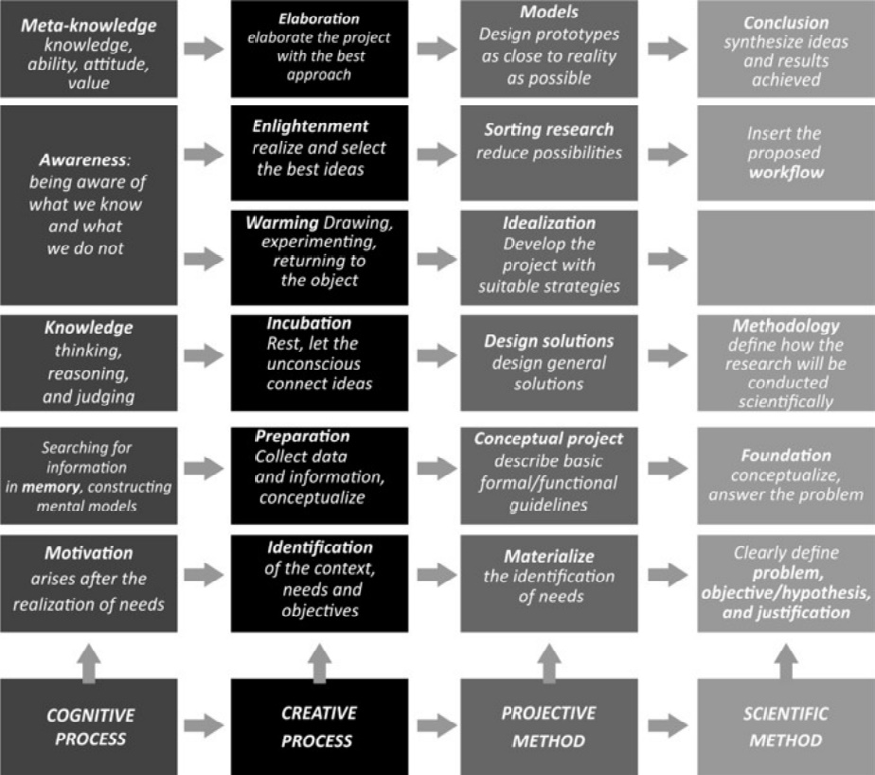
Figure 1. Management System through Knowledge Process applied to project development.
Source: Fornasier, Martins and Demarchi (2008, p.147).
We chose to work with the management through process because its key activities:
- promote meaningful connections between creative, cognitive, scientific, and projective processes;
- are documented, thus resulting in non-randomized decision-making, since they are guided by a consistent train of thought towards innovative solutions;
- use tools in several steps of the process, with defined expected outcomes, favoring effective, non-obvious results and a coherent decision-making;
- favor the learning of theoretical processes through the frequent immersion in the context and the documentation of the practice;
- encourage the development of multiple skills (knowledge, abilities and attitudes);
- promote the abductive reasoning, which can lead to innovation.
The inter-relationship between processes and the sequence of steps allow the development of projects in logical, defined stages to design a product. Therefore, the systemic view of the process improves the students’ understanding and learning (Figure 1). It is important to mention that some of the stages are essentially conducted with scientific accuracy, which opposes to the argument of the creative force as simple inspiration. This process was described by Fornasier, Martins and Demarchi (2008, p. 127-152), and is supported by the five types of knowledge (Subjective, Tacit, Cultural, Objective, and Explicit) defined by the same authors (2014, p. 25-44).
This system employs the DT approach so that the professor, which is also a designer, can be a mediator of learning. “The designer is an innovator who goes in-field, observes, questions, and listens to the world around. This means that the first contribution of design is the development of ideas that later will be transformed into concepts” (Demarchi and Fornasier, 2018, p. 867). The DT process includes two cycles, namely: divergence and convergence (Figure 2, represented by the rhombuses), which navigates between the deductive reasoning (the logic of what it must be) and the inductive reasoning (the operational logic). When combined, they form the abductive reasoning, which encourages students to think in unconventional ways, while challenging the explanations generally accepted as “the undeniable truth”. It also generates some tension that can be reduced by using the creativity tools in searching for patterns from the data available. However, the use of creativity tools must have well-defined objectives and expected outcomes.
Students are more likely to make non-arbitrary decisions when they apply the divergent and convergent thinking, thus moving to the next stage of the process. Some stages can take place concurrently, depending on how close they are to the problem or to the other stages, since the DT (Demarchi and Fornasier, 2018, p. 865) “is a creative process that fosters [peer] collaboration and the experimentation [with drawings, materials and prototypes] in order to mitigate risks in the innovation process”.
Cavalcanti and Filatro (2016, p. 61) explain that the DT is a process suited for education because “it promotes the problem-solving from empathy, placing the people involved in the center of attention and inside the context where the challenging situation is located”. The authors present the DT steps (developed by the Stanford University, 2011), namely: Empathize, Define, Ideate, Prototype, and Test – which are also included in the IP’s Management System (Figure 2). The third step, Ideate, consists of three full cycles of divergence and convergence.
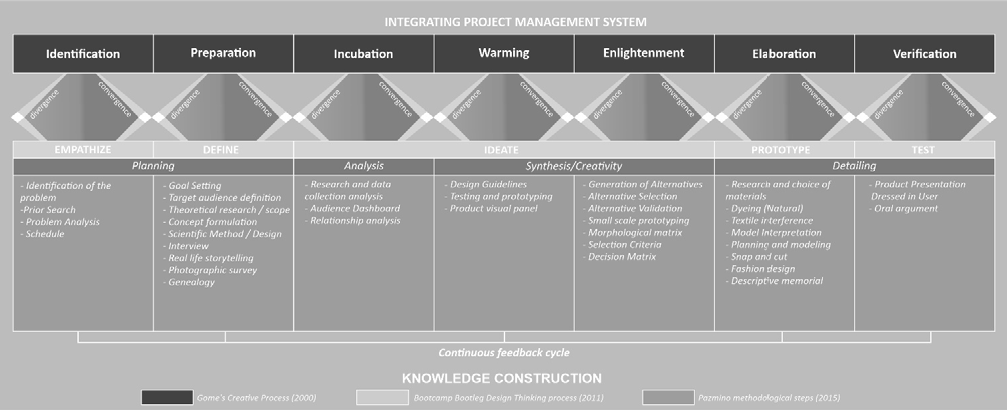
Figure 2. Integrative Project Management System.
In the teaching-learning process, design thinking encourages students to: take the starring role of their knowledge (learn to be); design various drawings and prototypes to avoid mistakes (learn to make); be empathetic and become a multidisciplinary professional (learn to live), and manage their own knowledge through research (learn to know).
In developing the creative thinking, students must consider the DT along with the creativity process suggested by Gomes (2000), which is divided in 7 steps: identification, preparation, incubation, warming, enlightenment, and verification (refer to Figure 1 and Figure 2). It is important to mention that each step has only one cycle of convergence-divergence, which favors the students’ understanding to perform the tasks. Students also apply some of the creativity tools described by Pazmino (2015), according to the requirements of each project (Figure 2), and to the stage of the project, that is, planning, analysis, synthesis/creativity or detailing. The planning stage, however, includes two divergence-convergence cycles, as well as the Synthesis/Creativity stage.
The system consists of an inseparable group of active elements, in which meanings can only be fully realized when considered at the same time with their collection of inter-relationships. Such inter-relationships, or interaction between parts (processes, steps, tools), result in recognizing the very existence of the system – that is, the system of Knowledge Construction.
Methodology
This study uses the deductive methodwhich intends to validate hypothesis: if all of them are true, then the conclusion must be true as well (Marconi and Lakatos, 2010). It employs a qualitative approach, in order to understand the nature of the social phenomenon studied, reaching a deeper understanding on the unique behavior of individuals and groups (Richardson, 2010). It is also exploratory and descriptive – through a case study – because it explains the phenomena related to the teaching of project process through knowledge production and its variables (which has been being improved since 2010, when it was first launched).
Case study: Integrative Project “Family origins and the searching for myself”
In the project “Family origins and the searching for myself”, students are expected to research and uncover their family history and systematize it through a process diary in order to design a clothing piece to represent them. They are also expected to be cognitively and emotionally involved with their unique context, hence favoring the understanding and learning of the design process and of the creativity techniques. We established evaluative, theoretical, and practical criteria so that professors could mediate the learning outcomes and assess the design process performed by the students.
We describe the results of an applied research from the creation of a system that helps students perform all the stages of the process and allows professors to assess and monitor them at the same time. The case study, named “Family origins and the searching for myself”, was applied in 2018 with 30 students. In this project, students were expected to:
- know their origins through family history and identity, including their experiences, life repertoire, and real-life stories (origins, beliefs, rituals, habits, etc.);
- identify the project needs and solutions, by applying methods and creativity tools;
- practice the systemic view and the systemic thinking through the development of skills and basic knowledge on the management of the organized creative thinking; and
- apply the cognitive, creative, and scientific methods (to define the design problem and the objectives). These methods are “interdependent processes that form a management system through knowledge process” (Fornasier, Demarchi and Martins, 2008, p. 129) and are used to design the garment.
In order to evaluate the project, professors considered tangible results, the process diary and the final product. The subjective results, in turn, rely on a systematic individual assessment of the skills developed to perform the process steps along the project schedule, besides to the oral presentation of the garment to an examining board consisting of the professors involved in the Integrative Project. The evaluation criteria change according to each subject; however, the examining board discusses each project collectively, considering the initial proposal, project requirements and limitations (previously defined), and the activities described in the interdisciplinarity board.
Results – Discussion
After the launching of the IP in classroom (in the Research and Creation subject), students began researching their family origin through techniques such as real-life stories and storytelling (collected from the family members), photography, and interviews, which allowed them to create their family tree. This research is contextual, that is, aims at defining the target audience (or end-user), and a design question to be solved. This moment falls under the problem identification and the preparation stages described in Gomes’s creative process (2000), when the design problem is defined according to the information available and through the use of scientific methods, techniques and tools to collect data.
The incubation is the stage when data is analyzed and students reach deeper levels in the research (a bibliographical research, emphasizing topics that are relevant to connect with “myself”), exploring the family history up to the present. This stage brings to surface knowledge and information that will be used in the fourth stage, the warming. In this stage, students experiment with and design the product (wearable artifact) according to the initial requirements, with a focus on the conceptual message defined through previous knowledge from the research and the use of creativity tools suggested by Pazmino (2015). Sketches, material experimentation, etc., are supported by the following subjects: Research and Creation, Visual Methodology, and Processes and Textile Materials. Once the experimentation ends and possible solutions are generated, students select the best options, according to the criteria established for each project. The best solution is the one that meets the needs and concepts of the project. Then, students proceed with the drawing of the garment (guided by the Graphical Representation subject). This takes place in the fifth stage, the enlightenment.
In the next stage of the creative process – the elaboration – students are requested to prototype the wearable artifact, with the support of two more subjects: 2D Garment Construction and Sewing Technologies. Finally, in the verification stage, the wearable artifacts are presented to an examining board consisting of all the professors involved in the Integrative Project, aiming to evaluate the project development in accordance with the content of the course.
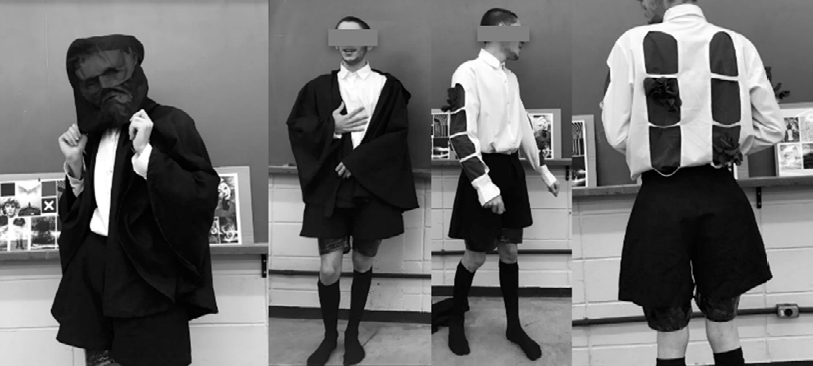
Figure 3. Integrative Project 01.
Source: Student: Rodrigo Guimaraes Marques Luz (2018).

Figure 4. Integrative Project 02.
Source: Students: Ana Beatriz Bianchi Fittipaldi (2018) and Lívia Akari Kuroba (2018).
Figures 3 and 4 present some of the results achieved by students in the presentation of the project, when the student wears the product and orally argument about it. Concepts and meanings cannot be described in this study, because they would expose the students’ personal history.
Some of the students explored their creativity with the support of the proposed system, thus reaching very positive results. However, some students did not apply the system completely, which became evident by the gaps between stages and the fragility in the project thinking. Seven out of thirty students in class had a satisfactory performance in the project; five had excellent results with their products.
Students are expected to design their products using the five types of knowledge described by Fornasier, Martins and Demarchi (2014). The explicit knowledge results from the synthesis of the knowledge recorded in the diary – that is, the description of all the stages of the process, previous research to define the problem, objectives, and the use and validation of the artifact (objective knowledge). The tacit knowledge refers to the manual skills developed during the process, such as dye testing (in the Textile Materials subject), garment construction (Garment Construction subject), sewing (Sewing Technologies), sketches (Research and Creation), fashion drawings (Graphical Representation) and the visual panels (Visual Methodology), which are all attached to the diary through photos or memos.
The cultural knowledge is the research on the family origins, traditions, myths, habits, heroes, beliefs, skills, attitudes, professions, etc., that the student will transform into knowledge and record on the diaries, through written stories, photos, family tree, etc. – which then constructs the knowledge needed to create the concept of “myself”.
The learning objectives of the project are to connect theory and practice in the system; practice the empathy and the design thinking; and design the wearable artifact by the application of theoretical and practical strategies, related to the objective knowledge. That means the students must convert all their previous knowledge, relate it with new knowledge, and transform it into new subjective knowledge – which are not codified or explicit. For this reason, it may be difficult to be assessed by the professors, who must then rely on the physical products (clothing piece and the diary) and on the progression of students throughout the process.
Conclusion
Fornasier, Martins and Demarchi (2008) explain that the cognitive, creative, projective, and scientific methods are interdependent. Combined, they form a management system through knowledge process. They contribute to the understanding and the development of projects, hence providing conclusions and expanding the cognitive and creative experience. “The design practice includes the project development, which is an activity performed through a group of projective stages, using different creativity techniques” (Fornasier, Martins and Demarchi, 2008). The design process, however, cannot be shattered; it is organized in a systemic, yet organic, sequence of relationships with natural systems. A system is identified by the inter-relationships or the interactions between its parts (Bertalanffy, 1973). In this sense, we do not intend to promote a standardized projective activity, but rather to encourage the process thinking through stages. In fact, we noticed that the students who understood the process stages and described them in their diaries were also the ones who reached a higher level of innovation. Yet, they were not necessarily the ones with the best wearable results, mainly because of the lack of manual ability to construct it.
It is concluded that the Design Thinking approach guides the development of the creative process, for it takes into consideration the parties involved and the relationships between them, as well as the previous knowledge and the new knowledge emerged from the exploratory bibliographical and in-field researches. Since creativity is the core aspect of the Design Thinking, which comes from the connection of different types of knowledge, the main activity of the designer is to manage their knowledge, represented in this study by the five types of knowledge described by Fornasier, Martins and Demarchi (2014). In this sense, results were assessed from the description of the process and the diaries provided by the students, as well as in the presence of proper words and expressions both in one-on-one conversations and written in the diaries.
Professors are challenged to provide students with means to understand that undergraduate courses are not intended to teach how to do, but rather to reflect on what to do – and then do. Motivating students to learn to think as designers is probably the key factor here. Think as a designer means realize, analyze, and understand the situations and contexts to design products and processes targeted to real needs. Currently, information is easily accessible, but transforming it into knowledge may be a barrier. The three students used as example in this study performed all the activities according to the schedule and reached excellent results. Notwithstanding, we emphasize the fact that all the three are encouraged by their families, have frequent access to social and cultural events, and that their family members are present in their lives, even remotely.
It is also important to mention that, in 2018’s Integrative Project, six students did not turn in the process diary, or did it to the bare minimum, which made it difficult for the professors to monitor and evaluate their projective reasoning. Four of them had difficulty in verbalizing and describing their actions, and often used slangs and idiomatic expressions. Those students reached less than expected results, and the professors could not assess the use of the system and the projective reasoning in those cases.
Fashion design undergraduate courses must promote the valorization of positive attitudes among students, encouraging them to share their experiences and socialize. Thus, we can promote the activities that are really relevant to the learning process, since it occurs through hearing, seeing, and doing. This study is an example of the possibilities to move from the simple memorization of abstract concepts to a type of knowledge constructed with awareness, competence, and emotional engagement.
References
- Bertalanffy, L. (1973). Teoria geral dos sistemas. Vozes.
- Brown, T. (2009). Change by design: how design thinking transforms organizations and inspires innovation. HarperCollins. DOI
- Cavalcanti, C. C. & Filatro, A. (2016). Design thinking: na educação presencial, a distância e corporativa. Saraiva.
- Choo, C. W. (2003). A organização do conhecimento: como as organizações usam a informação para criar significado, construir conhecimento e tomar decisões. Senac.
- Cross, N. (2011). Design Thinking. Berg.
- Daher, M. A. Z., et al. (2006). O projeto político pedagógico do curso de Design de Moda da Universidade Estadual de Londrina: uma construção coletiva. Anais Do 7 Congresso Brasileiro de Pesquisa e Desenvolvimento em Design. DOI
- De Masi, D. (2003). Criatividade e grupos criativos. Sextante.
- De Sordi, J. O. (2005). Gestão por processos: uma abordagem da moderna administração. Saraiva.
- DemarchI, A. P. P. & Fornasier, C. B. R. (2018). O uso do design thinking em um microcosmos do Museu de Londrina para a melhoria da aprendizagem. Anais do XIX Encontro Nacional de Pesquisa em Ciência da Informação (ENANCIB) (pp. 860-878). DOI
- Fornasier, C. B. R., Martins, R. F. F. & DemarchI, A. P. (2008). O ensino da disciplina de desenvolvimento de projetos como sistema de gestão do conhecimento. In D. B. Pires (org.). Design de moda: olhares diversos (pp.127-152). Estação da Letras. DOI
- Fornasier, C. B. R.; Martins, R. de F. & Demarchi, A. P. P. (2014). Análise comparativa das competências dos gestores de design e gestores de organizações colaborativas familiares da vitivinicultura. In J. A. Mendonça y H. W. Camargo (orgs.) Design e comunicação. Syntagma.
- Gomes, L. V. N. (2001). Criatividade, projeto, desenho produto. sCHDs.
- Marconi, M. A. & Lakatos, E. M. (2010). Fundamentos da metodologia científica. Atlas.
- Pazmino, A. V. (2015). Como se cria: 40 métodos para design de produto. Blucher
- Richardson, R. J. (2010). Pesquisa social: métodos e técnicas. Atlas.