


Fuente: Autoría propia
Recibido: 30/10/2024
Aprobado: 18/01/2025
Voices that protect the territory of Riosucio (Caldas).
Community practices as care networks
Voces que resguardan al
territorio de Riosucio (Caldas).
Prácticas comunitarias como redes de cuidado
Vozes que protegem o território de Riosucio (Caldas).
Práticas comunitárias como redes de cuidado
Des voix qui protègent le territoire de Riosucio (Caldas).
Les pratiques communautaires comme réseaux de soins
Miguel Arango-Marín
Universidad Pontificia Bolivariana
miguel.arango@upb.edu.co
https://orcid.org/0000-0003-4012-2056
Marcela Cardona-González
Instituto Tecnológico Metropolitano
marcelacardona8213@correo.itm.edu.co
https://orcid.org/0000-0003-3460-3152
Valentina Mejía-Amézquita
Universidad Nacional de Colombia, sede Manizales
vmejiaa@unal.edu.co
https://orcid.org/0000-0002-7668-5320
Luisa Fernanda Zapata-Arango
Universidad de Caldas
luisa.zapata@ucaldas.edu.co
https://orcid.org/0000-0001-6586-0659
Cómo citar este artículo:
Arango-Marín, M., Cardona-González, M., Mejía-Amézquita, V. y Zapata-Arango, L. F. (2025). Voices that protect the territory of Riosucio (Caldas). Community practices as care networks. BITÁCORA URBANO TERRITORIAL, 35(I): 197-208.
https://doi.org/10.15446/bitacora.v35n1.117304
ISSN electrónico 2027-145X. ISSN impreso 0124-7913. Universidad Nacional de Colombia, Bogotá
[1] This article presents some of the theoretical reflections and methodological approaches from the ongoing doctoral thesis entitled The Times of Disdained Things: Validity and Obsolescence in the Everyday Practices of Rural Women, developed within the framework of the PhD in Design and Creation at the University of Caldas, cohort XII.
(1) 2025: 197-208
Autores
05_117304_E
Abstract
The article focuses on highlighting some community practices in the rural area of Riosucio (Caldas) municipality located on the eastern slope of the western mountain range in Colombia aimed at defending and safeguarding their territory and their unique ways of living. For this purpose, the experiences of a qualitative research-creation project carried out in the territory between 2021 and the 2023 are collected. In this study, ethnographic techniques, participatory work with focus groups and co-creation workshops with the communities of the four indigenous reservations that make up the municipality were applied. Thus, from a multi-scale analytical approach that criticizes the Paisaje Cultural Cafetero as ‘the way’ to understand this territory, it is proposed that in the community practices of the four indigenous reservations of Riosucio it is possible to find some keys to diversify this conception and point out the significance of care networks as a fundamental aspect for a community cohesion that transcends the current forms of development and economic growth. The text concludes by stating that in these community ways of living, a unique awareness of the safeguarding of rural territory is consolidated as a condition for the continuation of life.
Keywords: habitat, rural women, cultural landscape, participatory research, design
Resumen
El artículo se centra en resaltar algunas prácticas comunitarias de la zona rural de Riosucio (Caldas), municipio ubicado sobre la vertiente oriental de la cordillera occidental en Colombia, encaminadas a defender y resguardar su territorio y sus formas de habitar. Para dar cuenta de ello, se recogen las experiencias de un proyecto de investigación creación de enfoque cualitativo realizado en el territorio entre el 2021y el 2023 en el cual se aplicaron técnicas etnográficas, trabajo participativo con grupos focales y talleres de co-creación con las comunidades de los cuatro resguardos indígenas que constituyen el municipio. Así, desde una apuesta analítica multiescalar que hace crítica al Paisaje Cultural Cafetero como ‘la manera’ de comprender este territorio, se propone que, en las prácticas comunitarias de los cuatro resguardos indígenas de Riosucio, es posible encontrar algunas claves para diversificar esta concepción y señalar la significación de las redes de cuidado como un aspecto fundamental para una cohesión comunitaria que trasciende las actuales formas de desarrollo y crecimiento económico. El texto concluye dando cuenta de que en estas maneras comunitarias de habitar se consolida una singular conciencia de la salvaguarda del territorio rural como una condición para la continuación de la vida.
Palabras clave: hábitat, mujer rural, paisaje cultural, investigación participativa, diseño
Resumo
O artigo concentra sua atenção em destacar algumas práticas comunitárias na zona rural de Riosucio (Caldas), município localizado na encosta leste da cordilheira ocidental da Colômbia destinadas a defender e proteger seu território e suas formas únicas de viver. Para dar conta disso, são coletadas as experiências de um projeto de pesquisa-criação qualitativa realizado no território entre 2021 e o 2023, onde técnicas etnográficas, trabalho participativo com grupos focais e oficinas de cocriação com as comunidades das quatro reservas indígenas que fazem até o município. Assim, a partir de uma abordagem analítica multiescalar que crítica a Paisaje Cultural Cafetero como ‘a forma’ de compreender este território, propõe-se que nas práticas comunitárias das quatro reservas indígenas do Riosucio seja possível encontrar algumas chaves para diversificar esta concepção e apontam a importância das redes de cuidados como aspecto fundamental para a coesão comunitária que transcende as formas actuais de desenvolvimento e crescimento económico. O texto conclui percebendo que nestes modos de viver comunitário se consolida uma consciência única de salvaguarda do território rural como condição para a continuação da vida.
Palabras-chave : habitat, mulheres rurais, paisagem cultural, investigação participativa, design
Résumé
L’article met l’accent sur la mise en évidence de certaines pratiques communautaires de la zone rurale de Riosucio (Caldas) municipalité situé sur le versant oriental de la chaîne de montagnes occidentale de Colombie visant à défendre et protéger leur territoire et leurs modes de vie uniques. Pour en rendre compte, sont rassemblées les expériences d’un projet de recherche-création qualitative réalisé sur le territoire entre 2021 et 2023, où techniques ethnographiques, travail participatif avec groupes de discussion et ateliers de co-création avec les communautés des quatre réserves autochtones qui font jusqu’à la municipalité. Ainsi, à partir d’une approche analytique multi-échelle qui critique le Paisaje Cultural Cafetero comme ‘la manière’ de comprendre ce territoire, il est proposé que dans les pratiques communautaires des quatre réserves indigènes de Riosucio il soit possible de trouver quelques clés pour diversifier ce territoire. conception et soulignent l’importance des réseaux de soins en tant qu’aspect fondamental de la cohésion communautaire qui transcende les formes actuelles de développement et de croissance économique. Le texte conclut en constatant que dans ces modes de vie communautaires se consolide une conscience unique de la sauvegarde du territoire rural comme condition de la continuation de la vie.
Mots-clés : habitat, femme rurale, paysage culturel, recherche participative, conception
Introduction

This article is part of the outcomes of a research-creation project funded by MinCiencias and co-financed by four universities and a well-established cultural center. The project was carried out between 2021 and 2023 in Riosucio (Caldas). It involved a team of researchers from various creative and project-based disciplines such as design, architecture, communication, and visual arts, as well as from the humanities, including anthropology and philosophy. Due to its committed, participatory, and situated approach, the project was consolidated through the involvement of multiple communities belonging to the four Indigenous reserves that make up the municipality, namely: the Nuestra Señora Candelaria de la Montaña Indigenous Reserve, the Colonial-Origin Indigenous Reserve of Cañamomo Lomaprieta, the Ancestral Territory of the San Lorenzo Indigenous Reserve, and the Escopetera and Pirza Indigenous Reserve (see Figure 1).
The stated purpose of the research was to re-narrate, through the voice of rural women, the traditional knowledge that ensures the production and reproduction of everyday life in peasant households, domestic care work, and the safeguarding of the territory. Within the framework of this initiative, it became possible to identify a series of community practices, which this study recognizes as structural actions for the defense and preservation of unique ways of inhabiting. These practices, although seemingly fragmented across the different Indigenous reserves, contribute to making Riosucio a diverse, pluriethnic, and multicultural territory that far exceeds the homogenizing definitions of the Cultural Coffee Landscape, which often seeks to encompass, generalize, and indeed obscure this region.
The conceptual framework for recognizing these community practices as part of territorial care networks was based on an interrelated understanding of the notions of habitat and cultural landscape, as well as their multiscalar forms of expression.
In this research, community practices are understood as collective actions rooted in embodied knowledge and shared experience—knowledge with others—that is transmitted and preserved. By recognizing what is vital and communal, these practices transcend the view of rural activity as merely related to labor and land productivity (Tinjacá, 2023). Accordingly, everyday practices in rural life gain particular significance when understood as actions aimed at the consensual construction of that which is held in common and considered worthy of collective management and care. Examples include essential water sources or significant geographic features and cultural landscape elements with high ecological and symbolic value (García et al., 2021).
Consequently, care networks are understood here as relational, non-individualizing forms of community agency that, in rural contexts, necessarily involve the agency of women. This agency is not exercised as a gift or vocation, but rather as a way of being and existing—a form of knowledge to care for themselves, others, and other forms of life within the family and the broader community (Osorio, 2015; Kunin, 2018). Additionally, this study aligns with perspectives that value alternative ways of inhabiting, producing, and consuming—in short, of caring—which are evidenced in Latin American peasant and Indigenous ways of life (Celiberti, 2023; Puelo, 2023). These alternatives challenge neoliberal social organization and are shaped through networks of solidarity, mutual aid, and cooperative practices in the face of hardship and precariousness (Draper, 2018).
Habitat, in turn, is understood as the interrelation established between people, artifacts, and spatialities, materialized through everyday spatialized practices that make possible the production and reproduction of human life within the territory (Yory, 2007; Echavarría, 2009; Gutiérrez, 2009).
The notion of cultural landscape refers to the performative actions of people upon geography—that is, the ways in which rural communities in Riosucio live, cultivate, and transform their territory in order to inhabit it. In other words, it is the trace left by a human group through inhabitation, which can be perceived through the senses and therefore interpreted to understand the practices that shape it (Fernández, 2006; Cruz & Español, 2009; Martínez, 2017).
With regard to the multiscalar dimension, this refers to the multiple scales through which a comprehensive understanding of a territory can be approached. For instance, planning issues are associated with the scalar levels from which a territory is viewed, studied, and understood (Arboleda, 2007; Lussault, 2015; Ramírez & López, 2015). According to this framework of scalar levels or dimensions, if territorial issues are approached at a smaller scale—that is, from the scalar dimension of place—it becomes possible to make explicit how large global problems materialize in local settings (Santos, 1996; Massey, 2004; Massey, 2013).
In this way, large-scale issues such as hillside cattle ranching, monocultures—especially coffee—and the gold mining interests of major international corporations (Corales-Roa, 2011; Centro Nacional de Memoria Histórica, 2022) encounter forms of resistance in small-scale, micro-level actions. Rural women represent key plots of possibility for the preservation, conservation, and realization of alternative ways of life in the face of today’s major crises (Cárdenas & Orozco, 2022).
This convergence of approaches shaped the narrative of the research-creation project—one that enables the connection of small-scale practices from the four Indigenous reserves aimed at resistance, defense, and the maintenance of their territories and their unique ways of inhabiting them. Specifically, reference is made to community practices such as: the recovery and safeguarding of native seeds from the region, the maintenance of traditional wood-fired kitchens, the consolidation of family and community-run sugarcane mills (trapiches), and processes of associativity around local artisanal knowledge rooted in the territory.
Methodology

This work is grounded in the premise that creative processes carried out within the design disciplines and the arts are, in themselves, forms of knowledge production that broaden disciplinary discussions. If such processes were explored in isolated disciplinary compartments, the resulting insights would be visibly limited, narrowing the scope of understanding and rendering socio-cultural aspects invisible (Gil & Laigelet, 2013; Ballesteros & Beltrán, 2018).
Precisely for these reasons, this project was conceived and developed through the theoretical and methodological frameworks of research-creation in design, the arts, and architecture. Its primary source lies in embodied knowledge (Bourdieu, 2007), in the integration of feeling and thinking (Ramírez, 2023), and in the journey and fieldwork as essential aspects of this type of inquiry (Ferro, 2011; Careri, 2014; Arango et al., 2019; Careri, 2014). It is important to highlight that co-creative exercises depend on collaborative work with community members (Garduño, 2018), on the implementation of co-creative workshops with focus groups (Patiño et al., 2023), on deliberate conversations grounded in networks of trust that allow for the unveiling of intimate, cared-for knowledge, and on the conscious recognition of the small, everyday actions that bring meaning and vitality to the territory—elements that ultimately became foundational to the project’s development. Additionally, a key component of the methodological dimension—and the underlying hybrid logic that enabled this research-creation process to evolve into a multiscalar and multidimensional understanding of the phenomenon—was the active, synergistic, horizontal, and dialogical participation of a core group of thirteen co-researchers from the region and from the department of Antioquia. Their involvement was rooted in a form of inquiry that was situated, consensual, and imbued with territorial and community-based meaning.
As previously noted, this research-creation project was formalized with both the communities and the funding entities at the end of 2020 and was implemented between January 2021 and June 2023. It aimed to understand how a living and diverse cultural landscape is constituted, through participant observation, dialogue, and hands-on work with specific groups of community leaders, artisan associations, families with productive initiatives, and cultural managers. In total, 15 field visits were conducted, each lasting between four and five days. These were characterized by visits to selected households, community centers, and central areas within the Indigenous reserves. In addition, participatory workshops, guided territorial tours, and community conversation spaces—designed through consensus and with con-sentido (shared meaning and intention)—were implemented.
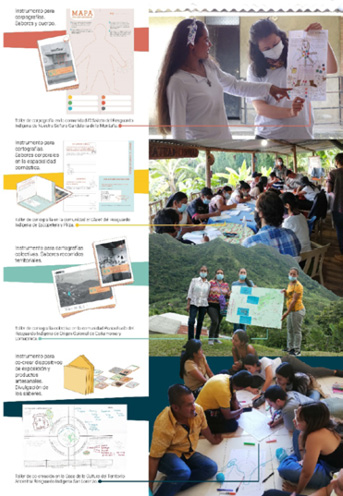
These encounters involved a core group of 41 women from the four Indigenous reserves of Riosucio, with whom 12 co-creative workshops were carried out in the form of focus groups. The aim was to identify their embodied knowledge, their use of everyday objects, their modes of inhabiting, and their ways of being at both the community and territorial levels. Various tools were designed for the participatory and co-creative collection of information, including Corpographies: A strategy to account for the everyday knowledge these women practice in making the home, caring for loved ones, animals, plants, neighbors, and their immediate surroundings. Second, Home Cartographies: Maps of their own homes were created to illustrate how embodied knowledge unfolds within domestic spaces and their immediate context. Third, Community Cartographies: Larger-scale cartographies were collectively constructed with each community through territorial walks that connected body and home knowledge to the broader community context, thus making visible the networks of care they establish as a configuration of their territoriality. Fourth, Co-creative Processes: The development of co-creative processes for the production of exhibition artifacts, artisanal objects, and audiovisual materials that would allow for the condensation, dissemination, and re-narration of this knowledge as powerful, creative, and enduring ways of life (see Figure 2).
Results: Voices and Practices from the Four Indigenous Reserves
This section is guided by the premise that the geographic and spatial conditions of a region become territory insofar as they are linked to the dynamics of inhabiting—that is, to the ways in which people name, appropriate, modify, make sense of, and integrate these spaces into their lives, thus consolidating a cultural landscape. With this in mind, the results of this study are presented through a threefold structure articulated around testimonial, descriptive, and visual dimensions. This approach highlights the community practices that, on a small scale, have been safeguarding the rural territory of Riosucio through the voices and care networks of the women who inhabit it.
From the Indigenous Reserve of Nuestra Señora Candelaria de la Montaña
Located in the northwest of the region, the Indigenous Reserve of Nuestra Señora Candelaria de la Montaña is the largest of the four reserves in terms of land area. It marks the political-administrative boundary between the municipalities of southwestern Antioquia and the other reserves in the rural area currently belonging to the department of Caldas. The reserve has a strong peasant influence and agricultural work, with coffee cultivation being especially prominent. Thus, most of the practices narrated in this area relate to the care of animals and crops, implying an understanding of land stewardship, seed knowledge, and the care of domesticated life.
“My grandfather was the one who taught me to work with cattle, everything; they sent me around to learn. He used to say, ‘daughter, learn this’ [...] They taught me to milk, to make cheese, everything. My grandfather even taught me to wire fences when I was about 9 or 10 years old.” (Ruth Albany Cañas from the El Salado community, personal communication, October 26, 2021)
In this sense, the care networks woven in this area are closely linked to family networks, as agricultural knowledge is learned from elders and taught to children. This represents a commitment to the intergenerational transmission of care for the territory, reinforced by the fact that families usually live in the same community, solidified by neighborhood and godparenting ties in daily life: “We are family, we see the plants grow and produce, imagine delicious dishes, transform the products from the garden we cultivate as a family with the help of my mother, who is a seed custodian.” (Yulieth Morales Bañol from the El Salado community, personal communication, November 12, 2021)
Thus, a first care network is consolidated within the home, aimed at expanding knowledge over time and multiplied when a daughter or son establishes their own household nearby, ensuring that the identity-bearing cultural landscape and its care practices are inherited and appropriated by new generations in daily life.
From the Colonial-Origin Indigenous Reserve of Cañamomo and Lomaprieta
This is one of the oldest reserves in terms of organizational consolidation for territorial defense and land use. It is located in the mountain range of the Western Cordillera along the political-administrative boundaries of the municipalities of Riosucio and Supía, Caldas. The various communities situated on the hillsides engage in diverse productive activities associated with temperate and warm climates, including sugarcane harvesting and panela (unrefined cane sugar) production. Here, the communities’ capacity to establish ‘collective houses’ was recognized—shared housing systems built based on the relationships between family homes and communal spaces that guarantee both physical and symbolic access to all community members across the territory.
Using the sugarcane production system as a reference, there is an evident interrelation between the hills, spaces, families, neighbors, products, and sales. This interrelation maps networks generated by community practices which, seeking economic support, generate care networks among neighbors and family. The most relevant spatial landmarks in this system are the trapiches (sugar mills), which may be family-run or neighborhood-run; these become semi-public/private places requiring participants to reach agreements, organize, and support each other, since what is individually owned simultaneously becomes a foundation of the common good: “Sometimes three or four families grind together, sometimes just one family grinds per day, but it’s also a way of greatly supporting neighbors because that’s what it’s about.” (Sonia Cañas from the Portachuelo community, personal communication, January 22, 2022)
These community initiatives are complex, involving discussions and obstacles in their development. Nevertheless, they have been and remain the chosen strategy to relate with others and production, recognized as a kind and shared way to make use of territorial resources and their economic benefits. This highlights alternative ways of understanding land exploitation—a perspective that balances agricultural production, territorial wellbeing, and an emotional connection to the land with equal importance. “Now I understood, thanks to knowledge, thanks to touching the earth every day, thanks to having contact with indigenous peoples, thanks to the spirituality that comes through the process [...] it’s not just about making money; maybe it’s to subsist, to make productive, with beautiful products full of good vibes, Mother Earth [...] and I realized that when I began this process, the plants were sown and grew calmly.” (Sandra Calvo Pinzón, inhabitant of the Tumbabarreto community, personal communication, January 22, 2022)
Thus, community networks extend beyond homes, extrapolating care actions from inside houses to the outside, allowing places like neighborhood trapiches to become epicenters of collaboration and cooperative territorial care.
From the Ancestral Territory Indigenous Reserve of San Lorenzo
The center of the reserve is located in a mountain hollow about twenty minutes by car from the urban area of Riosucio. This central area, surrounded by high and biodiverse territory, energizes relations between its communities; here can be found the parish, the weekly Sunday market, and the San Lorenzo Indigenous Reserve Cultural Center. The sense of custodianship conveyed by the surrounding hills is closely aligned with the intentions of the inhabitants. Thus, the stance of indigenous authorities in this reserve is based on vigilance and scrutiny of external views and actions toward the territory:
“San Lorenzo is a sacred territory; in this land lies the memory of our mothers and fathers. Of our ancestors. Because it is sacred, we protect it from external interests that want to come here and exploit resources which, to extract, would destroy it.” (Manuela Delgado Bañol from San Lorenzo, personal communication, February 19, 2023)
It is important to highlight that care here not only involves creating conditions for life to continue but also relates to dignity, preserving existence, memories, and ancestors. This constitutes a network for territorial defense grounded in the sacred conception, a network that reveals external pressures threatening ways of inhabiting this territory and that fosters practices of resistance. Among the various practices found, artisanal knowledge and its potential for associative production were characteristic of this reserve.
At the Cultural Center is the CISLOA (San Lorenzo Indigenous Culture and Handicrafts) store and meeting space—an association of artisans, mostly producing basketry and weaving crafts. Their goal is to gather and disseminate traditional artisanal work carried out in the distant and dispersed communities of the reserve. “I learned basket weaving and mat making. It’s been 57 years [...] I taught many people [...] I taught everyone who asked me [...] I started working with crafts when I was 10 years old [...] I learned to cultivate, harvest, and prepare the palm from our mother and grandmother. I also learned to weave by watching my grandmother work [...] with the association, we met colleagues and sell our work [...] with the baskets we make, we maintain the tradition.” (Rosa Elena and María Belén, artisans of CISLOA from San Lorenzo, personal communication, February 18, 2023)
Artisanal practices produce useful and marketable artifacts while fostering educational and identity values. These are concrete elements and actions linked to knowledge networks for cultural preservation, with a broader goal of contributing to the defense of this sacred territory by telling small-scale stories.
From the Indigenous Reserve of Escopetera and Pirza
From the edge of Bonafont, the reserve’s central area, there is a privileged view toward the Pirzas Valley, an opening in the mountain range of the Western Cordillera shared with the department of Risaralda. Within those mountains settling the communities of the reserve, intertwined knowledge related to seed sovereignty, crop cultivation, and animal care was found, centered physically around the Traditional Kitchen El Claret—a place dedicated to resistance, knowledge transmission, oral tradition preservation, and seed custodianship to preserve memory.
“I am the owner and coordinator of this traditional kitchen project. Within our indigenous community [...] here in our territory, we feel threatened by monocultures, such as sugarcane, plantain, and especially coffee. Our way, from the kitchen, to counteract this is through food sovereignty, recovering native and traditional seeds which we are transforming to bring to the public and our population as a strategy of resistance.” (Luz Mary Bartolo from the El Claret community, personal communication, August 16, 2022)
The conversations reveal a community where women, through openness, have enabled dialogue around domestic care practices, traditional cooking, and the ways in which territory is made and preserved to resist and remain within it. Here, community practices exhibit territorial deployment capable of connecting mountains, paths, women, men, elders, youth, girls, and boys—through orality and action, teaching and learning possible paths toward sovereignty and coexistence.
The above illustrates that community actions in each of the four reserves have unique ways of materializing care that safeguard the territory through knowledge, the body, artifacts, the home, and the territory itself (see Figure 3).
Discussion: Toward Care Networks
A network is characterized by the linking of points of concentration and confluence of material, information, and even memories. In these nodes, data, discourses, symbolisms, and, for the purposes of this work, community practices can concentrate. These practices, in isolation, might seem innocuous and insignificant at a broader scale. However, it is proposed here that these nodes of community practices are connected through networks which, according to the rural women of the four reserves of Riosucio, care for the territory and its ways of life. By doing so, their power is recognized as concrete actions that, when interrelated (understood as a network), are practiced daily to generate forms of resistance that counterbalance conventional productive-economic interests that ‘de-futurize’ (Fry, 2020), expropriate, and dismantle homogenizing discourses that, in turn, invisibilize and flatten reality and its possibilities for constituting other possible futures.
In this context, this work makes explicit the relationships between these nodes of community practices established as concrete ways of inhabiting that, when linked, expand their scope from the micro-scale of the place to the macro-scale territorial level.
Thus, by understanding the different community practices of the four reserves through what they share in terms of discourse and everyday enactment in the dynamics of production and reproduction of family and community life, the structural principles that make these modes of inhabiting possible over time become explicit. With this, the repeated expressions of women from the four reserves linked to the project, referring to the indispensability of living in balance with ‘Mother Nature,’ ‘Mother Earth,’ or the ‘common home,’ allude to a deep understanding of their close connection with the ecosystem of which they and other members of their community are part.
In this sense, whether the practices of one reserve are articulated with the promotion of traditional cooking as a way to recover memory through the integration of the chagra (shifting cultivation garden), the dining table, and the palate; or in the formation of women’s groups dedicated to sowing, educating, and promoting the cultivation of a heterogeneity of native seeds; or in the consolidation of community and family productive initiatives where agreements are established regarding the distribution of labor and collective economic gains; or in the associativity around artisanal knowledge transmitted across generations— in all cases, these practices seek to reaffirm their ways of life and, consequently, contribute to the care of themselves, others, and other forms of life. In short, the care of the territory of Riosucio.
Understood in this way, it is possible to recognize that this network of meaningful nodes (read as practices) that daily maintain the community bonds of each reserve is characterized by its heterogeneity, in the sense that each node is a distinct manifestation of those forms of care. If this is so, the cultural landscape of Riosucio, framed by the grand narrative of the Coffee Axis as a territory constituted by the migration of white settlers who claimed and made productive this rugged geography through coffee cultivation, is at least limited.
Indeed, what is intended to be highlighted here is that, in the interconnected approach to the care networks supported by the most routinized practices of the women inhabiting the four reserves of Riosucio, there exists a plurality of components that craft a more robust, dynamic, and complex cultural landscape—a sort of pluriethnic and multicultural melting pot—that destabilizes and strongly emphasizes the limitations of the narrative that has colonized the cultural and landscape discourse of the region.
This plural understanding of the cultural landscape—no longer only coffee-related but also indigenous, feminized, communal, of gathering, and collective care networks—is neither self-evident nor a minor clarity. On the contrary, making it evident that such geography becomes cultural landscape, among other matters, through the linking of the small and diverse everyday actions of women from the four reserves, is to recognize that their territorial constitution involves clear commitments to the long-term maintenance of life in the ‘common home.’
Conclusions
With the foregoing, it is recognized that this text synthesizes the research-creation project through three interrelated coordinates that made it possible: the journey as method, joint creation as a means to understand community processes, and the idea that the connection of community practices establishes a network of care for the territory.
Regarding the first coordinate, it can be said that the journey was a key element for reaching the understandings presented here, since not only were diverse knowledges and disciplines brought into conversation, but also latitudes that synchronously and asynchronously intertwined. As Careri (2014) aptly notes, “At the base of travel there is often a desire for existential mutation. Traveling is the expiation of guilt, an initiation, a cultural enrichment, an experience…” (p. 34), alluding to movement and experience as a foundation.
Thus, the practice of traveling and wandering in this experience allowed an emergent rethinking and reconfiguration of each methodological step taken during fieldwork, enabling understanding and adaptation to the times, daily logics of each community, and the access routes to each territory with its challenges and particularities; knowledges such as climbing mountains, riding jeeps, and horseback riding became evident during the journeys as other ways of traversing and reading the landscape. The experience of wandering, as Careri mentions, goes beyond physically crossing a space; it also implies the transformation of place as it is charged with meaning and stories. Travel and wandering connect, transform, traverse, and enable the creation and re-narration of a territory.
The second coordinate values research-creation as an opportunity to realize dialogues based on its clear commitments to co-creation and recognition of everyday knowledges as an indispensable source for understanding the places where work is carried out. This generates environments of conversation among diverse viewpoints, actors, and settings. Beyond knowledge construction, it is natural that during its development the creative spaces include active and interested listening to other perspectives. Thus, this type of research presents itself as a viable alternative given its characteristic ability to localize and micro-scale territorial management projects where genuine, not merely nominal, participation of directly involved communities is sought. In this way, territorial management and planning projects that propose futures for concrete and localized collectives and communities should start from territorial readings developed through consensual and consenting conversations with those very people who are already living, acting, and planning—in their own terms—their territories.
Lastly, as the third coordinate, it remains to say that the community practices of the Riosucio reserves, understood as networks of care, have not been considered here as actions of traditional communities valuable solely due to their connection to past ways of inhabiting isolated geographies disconnected from national and global dynamics. On the contrary, what has been sought is to highlight these practices as concrete actions for the defense and safeguarding of a territory in dispute. As actions that, while drawing on past knowledges, transform to operate decisively and clearly in the present. Actions that, in any case, are enacting now other possibilities for futures centered on the care of what is one’s own and of the other, on the preservation of the common home, on the pedagogy of ways of being and existing that are planted, maintained, harvested, cooked, conversed, vocalized, practiced, transmitted, transformed, and preserved.
Bibliographic references

ARANGO, M., CARDONA, M., & VILLA, A. (2019). Diseño en diálogo: por una valoración del pensar, el hacer y el saber construido con comunidades artesanales de Ráquira, Boyacá y Hato Corozal, Casanare. En N. Builes, & A. Builes (eds.), Creación y debate (pp. 45-58). Universidad Pontificia Bolivariana.
ARBOLEDA, E. (2007). La frontera borrosa en la construcción conceptual y fáctica del hábitat. Relaciones centro-periferia, caso San Lorenzo, Medellín. Escuela del Hábitat CEHAP.
BALLESTEROS, M., & BELTRÁN, E. M. (2018). ¿Investigar creando? Una guía para la investigación creación de la academia. Universidad del Bosque. Facultad de Creación y Comunicación.
BOURDIEU, P. (2007). El sentido práctico. Siglo XX Editores.
CÁRDENAS, M., & Y OROZCO, S. (2022). Los desafíos de la mitigación del cambio climático en América Latina y el Caribe: algunas propuestas de acción. Programa de las Naciones Unidas para el Desarrollo (PNUD).
CARERI, F. (2014). Walkscapes. El andar como práctica estética. Gustavo Gili.
CELIBERTI, L. (2023). Territorios de cuidado para sostener la vida. Güemes, C y Cos Montiel F. (Eds.), Cuidados y ecofeminismo. Consolidar avances y construir futuros igualitarios en Latinoamérica (págs. 39-52). Fundación Carolina.
CENTRO NACIONAL DE MEMORIA HISTÓRICA. (2022). Virrúa: territorio sagrado. Memorias de resistencia de San Lorenzo. Centro Nacional de Memoria Histórica.
CORRALES, E. (2011). Evolución de la estructura agraria y transformación socio-productiva del paisaje rural en Riosucio y Supía (Caldas, Colombia) a partir de mediados del siglo XIX. Cuadernos de Desarrollo Rural, 8(67), 153-179. https://revistas.javeriana.edu.co/index.php/desarrolloRural/article/view/2008
CRUZ, L., & ESPAÑOL, I. (2009). El paisaje de la percepción a la gestión. Liteam.
DRAPER, S. (2018). Tejer cuidados a micro y macro escala entre lo público y lo común. En: Vega, C, Martínez-Buján, R y Paredes, M. (Eds.), Cuidado, comunidad y común. Experiencias cooperativas en el sostenimiento de la vida (págs. 167-186). Traficantes de Sueños.
ECHEVERRÍA, M. (2009). Hábitat: concepto, campo y trama de vida. Escuela del Hábitat CEHAP.
FERNÁNDEZ, F. (2006). Geografía cultural. En: D. Hiernaux y A. Lindon (eds.), Tratado de geografía humana (pp. 220-253). Anthropos.
FERRO, G. (2009). Guías de observación y valoración cultural. Apuntes, 22(1), 34-53. https://revistas.javeriana.edu.co/index.php/revApuntesArq/article/view/8946
FRY, T. (2020). Futuring design education for a future. Open Arts Journal, 9, 163-167. https://doi.org/10.5456/issn.2050-3679/2020w11
GARCÍA, S., SANZ, J., & UGENA-SANCHO, S. (2020). Discursos y prácticas en experiencias de cuidado comunitario. Una perspectiva moral entre cuidados gaseosos, líquidos y sólidos. Revista Española de Sociología, 30(2), 1-19. https://doi.org/10.22325/fes/res.2021.28
GARDUÑO, C. (2018). El diseño como libertad práctica. Aalto University.
GIL, J., & LAIGNELET, V. (2013). El arte como productor de conocimiento. Secretaría de Cultural, Recreación y Deporte y Fundación Universitaria de Bogotá Jorge Tadeo Lozano.
GUTIÉRREZ, F. (2009). Entre objetos y sistemas. “Hábitat”, una propuesta disciplinar. . En: M. C. Echeverría, et al., ¿Qué es el hábitat?: las preguntas del Hábitat. Escuela del Hábitat CEHAP.
KUNIN, J. (2018). Prácticas de cuidado, mujeres y agencia en el interior rural de Buenas Aires. Perifèria, 23(2), 43-69. https://doi.org/10.5565/rev/periferia.642
LUSSAULT, M. (2015). El hombre espacial. La construcción social del espacio humano. Amorrortu.
MARTÍNEZ, E. (2017). El puesto de la cultura en el paisaje. Treballs de la Societat Catalana de Geografía, 83, 31-7-49. https://raco.cat/index.php/TreballsSCGeografia/article/view/98490/427507
MASSEY, D. (2004). Lugar, identidad y geografías de la responsabilidad en un mundo en proceso de globalización. Treballs de la Societat Catalana de Geografía, 57, 77-84. https://raco.cat/index.php/TreballsSCGeografia/article/view/10482
MASSEY, D. (2013). Espacio, lugar y política en la coyuntura actual. Urban. Tribuna, 4, 7-12. https://polired.upm.es/index.php/urban/article/view/1864
OSORIO, V. (2015). El cuidado como trabajo y como derecho. En: Osorio, V. (Coord.), De cuidados y descuidos. La economía del cuidado en Colombia y perspectivas de política pública (págs. 13-26). Escuela Nacional Sindical.
PATIÑO, E., ARANGO-MARÍN, M., & CRUZ, M. (2023). Dialogue between Craft Knowledge and Design: A Collaboration Experiencie for Comprehensive Sustaintability. The International Journal of Designed Objects, 17(2), 1-19. https://doi.org/10.18848/2325-1379/CGP/v17i02/65-83
PULEO, A. (2023). El ecofeminismo, conciencia feminista profunda de la crisis socioambiental. En Güemes, C y Cos Montiel F. (Eds.), Cuidados y ecofeminismo. Consolidar avances y construir futuros igualitarios en Latinoamérica (págs. 13-24). Fundación Carolina.
RAMÍREZ, B., & LÓPEZ, L. (2015). Espacio, paisaje, región, territorio y lugar: la diversidad en el pensamiento contemporáneo. UNAM, Instituto de Geografía: UAM, Xochimilco.
RAMÍREZ, J. (2024). Una reflexión epistemológica para la construcción del cuerpo sentipensante: la búsqueda del cuerpo perdido. Corpo-Grafías Estudios críticos de y desde los cuerpos, 11(11), 149-166. https://doi.org/10.14483/25909398.22352
SANTOS, M. (1996). De la totalidad al lugar. Oikos-Tau.
TINJACÁ, E. L. (2023). Prácticas y saberes comunitarios, una apuesta por la formación en procesos organizativos rurales: Colectivo Guardianes de Semillas, Guadas Cundinamarca. Universidad Pedagógica Nacional. Maestría en Desarrollo Educativo y Social [Tesis de maestría no publicada].
YORY, C. M. (2007). Topofilia o de la dimensión poética del habitar. Pontificia Universidad Javeriana.
Miguel Arango-Marín
Master's degree in Habitat and Industrial Design. Her main research interests have included the relational and spatial nature of artifacts as a gateway to understanding social phenomena in the habitat, territorialized design as a commitment to building more sustainable futures, and design as an enabler of bridges of dialogue.
Marcela Cardona-González
PhD in Design and Creation, Master's in Philosophy, Specialist in Real Estate Management, and Architect. Her areas of interest include the critical interrelationship between aesthetics, architecture, design and creation, domesticity and everyday life, housing and living practices, rural and urban habitat, identities, and cultural practices.
Valentina Mejía-Amézquita
Master's degree in Interactive Design and Creation, PhD candidate in Design and Creation, and Industrial Designer. Her research focuses on the aesthetic and symbolic dimension of everyday artifacts and on daily practices related to dwelling, in the domestic and territorial sphere.
Luisa Fernanda Zapata-Arango
Master in Interactive Design and Creation, PhD candidate in Design and Creation and Industrial Designer. Her research focuses on the aesthetic and symbolic dimension of everyday artifacts and on the daily practices linked to living, in the domestic and territorial spheres.
Autors
Community practices as care networks
Voices that protect the territory of Riosucio (Caldas).
Community practices as care networks
Community practices as care networks

Figure 1. Geographic reference map of the four Indigenous reserves of Riosucio (Caldas)
Source: Prepared by the research-creation team.
Community practices as care networks
Community practices as care networks
Figure 2. Illustrated diagram of the co-creative research-creation process
Note: This diagram presents selected tools, workshops, and outcomes from the dialogue exercises with the communities.
Source: Prepared by the research-creation team.
Community practices as care networks
Community practices as care networks
Community practices as care networks
Figure 3. Illustrated scheme making explicit the singular community practices of each of the four reserves of Riosucio (Caldas).
Source: Produced by the research-creation team.

Community practices as care networks
Community practices as care networks
Community practices as care networks
Community practices as care networks