Transvaginal evisceration after abdominal hysterectomy. Case report
Palabras clave: Prolapso visceral; Histerectomía; Colostomía.
Keywords: Visceral Prolapse; Hysterectomy; Colostomy.
James Neira
Professor, Department of General Surgery
- Universidad de Guayaquil -
Guayaquil - Ecuador.
Irlanda Moyota
Lúver Macías J.
David Yépez
Graduate resident of General Surgery
- Hospital Luis Vernaza - Guayaquil - Ecuador.
abstract
Evisceration is a condition in which abdominal viscera protrude through an unnatural hole, with an incidence between 0.03 and 4.1%. This condition often occurs after an abdominal hysterectomy (47%), vaginal hysterectomy (29.4%) or laparoscopic approach (23.6%). It has the highest incidence in hysterectomized postmenopausal women, while the time interval between surgery and complication onset may vary from a few days to a few years. Moreover, in most cases, the eviscerated organ is the small intestine, which represents a surgical emergency. Transvaginal evisceration is a rare entity and is scarcely documented; the case of a 81-year-old patient with a history of abdominal hysterectomy, who attended the medical service after eight hours of evolution of a clinical picture characterized by pelvic pain and ejection of the large intestine (sigmoid colon) through the vaginal canal is presented here. The patient underwent an exploratory laparotomy, Hartmann colostomy, rectopexy to the promontory and restitution of traffic in a subsequent procedure; after presenting a satisfactory evolution, she was discharged.
IntroducTiOn
Intestinal transvaginal evisceration after hysterectomy is an unusual situation and little known by health professionals, as evidenced in the few cases published to date, hence the uniqueness and importance of the case reported here.
With an incidence between 0.03 and 4.1% (1), evisceration is a condition in which abdominal viscera protrude through an unnatural hole, leaving them exposed to external agents. In 2009, Partsinevelos et al. (2) published a review of 51 cases which found that the highest percentage of cases occurred after abdominal hysterectomy (47%), followed by vaginal hysterectomy (29.4%) and laparoscopic procedure (23.6%). Meanwhile, a study conducted in 2012 indicates a higher incidence of vaginal cuff dehiscence after undergoing laparoscopic hysterectomy (1.14%) than after undergoing abdominal (0.10%) and vaginal (0.14%) hysterectomy (3).
When analyzing the different laparoscopic approaches to hysterectomy, it is possible to observe that the incidence of evisceration is higher in total laparoscopic hysterectomy than in vaginal hysterectomy by laparoscopy; on the other hand, for laparoscopic hysterectomy, intracorporeal suturing of the vaginal cuff yields better results than vaginal suture (4).
The predisposing factors for this condition include pregnancy, pelvic surgery, multiparity, neuropathy, obesity, menopause and smoking, in addition to factors associated with the race of the patient (5); the time elapsed between surgery and complication onset may vary from 1 day to 25 years (6). The study required for diagnosis is clinical and is evaluated according to the symptoms presented, which consist of fullness sensation or perception of a foreign body in the vagina, and presence of a soft bulky mass, which often presents along with urinal symptoms.
Physical examination is key; if total prolapse is not evident, the patient is requested to push once to observe the protrusion of the organ (6,7,8). Vaginal evisceration is a surgical emergency that can be handled by vaginal or abdominal way, or both depending on the case.
Clinical case
81-year-old patient with a medical history of hypertension and diabetes mellitus. Surgical history includes abdominal hysterectomy plus colporrhaphy performed twice; the first one was done due to genital prolapse two years before admission, and the second, four months before admission. Obstetric history includes four vaginal deliveries.
The patient attended medical consultation with a clinical picture of eight hours of evolution characterized by severe pain in the lower abdomen which radiated to the genital region, and by ejection of the sigmoid intestine through the vagina after performing Valsalva maneuver. Physical examination showed the following signs: blood pressure 150/80 mmHg; pulse 95/min; respiratory rate 22/min; temperature 36 ºC, and saturation 98%.
The patient presented with dry oral mucosa, soft, pitting, painful superficial and deep palpation in the lower abdomen, mild pain, decreased bowel sounds, and no signs of peritoneal irritation. The mass protruding from the vagina, and corresponding to a segment of the large intestine (sigmoid) with discoloration, can be observed in Figure 1.
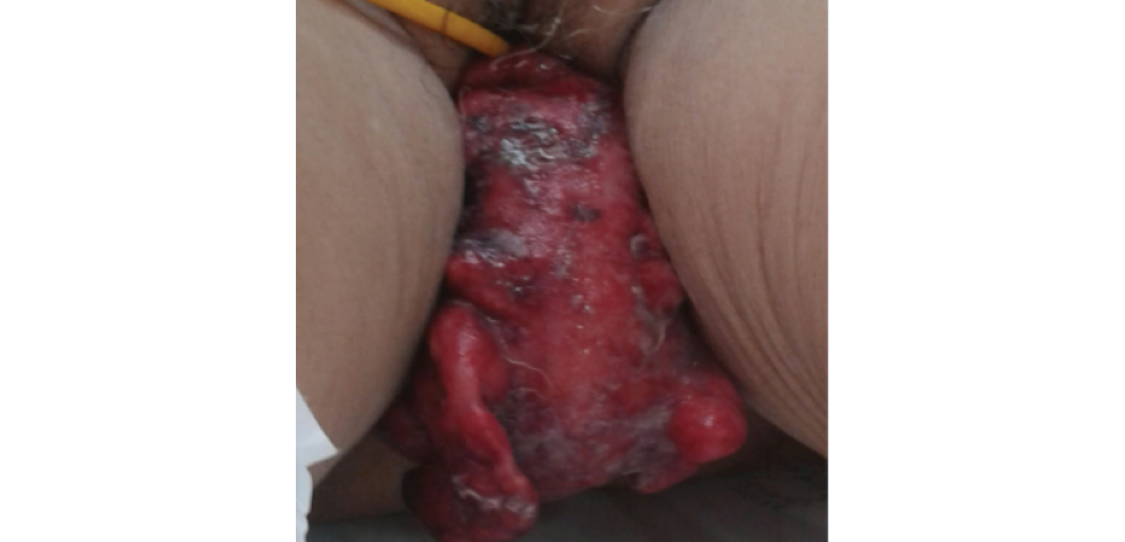
Figure 1. Sigmoid ejection through the vaginal orifice with color changes (arrow).
Source: Own elaboration based on the data obtained in the study.
The following results were obtained in the laboratory tests: blood count- leukocytes: 16,310/mm3; neutrophils: 88.2%; hemoglobin: 12.5 g/dL; hematocrit: 38.4%; pH: 7.2 PCO2:27.5 mmHg; HCO3:16.6 mEq/L; Na: 132 mEq/L; K: 3.9 mEq/L; Cl: 98 mEq/L; PCR: 8.99 mg/L; 3.0 mmol/L lactate. On the other hand, hydro-aerial levels were found in abdominal radiography. Diagnosis on admission: intestinal transvaginal evisceration.
The patient underwent an exploratory laparotomy and manual reduction of hernia. The most important findings were the presence of a sigmoid hernia ejected through vaginal orifice with color changes (Figure 2 and 3). A resection of approximately 20 cm in the devitalized sigmoid colon segment, Hartmann colostomy formation, with primary raffia in vaginal cuff without mesh placement, and rectopexy of the endopelvic fascia anterior to rectum were performed.

Figure 2. Sigmoid colon segment reduced, with color changes (arrow).
Source: Own elaboration based on the data obtained in the study.
Figure 3. Resected segment of sigmoid colon.
Source: Own elaboration based on the data obtained in the study.
The patient was discharged 10 days after surgery, in good general condition. Six months after surgery, successful return of intestinal transit was performed.
Discussion
Evisceration is a rarely reported complication; the terminal ileum is the organ that is primarily involved. Notwithstanding, there are cases that report omentum, fallopian tubes, appendix and ovarian cyst ejection (3.4). This case reports evisceration of the sigmoid colon.
The main factor associated with intestinal evisceration through vaginal cuff is vaginal, abdominal or laparoscopic hysterectomy, as it causes a shortening of the round and broad ligaments, leaving them without support, besides of cutting and leaving, with or without support, the uterosacral and cardinal ligaments. The loss of these supports relaxes the pelvic diaphragm and the perineal membrane (2,3,4).
Other associated factors include hypo-estrogenic state, which produces atrophy of the vaginal cuff; poor surgical technique; postsurgical infection or hematoma; intercourse before complete healing; Valsalva maneuvers; age; smoking; chronic treatment with corticosteroids; radiotherapy, and obesity. The time elapsed between surgery and the onset of complication varies as reported in the literature, and may be from 1 day to 25 years after surgery (6); in this case, 20 years passed.
The vaginal cuff prolapse is classified into three degrees (3):
- Grade I: does not reach the introitus
- Grade II: reaches introitus
- Grade III: goes beyond introitus.
The clinical picture is characterized by vaginal or pelvic pain, protrusion of tissue or lump through introitus, mass protruding through the vagina, back pain, urinary incontinence, and vaginal bleeding.
Surgery aims to reduce the intestine, the eventual resection of devitalized intestinal loops, and vaginal defect repair using stitches with non-absorbable material or by placing a non-absorbable polypropylene mesh (8). The approach may be vaginal, abdominal, or combined, depending on the conditions of the patient and bowel viability at the time of treatment (8,9).
According to the literature, the combined approach is considered as the most appropriate, especially when intestinal ischemia is suspected; it is also recommended for the proper evaluation and effective repair of the tissues involved, while repairing the pelvic floor during surgery (11). While other authors defend repair in a subsequent procedure (6), infection is reduced with the use of this approach, although surgical and anesthetic risk increase; however, treatment depends on the patient’s hemodynamic status and pollution in the moment.
Nevertheless, other authors prefer primary repair (8-10,12). An effective technique for pelvic floor repair is McCall modified culdoplasty to prevent recurrence of enterocele; obliteration of recto-uterine pouch may also be useful (Moschowitz procedure) (8,10,12). In many cases, simple closure of the vaginal cuff is sufficient, but a non-resorbable polytetrafluoroethylene or polypropylene mesh could be placed to reinforce the suture.
In the case reported here, resection of the devitalized sigmoid segment was performed, followed by Hartman colostomy and sacra rectopexy in order to resolve the emergency, as well as associated comorbid factors. The restitution of intestinal transit was carried out in a subsequent procedure six months after resection.
Conclusion
Transvaginal evisceration is a highly unknown complication with low incidence in hysterectomised patients caused by the laxity of the tissues; therefore, early diagnosis and treatment are essential for preventing associated morbidity and mortality.
Proper treatment of pelvic dysfunctions and gynecological surgeries with a refined technique help avoiding, to a large extent, the onset of this condition and its impact on the organs of the abdominal cavity.
Authorship Contribution
The lead author and co-authors were involved during the entire process of this case report.
Funding
None stated by the authors.
Conflicts of interest
None stated by the authors.
References
1.González I, Aragón MA, Arribas T, Guardia L, Rojas B. Evisceración vaginal tras tratamiento con radioterapia e histerectomía abdominal. Rev. chil. obstet. ginecol. . 2015;80(3):256-60. http://doi.org/btzq.
2.Partsinevelos GA, Rodolakis A, Athanasiou S, Antsaklis A. Vaginal evisceration after hysterectomy: a rare condition a gynecologist should be familiar with. Arch Gynecol Obstet. 2009;279(2):267-70. http://doi.org/cpftwg.
3.Liao CY, Sung SY, Lin HL. Peritonitis caused by vaginal evisceration following laparoscopy-assisted vaginal hysterectomy. Taiwan J Obstet Gynecol. 2013;52(2):285-6. http://doi.org/btzr.
4.Kim MK, Kim S, Bae HS, Lee JK, Lee NW, Song JY. Evaluation of risk factors of vaginal cuff dehiscence after hysterectomy. Obstet Gynecol Sci. 2014;57(2):136-43. http://doi.org/btzs.
5.Sánchez-Hidalgo JM, Naranjo-Torres A, Ciria-Bru R, Gallardo-Valverde JM, Rufián-Peña S. Evisceración vaginal. Cir Esp. 2008 [cited 2016 Nov 28];84(2):101-2. Available from: https://goo.gl/7W21Gb.
6.Quiroz-Guadarrama CD, Martínez-Ordaz JL, Rojano-Rodríguez ME, Beristain-Hernández JL, Moreno-Portillo M. Evisceración vaginal. Informe de un caso y revisión de la bibliografía. Ginecol Obstet Mex. 2013 [cited 2016 Nov 28];81:349-52. Available from: https://goo.gl/AMNr0B.
7.Sepúlveda Agudelo J, Quintero EM, Mejía MB, Oróstegui Correa S, Alarcón Nivia MA. Prolapso de la Cúpula Vaginal. Revisión del Manejo Médico y Quirúrgico. Revista de Ginecología. 2009 [cited 2016 Nov 28];50(1). Available from: https://goo.gl/Ysxzro.
8.Walters M, Ridgeway B. Tratamiento Quirúrgico del Prolapso de Cúpula Vaginal. Obstet Gynecol. 2013 [cited 2016 Nov 28];121:354-74. Available from: https://goo.gl/XkqPWj.
9.Martí Carvajal P, Pineda E, Martí C. Evisceración vaginal post histerectomía vaginal. A propósito de un caso. Academia Biomédica Digital. 2010 [cited 2016 Nov 28];44. Available from: https://goo.gl/V5oy6J.
10.Ramírez PT, Klemer DP. Vaginal evisceration after hysterectomy: a literature review. Obstet Gynecol Surv. 2002;57(7):462-7. http://doi.org/bmp7nt.
11.Chong GO, Hong DG, Cho YL, Park IS, Lee YS. Vaginal evisceration after total laparoscopic radical hysterectomy in cervical cancer. Am J Obstet Gynecol. 2010;202(3): e7-e8. http://doi.org/fp6n3d.
12.Gutiérrez Machado M, Suárez González JA, Rodríguez Treto R, González Aguiar HI, Rodríguez Mantilla HE, Benavides Casal ME. Evisceración Transvaginal post-histerectomía. A propósito de un caso poco frecuente. Rev Cubana Obstet Ginecol. 2009 [cited 2016 Nov 28];35(1):1-6. Available from: https://goo.gl/dXKAot.