Publicado
Atténuation du ground roll par le filtre surface wave atténuation : application pour le cas des données sismiques
Ground roll attenuation by surface wave attenuation filter: application for the case of seismic data
Atenuación del balanceo del suelo por filtro de atenuación de ondas superficiales: aplicación para el caso de datos sísmicos
DOI:
https://doi.org/10.15446/rbct.105227Palabras clave:
bruit; filtre; transformée de Fourier; section sismique; RMS, spectre (fr)noise; filter; Fourier transformed; seismic section; RMS, spectrum (en)
Ruido, Filtro, transformado de Fourier, sección sísmica, RMS, espectro (es)
Descargas
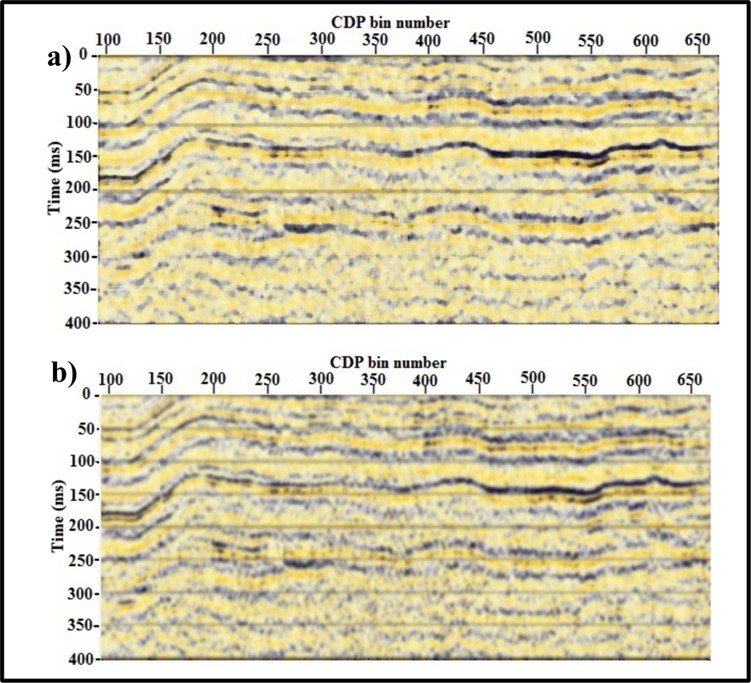
L’étape de l’interprétation sismique reste tributaire de la qualité des enregistrements des données, souvent affectés par des bruits cohérents et incohérents. Le but principal de ce travail consiste à l’utilisation du filtre "Surface Wave Noise Atténuation" basé sur la transformée de Fourier afin d’atténuer le bruit de surface présent sur une section sismique sommée en couverture multiple. Le filtre proposé a été appliqué dans le premier stade de notre test, sur des données sismiques synthétiques sur lesquelles un bruit organisé a été ajouté, tandis qu’en second, le filtre a été appliqué sur des données réelles, pour éliminer dans la mesure du possible le ground roll affectant l’image sismique avant et après sommation. L’optimisation des paramètres du filtre a permis d’obtenir une qualité sismique acceptable. Le recours à d’autres filtres, le filtre médian et le filtre gaussien en l’occurrence, ont permis d’atténuer le bruit résiduel et les réflecteurs apparaissent d’une façon encore meilleure.
The seismic interpretation step remains dependent on the quality of the data recordings, which are often affected by coherent and inconsistent noises. The main objective of this work is to use the filter "Surface Wave Noise Attenuation", which is based on the Fourier transformation to minimise the surface noise, present on a seismic cross-section summarised in multiple coverage. The proposed filter was applied, in the first stage of our test, to synthetic seismic data on which organised noise was added, while in the second stage the filter was applied to real data, to eliminate as far as possible the ground roll affecting the seismic image before and after stacking. Optimization of the filter parameters allowed an acceptable seismic quality. The use of other filters, the median filter and the Gaussian filter in this case, has reduced the residual noise and the reflectors appear even better.
La etapa de interpretación sísmica sigue dependiendo de la calidad del registro de los datos, que a menudo se ven afectadas por ruidos coherentes e inconsistentes. El objetivo principal de este trabajo es utilizar el filtro "Surface Wave Noise Attenuation", que se basa en la transformación de Fourier para minimizar el ruido superficial, presente en una sección sísmica resumida en cobertura múltiple. El filtro propuesto se aplicó, en la primera etapa de nuestra prueba, a datos sísmicos sintéticos sobre los que se agregó ruido organizado, mientras que en la segunda etapa el filtro se aplicó a datos reales, para eliminar en la medida de lo posible el balanceo de tierra que afecta a la imagen sísmica antes y después del apilamiento. La optimización de los parámetros del filtro permitió una calidad sísmica aceptable. El uso de otros filtros, el filtro mediano y el filtro gaussiano en este caso, ha reducido el ruido residual y los reflectores aparecen aún mejor.
Referencias
Al-Anezi, G.T., AlMalki, M. and Alkhalifa, T. (2013). Mapping of bedrock using the high-resolution seismic reflection technique at Wadi Al Dawasir Region, Saudi Arabia. Arabian Journal of Geosciences, 6(1), pp. 235-245. DOI: https://doi.org/10.1071/ASEG2012ab220
Bergounioux, M. (2015). Introduction au traitement mathématique des images-méthodes déterministes. 76. Springer Berlin, Heidelberg. 241 P. Disponible en: https://hal.science/hal-01137367/. DOI: https://doi.org/10.1007/978-3-662-46539-4
Bhuiyan, M.A.A. and Khan, A.R. (2018). Image quality assessment employing RMS contrast and histogram similarity. Int. Arab J. Inf. Technol., 15(6), pp. 983-989.
Bo, W., Shengdong, L., Biao, J. and Wanyong, Q. (2019). Fine imaging by using advanced detection of reflected waves in underground coal mine. Earth Sciences Research Journal, 23(1), pp. 93-99. DOI: https://doi.org/10.15446/esrj.v23n1.78750
Cary, P. and Zhang, C. (2009). Ground roll attenuation via SVD and adaptive subtraction. In: Frontiers+ Innovation–2009 CSPG CSEG CWLS Convention, Calgary, Canada. pp. 372-375.
Chandrakala, M. (2016). Comparative study and image analysis of local adaptive thresholding techniques. International Journal of Innovative Research in Computer and Communication Engineering, 4(5), pp. 8432-8439.
Dos Santos, Q.C. and Porsani, M.J. (2012). Ground roll attenuation using shaping filters and band limited sweep signals. Brazilian Journal of Geophysics, 30(4), pp. 545-554. DOI: https://doi.org/10.22564/rbgf.v30i4.241
Dubois, J. and Diament, M. (2001). Géophysique cours et exercices, édition DUNOD.
Fabre, J. (1976) Introduction à la géologie du Sahara algérien et des régions voisines : La couverture phanérozoïque. Vol. 1, SNED, Alger, 422 P.
Ferahtia, J., Aïfa, T., Baddari, K., Djarfour, N. and El Adj, S. (2013). Image-based processing techniques applied to seismic data filtering. Journal of Petroleum Science and Engineering, 104, pp. 17-26. DOI: https://doi.org/10.1016/j.petrol.2013.03.026
Goudarzi, A.R. and Ali-Riahi, M. (2012). Adaptive seismic ground roll attenuation using the double density dual tree discrete wavelet transform (DWT) method. Earth Sciences Research Journal, 16(2), pp. 113-120.
Jakhetiya, V., Lin, W., Jaiswal, S., Gu, K. and Guntuku, S.C. (2018). Just noticeable difference for natural images using RMS contrast and feed-back mechanism. Neurocomputing, 275, pp. 366-376. DOI: https://doi.org/10.1016/j.neucom.2017.08.031
Kaur, H. Fomel, S. and Pham, N. (2020). Seismic ground‐roll noise attenuation using deep learning. Geophysical Prospecting, 68(7), pp. 2064-2077. DOI: https://doi.org/10.1111/1365-2478.12985
Karsli, H. and Bayrak, Y. (2008). Ground-roll attenuation based on Wiener filtering and benefits of time-frequency imaging. The Leading Edge, 27(2), pp. 206-209. DOI: https://doi.org/10.1190/1.2840368.
Mahmood, F., Toots, M., Öfverstedt, L.G. and Skoglund, U. (2015, December). 2D discrete Fourier transform with simultaneous edge artifact removal for real-time applications. In: 2015 International Conference on Field Programmable Technology (FPT) (pp. 236-239). IEEE. DOI: https://doi.org/10.1109/FPT.2015.7393157
Moya-Gutiérrez, A.J., Torres-Peña, J.A. y Contreras-Martínez, M. (2020). Caracterización de sitio empleando prospección geofísica y geotécnica. Caso de estudio vía principal Troncal Central del Norte (Ruta Nacional 55) a la altura del Km 68+500 en el Municipio de Pamplona, Norte de Santander, Colombia. Boletín de Ciencias de la Tierra, (48), pp. 30-45. DOI: https://doi.org/10.15446/rbct.n48.85411
Ologe, O. and Mary, T.O. (2021). Seismic Attributes Analysis as a Precursor to Hydrocarbon Indicators: A case study of “Ok” Field, Niger Delta. Tanzania Journal of Science, 47(1), pp. 134-144.
Pham, N. and Li, W. (2022). Physics-constrained deep learning for ground roll attenuation. Geophysics, 87(1), pp. V15-V27. DOI: https://doi.org/10.1190/geo2020-0691.1
Solomon, C. and Breckon, T. (2011). Fundamentals of digital image processing: a practical approach with examples in Matlab. John Wiley & Sons. DOI: https://doi.org/10.1002/9780470689776
Telford, W.M., Geldart, L.P. and Sheriff, R.E. (1990). Applied geophysics. Cambridge University Press. DOI: https://doi.org/10.1017/CBO9781139167932
Tukey, J.W. (1974). Nonlinear (no superposable) methods for smoothing data. Proc. Cong. Rec. EASCOM'74, pp. 673-681.
Xiao, L., Zhang, Z. and Gao, J. (2022). Ground roll attenuation of multicomponent seismic data with the Noise-Assisted Multivariate Empirical Mode Decomposition (NA-MEMD) Method. Applied Sciences, 12(5), art. 2429. DOI: https://doi.org/10.3390/app12052429
Yilmaz, Ö. (2001). Seismic data analysis: processing, inversion, and interpretation of seismic data. Society of exploration geophysicists. DOI: https://doi.org/10.1190/1.9781560801580
Zeighami, F., Palermo, A., Vratsikidis, A., Cheng, Z., Pitilakis, D. and Marzani, A. (2021). Medium-scale resonant wave barrier for seismic surface waves. Mechanics Based Design of Structures and Machines, 49(8), pp. 1157-1172. DOI: https://doi.org/10.1080/15397734.2020.1835487
Dimensions
PlumX
Visitas a la página del resumen del artículo
Descargas
Cómo citar
Licencia
Derechos de autor 2022 Boletín de Ciencias de la Tierra

Esta obra está bajo una licencia internacional Creative Commons Atribución-NoComercial-SinDerivadas 4.0.
El autor o autores de un artículo aceptado para publicación en cualquiera de las revistas editadas por la facultad de Minas cederán la totalidad de los derechos patrimoniales a la Universidad Nacional de Colombia de manera gratuita, dentro de los cuáles se incluyen: el derecho a editar, publicar, reproducir y distribuir tanto en medios impresos como digitales, además de incluir en artículo en índices internacionales y/o bases de datos, de igual manera, se faculta a la editorial para utilizar las imágenes, tablas y/o cualquier material gráfico presentado en el artículo para el diseño de carátulas o posters de la misma revista. Al asumir los derechos patrimoniales del artículo, no podrá reproducirse parcial o totalmente en ningún medio impreso o digital sin permiso expreso del mismo.