
Publicado
Bibliometric analysis in brake disc: an overview
Análisis bibliométrico en frenos de disco: una visión general
DOI:
https://doi.org/10.15446/dyna.v88n217.91091Palabras clave:
Scientometric; Brake disc; Geometry; Bibliometric analysis; Trends (en)Cienciometría; Frenos de disco; Geometría; Análisis Bibliométrico; Tendencias (es)
Descargas
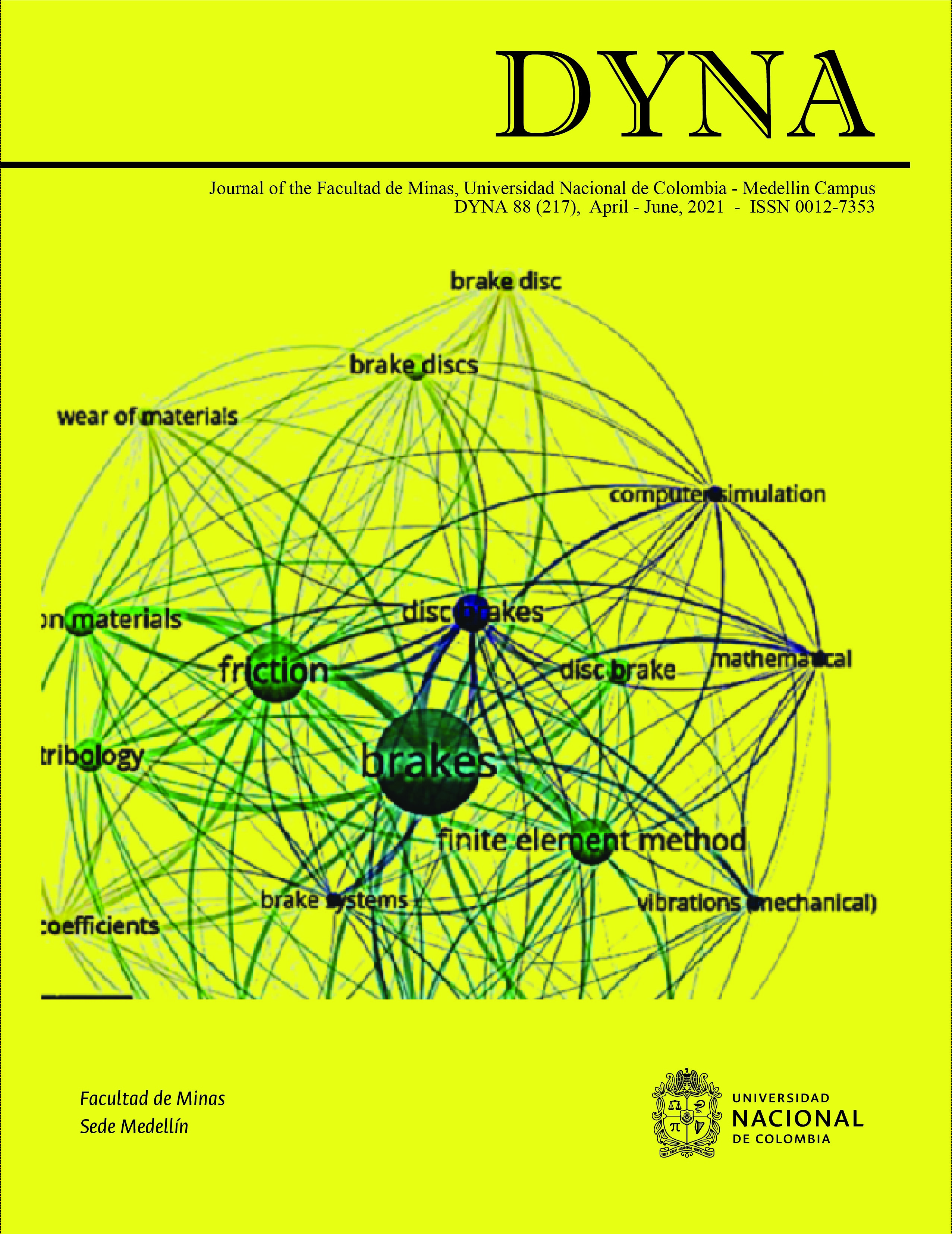
In this article, the Bibliometric analysis of the study of disc brakes in automotive applications was carried out. The main objective of this work is to present a historical analysis of the behavior and evolution of the publication of publications related to the subject of disc brakes across the years; for this purpose, the R package Bibliometrix and VOSviewer were used, and the data was collected from the Scopus database using three keywords (Brakes, Disk, and analysis). The results showed that a total of 1,584 documents published mainly in English, the growth rate of this topic is 8.78% from 1964 to 2020, taking into account the first publication in this important area of the automotive industry. The analyzed articles were published by 2,971 authors from different parts of the world, with authors from China predominant, followed by India and the United States. Finally, the most representative journal on this topic is SAE Technical Articles with 241 articles, followed by Wear with 40 publications, which belong to quartile Q2 and Q1, respectively. On the other hand, current trends in publications are based on the optimization of the mechanical and chemical properties of the materials and components used in disc brakes, mainly related to geometry and performance.
En el presente artículo se llevó a cabo el análisis bibliométrico del estudio de frenos de disco en aplicaciones del sector automotriz. El objetivo principal de este trabajo es presentar un análisis histórico del comportamiento y evolución de la publicación de trabajos relacionados con la temática de los frenos de disco a lo largo de los años; para este propósito se utilizó el paquete R Bibliometrix y VOSviewer, y los datos fueron recopilados desde la base de datos Scopus utilizando tres palabras clave (Frenos, Disco y análisis). Los resultados mostraron que de un total de 1,584 documentos publicados principalmente en inglés, la tasa de crecimiento de esta temática es de 8.78% desde 1964 hasta 2020, teniendo en cuenta la primera publicación en esta área importante de la industria automotriz. Los artículos analizados fueron publicados por 2,971 autores de diferentes partes del mundo, predominando autores de China, seguido de la india y los estados unidos. Finalmente, la revista más representativa en este tópico es la revista SAE Technical papers de donde 241 artículos, seguida la revista Wear con 40 publicaciones, las cuales pertenecen al cuartil Q2 y Q1, respectivamente. Por otra parte, las tendencias actuales de las publicaciones se basan en la optimización de las propiedades mecánicas y químicas de los materiales y componentes utilizados en los frenos de disco, relacionados principalmente con la geometría y desempeño.
Referencias
García-León, R.A., Flórez-Solano, E. and Acevedo-Peñaloza, C., Análisis termodinámico en frenos de disco. Bogotá, Colombia: ECOE Ediciones, 2018.
SN., Descripción y eficacia del sistema de frenado, Kashima University, 2020. [Online]. Available at: http://kashima.campuseina.com/mod/book/view.php?id=7679.
García-León, R.A., Acevedo-Peñaloza, C.H. and Rojas-Suarez, J., Análisis metalográfico y materiales de los frenos de disco. Bogotá, Colombia: ECOE Ediciones, 2019.
García-León, R.A., Flórez-Solano, E. and Suárez-Quiñones, Á., Brake Discs: a technological review from its analysis and assessment. Inf. Técnico, 83(2), pp. 217-234, 2019. DOI: 10.23850/22565035.1766
Kikuchi, T., Hara, Y., Sakairi, M., Yonezawa, T., Yonezawa, A. and Takahashi, H., Corrosion of Al-Sn-Bi alloys in alcohol at high temperatures. Part I: effects of the metallurgical structure of the alloys and the metal salt additions to alcohol. Corros. Sci., 52(4), pp. 1482-1491, 2010. DOI: 10.1016/j.corsci.2009.12.007
Yevtushenko A. and Kuciej, M., Temperature and thermal stresses in a pad/disc during braking. Appl. Therm. Eng., 30(4), pp. 354-359, 2010. DOI: 10.1016/j.applthermaleng.2009.09.015
Wahlström, J., A study of airborne wear particles from automotive disc brakes, KTH. Royal Institute of Technology, 2011.
Eriksson, M., Bergman, F. and Jacobson, S., On the nature of tribological contact in automotive brakes. Wear, 252(1-2), pp. 26-36, 2002. DOI: 10.1016/S0043-1648(01)00849-3
Chi, Z., He, Y. and Naterer, G., Convective heat transfer optimization of automotive brake discs. SAE Int. J. Passeng. Cars - Mech. Syst., 2(1), pp. 961-969, 2009. DOI: 10.4271/2009-01-0859
Ho, Y.-H., Athavale, M.M., Forry, J.M., Hendricks, R.C. and Steinetz, B.M., Numerical simulation of secondary flow in gas turbine disc cavities, including conjugate heat transfer, in ASME 1996 International Gas Turbine and Aeroengine Congress and Exhibition, GT, vol. 1, 1996.
García-León, R.A., Thermal study in three vented brake discs, using the finite element analysis. DYNA, 84(200), pp. 19-27, 2017. DOI: 10.15446/dyna.v84n200.55663.
Dhaubhadel, M.N., Review: CFD applications in the automotive industry. J. Fluids Eng., 118(4), pp. 647, 1996. DOI:
Dimitris, D., Frank, M. and Tabor, G., Multiscale Computational fluid dynamics. Energies 12(17), pp. 3272. 2019.DOI: 10.3390/en12173272
Wurm, J., Fitl, M., Gumpesberger, M., Väisänen, E. and Hochenauer, C., Novel CFD approach for the thermal analysis of a continuous variable transmission (CVT). Appl. Therm. Eng., 103(1), pp. 159-168, 2016. DOI: 10.1016/j.applthermaleng.2016.04.092
Pevec, M., Potrc, I., Bombek, G. and Vranesevic, D., Prediction of the cooling factors of a vehicle brake disc and its influence on the results of a thermal numerical simulation. Int. J. Automot. Technol., 13(5), pp. 725-733, 2012. DOI: 10.1007/s12239-012-0071-y
Bocîi, L.S., The influence of braking time on heat flow through the friction surfaces of the friction elements of disk brakes for railway vehicles. Transport, 26(1), pp. 75-78, 2011. DOI: 10.3846/16484142.2011.563494
García-León, R.A. and Pérez-Rojas, E., Analysis of the amount of heat flow between cooling channels in three vented brake discs. Ing. y Univ., 21(1), pp. 71-96, 2017. DOI: 10.11144/Javeriana.iyu21-1.aahf
Yan, H.B., Feng, S.S., Yang, X.H. and Lu, T.J., Role of cross-drilled holes in enhanced cooling of ventilated brake discs. Appl. Therm. Eng., 91(1), pp. 318-333, 2015. DOI: 10.1016/j.applthermaleng.2015.08.042
García-León R.A. and Flórez-Solano, E., Dynamic analysis of three autoventilated disc brakes. Ing. e Investig., 37(3), pp. 102-114, 2017. DOI: 10.15446/ing.investig.v37n3.63381.
Matějka, V. et al., Possible stibnite transformation at the friction surface of the semi-metallic friction composites designed for car brake linings. Appl. Surf. Sci., 258(5), pp. 1862-1868, 2011. DOI: 10.1016/j.apsusc.2011.10.063
Aria, M. and Cuccurullo, C., Bibliometrix : An R-tool for comprehensive science mapping analysis. J. Informetr., 11(4), pp. 959-975, 2017. DOI: 10.1007/s11192-011-0582-8
García-Léon, R.A., Martínez-Trinidad, J. and Campos-Silva, I., Historical review on the boriding process using bibliometric analysis. Trans. Indian Inst. Met., 2021. DOI: 10.1007/s12666-020-02174-6
Aguillo, I.F. Is Google Scholar useful for bibliometrics?. A webometric analysis. Scientometrics, 91(2), pp. 343-351, 2012. DOI: 10.1007/s11192-011-0582-8
Ouyang, H., Nack, W., Yuan, Y. and Chen, F., Numerical analysis of automotive disc brake squeal: a review. Int. J. Veh. Noise Vib., 1(3/4), pp. 207-231, 2005. DOI: 10.1504/IJVNV.2005.007524
Paya, B.A., Esat, I.I. and Badi, M.N.M., Artificial neural network based fault diagnostics of rotating machinery using wavelet transforms as a preprocessor. Mech. Syst. Signal Process, 11(5), pp. 751-765, 1997. DOI: 10.1006/mssp.1997.0090
Li W.H., and Du, H., Design and experimental evaluation of a magnetorheological brake. Int. J. Adv. Manuf. Technol., 21(7), pp. 508-515, 2003. DOI: 10.1007/s001700300060
Massi, F., Baillet, L., Giannini, O. and Sestieri, A., Brake squeal: Linear and nonlinear numerical approaches. Mech. Syst. Signal Process, 21(6), pp. 2374-2393, 2007. DOI: 10.1016/j.ymssp.2006.12.008
Mackin T.J. et al., Thermal cracking in disc brakes. Eng. Fail. Anal., 9(1), pp. 63-76, 2002. DOI: 10.1016/S1350-6307(00)00037-6
Enblom, R. and Berg, M., Simulation of railway wheel profile development due to wear—influence of disc braking and contact environment. Wear, 258(7), pp. 1055-1063, 2005. DOI: 10.1016/j.wear.2004.03.055
Liu, B., Li, W.H., Kosasih, P.B. and Zhang, X.Z., Development of an MR-brake-based haptic device. Smart Mater. Struct, 15(6), pp. 1960-1966, 2006. DOI: 10.1088/0964-1726/15/6/052
Choi J.-H. and Lee, I., Finite element analysis of transient thermoelastic behaviors in disk brakes. Wear, 257(1), pp. 47-58, 2004. DOI: 10.1016/j.wear.2003.07.008
Zagrodzki, P., Analysis of thermomechanical phenomena in multidisc clutches and brakes. Wear, 140(2), pp. 291-308, 1990. DOI: 10.1016/0043-1648(90)90091-N
Panier, S., Dufrénoy, P. and Weichert, D., An experimental investigation of hot spots in railway disc brakes. Wear, 256(7), pp. 764-773, 2004. DOI: 10.1016/S0043-1648(03)00459-9
AbuBakar, A.R. and Ouyang, H., Complex eigenvalue analysis and dynamic transient analysis in predicting disc brake squeal. Int. J. Veh. Noise Vib., 2(2), pp. 143-155, 2006. DOI: 10.1504/IJVNV.2006.011051
Shin, K., Brennan, M.J., Oh, J.E. and Harris, C.J., Analysis of disc brake noise using a two-degree-of-freedom model. J. Sound Vib., 254(5), pp. 837-848, 2002. DOI: 10.1006/jsvi.2001.4127
Uexküll, O.V., Skerfving, S., Doyle, R. and Braungart, M., Antimony in brake pads-a carcinogenic component?. J. Clean. Prod., 13(1), pp. 19-31, 2005. DOI: 10.1016/j.jclepro.2003.10.008
Liles, G.D., Analysis of disc brake squeal using finite element methods. In: SAE Noise and Vibration Conference and Exposition, 1989.
Hee K.W. and Filip, P., Performance of ceramic enhanced phenolic matrix brake lining materials for automotive brake linings. Wear, 259(7), pp. 1088-1096, 2005. DOI: 10.1016/j.wear.2005.02.083
Nguyen Q.H. and Choi, S.B., Optimal design of an automotive magnetorheological brake considering geometric dimensions and zero-field friction heat. Smart Mater. Struct., 19(11), pp. 115024, 2010. DOI: 10.1088/0964-1726/19/11/115024
Liu P. et al., Analysis of disc brake squeal using the complex eigenvalue method. Appl. Acoust., 68(6), pp. 603-615, 2007. DOI: 10.1016/j.apacoust.2006.03.012
Oberst S. and Lai, J.C.S., Statistical analysis of brake squeal noise. J. Sound Vib., 330(12), pp. 2978-2994, 2011. DOI: 10.1016/j.jsv.2010.12.021
Kao, T.K., Richmond, J.W. and Douarre, A., Brake disc hot spotting and thermal judder: an experimental and finite element study. Int. J. Veh. Des., 23(3/4), pp. 276-296, 2000. DOI: 10.1504/IJVD.2000.001896
Dimensions
PlumX
Visitas a la página del resumen del artículo
Descargas
Cómo citar
Licencia

Esta obra está bajo una licencia internacional Creative Commons Atribución-NoComercial-SinDerivadas 4.0.
El autor o autores de un artículo aceptado para publicación en cualquiera de las revistas editadas por la facultad de Minas cederán la totalidad de los derechos patrimoniales a la Universidad Nacional de Colombia de manera gratuita, dentro de los cuáles se incluyen: el derecho a editar, publicar, reproducir y distribuir tanto en medios impresos como digitales, además de incluir en artículo en índices internacionales y/o bases de datos, de igual manera, se faculta a la editorial para utilizar las imágenes, tablas y/o cualquier material gráfico presentado en el artículo para el diseño de carátulas o posters de la misma revista.








