Publicado
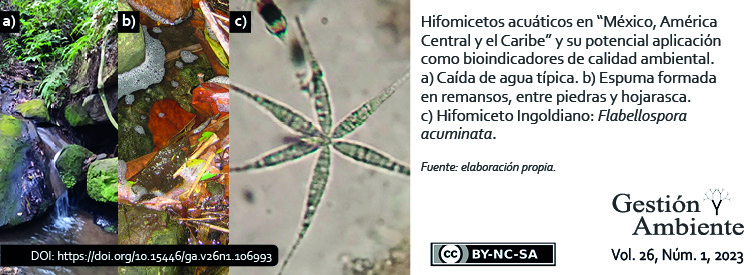
Hifomicetos acuáticos en México, América Central y el Caribe y su potencial aplicación como bioindicadores de calidad ambiental
Aquatic hyphomycetes in Mexico, Central America and the Caribbean and their bioindicators of enviromental quality
DOI:
https://doi.org/10.15446/ga.v26n1.106993Palabras clave:
Hongos Ingoldianos, Hongos aero- acuáticos, Hongos transicionales, indicadores de calidad de agua (es)Ingold fungi, aero-aquatic fungi, transitio- nal fungi, water quality indicators (en)
Descargas
Los hifomicetos acuáticos son microorganismos fúngicos anamórficos de cuerpos de agua lóticos prístinos, que participan en la degradación de material vegetal en el mismo, facilitando el reciclaje de nutrientes en los ecosistemas dulceacuícolas, siendo importantes ecológicamente por ser potenciales bioindicadores de calidad ambiental, aunado a presentar una amplia gama de enzimas de relevancia biotecnológica. Las investigaciones de estos organismos son pocas en la región Neotropical, como en la subregión de América latina conformada por México, América Central y el Caribe, donde se ha registrado un total de 236 especies, 109 Ingoldianas, 24 aero acuáticas y 103 transicionales, siendo Puerto Rico el país con el mayor numero de reportes (135; 74,8% Ingoldianos), seguido de Cuba (73; 52% transicionales), aunado al escaso estudio (solo dos trabajos) de estos como indicadores de calidad, donde se demuestra su rol como bioindicadores. Por lo cual esta revisión busca ser la base para impulsar nuevas investigaciones con este grupo fúngico, a fin de incrementar su registro, validando que la zona tropical es la de mayor biodiversidad, aunado al futuro establecimiento de índices biológicos de calidad ambiental con estos hongos, para su uso ecológicamente sustentable.
Aquatic hyphomycetes are anamorphic fungal microorganisms occurring in pristine lotic water bodies, which participate in the degradation of plant material facilitating the cycling of nutrients in the freshwater ecosystems, also being ecologically important because they are potential bioindicators of environmental quality, together with having a wide range of enzymes of biotechnological relevance. Investigations of these organisms are scarce in the Neotropical region, such as in the sub-region of Latin America including México, Central America and the Caribbean, where a total of 236 species have been registered, 109 Ingoldian, 24 aero aquatic and 103 transitional. Puerto Rico is the country with the highest number of reports (135; 74,8% Ingoldians), followed by Cuba (73; 52% transitional), coupled with the poor study (only two studies) of these as quality indicators, where their bioindicator role is demonstrated. Therefore, this review seeks to be the basis for promoting new research with this fungal group, in order to increase its registration, validating that the tropical zone is the one with the greatest biodiversity, together with the future establishment of biological indices of environmental quality with these fungi, for ecologically sustainable use.
Referencias
REFERENCIAS
Ando, K., Kawamoto, I, 1989. Terrestrial Aquatic Hyphomycetes’, a new ecological group observed in rain drops from intact leaves. V Int. Symp. Microb. Ecol. (ISME 5), Kyoto, Japan. 128, 16.
Ando, K., Kawamoto, I, 1990. Terrestrial Ingoldian hyphomycetes from intact plants and fallen leaves. IV Int. Mycol. Congr., Regensburg, August 1990, Abstract, 106.
Arsuffi, T. Suberkropp, K. 1984. Leaf processing capabilities of aquatic hyphomycetes: interspecific differences and influence on shredder feeding preference. Oikos 42:144-154.
Asif, N., Malik, M.F. and Chaudhry, F.N., 2018. A Review of on Environmental Pollution Bioindicators. Pollution 4(1), 111-118.
Baldy, V., Chauvet, E., Charcosset, J., Gessner, M, 2002. Microbial dynamics associated with leaves decomposing in the mainstram and floodplain pond of a large river. Aq. Microb. Ecol. 28, 25-36.
Bärlocher, F. 1992a. The ecology of aquatic Hyphomycetes. Springer Verlag, Berlin, Germany. 225 pp.
Bärlocher, F. 1992b. Research on aquatic Hyphomycetes: historical background and overview. p.1-15 In: The ecology of aquatic Hyphomycetes. Springer Verlag, Berlin, Germany.
Bärlocher, F. 1992c. Community organization, p. 38–76. In The ecology of aquatic hyphomycetes. Springer-Verlag, Berlin, Germany.
Bärlocher, F. 2000. Water-borne conidia of aquatic hyphomycetes: seasonal and yearly patterns in Catamaran Brook, New Brunswick, Canada. Can. J. Bot. 78:157-167.
Bärlocher, F., 2016. Aquatic hyphomycetes in a changing environment. 19,14-27
Bärlocher, F., Helson, J., Dudley, W., 2010. Aquatic hyphomycete communities across a land-use gradient of Panamanian streams. Fundam. Appl. Limnol., Arch. Hydrobiol. 177(3), 209-221.
Bärlocher, F., Kendrick, B. 1974. Dynamics of the Fungal Population on Leaves in a Stream. J Ecol. 62(3):761-791.
Barbosa, F., Gusmão, L., Raja, H., Shearer, C., 2013. New species and new records of freshwater ascomycetes from Brazil and Costa Rica. Mycologia, 105(2), 335–343.
Becerra, C., Heredia, G., Arias, R., 2007. Contribución al conocimiento de los hongos anamorfos saprobios del Estado de Tabasco. II. Rev. Mex. Micol. 24, 39-53.
Becerra, C., Heredia, G., Arias, R., Castañeda, R., Mena, J., 2011. Especies raras de hongos anamorfos saprobios en el Estado de Tabasco. Acta Bot. Mex. 96, 15-31.
Betancourt, C., 1988. Some aquatic hyphomycetes from Panama, Central America. Abstr. Proc. Acad. Sc. (Abstract no. 72).
Betancourt, C., Caballero, M., 1982. Aquatic hyphomycetes (Deuteromicotina) from Los Chorros, Utuado, Puerto Rico. Abstr. Proc. Iowa. Acad. Sc. (Abstract no. 26).
Betancourt, C., Caballero, M., 1983. Aquatic hyphomycetes (Deuteromicotina) from Los Chorros, Utuado, Puerto Rico. Caribbean J. Science. 19,41-46.
Betancourt, C., Cruz, J., Garcia, J., Mercado, N., 1983. Aquatic hyphomycetes from dona Juana River al Toro Negro State Forest, Villalba, Puerto Rico. Abstr. Proc. Iowa. Acad. Sc. (Abstract no. 37).
Betancourt, C., Rivera, R., Valera, E., 1986a. Some aquatic hyphomycetes from Maricao River at Marcao State Forest, Maricao, Perto Rico. Abstr. Proc. Iowa. Acad. Sc. (Abstract no. 46).
Betancourt, C., Cruz, J., Garcia, J., Galarza, L., 1986b. Estudio preliminar de los hifomicetos acuáticos (Deuteromicotina) de la Republica Dominicana. Caribbean J. Science. 22, 49-51.
Betancourt, C., Cruz, J., Garcia, J., 1987. Los hifomicetos acuáticos de la Quebrada Doña Juana en el Bosque Estatal de Toro Negro, Villalba, Puerto Rico. Caribbean J. Science. 23(2), 278-284.
Betancourt, C., Justiniano, J., 1989. Hongos Ingoldianos presentes en el arroyo de Oro, Mayaguez, Perto Rico. Int. J. Mycol. Lichenol. 4,1-8.
Betancourt, C., Ramírez, E., 1990. Aquatic hyphomycetes from Guanajibo river, Mayaguez, Perto Rico. Abstr. Proc. Acad. Sc. (Abstract no. 40).
Bills, G., Polishook, J., 1994. Abundance and diversity of microfungi in leaf litter of a lowland rain forest in Costa Rica. Mycologia. 86(2), 187-198.
Cáceres, O., Castillo, S., Hofmann, T., 2015. Hifomicetos acuáticos asociados a hojarasca sumergida en el río Majagua, Chiriquí, Panamá. Rev. Mex. Micol. 42, 65-69.
Calabon, M., Hyde, K., Jones, E., Luo, Z., Dong, W., Hurdeal, V., Gentekaki, E., Rossi, W., Leonardi, M., Thiyagaraja, V., Lestari, A., Shen, H., Bao, D., Boonyuen, N., Zeng, M., 2022. Freshwater fungal numbers. Fungal Diversity. 114, 3-235.
Castañeda, R., 1986a. Fungi Cubenses. Instituto de Investigaciones Fundamentales en Agricultura Tropical. “Alejandro de Humboldt”, La Habana, Cuba 64 pp.
Castañeda, R., 1986b. Deuteromycotina de Cuba. Hyphomycetes IV. Instituto de Investigaciones Fundamentales en Agricultura Tropical. “Alejandro de Humboldt”, La Habana, Cuba 17 pp.
Castañeda, R., Kendrick, B., 1991. Ninety-nine conidial fungi from Cuba and three from Canada. Dept. of Biology, University of Waterloo. Ontario-Canada. 132 pp.
Chamier, A., Dixon, P. 1982. Pectinases in leaf degradation by aquatic hyphomycetes in: the field study the colonization-pattern of aquatic hyphomycetes on leaf packs in a surrey stream. Oecologia 52(1):109-115.
Chavarria, A., Gonzalez, M., Dantán, E., Cifuentes, J., 2010. Evaluación espacial y temporal de la diversidad de los ascomicetes dulceacuícolas del canal turístico Santa Cruz, Xochimilco, México. Rev. Mex. Biod. 81, 733-744.
Cornejo, A., Pérez, J., Lopez, N., García, G., Pérez, E., Guerra, A., Nieto, C., Boyero, L., 2021. Litter decomposition can be reduced by pesticide effects ondetritivores and decomposers: Implications for tropical streamfunctioning. Environmental Pollution 285, En prensa.
Crane, J., Dumont, K., 1975. Hyphomycetes from the West Indies and Venezuela. Can. J. Bot. 53, 843-851.
Delgado, G., 2011. Nicaraguan fungi: a checklist of hyphomycetes. Mycotaxon. 115, 534-565.
Delgado. G., Mena, J., 2004. Hifomicetos aero-acuáticos e Ingoldianos de la Reserva de la Biosfera Sierra del Rosario (Cuba). Bol. Soc. Micol. Madrid. 28, 1-9.
Delgado. G., Heredia, G., Arias, R., Mena, J., 2006. Contribución al estudio de los hongos anamórficos de México. Nuevos registros para el estado de Veracruz. Bol. Soc. Micol. Madrid 30, 235-242.
Dennis, R., 1970. Fungus Flora of Venezuela and adjacent countries. Her Majesty᾽s Stationay office, London.
Descals, E., Moralejo, E., 2001. El agua y la reproducción asexual en los hongos Ingoldianos. Bot. Comp. 25,13-71.
Fernandez, R., Smits, G., Pinto, M., 2010. Características e importancia de los hifomicetos acuáticos y registro de especies en Venezuela. Rev. Faraute Cien. Tecn. 5(2), 1-15.
Fernandez, R., Smits, G., 2015. Actualización de inventario de especies de hifomicetos acuáticos en Venezuela. Gestión y Ambiente. 18(2),153-180.
Goh, T., Hyde, K., 1996. Biodiversity of freshwater fungi. J Ind Microbio. 17, 328-345.
Goos, R., 1985. A review of the anamorph genus Helicomyces. Mycologia. 77(4), 606-618.
Goos, R., 1990. A review of the anamorph genus Xenosporium. Mycologia. 82(6), 742-752.
Gulis, V., Suberkropp, K, 2003. Effect of inorganic nutrients on relative contribution of fungi and bacteria to carbon flow from submerged decomposing leaf litter. Microb. Ecol. 45, 11-19.
Hamilton, S., 1973. Aquatic hyphomycetes flora of two rain forest streams in northeastern Puerto Rico. M.S. Tesis. Ohio State University, Columbus, Ohio. 43 pp.
Heredia, G., 1993. Mycoflora associated with Green leaves and leaf litter of Quercus germana, Quercus satorii and Liquidambar stryaciflua in a Mexican cloud forest. Crytogam Mycol. 14,171-183.
Heredia, G., 1994. Hifomicetos dematiáceos en bosque mesófilo de Montaña. Registros nuevos para México. Acta Bot. Mex. 27, 15-32.
Heredia, G., Mercado, A., Mena, J., 1995. Conidial fungi from leaf litter in a mesophille cloud forest of Veracruz, México. Mycotaxon. 55, 473-490.
Heredia, G., Arias, R., Reyes, M., 2000. Leaf litter fungi. Eight setose conidial species uknown from México. Rev. Mex. Micol. 1,17-25.
Heredia, G., Reyes, M., Arias, R., Mena-Portales, J., Mercado, A., 2004. Adiciones al conocimiento de la diversidad de los hongos conidiales del bosque mesófilo de montaña del Estado de Veracruz.Acta Bot. Mex. 66, 1-22.
Heredia, G., Arias, R, Mena, J., Mercado, A., 2005. Adiciones al conocimiento de la diversidad de los hongos conidiales del bosque mesófilo de montaña del Estado de Veracruz. II. Acta Bot. Mex. 77,15-30.
Holuvobá, V., Mercado, A., 1986. Studies on hyphomycetes from Cuba IV. Dematiaceous hyphomycetes from the Province Pinar del rio. Ceska Mycol. 40, 142-164.
Hudson, H., Ingold, C., 1960. Aquatic hyphomycetes from Jamaica. Trans. Brit. Mycol. Soc. 43(3), 469-478.
Hudson, H., 1961. Heliscus submersus sp. Nov., an aquatic hyphomycetes from Jamaica. Trans. Brit. Mycol. Soc. 44(1), 91-94.
Ingold, C., 1942. “Aquatic Hyphomycetes of decaying alder leaves”. Trans. Brit. Mycol. Soc. 25, 339-417.
Ingold, C., 1943a. “Further observations on aquatic Hyphomycetes”. Trans. Brit. Mycol. Soc. 26,104-115.
Ingold, C., 1943b. “On the distribution of aquatic hyphomycetes saprophytic on submerged decaying leaves”. New Phytol. 42: 139-143.
Ingold, C., 1944. “Some new aquatic hyphomycetes”. Trans. Brit. Mycol. Soc. 28, 35-43.
Ingold, C., 1975. An Illustrated Guide to Aquatic and Water-borne Hyphomycetes Fungi Imperfecti with Notes on their Biology. Freshwater Biol Assoc Sci Publ. 30, 1-96.
Ingold, C., 1979. “Advances in the study of so-called aquatic hyphomycetes”. Am. J. Bot. 66(2), 218-226.
Jabiol, J., Bruder, A., Geesner, M., Makkonen, M., Mckie, B., Peeters, E., Vos, V., Chauvet, E., 2013. Diversity patterns of leaf-associated aquatic hyphomycetesalong a broad latitudinal gradient. Fungal Ecology 6(5), 439-448.
Justiniano, J., Betancourt, C., 1989a. Colonización de Syzygium jambos L., por hongos Ingoldianos. Caribbean J. Science. 25(3-4), 101-110.
Justiniano, J., Betancourt, C., 1989b. Hongos ingoldianos presentes en el Rio Maricao, Puerto Rico. Caribbean J. Science. 25,111-114.
Lane, L., Shearer, C., 1984. Helicomyces torquatus, a new hyphomycetes from Panama. Mycotaxon. 19, 291-297.
Marvanová, L., Marvan, P. 1969. Aquatic Hyphomycetes in Cuba. Českâ Mykologie 23(2),135-140.
Matsushima, T., 1987. Matsushima Mycol. Mem. No 5. Kobe, Japan. 448 pp + 392-393 pl.
Markert, B., Breure, A. and Zechmeister, H., 2003. Definitions, strategies and principles forbioindication/biomonitoring of the environment. In: Bioindicators and biomonitors. Markert, B., Breure, A., Zechmeister, H (Editors), Elsevier Science, The Netherlands. pp:3-39.
Mena, J., Cantillo, T., Jimenez, I., 2018. Hifomicetes de la Reserva de la Biosfera “Ciénaga de Zapata”, Cuba. Acta Bot. Cubana. 217(2), 96-108.
Mercado, A., 1984. Hifomicetos dematiáceos de Sierra del rosario, Cuba, Ed Acad. La habana, Cuba. 181 pp.
Mercado, A., Heredia, G., 1994. Hyphomycetes asociados a restos vegetales en el Estado de Veracruz, México. Rev. Mex. Micol. 10, 33-48.
Mercado, A., Heredia, G., Mena, J., 1995. New species of Dematiaceous Hyphomycetes from Veracruz, México. Mycotaxon 55, 491-499.
Michaelides, J., Kendrick, B., 1978. An investigation of factors retarding colonization of conifer needles by amphibious hyphomycetes in streams. Mycologia 70, 419-430.
Morris, E., 1972. Costa Rican Hyphomycetes. Mycologia. 64(4), 887-896.
Morris, E., 1978. Belizean fungi. Mycotaxon. 7(2), 265-274.
Nieves, A., 2003. Mycological surgey of rio Camuy caves park, Puerto Rico. J Cave Karst Stu. 65(1), 23-28.
Nieves, A., Santos-Flores, C., 2005. Aquatic fungi from estuaries in Puerto Rico: Mouth of the Manatí River. J. Agrie. Univ. P.R. 89(l-2), 97-105.
Nilsson, S., 1964. Freshwater hyphomycetes: taxonomy, morphology and ecology. Symbolae Botanica Upsalienses. 18,1-130.
Padgett, D., 1976. Leaf descomposition by fungi in a tropical rain forest stream. Biotropica. 8, 166-178.
Park, D., 1972. On the ecology of heterotrophic microorganisms in fresh water. Trans. Br. Mycol. Soc. 58, 291-299.
Parmar, T., Rawtani, D., Agrawal, Y., 2016. Bioindicators: the natural indicator ofenvironmental pollution. Frontiers in life Sci. 9(2), 110-118.
Price, I., Talbot, P. 1966. An aquatic hyphomycete in a lignicolous habitat. Aust. J. Bot. 14, 19-23.
Rambelli, A., Ciccarone, C., 2008. New and interesting Dematiaceous Hyphomycetes from Costa Rica forest litters. Quad. Bot. Ambientale Appl. 19,125-152.
Rosique, E., Córdova, L., Cappello, S., Cid, A., 2018. Hongos ingoldianos de las cascadas del Parque Estatal Agua Blanca, Tabasco, México Ingoldian fungi of the cascades of the Agua Blanca State Park, Tabasco, México. Scientia Fungorum. 47, 3-11.
Rajashekhar, M. & Kaveriappa, K.M. 2003. Diversyty of aquatic hyphomycetes in the aquatic ecosystems of the Western Ghats of India. Hydrobiologia. 501 (1-3):167-177
Sajina, A., Sudheesan, D., Kumar, L., Sandhya K. 2021. Fish as Ecological Health Indicators of Freshwater Ecosystems. Biotica Research Today 3(1),77-80.
Santos-Flores, C., Betancourt, C., 1994. Aquatic Hyphomycetes (Deuteromycotina) from Río Loco al Susúa State Forest, puerto Rico. Caribbean J. Science. 30(3-4), 262-267.
Santos-Flores, C., Betancourt, C., Nieves, M., 1996a. New records of water-borne hyphomycetes for Puerto Rico. Caribbean J. Science. 32(1-2), 105-110.
Santos-Flores, C., Nieves, M., 1996b. The genus Condylospora Nawawi (Hyphomycetes) in Puerto Rico. Caribbean J. Science. 32(1), 116-120.
Santos-Flores, C., Nieves, M., Betancourt, C., 1995. Hyphomycetes with multiradiate conidia in stream foam from Puerto Rico. Caribbean J. Science. 31(1-2), 49-56.
Santos-Flores, C., Betancourt, C., 1997. “Aquatic and water-borne hyphomycetes (Deuteromycotina) in streams of Puerto Rico (Including records from other Neotropical locations)” Caribbean J. Science. Spec. Publ. 2. 116 pp.
Shearer, C., Lane, L., 1983. Comparison of three techniques for the study of aquatic hyphomycetes communities. Mycologia. 75, 498-508.
Shearer, C., Descals, E., Kohlmeyer, B., Kohlmeyer, J., Marvanová, L., Padget, D., Porter, D.,
Schoenlein-Crusius, I., Milanez, A., 2003. The diversity of aquatic hyphomycetes in South America. Braz J Micobiol. 34,183-193.
Seena, S., Baschien, C., Barros, J., Sridhar, K., Graca, M., Mykrä, H., Bundschuh, M. 2022. Ecosystem services provided by fungi freshwater: a wake-up call. Hydrobiologia. DOI: https://doi.org/10.1007/s10750-022-05030-4
Smits, G., Fernández, R., Cressa, C., 2007. Preliminary study of aquatic hyphomycetes from Venezuelan streams. Acta Bot. Venez. 30(2), 345-355.
Solé, M., Fetzer, I., Wennrich, R., Sridhar, K. R., Harms, H., Krauss, G., 2008. Aquatic hyphomycete communities as potential bioindicators for assessing anthropogenic stress. Science of the Total Environment 389(2-3), 557-565.
Sridhar, K., 2005. Freshwater hyphomycetes - concepts and connections.Kavaka. 33, 9-20.
Sridhar, K., 2009. Aquatic fungi – Are they planktonic?. In: Plankton Dynamics of Indian Waters (Ed. Hosetti, B.B.) Pratiksha Publications, Jaipur, India. pp: 133-148.
Sridhar, K., 2020. Dimensions, diversity and ecology of aquatic mycobiome. Kavaka. 54, 10-23.
Stevenson, J., Rands, R, 1921. An Annotated List of the Fungi and Bacteria Associated With Sugarcane and Its Products. Bulletin III (Bot. Ser.) Part 1, 66-97.
Sumudumali, R., Jayawardana, J., 2021. A Review of Biological Monitoring of Aquatic Ecosystems Approaches: with Special Reference to Macroinvertebrates and Pesticide Pollution. Environmental Managemen 67, 263-276.
Tsui, C., Baschien, C., Goh, T., 2016. Biology and Ecology of Freshwater Fungi. In D.-W. Li (ed.), Biology of Microfungi, Fungal Biology. pp: 285-313. Springer Verlag Netherlands
Urriola, G., Hofmann, T., González, L., Cáceres, O., 2016. Estudio preliminar de hyphomycetes acuáticos de la cuenca del río Macho de Monte, Chiriquí, Panama. Avances en investigación (2° Congreso) Universidad Autónoma de Chiriquí, Panamá. pp: 66-72.
Vélez, A., Lozano, S., Cáceres, K., 2016. Diversidad de fitoplancton como indicador de calidad de agua en la cuenca baja del río Lurín, Lima, Perú. Ecología Aplicada 15(2), 69-79.
Voglmayr, H., Degado, G., 2001. Dendroclathra caeruleofusca gen.nov. et sp.nov., an aeroaquatic hyphomycete from Cuba Hermann. Can. J. Bot. 79, 995-1000.
Voglmayr, H., Degado, G., 2003. New species, notes and key to the aeroaquatic genera Beverwykella and Ramicephala gen. nov. Mycol. Res. 107(2), 236-244.
Dimensions
PlumX
Visitas a la página del resumen del artículo
Descargas
Cómo citar
Licencia

Esta obra está bajo una licencia internacional Creative Commons Atribución-NoComercial-CompartirIgual 4.0.
Los artículos que sean publicados en la revista Gestión y Ambiente, también serán publicados en el sitio web http://www.revistas.unal.edu.co/index.php/gestion/index y en formatos electrónicos como PDF, HTML, XML, entre otros. Además, en diferentes redes sociales de difusión del conocimiento. Gestión y Ambiente adopta directrices de ética por Committee on Publication Ethics (COPE) sobre buenas prácticas de conducta (evitar conductas como plagio, falsificación, autoría ficticia, entre otros), describe conflictos de interés o en competencia, contribuciones de autoría y fuentes de financiación. Todo lo publicado se considerará propiedad de la revista Gestión y Ambiente, pero pueden usarse bajo la licencia Creative Commons “Reconocimiento-No Comercial-Compartir Igual International (BY-NC-SA) 4.0”