Publicado
Tratamiento de aceite usado de vehículos diésel por hidrólisis y adsorción con fines de reutilización
Treatment of used diesel vehicle oil by hydrolysis and adsorption: Reutilization
DOI:
https://doi.org/10.15446/ga.v25n1.99621Palabras clave:
Aceite vehicular, economía circular, lubricación, metales, tecnologías verdes (es)Vehicle oil, circular economy, lubrication, metals, green technologies (en)
Descargas
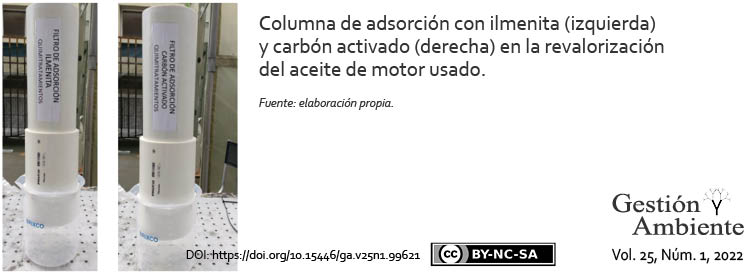
Los aceites lubricantes usados son catalogados como residuos peligrosos por el contenido de metales pesados y sustancias tóxicas provenientes de la combustión y desgaste del motor, lo que representa un riesgo para las personas que los manipulan y generan contaminación ambiental. A pesar de perder su vida útil, los lubricantes usados pueden integrarse a la cadena productiva como materia prima secundaria, sin embargo, su utilidad se limita a la generación de energía térmica. Con el propósito de evaluar un tratamiento alternativo para el aceite lubricante usado, se caracterizó el lubricante y se encontraron componentes críticos de agua, calcio, fósforo, zinc y silicio. El tratamiento consistió en la hidrólisis con ácido sulfúrico a diferentes concentraciones (5 %, 10 % y 15 %, v/v) y posterior adsorción con ilmenita y carbón activado. Los resultados mostraron reducciones en los contenidos de silicio, aluminio, cromo, cobre, hierro, plomo, níquel, estaño, vanadio y bario, que cumplen con la norma técnica colombiana. Sin embargo, las concentraciones de calcio, magnesio, fósforo y zinc no cumplieron los niveles estipulados en la norma NTC 5996. Es necesario profundizar en la combinación de tratamientos para lograr criterios técnicos en el uso de aceites tratados.
Used lubricating oils come under the category of hazardous waste due to the content of heavy metals and toxic substances produced during combustion and subsequent engine wear, which represents a risk for the people who handle them and generates environmental pollution. Despite losing their lifespan, used lubricants can be integrated into the production chain as a secondary raw material since their usefulness is limited to thermal energy. In order to evaluate an alternative treatment to used lubricating oil, the lubricant was previously characterized and finding critical components of water, calcium, phosphorus, zinc, and silicon. The treatment consisted of hydrolysis with sulfuric acid at different concentrations (5%, 10%, and 15 %, v/v) and subsequent contrast adsorption with ilmenite and activated carbon. The results showed reductions in the contents of silicon, aluminum, chromium, copper, iron, lead, nickel, tin, vanadium, and barium, thereby fulfilling the Colombian technical standard. However, calcium, magnesium, phosphorus, and zinc concentrations did not meet the levels stipulated in Colombian standard NTC 5996. It is necessary to deepen the combination of treatments to achieve technical criteria in the use of treated oils.
Referencias
Adjamov, K., Guseynova, E., Imanova, N., Ismailova, K., Ismailova, V., Agabekova, M., Yusubova, S., Asgarova, M., 2017. Assessment of physical and chemical properties of the waste motor oil. Azerbaijan Chem. J. 1, 80-84.
Appiah-Adjei, E., Baidu, E., Adjei, K., Nkansah, M., 2019. Potential heavy metal pollution of soils from artisanal automobile workshops: the case of Suame Magazine, Ghana. Environ. Earth Sci. 78(3), 62. DOI: https://doi.org/10.1007/s12665-019-8069-7
ASTM, 2017. ASTM D6595. Standard test method for determination of wear metals and contaminants in used lubricating oils or used hydraulic fluids by rotating disc electrode atomic emission spectrometry. Book of ASTM Standards. Vol. 5, Sec. 3. DOI: https://doi.org/10.1520/D6595-17
ASTM, 2018a. ASTM E2412. Standard practice for condition monitoring of in-service lubricants by trend analysis using fourier transform infrared (FT-IR) spectrometr. Book of ASTM Standards. Vol. 5, Se. 5. DOI: https://doi.org/10.1520/E2412-10R18
ASTM, 2019a. ASTM D7946-19. Standard test method for initial ph (I-pH)-value of petroleum products. Book of ASTM Standards. Vol. 5, Sec. 4. DOI: https://doi.org/10.1520/D7946-19
ASTM, 2019b. ASTM D189. Standard test method for conradson carbon residue of petroleum products. Book of ASTM Standards. Vol. 5, Sec. 1. DOI: https://doi.org/10.1520/D0189-06R19
ASTM, 2020. ASTM D7279-20. Standard test method for kinematic viscosity of transparent and opaque liquids by automated houillon viscometer. Book of ASTM Standards. Vol. 5, Sec. 3. DOI: https://doi.org/10.1520/D7279-20
ASTM, 2021a. ASTM D2896. Standard test method for base number of petroleum products by potentiometric perchloric acid titration. Book of ASTM Standards. Vol. 5, Sec. 1. DOI: https://doi.org/10.1520/D2896-21
ASTM, 2021b. ASTM D974. Standard test method for acid and base number by color-indicator titration. Book of ASTM Standards. Vol. 5, Sec. 1. DOI: https://doi.org/10.1520/D0974-21
ASTM, 2022. ASTM D2983. Standard test method for low-temperature viscosity of automatic transmission fluids, hydraulic fluids, and lubricants using a rotational viscometer. Book of ASTM Standards. Vol 5, Sec. 1. DOI: https://doi.org/10.1520/D2983-22
Bisbal, R., Gómez, F., Di Yorio, C., Pérez, M., 2015. Evaluación de las características y propiedades de fundición de Arena de Olivino Venezolana (Parte I). Rev. Fac. Ing. UCV 30(3), 95-110.
Buchelli-Carpio, L., Garcia-Granizo, V., 2015. Detección temprana de fallas en motores de combustión interna a diesel mediante la técnica de análisis de aceite. Rev. Cienc. UNEMI, 8(15), 84-95. DOI: https://doi.org/10.29076/issn.2528-7737vol8iss15.2015pp84-95p
Cabascango Collahuazo, S., Antamba Guasgua, J., Corrales Zurita, L., Guerra Naranjo, J., 2020. Diagnóstico de la condición de desgaste basado en el análisis de aceite usado. Caso de estudio: Vehículo de servicio de taxi. Conciencia Digital 3(3.2), 18-28. DOI: https://doi.org/10.33262/concienciadigital.v3i3.2.1399
Chen, Y., 2011. Synthesis, characterization and dye adsorption of ilmenite nanoparticles. J. Non-Cryst. Solids 357(1), 136-139. DOI: https://doi.org/10.1016/j.jnoncrysol.2010.09.070
Chen, P., Zhai, J., Sun, W., Hu, Y., Yin, Z., Lai, X., 2017. Adsorption mechanism of lead ions at ilmenite/water interface and its influence on ilmenite flotability J. Ind. Eng. Chem. 53, 285-293. DOI: https://doi.org/10.1016/j.jiec.2017.04.037
Dabai, M., Bello, N., 2019. Comparative study of regeneration of used lubricating oil using sulphuric and oxalic acids/clay treatment process. Int. J. Innov. Res. Sci. Eng. Technol. 6(3), 13-23.
Delgado, E., Parra, J., Aguilar, L., Guevara, D., Novoa, J., 2007. Combustibles alternativos a partir de aceites usados con tratamientos de limpieza. Avan. Inv. Ing. 4(7), 80-84.
Delgado, J., Saldivia, F., Fygueroa, S., 2014. Sistema parala determinación de la degradación del lubricante basado en el tratamiento digital de manchas de aceite de motores diésel. Rev. UIS Ing. 13(1), 55-61.
Ding, B., Liu, H., Wang, W., 2021. Material and method for treatment of U-containing wastewater based on U enrichment mechanism of altered ilmenite in Sandstone-type U deposit. At. Energy Sci. Technol. 55, 23-29. (In Chinese with English Abstract).
Fong Silva, W., Quiñones Bolaños, E., Tejada Tovar, C., 2017. Caracterización físico-química de aceites usados de motores para su reciclaje. Prospect. 15(2), 135-144. DOI: https://doi.org/10.15665/rp.v15i2.782
Franco, J., Cramer, T., Bonilla, A., Castañeda, A., Poujol, M., Amaya, Z. 2021. Mineralogía y geocronología de rutilo-(Nb,Ta) relacionado a casiterita y columbitatantalita provenientes de rocas Mesoproterozoicas del Cratón Amazónico cerca de Cachicamo, Colombia. Bol. Geol. 43(1), 99–126. DOI: https://doi.org/10.18273/revbol.v43n1-2021005
Higuera Cobos, O., Arroyave Londoño, J., Flórez Garcia, L., 2009. Diseño de un biofiltro para reducir el índice de contaminación por cromo generado en las industrias del curtido de cueros. DYNA Rev. Fac. Nac. Minas 76(160), 107-119.
Icontec, 2002. NTC 336. Grasas y aceites animales y vegetales. Métodos de la determinación de la densidad (masa por volumen convencional). Bogotá.
Icontec, 2011. NTC 5836-1. Manual de estándares de medición de petróleo, sección muestreo. Práctica normativa para el petróleo y productos del petróleo. Parte 1: Muestreo manual. Bogotá.
Icontec, 2013. NTC 5995. Petróleo y sus derivados. Bases lubricantes re-refinadas. Bogotá.
Kaipannan, S., Ganesh, P., Manickavasakam, K., Sundaramoorthy, S., Govindarajan, K., Mayavan, S., Marappan, S., 2020. Waste engine oil derived porous carbon/ ZnS Nanocomposite as Bi-functional electrocatalyst for supercapacitor and oxygen reduction. J. Energy Storage 32, 101774. DOI: https://doi.org/10.1016/j.est.2020.101774
Lam, S., Liew, R., Jusoh, A., Chong, C., Ani, F., Chase, H. A. 2016. Progress in waste oil to sustainable energy, with emphasis on pyrolysis techniques. Renew Sust. Energ. Rev. 53, 741-753. DOI: https://doi.org/10.1016/j.rser.2015.09.005
López, J., González, M., Scaini, A., Goñi, M., Valdenebro, J., Gimena, F., 2012. Caracterización del modelo HEC-HMS en la cuenca de río Arga en Pamplona y su aplicación a cinco avenidas significativas. Obras y Proyectos 12, 15-30. DOI: https://doi.org/10.4067/s0718-28132012000200002
LV, Y., Le, Q.-T., Bui, H.-B., Bui, X.-N., Nguyen, H., Nguyen-Thoi, T., Dou, J., Song, X., 2020. A comparative study of different machine learning algorithms in predicting the content of ilmenite in titanium placer. Appl. Sci. 10(2), 635. DOI: https://doi.org/10.3390/app10020635
Ministerio de Ambiente y Desarrollo Sostenible, 2014. Manual técnico para el manejo de aceites lubricantes usados de origen automotor industria. 2ª ed. Bogotá.
Mishra, A., Siddiqi, H., Kumari, U., Behera, I., Mukherjee, S., Meikap, B., 2021. Pyrolysis of waste lubricating oil/waste motor oil to generate high-grade fuel oil: A comprehensive review. Renew. Sustain. Energy Rev. 150, 111446. https://doi.org/10.1016/j.rser.2021.111446
Muñoz, É., Montoya, D., Muñoz, A., 2020. Planteamiento y solución de la problemática de los aceites usados en Colombia. Rev. Ambient. Éolo 18(1), 22.
Oladimeji, T., Oguntuashe, K., Emetere, M., Efeovbokhan, V., Odunlami, O., Obanla, O., 2020. Industrial- and automotive-used lubricating oils recycling cum acidic sludge treatment. Int. J. Adv. Manuf. Technol. 106(9-10), 4157-4167. DOI: https://doi.org/10.1007/s00170-019-04751-6
Ouyang, P., Zhang, X., 2020. Regeneration of the waste lubricating oil based upon flyash adsorption / solvent extraction. Environ. Sci. Poll. Res. 27(30), 37210-37217. DOI: https://doi.org/10.1007/s11356-019-07389-9
Pawlak, Z., Urbaniak, W., Kaldonski, T., Styp-Rekowski, M., 2010. Energy conservation through recycling of used oil. Ecol. Eng. 36(12), 1761-1764. DOI: https://doi.org/10.1016/j.ecoleng.2010.08.007
Ponche, E. 2005. diseño de un tren de potabilización para una planta generadora de agua embotellada. Universidad de las Américas, Puebla, México.
Ramírez, C., Carvajal, Y., Bocanegra, R., Sandoval, M., 2018. Determinación de relaciones nivel – caudal simple o compleja en un río. Caso del río Cauca. Ingeniería y Competitividad 20(2), 45-56. https://doi.org/10.25100/iyc.v20i2.6354
Romero, J., 2013. Potabilización del agua. 4a ed. Alfaomega; Escuela Colombiana de Ingeniería, Bogotá.
Saldivia, F., 2013. Aplicación de mantenimiento predictivo. Caso estudio: análisis de aceite usado en un motor de combustión interna. In: Memorias del 11a LACCEI Latin American and Caribbean Conference for Engineering and Technology (LACCEI’2013): Innovation in Engineering, Technology and Education for Competitiveness and Prosperity. Cancún, México.
Sánchez-Alvarracín, C., Criollo-Bravo, J., Albuja-Arias, D., García-Ávila, F., Pelaez-Samaniego, R., 2021. Characterization of used lubricant oil in a Latin-American medium-size city and analysis of options for its regeneration. Recycling 6(1), 10. DOI: https://doi.org/10.3390/recycling6010010
Santos, B., 1993. Process for re-refining used oil. Patent No. US 5,514,272A del 7 de mayo de 1996. Fremont, CA.
Si, X.-G., Lu, X.-G., Li, C.-W., Li, C.-H., Ding, W.-Z., 2012. Phase transformation and reduction kineticsduring the hydrogen reduction of ilmenite concentrate. Int. J. Miner. Metall. Mater. 19(5), 384-390. DOI: https://doi.org/10.1007/s12613-012-0568-4
Speight, J., Exall, D., 2014. Refining used lubricating oils. CRC Press, Boca Raton, FL. DOI: https://doi.org/10.1201/b16745
Wankat, P., 2008. Ingeniería de procesos de separación. 2a ed. Pearson Prentice Hall, Ciudad de México.
Zzeyani, S., Mikou, M., Naja, J., Bouyazza, L., Fekkar, G., Aiboudi, M., 2019. Assessment of the waste lubricating oils management with antioxidants vegetables extracts based resources using EPR and FTIR spectroscopy techniques. Energy 180, 206-215. DOI: https://doi.org/10.1016/j.energy.2019.05.007
Zzeyani, S., Mikou, M., Jamal, N., 2018. Physicochemical characterization of the synthetic lubricating oils degradation under the effect of vehicle engine operation. Eurasian J. Anal. Chem. 13(4).
Dimensions
PlumX
Visitas a la página del resumen del artículo
Descargas
Cómo citar
Licencia

Esta obra está bajo una licencia internacional Creative Commons Atribución-NoComercial-CompartirIgual 4.0.
Los artículos que sean publicados en la revista Gestión y Ambiente, también serán publicados en el sitio web http://www.revistas.unal.edu.co/index.php/gestion/index y en formatos electrónicos como PDF, HTML, XML, entre otros. Además, en diferentes redes sociales de difusión del conocimiento. Gestión y Ambiente adopta directrices de ética por Committee on Publication Ethics (COPE) sobre buenas prácticas de conducta (evitar conductas como plagio, falsificación, autoría ficticia, entre otros), describe conflictos de interés o en competencia, contribuciones de autoría y fuentes de financiación. Todo lo publicado se considerará propiedad de la revista Gestión y Ambiente, pero pueden usarse bajo la licencia Creative Commons “Reconocimiento-No Comercial-Compartir Igual International (BY-NC-SA) 4.0”