Publicado
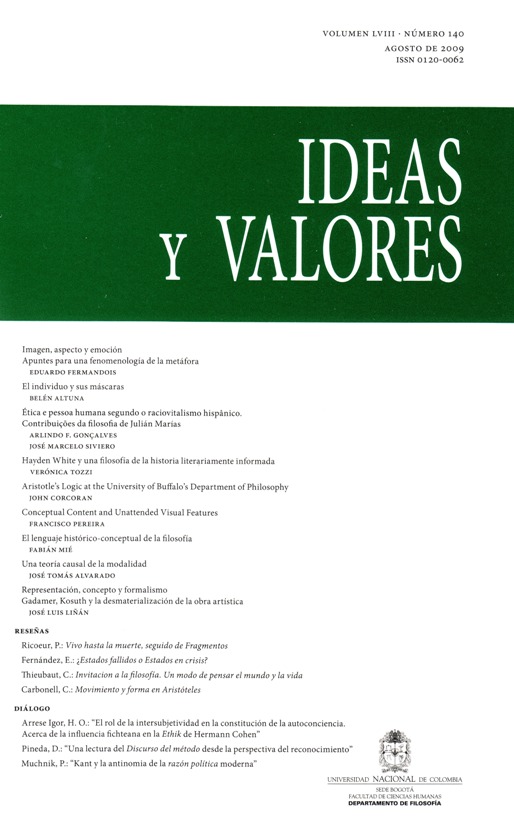
Imagen, aspecto y emoción: Apuntes para una fenomenología de la metáfora
Palabras clave:
Wittgenstein, metáfora, comprensión, imágenes, ver aspectos, emociones, significado secundario (es)Referencias
Black, M. "More about metaphor". Metaphor and Thought. 2nd ed. Ortony, A. Cambridge, U.K.: Cambridge University Press, 1993. 1941.
Cooper, D. "Davies on Recent Theories of Metaphor", Mind 93 (1984): 433-439.
Cooper, D. Metaphor. New York: Basil Blackwell, 1986.
Davidson, D. "Reply to Oliver Scholz". Reflecting Davidson, ed. Stoecker, R. Berlin - New York: De Gruyter, 1993.
Davidson, D. "Lo que significan metáforas". La búsqueda del significado. Tercera edición, ed. Valdés Villanueva, L. M. Madrid: Tecnos, 1999. 568-587.
Fermandois, E. "Verdad y metáfora: una aproximación pragmática", Crítica 95 (2000): 71-102.
Fermandois, E. "Innovation und Stabi lität in der Sprache - am Beispiel der Metapher", Kreativität. XX. Deutscher Kongress für Philosophie, ed. Abel, G. Sektionsbeiträge Bd. 2, Berlin: Universitätsverlag der TU Berlin, 2005. 99-110.
Fermandois, E. "De por qué en la filosofía importan los ejemplos", Areté XX (2008): 189-216.
Guttenplan, S. Objects of Metaphor. Oxford: Clarendon Press, 2005.
Grupo µ. Retórica general. Barcelona - Buenos Aires - México D.F.: Paidós, 1987.
Hanfling, O. "I heard a plaintive melody: Philosophical Investigations, p. 209". Wittgenstein Centenary Essays, ed. Phillips Griffiths, A. Cambridge: Cambridge University Press, 1991. 117-133.
Hester, M. B. "Metaphor and Aspect Seeing", The Journal of Aesthetics and Art Criticism 25 (1966): 205-212.
Johannessen, K. S. "Art, Philosophy, and Intransitive Understanding". Wittgenstein: Towards Re-evaluation, eds. Haller, R. & Brandl, J. (Proceedings of the 14th International Wittgenstein Symposium). Vienna: Hölder-Pichler-Tempsky, 1990. 323-333.
Krebs, V. J. "El problema de la subjetividad y la importancia de ver aspectos en Wittgenstein". Del espejo a las herramientas, eds. Flores, A., Holguín, M. y Meléndez, R. Bogotá: Siglo del Hombre, 2003. 261-288.
Lange, E.-M. Ludwig Wittgenstein: Philosophische Untersuchungen. Paderborn: Schöningh, 1998.
Le Guern, M. La metáfora y la metonimia. Madrid: Cátedra, 1990.
Moran, R. "Seeing and Believing: Metaphor, Image, and Force", Critical Inquiry 16 (1989): 87-112.
Moran, R. "Metaphor". A Companion to the Philosophy of Language. eds. Hale, B. & Wright, C. Oxford: Blackwell, 1997. 248-268.
Mulhall, S. On Being in the World: Wittgenstein and Heidegger on Seeing Aspects. London, New York: Routledge, 1990.
Mulhall, S. "Seeing Aspects". Wittgenstein: A Critical Reader, ed. Glock, H.-J. Oxford: Blackwell, 2001. 246-267.
Ricoeur, P. "The Metaphorical Process as Cognition, Imagination, and Feeling". Philosophical Perspectives on Metaphor, ed. Johnson, M. Minneapolis: University of Minnesota Press, 1981. 228-247.
Ricoeur, P. La metáfora viva. Madrid: Trotta/Ediciones Cristiandad, 2001.
Rorty, R. "Ruidos poco conocidos: Hesse y Davidson sobre la metáfora". Objetivismo, relativismo y verdad. Barcelona: Paidós, 1996. 223-236.
Scholz, O. "Wie schlimm ist Bedeutungsblindheit? Zur Kernfrage von PU II, xi". Wittgenstein über die Seele, eds. von Savigny, E. & Scholz, O. Frankfurt am Main: Suhrkamp, 1995. 213-232.
Schulte, J. "Metaphern und sekundäre Bedeutung". Chor und Gesetz. Frankfurt am Main: Suhrkamp, 1990. 104-112.
Tirrell, L. "Seeing Metaphor as Seeing-As: Remarks on Davidson's Positive View of Metaphor", Philosophical Investigations 14 (1991): 143-154.
White, R. M. The Structure of Metaphor: The Way the Language of Metaphor Works. Oxford: Blackwell, 1996.
Wittgenstein, L. Philosophische Grammatik. Frankfurt am Main: Suhrkamp, 1984.
Wittgenstein, L. Investigaciones Filosóficas. Barcelona - México: UNAM/ Crítica, 1988.
Zemach, H. M. "Meaning, the Experience of Meaning and the Meaningblind in Wittgenstein's Late Philosophy", The Monist 78 (1995): 480-495.
Visitas a la página del resumen del artículo
Descargas
Cómo citar
Licencia
Derechos de autor 2016 Universidad Nacional de Colombia

Esta obra está bajo una licencia internacional Creative Commons Atribución 4.0.
De acuerdo con la Licencia Creative Commons Atribución-No Comercial-SinDerivar 4.0 Internacional. Se autoriza copiar, redistribuir el material en cualquier medio o formato, siempre y cuando se conceda el crédito a los autores de los textos y a Ideas y Valores como fuente de publicación original. No se permite el uso comercial de copia o distribución de contenidos, así como tampoco la adaptación, derivación o transformación alguna de estos sin la autorización previa de los autores y de la dirección de Ideas y Valores. Para mayor información sobre los términos de esta licencia puede consultar: http://creativecommons.org/licenses/by-nc-nd/4.0/legalcode.








.jpg)