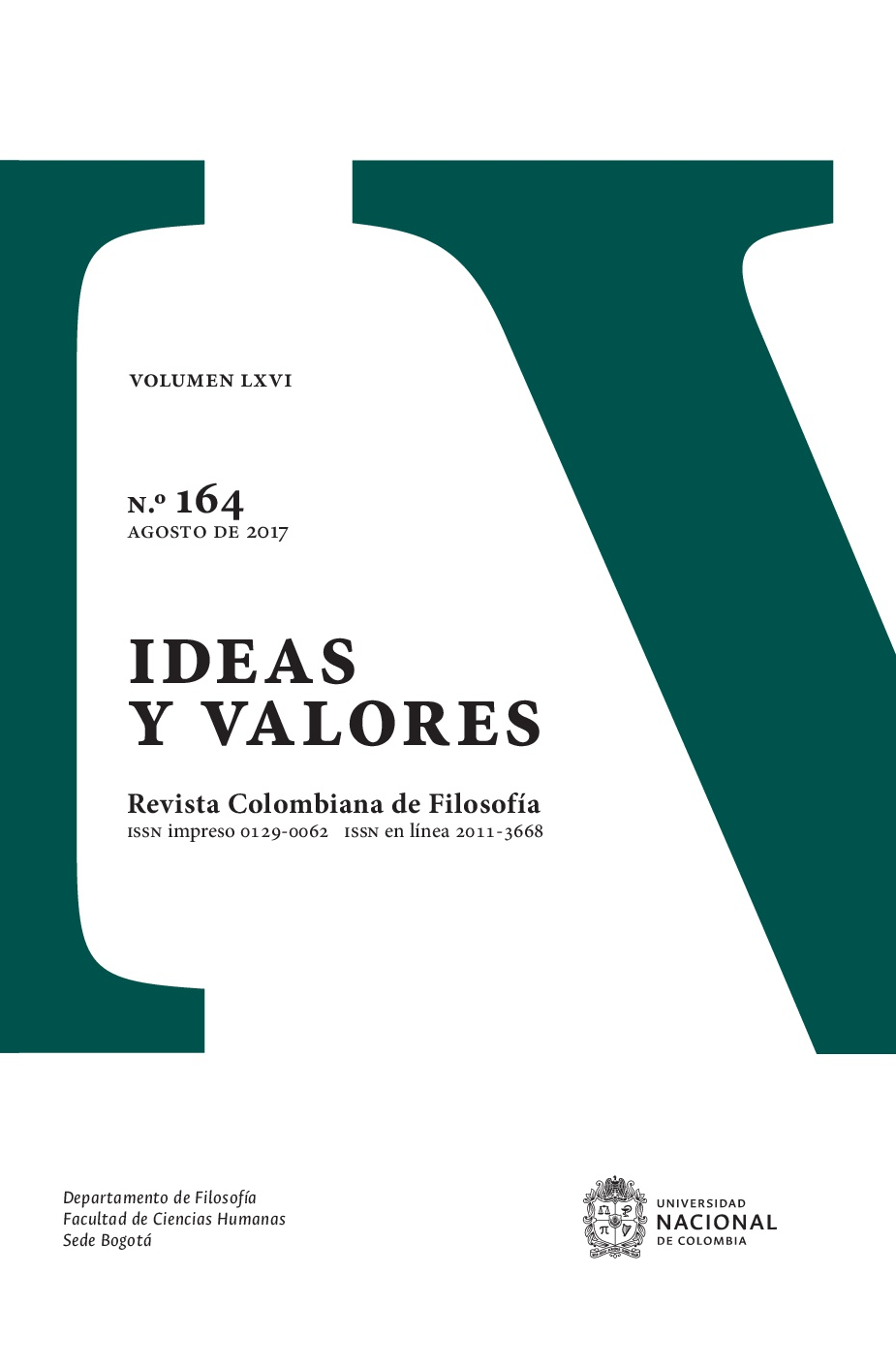
Publicado
"Otro" liberalismo. Individualismo y colectivismo en la obra de John Stuart Mill
“Another” liberalism. Individualism and collectivism in the work of John Stuart Mill
DOI:
https://doi.org/10.15446/ideasyvalores.v66n164.51326Palabras clave:
J. S. Mill, liberalismo, neoliberalismo, socialismo (es)J. S. Mill, liberalism, neoliberalism, socialism (en)
El artículo argumenta que, contrario a lo que sostiene el neoliberalismo contemporáneo, lo individual y lo colectivo no constituyen los extremos de una antítesis ante la que estemos obligados a elegir. Se examina el debate político de la segunda mitad del siglo victoriano sobre la pertinencia y los límites de la intervención estatal. Tomando como pretexto la obra de un pensador cuya posición sobre la libertad negativa marcará la historia del liberalismo positivo y del colectivismo, se concluye que la ideología que hereda y continúa la tradición del liberalismo político europeo no es el neoliberalismo, sino el socialismo.
Referencias
Baker, E. Political Thought in England. From Herbert Spencer to the Present Day. London: Williams and Norgate, 1915. 248-252.
Baum, B. “J. S. Mill and Liberal Socialism.” J. S. Mill’s Political Thought: A Bicentennial Reassessment. Eds. Nadia Urbinati y Alex Zakaras. Cambridge: Cambridge University Press, 2007. 98-123.
Berlin, I. “John Stuart Mill y los fines de la vida.” Sobre la libertad. Ed. John Stuart Mill. Madrid: Alianza Editorial, 1988. 9-49.
Bevir, M. “¿Hay problemas perennes en teoría política?” Res Pública12 (2003): 7-26.
Brown, D. G. “Mill on Liberty and Morality.” The Philosophical Review81.2 (1972): 133-158.
Collini, S. That Noble Science of Politics: A Study in Nineteenth Century Intellectual History. Cambridge: Cambridge University Press, 1983.
Cranston, M. John Stuart Mill. London: British Council, 1967.
Dicey, A. V. Lectures on the Relations Between Law and Public Opinion in England during the Nineteenth Century. London: Macmillan, 1981.
Donner, W. “Mill’s Moral and Political Philosophy.” Mill. Eds. Wendy Donner y Richard Fumerton. Chichester: Willey-Blackwell, 2009. 13-143.
Greenleaf, W. H. The British Political Tradition. London: Methuen, 1983.
Hill, C. E. “Utilitarianism and Intelectual Origins of Fabianism.” Diss. London School of Economics, 1985.
Lukes, S. “The Meanings of Individualism.” Journal of the History of Ideas32.1 (1971): 45-72.
Mill, J. S. “Municipal Institutions.” The ExaminerAugust, 1833. 496.
Mill, J. S. “The Rationale of Political Representation.”London and Westminster Review1 (1835): 346-358.
Mill, J. S. Programme of the Land Tenure Reform Association, with an Explanatiory. London: Longmans, 1871.
Mill, J. S. “The Right of Property in Land.” The Examiner19 July, 1873.
Mill, J. S. Collected Works of John Stuart Mill. 33 vols. Ed. John Mercel Robson. London: Routledge; Kegan Paul, 1963.
Mill, J. S. Utilitarismo. Trad. Esperanza Guisán. Madrid: Alianza Editorial, 1984.
Mill, J. S. Autobiografía. Trad. Carlos Mellizo. Madrid: Alianza Editorial, 1986.
Mill, J. S. Sobre la libertad. Trad. Pablo de Azcárate. Madrid: Alianza Editorial, 1988.
Mineka, F. E., ed. The Early Letters of John Stuart Mill, 1812-1848. Toronto: Toronto University Press, 1963.
Morley, J. The Life of Richard Cobden. London: Robert Brothers, 1881.
Packer, M. The Life of John Stuart Mill.London: Secker and Warburg, 1954.
Rosen, F. Mill. Founders of Modern Political and Social Thought. Oxford: Oxford University Press, 2013.
Ryan, A. The Philosophy of John Stuart Mill. London: Prometeus Books, 1975.
Stafford, W. “How Can a Paradigmatic Liberal Call Himself a Socialist? The Case of John Stuart Mill.” Journal of Political Ideologies3.3 (1998): 325-45.
Swart, K. W. “Individualism in the Mid xixth Century, 1826-1860.” Journal of the History of Ideas 23 (1962): 72-105.
Tocqueville, A. La Democracia en América. Trad. Dolores Sánchez de Aleu. Madrid: Alianza Editorial, 1980.
Wolfe, W. From Radicalism to Socialism: Men and Ideas in the Formation of Fabian Socialist Doctrines, 1881-1889. New Haven and London: Yale University Press, 1975.
Dimensions
PlumX
Visitas a la página del resumen del artículo
Descargas
Cómo citar
Licencia
Derechos de autor 2017 Los derechos son del autor(es), quien(es) puede re-publicar en parte o en su totalidad el documento ya publicado en la revista siempre y cuando se dé el debido reconocimiento a Ideas y Valores

Esta obra está bajo una licencia internacional Creative Commons Atribución-NoComercial-SinDerivadas 4.0.
De acuerdo con la Licencia Creative Commons Atribución-No Comercial-SinDerivar 4.0 Internacional. Se autoriza copiar, redistribuir el material en cualquier medio o formato, siempre y cuando se conceda el crédito a los autores de los textos y a Ideas y Valores como fuente de publicación original. No se permite el uso comercial de copia o distribución de contenidos, así como tampoco la adaptación, derivación o transformación alguna de estos sin la autorización previa de los autores y de la dirección de Ideas y Valores. Para mayor información sobre los términos de esta licencia puede consultar: http://creativecommons.org/licenses/by-nc-nd/4.0/legalcode.








.jpg)