Publicado
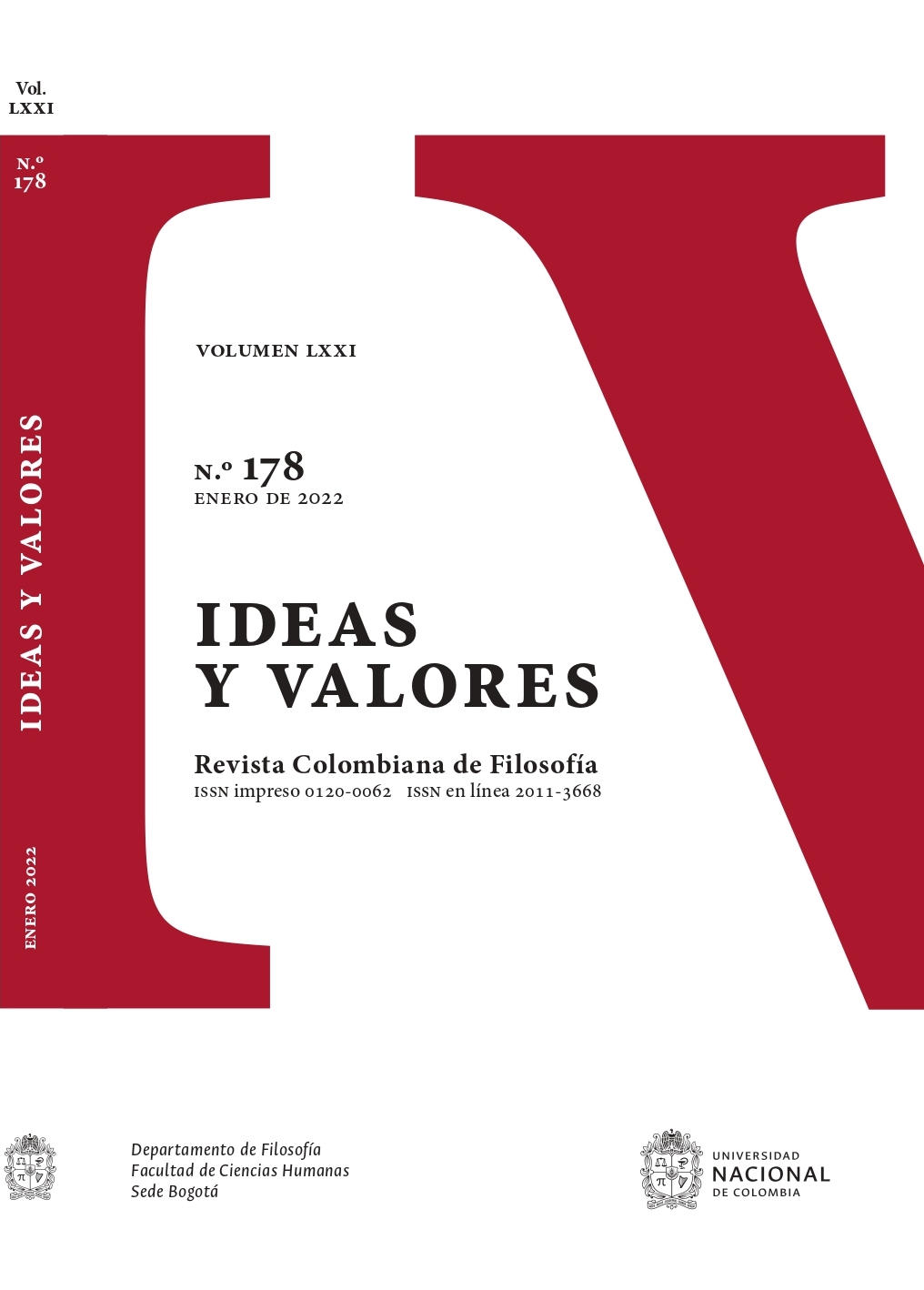
Los fragmentos del tratado Sobre los acertijos de Clearco de Solos
DOI:
https://doi.org/10.15446/ideasyvalores.v71n178.93024Descargas
En este trabajo, presento una traducción del griego antiguo al castellano de los fragmentos del tratado Sobre los acertijos de Clearco de Solos. En esta obra, encontramos una definición de “acertijo”, un criterio de clasificación y numerosos ejemplos. La traducción está acompañada de una introducción en la que presento algunas observaciones sobre la transmisión del tratado Sobre los acertijos y analizo el concepto de “acertijo”, teniendo en cuenta la definición y los ejemplos que propone Clearco.
Referencias
Arnott, G. “Athenaeus and the Epitome: Texts, Manuscripts and Early Editions.” Athenaeus and his World. Reading Greek Culture in the Roman Empire. Ed. David Braund and John Wilkins. Exeter: University of Exeter Press, 2000. 41-52.
Baltussen, H. The Peripatetics. Aristotle’s Heirs, 322 bce-200 ce. London; New York: Routledge, 2016.
Berra, A. Théorie et pratique de l’énigme en Grèce ancienne. Paris: École des Hautes Études en Sciences Sociales, 2008.
Beta, S. Il labirinto della parola. Enigmi, oracoli e sogni nella cultura antica. Torino: Einaudi, 2016.
Bing, P. “Kastorion of Soloi’s Hymn to Pan (Supplementum Hellenisticum 310).” The American Journal of Philology 4.106 (1985): 502-509.
Bowie, Ewen. “Panarces.” Brill’s New Pauly. Ed. Hubert Cancik, Helmuth Schneider, Christine F. Salazar, Manfred Landfester and Francis G. Gentry. Leiden-Boston: Brill, 2006. [http://dx.doi.org/10.1163/1574-9347_bnp_e905410.]
Chantraine, P. Dictionnaire étymologique de la langue grecque. Histoire des mots. 4 vols. Paris: Klincksieck, [1968]1977.
Citelli, L. Ateneo. I Deipnosofisti. I dotti a banchetto. Vol. III: Libro XIV. Traduzione e commento. Coord. Leo Citelli e Maria L. Gambato. Roma: Salerno Editrice, 2001.
Colli, Giorgio. La sapienza greca. Vol. I. Dioniso, Apollo, Eleusi, Orfeo, Museo, Iperborei, Enigma. Milano: Adelphi, 2005 [1º ed. 1977].
D’Angour, A. “How the Dithyramb Got Its Shape.” The Classical Quarterly 47.2 (1997): 331-351.
Della Bona, M. E. “Gare simposiali di enigmi e indovinelli.” Quaderni Urbinati di Cultura Classica 104.2 (2013): 169-182.
Dorandi, T. “Prolegomeni a una nuova raccolta dei frammenti di Clearco di Soli.” Göttinger Forum für Altertumswissenschaft 14 (2011): 1-15.
Fontenrose, Joseph. The Delphic Oracle. Its Responses and Operations. Berkeley: University of California Press, 1978.
Lefebvre, D. “Aristotle and the Hellenistic Peripatos: From Theophrastus to Critolaus.” Brill’s Companion to the Reception of Aristotle in Antiquity. Ed. Andrea Falcón. Leiden-Boston: Brill, 2016. 13-34.
Gardella, M. “Cleobulina of Rhodes and the Philosophical Power of Riddles.” Women’s Perspectives on Ancient and Medieval Philosophy. Eds. Isabelle Chouinard, Zoe McConaughey, Aline Medeiros Ramos y Roxane Noël. New York: Springer, 2021. 31-45.
Gardella, Mariana. “Aristotle on Riddle.” Ancient Philosophy 42 (2022): 1-17.
Guichard, L. A. “Acerca del tratado Περὶ γρίφων de Clearco de Solos.” Dic mihi, Musa, virum. Homenaje al Profesor Antonio López Eire. Ed. Francisco Cortés Gabaudán y Julián V. Méndez Dosuna. Salamanca: Ediciones Universidad de Salamanca, 2010. 285-291.
Jacob, C. “Athenaeus the Librarian.” Athenaeus and his World. Reading Greek Culture in the Roman Empire. Eds. David Braund y John Wilkins. Exeter: University of Exeter Press, 2000. 85-110.
Kirby, J. T. “Aristotle on Metaphor.” The American Journal of Philology 118.4 (1997): 517-554.
Konstantakos, I. M. “Trial by Riddle: The Testing of the Counsellor and the Contest of Kings in the Legend of Amasis and Bias.” Classica et Mediaevalia 55 (2004): 85-138.
Laks, A. “Substitution et connaissance: Une interprétation unitaire (ou presque) de la théorie aristotélicienne de la métaphore.” Aristotle’s Rhetoric. Philosophical Essays. Ed. David J. Furley and Alexander Nehamas. New York: Princeton University Press, 1994. 283-305.
Lloyd, Geoffrey E. R. Aristotelian Explorations. Cambridge: Cambridge University Press, 1996.
Luz, C. Technopaignia. Formspiele in der griechischen Dichtung. Leiden-Boston: Brill, 2010.
Luz, C. “What Has It Got in Its Pocketses? Or, What Makes a Riddle a Riddle?” The Muse at Play. Riddles and Wordplay in Greek and Latin Poetry. Eds. Jan Kwapisz, David Petrain y Mikołaj Szymański. Berlin: De Gruyter, 2013. 83-99.
Marchiori, A. Ateneo. I Deipnosofisti. I dotti a banchetto. Vol. ii: Libro viii. Traduzione e commento. Coords. Leo Citelli y Maria L. Gambato. Roma: Salerno Editrice, 2001.
Monda, S. “Introduzione.” Ainigma e griphos. Gli antichi e l’oscurità della parola. Ed. Salvatore Monda. Pisa: ets, 2012. 7-20.
Naerebout, F. G., y Beerden, K. “‘Gods Cannot Tell Lies’: Riddling and Ancient Greek Divination.” The Muse at Play. Riddles and Wordplay in Greek and Latin Poetry. Eds. Jan Kwapisz, David Petrain y Mikołaj Szymański. Berlin: De Gruyter, 2013. 121-147.
O’Rourke, F. “Aristotle and the Metaphysics of Metaphor.” Proceedings of the Boston Area Colloquium of Ancient Philosophy 21 (2006): 155-190.
Olson, S. D. Athenaeus. The Learned Banqueters. Books 10.420e-11. Cambridge, ma: Harvard University Press, 2009.
Paulas, John. “How to Read Athenaeus’ Deipnosophists.” The American Journal of Philology 133.3 (2012): 403-439.
Porter, James I. “Lasus of Hermione, Pindar and the Riddle of S.” The Classical Quarterly 57.1 (2007): 1-21.
Potamiti, Anna. “γρίφους παίζειν: Playing at Riddles in Greek.” Greek, Roman, and Byzantine Studies 55.1 (2015): 133-153.
Pucci, P. Enigma, segreto, oracolo. Pisa-Roma: Istituti Editoriali e Poligrafici Internazionali, 1996.
Rosen, R. “Comedy and Confusion in Callias’ Letter Tragedy.” Classical Philology 94 (1999): 147-167.
Ruijgh, C. J. “Le Spectacle des lettres, comédie de Callias (Athénée X 453c-455b), avec un excursus sur les rapports entre la mélodie du chant et les contours mélodiques du langage parlé.” Mnemosyne 54.3 (2001): 257-335.
Schneider, J. “Cléarque de Soles.” Dictionnaire des philosophes antiques. Vol. ii: Babélyca d’Argos à Dyscolius. Dir. Richard Goulet. Paris: cnrs Éditions, 1994. 415-420.
Smith, J. A. “‘Clearing Up Some Confusion in Callias.’ Alphabet Tragedy: How to Read Sophocles Oedipus Tyrannus 332-33 et al.” Classical Philology 98.4 (2003): 313-329.
Struck, Peter T. Birth of the Symbol: Ancient Readers at the Limits of Their Texts. New Jersey: Princeton University Press, 2004.
Taifacos, I. Ἀρχαία Κυπριακή γραμματεία. Vol. 6. Φιλοσωφία: Κλέαρχος, Περσαίος, Δημώναξ καὶ ἄλλοι Κύπριοι φιλόσοφοι. Atenas: Λευκωσία, 2008.
Wehrli, F. Die Schule des Aristoteles. Texte und Kommentar. Vol. iii: Klearchos. Basel: Verlag, 1948.
Dimensions
PlumX
Visitas a la página del resumen del artículo
Descargas
Cómo citar
Licencia
Derechos de autor 2021 Los derechos son del autor(es), quien(es) puede re-publicar en parte o en su totalidad el documento ya publicado en la revista siempre y cuando se dé el debido reconocimiento a Ideas y Valores

Esta obra está bajo una licencia internacional Creative Commons Atribución-NoComercial-SinDerivadas 4.0.
De acuerdo con la Licencia Creative Commons Atribución-No Comercial-SinDerivar 4.0 Internacional. Se autoriza copiar, redistribuir el material en cualquier medio o formato, siempre y cuando se conceda el crédito a los autores de los textos y a Ideas y Valores como fuente de publicación original. No se permite el uso comercial de copia o distribución de contenidos, así como tampoco la adaptación, derivación o transformación alguna de estos sin la autorización previa de los autores y de la dirección de Ideas y Valores. Para mayor información sobre los términos de esta licencia puede consultar: http://creativecommons.org/licenses/by-nc-nd/4.0/legalcode.






.jpg)