Correo Electrónico
 DNINFOA - SIA
 Bibliotecas
 Convocatorias
 Identidad U.N.


Published
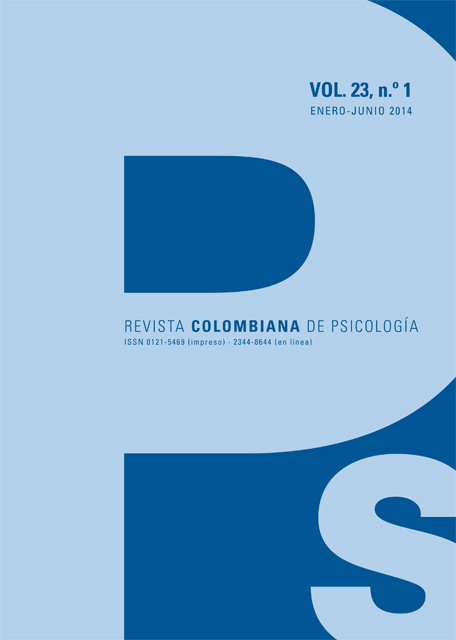
Evaluación de Respuestas de Dominio Apropiado e Inapropiado a Transgresiones Socio-Morales en el Contexto Educativo
Evaluation of Domain Appropriate and Inappropriate Responses to Socio-Moral Transgressions in the Educational Context
Avaliação de Respostas de Domínio Apropriado e Inapropriado a Transgressões Sociomorais no Contexto Educativo
Keywords:
educación moral, desarrollo moral, transgresiones, dominios del conocimiento social (es)moral education, moral development, transgressions, domains of social knowledge (en)
educação moral, desenvolvimento moral, transgressões, domínios do conhecimento social (pt)
Una serie de situaciones de transgresiones morales y convencionales fueron presentadas a 72 participantes de los grados 3° (7-10 años), 6° (11-13 años) y 9° (14-16 años) y a un grupo de profesores (24-65 años) de un colegio público en Bogotá. Para cada situación transgresora se les presentaron cinco posibles respuestas, cuya adecuación fue calificada por los participantes. Los resultados indican que hay una valoración superior de las respuestas inadecuadas en relación con las transgresiones morales por un gran número de participantes. Estos resultados sugieren que hay
una incoherencia en las respuestas educativas a las transgresiones morales y un predominio de las regulaciones convencionales que dificultan el entendimiento moral.
Downloads
References
Arthur, J. (2008). Traditional approaches to character education in Britain and America. En L. Nucci & D. Narvaez (Eds.), Handbook of moral and character education (pp. 80-98). New York: Routledge.
Bennett, W. J. (1993). The book of virtue: A treasury of great moral stories. New York: Simon & Schuster.
Bennett, W. J. (1996). El libro de las virtudes para niños: relatos de hoy y siempre. Barcelona: Ediciones B.S.A.
Blumenfeld, P. Hamilton, V. Wessels, K., & Falkner, D. (1979). Teaching responsibility to first graders. Theory into Practice, 18(3), 174-180.
Blumenfeld, P., Pintrich, P., & Hamilton, V. (1987). Teacher talk and students' reasoning about morals, conventions, and achievement. Child Development, 58(5), 1389-1401.
Botero, C. (2005). La formación de valores en la historia de la educación colombiana. Revista Iberoamericana de Educación, 36(2), 3-19.
Centro de Estudio y Análisis en Convivencia y Seguridad Ciudadana - CEACSC (2008). Diagnóstico de seguridad. Recuperado de http://www.ceacsc.gov.co/index.php?searchword=localidad+de+fontibon&_option=com_search&_Itemid
Elliot, I. (2000). Exploring life as a work of art: A basic school teachers commitment to character. Teaching Pre K-8. Magazine for professional development, 64-67.
Helwig, C. (1995). Adolescents' and young adults' conceptions of civil liberties: Freedom of speech and religion. Child Development, 66, 152-166.
Kilpatrick, W. (1992). Why Johnny can't tell right from wrong: Moral illiteracy and the case for character education. New York: Simon & Schuster.
Kilpatrick, W. & Wolfe, G. (1994). Books that build character. New York: Simon & Schuster.
Kohlberg, L. & Turiel, E. (1971). Moral development and moral education. En G. Lesser (Ed.), Psychology and educational practice (410-465). Chicago: Scott Foresman.
Lickona, T. (1991). Educating for character: How our schools can teach respect and responsibility. New York: Bantam Books.
Mischel, W. (1968). Personality and assessment. New York: Wiley.
Mischel, W. (1973). Toward a cognitive social learning reconceptualization of personality. Psychological Review, 80(4), 252-283.
Mischel, W. (1990). Personality dispositions revisited and revised: A view after three decades. En L. A. Pervin (Ed.), Handbook of personality theory and research (pp. 11-134). New York: Guilford.
Nucci, L. (1981). Conceptions of personal issues: A domain distinct from moral or societal concepts. Child Development, 52(1), 114-121.
Nucci, L. (1982). Conceptual development in the moral and conventional domains: Implications for values education. Review of Educational Research, 52(1), 93-122.
Nucci, L. (1984). Evaluating teachers as social agents: Students' ratings of domain appropriate and domain inappropriate teacher responses to transgressions. American Educational Research Journal, 21(2), 367-378.
Nucci, L. (2001). Education in the moral domain. Nueva York: Cambridge University Press.
Nucci, L. (2009). Nice is not enough: Facilitating moral development. New Jersey: Pearson Education.
Nucci, L. & Nucci, M. (1982). Children's social interactions in the context of moral and conventional transgression. Child Development, 53(2), 403-412.
Nucci, L. & Herman, S. (1982). Educational implications of behavioral disordered children's classifications of moral, conventional and personal issues. Journal of Abnormal Child Psychology, 10, 411-426.
Nucci, L. & Turiel, E. (1978). Social interactions and the development of social concepts in pre-school children. Child Development, 49(2), 400-407.
O'Sullivan, S. (2004). Books to live by: Using children's literature for character education. The Reading Teacher, 57(7), 640-645.
Posada, R. (2012). Experiences of violence and moral reasoning in a context of vengeance. Revista Colombiana de Psicología, 21(2), 197-212.
Posada, R. & Wainryb, C. (2008). Moral development in a violent society: Colombian children's judgments in the context of survival and revenge. Child Development, 79(4), 882-898.
Power, C., Higgins, A., & Kohlberg, L. (1989). Lawrence Kohlberg approach to moral education. New York: Columbia University Press.
Ross, L. & Nisbett R. N. (1991). The person and the situation: Perspectives on social psychology. Philadelphia: Temple University Press.
Smetana, J. (1981). Preschool children's conceptions of moral and social rules. Child Development, 52, 1333-1336.
Smetana, J. (1995). Morality in context: Abstractions, ambiguities, and applications. En R. Vasta (Ed.), Annals of Child Development (Vol. 10, pp. 83-130). London: Jessica Kingsley.
Smetana, J. (2006). Social cognitive domain theory: Consistencies and variations in children´s moral and social judgments. En M. Killen & J. Smetana (Eds.), Handbook of morald development (pp. 119-153). New Jersey: Lawrence Elbraum Associates.
Smetana, J., Bridgeman, D., & Turiel, E, (1983). Differentiation of domains and prosocial reasoning. En D. Bridgeman (Ed.), The nature of personal development: Interdisciplinary theories and strategies (pp. 163-183). New York: Academic Press.
Turiel, E. (1983). The development of social knowledge: Morality and convention. Cambridge UK: Cambridge University Press.
Turiel, E. (1998). The development of morality. En W. Damon, R. M. Lerner, & N. Einsenbeg (Eds.), Handbook of child psychology: Social, emotional, and personality development (Vol. 3, 5th ed., pp. 863-932). New York: Wiley.
Turiel, E. (2001). Foreword. En L. Nucci, Education in the moral domain (pp. 9-14). Cambridge UK: Cambridge University Press.
Turiel, E. (2002). The culture of morality. Cambridge UK: Cambridge University Press.
Wainryb, C. & Turiel, E. (1993). Conceptual and informational features in moral decision making. Educational Psychologist, 28(3), 205-218.
Weston, D. & Turiel, E. (1980). Act-rule relations: Children's concepts of social rules. Developmental Psychology, 16(5), 417-424.
License
Copyright (c) 2014 Revista Colombiana de PsicologíaThe RCP is published under the Creative Commons license and can be copied and reproduced according to the conditions of this license (http://creativecommons.org/licenses/by-nc-nd/2.5). RCP articles are available online at https://revistas.unal.edu.co/index.php/psicologia/issue/archive. If you would like to subscribe to the RCP as reader, please go to https://revistas.unal.edu.co/index.php/psicologia/information/readers and follow the instructions mentioned in the webpage. Additionally, a limited number of print journals are available upon request. To request print copies, please email revpsico_fchbog@unal.edu.co.