Correo Electrónico
 DNINFOA - SIA
 Bibliotecas
 Convocatorias
 Identidad U.N.


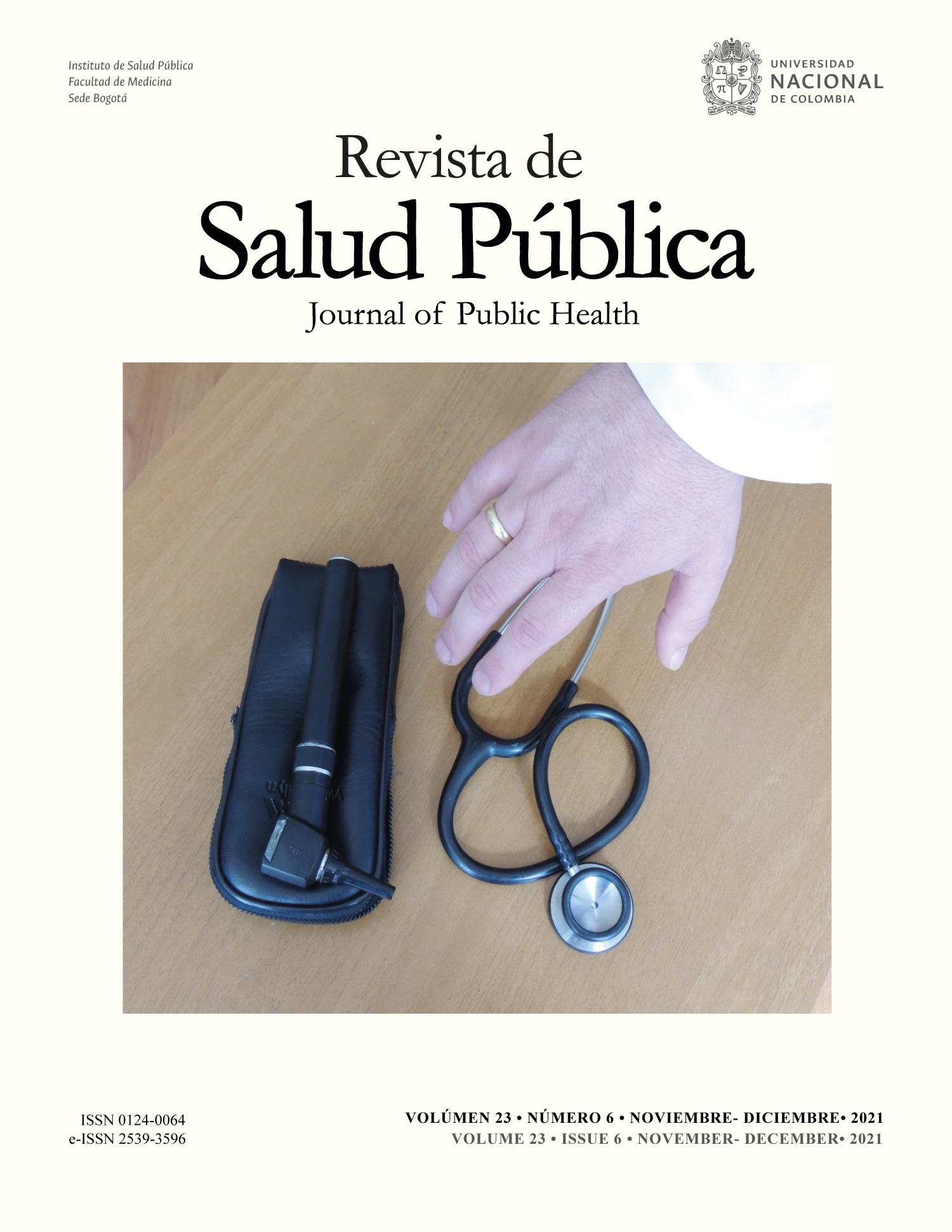
Publicado
Modelo dinámico para proyectar la necesidad de recursos humanos en salud: anestesistas en Uruguay
Anesthesiologists in Uruguay: Dynamic Model to Project the Need of Human Resources in Healthcare
DOI:
https://doi.org/10.15446/rsap.v23n6.90443Palabras clave:
recursos humanos, planificación, simulación (es)Workforce, health planning, projection (en)
Descargas
Objetivo Desarrollar un modelo dinámico para simular la oferta de médicos especialistas y estimar la brecha especto a la demanda/necesidad en anestesiología en el sistema de salud del Uruguay.
Métodos Se desarrolló un modelo de simulación dinámico determinístico implementado en el programa libre R. Se analizaron las proyecciones en el período 2011-2050 y se estimó la brecha a partir de la situación de equilibrio o desequilibrio entre oferta y demanda/necesidad. Se evaluó la calidad del modelo comparando los valores simulados con los datos históricos, con indicadores de bondad de ajuste, como la raíz del error cuadrático medio relativo (rRMSE). Se realizó un análisis de sensibilidad con respecto a los cupos de ingreso a la especialidady la tasa de crecimiento de la necesidad de especialistas.
Resultados Se proyectó la oferta y demanda de anestesistas para el período considerado. Se obtuvo un rRMSE menor a 0,1, lo que sugiere que el modelo propuesto reproduce adecuadamente la dinámica de la oferta real. Para el período proyectado la situación a mediano y largo plazo es de equilibrio.
Conclusión El modelo simulado presenta buen ajuste, por lo que la proyección de la oferta de Recursos Humanos (RR. HH.) representa de forma precisa la disponibilidad futura de la fuerza de trabajo. Además, el modelo representa un insumo de interés para la gestión informada sobre la necesidad de recursos humanos y las políticas de salud, dado que permite evaluar las proyecciones bajo diferentes escenarios.
Objectives The aim of this study is to develop a dynamic model to simulate the supply of specialized physicians in Anesthesiology and estimate the gap with its demand, within Uruguay healthcare system.
Methods A deterministic dynamic simulation model was developed and implemented using R software. Projections for the 2011-2050 period were analyzed, and the gap was estimated based on the equilibrium state of supply and demand. The quality of the model was evaluated comparing the simulated data with historical empirical data using goodness of fit indicators, such as the relative root mean square error (rRMSE).
Results The demand and supply of anesthesiologists was projected for the period under analysis. A rRMSE<0,1 was obtained, which suggests the proposed model adequately reproduces the real offer dynamics. Based on the defined gap criteria, in the medium and long-term the situation is in equilibrium state.
Conclusions The simulated model presents a good fit so that the human resources (HR) supply projection represents in a precise way the future availability of the workforce. Given that the model allows to evaluate the projection dynamics under different management scenarios, the model also represents an input of the utmost interest for management knowledgeable about human resource demands and healthcare policy.
Referencias
Ishikawa T, Fujiwara K, Ohba H, Suzuki T, Ogasawara K. Forcasting the regional distribution and sufficiency of physicians in Japan with a coupled system dynamics-geographic information system model. Hum Resour Health. 2017; 15(1):64. https://doi.org/10.1186/s12960-017-0238-8.
World Health Organization. Global strategy for Human resources for health: Workforce 2030 [Internet]. Geneva: WHO; 2016 [cited 2021 Feb 3]. https://bit.ly/3locbqV.
Ministerio de Salud de la República Oriental del Uruguay. Jornadas de Intercambio. A 10 años de iniciada la reforma sanitaria: evaluación y desafíos del Sistema Nacional Integrado de Salud [Internet]. Montevideo: Ministerio de Salud, OMS, OPS; 2016 [cited 2021 Fe 3]. https://bit.ly/3lp3dd7.
Ley 19301 de 2014. Poder Ejecutivo de la República Oriental del Uruguay. Sistema Nacional de Residencias Médicas [Internet]. 2014 [cited 2021 Mar 2]. https://bit.ly/31mfhEz.
Safarishahrbiri A. Workforce forecasting models: A systematic review. Journal of Forecasting. 2018;1-15.
Roberfroid D, Leonard C, Stordeur S. Physician supply forecast: better than peering in a crystal ball? Human Resources for Health. 2009; 7:10. https://doi.org/10.1186/1478-4491-7-10.
Homer JB, Hirsch GB. System Dynamics Modeling for Public Health: Background and Opportunities. AJPH. 2006; 96:452-8. https://doi.org/10.2105/AJPH.2005.062059.
AvokaAsamani J, Chebere M, Barton P, D’Almeida S, Ankrah E, Oppong R. Forecast of Healthcare Facilities and Health Workforce Reuirements for the Public Sector in Ghana, 2016-26. Int Health Policy Manag. 2018; 1-13. https://doi.org/10.15171/ijhpm.2018.64.
Laurence C, Karnon J. Improving the planning of the GP workforce in Australia: a simulation model incorporating work transitions, health need and service usage. Human Resources for Health. 2016; 14(13). https://doi.org/10.1186/s12960-016-0110-2.
Ishikawa T, Ohba H, Yokooka Y, Nakamura K, Ogasawara K. (2013). Forecasting the absolute and relative shortage of physicians in Japan using a system dynamics model approach. Human Resources for Health. 2013; 11:41. https://doi.org/10.1186/1478-4491-11-41.
Xu Z, Coors V. Combining system dynamics model, GIS and 3D visualization in sustainability assessment of urban residential development. Building and Environment. 2012; 47:272-87. https://doi.org/10.1016/j.buildenv.2011.07.012.
Guan D, Gao W, Su W, Li H, Hokao K. Modeling and dynamic assessment of urban economy–resource–environment system with a coupled system dynamics–geographic information system model. Ecological Indicators. 2011; 11(5):1333-44. https://doi.org/10.1016/j.ecolind.2011.02.007.
Senese F, Tubertini P, Mazzocchetti A, Lodi A, Rouzi C, Grilli R. Forecasting future needs and optimal allocation of medical residency positions: the Emilia-Romagna Region case study. 2015; 13(1):7. https://doi.org/10.1186/1478-4491-13-7.
Ansah J, de Korne D, Bayer S, Pan C, Jayabaskar T, Matchar D, Lew N, Phua A, Koh V, Lamoreaux E, Quek D. Future requirements for and supply of ophthalmologists for an aging population in Singapore. 2015; 13:86. https://doi.org/10.1186/s12960-015-0085-4.
CFWI. Future demand for skills: Initial Result. Horizon 2035. Health and care workforce futures [Internet]. United Kingdom; 2015 [cited 2021 Feb 3]. https://bit.ly/3xQHSOz.
CFWI. In-depth review of the general practitioner workforce. Final report [Internet]. United Kingdom; 2014 [cited 2021 Feb 3]. https://bit.ly/3lrRs5q.
CFWI. In-depth review ot the anaesthetics and intensive care medicine workforce. Final report [Internet]. United Kingdom; 2015 [cited 2021 Feb 3]. https://bit.ly/3pffp0U.
Cave S, Willis G, Woodward A. A restrospective of System Dynamics based workforce modelling at the Centre for Workforce Intelligece. 2016 [cited 2021 Mar 6]. https://bit.ly/3pkVcqP.
Masnick K, McDonnell G. A model linking clinical workforce skill mix planning to health and health care dynamics. Human Resources for Health. 2010; 8:11. https://doi.org/10.1186/1478-4491-8-11.
Barber P, López-Valcárcel BG. Forecasting the need for medical specialists in Spain: application of a system dynamics model. Hum ResourHealth. 2010; 8:24. https://doi.org/10.1186/1478-4491-8-24.
Barber P. Necesidad de recursos humanos de alto nivel en el sector sanitario, Panamá 2014-2025 [Internet]. Gran Canaria: Equipo de Economía de la Salud de la Universidad de Las Palmas de Gran Canaria; 2015 [citado 2021 Mar 4]. https://bit.ly/3pklJ7A.
Barber P, Gonzales López-Valcárcel B, Suárez R. Oferta, demanda y necesidad de médicos especialistas en Brasil. Proyecciones a 2020 [Internet]. Sociedade Brasileira de Medicina de Família e Comunidade (SBMFC); 2012. https://bit.ly/3xJIqG4.
Barber Pérez P, González López-Valcárcel B. Oferta y necesidad de médicos especialistas en España (2006-2030) [Internet]. Gran Canaria: Universidad de Las Palmas de Gran Canaria; 2007 [cited 2021 Mar 6]. https://bit.ly/3G5gaRd.
Barber Pérez P, González López-Valcárcel B. Estimación de Oferta y demanda de médicos especialistas. España (2018-2030) [Internet]. Gran Canaria: Universidad de Las Palmas de Gran Canaria; 2018 [cited 2021 Mar 6]. https://bit.ly/2ZLFxI7.
Ministerio de Salud Pública. Sistema Nacional Integrado de Salud. División RRHH. Estimación de las necesidades de anestesistas [Internet]. Montevideo: MSP; 2012 [cited 2021 Mar 6]. https://bit.ly/2ZO0pOZ.
Cavalleri F, Castromán P, Rodríguez A, Riva J. Utilidad de un método de simulación para evaluar la oferta y demanda de anestesiólogos en Uruguay (2011-2025): propuesta para prospección y planificación de necesidad de recursos humanos en Anestesiología. Rev Méd Urug [Internet]. 2013 [cited 2021 Mar 6]; 29(3):165-73. https://bit.ly/3lqBZCD.
Egger Halbeis CB, Schubert A. Staffing the operating room suite: perspectives from Europe and North America on the role of different anesthesia personnel. Anesthesiol Clin.2008; 26(4):637-63. https://doi.org/10.1016/j.anclin.2008.07.002.
Physician Supply and Demand: Projections to 2020 [Internet]. U.S. Department of Health and Human Services Health Resources and Services Administration. Bureau of Health Proffesions.2006 [cited 2021 Mar 6]. https://bit.ly/32JUYSg.
Cómo citar
APA
ACM
ACS
ABNT
Chicago
Harvard
IEEE
MLA
Turabian
Vancouver
Descargar cita
CrossRef Cited-by
1. Fiorella Cavalleri Ferrari, Marisa Buglioli, Ricardo Silvariño, José Boggia. (2022). Proyección de brecha de especialistas en nefrología en Uruguay 2020-2050: aplicación de un modelo de dinámica de sistemas. Revista de Salud Pública, 24(4), p.1. https://doi.org/10.15446/rsap.v24n4.103065.
Dimensions
PlumX
Visitas a la página del resumen del artículo
Descargas
Licencia
Derechos de autor 2021 Revista de Salud Pública

Esta obra está bajo una licencia internacional Creative Commons Atribución 4.0.
Esta revista provee acceso libre inmediato a su contenido bajo el principio de que hacer disponible gratuitamente investigación al publico apoya a un mayor intercambio de conocimiento global.
Todos los contenidos de esta revista, excepto dónde está identificado, están publicados bajo una Licencia Creative Commons Atribución 4.0.