 Correo Electrónico
 DNINFOA - SIA
 Bibliotecas
 Convocatorias
 Identidad U.N.


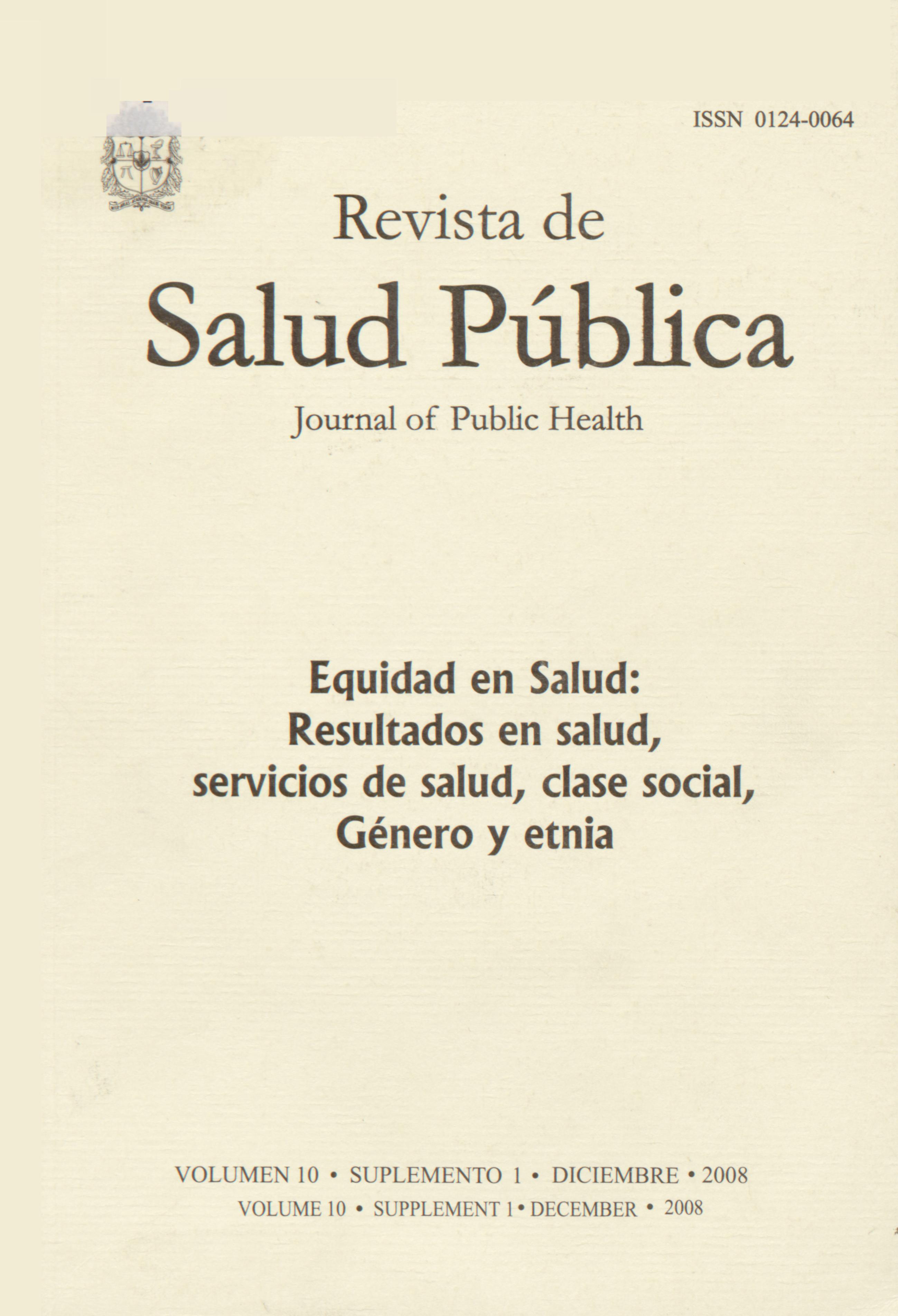
Publicado
Epidemiological estimators’ power of rating inequality in health in high-income OECD countries, 1998-2002
Capacidad de estimadores epidemiológicos para medir disparidades en salud en países OCDE de alto Ingreso, 1998-2002
Palabras clave:
Health status indicator, world health, health inequality, developed country (en)Indicadores de salud, salud mundial, desigualdades en la salud, países desarrollados (es)
Descargas
Objective. Examining the power (ability) of classical epidemiological estimators to rate inequality in health in univariate and composite ways.
Methods. Ecological study. Ratio, excess risk, attributable risk (AR) and relative difference were the estimators used for showing disparities; all of them were weighted by population size. Kappa concordance coefficient was used between weighted estimators and weighted Gini coefficients for each health outcome used. Cumulative variance at first factor in principal component analysis was used for determining the estimators’ suitability for use in a composite index. 24 high-income OECD (Organisation for Economical Cooperation and Development) countries’ data for 1998-2002 were included. Such data was obtained from OECD health data for 2004 (3rd edition). Data concerning child mortality and gross domestic product (GDP) was obtained from World Development Indicators for 2005 on CD-ROM.The main outcomes compared amongst countries were: maternal mortality, child mortality, infant mortality, low birth-weight, life-expectancy, measles’ immunisation and DTP immunisation.
Results. Ratio and AR ranked maternal mortality as being the condition having the most disparity; risk excess ranked vaccination programmes and relative difference ranked low birth-weight as being the worst conditions. There was concordance in the ranking of inequities amongst ratio, AR and Gini coefficients (p<0.05). Cumulative variance in the first factor was higher for ratio and AR when they were used for constructing a composite index. Conclusions Ratio and AR were better than risk excess and relative difference for measuring disparities in health and constructing composite inequity in health indexes.
Objetivo. Evaluar la capacidad de la Razón (R), exceso de riesgo (ER), fracción atribuible (FA) y diferencia relativa (DR) para medir las desigualdades en salud.
Métodos. Estudio ecológico. Se ponderó por el tamaño de la población. La concordancia por indicador entre estimadores y coeficiente de Gini (Gini) se evaluó con coeficiente Kappa. La varianza acumulada en el primer factor (análisis de componentes principales) fue utilizada para evaluar la capacidad de los estimadores para ser utilizados en un índice compuesto. 24 Países de Alto Ingreso (según Banco Mundial) entre 1998 y 2002, fueron incluidos. Los datos se obtuvieron del OECD Health Data, 2004 y del World Development Indicators-2005. Los indicadores comparados entre los países fueron: Mortalidad materna, mortalidad en niños menores de 5 años, mortalidad infantil, bajo peso al nacer, expectativa de vida al nacer, inmunización contra sarampión y contra DTP.
Resultados. R y FA posicionaron la mortalidad materna como la condición de mayor disparidad, ER posicionó los programas de vacunación y DR posicionó el bajo peso al nacer como la peor condición. Hubo concordancia en el posicionamiento de las desigualdades entre R, FA y Gini (p<0.05). La varianza acumulada en el primer factor fue mayor para R y FA, cuando ellos se utilizaron para construir un indicador compuesto.
Conclusiones. R y la FA atribuible son mejores que el ER y la DR para medir desigualdades en salud entre países y para construir un indicador de inequidad en salud compuesto.
Descargas
Citas
Glaser J. Intergroup Bias and Inequity: Legitimizing Beliefs and Policy Attitudes. Social Justice Research. 2005 2005/09//;18(3):257-82.
Robinson JC. Consolidation and the transformation of competition in health insurance. Health Aff (Millwood). 2004 Nov-Dec;23(6):11-24.
Hidayat B, Thabrany H, Dong H, Sauerborn R. The effects of mandatory health insurance on equity in access to outpatient care in Indonesia. Health Policy Plan. 2004 Sep;19(5):322-35.
Gattini C, Sanderson C, Castillo-Salgado C. Using different indicators of preventable mortality as an approach to measuring health inequalities in Chilean municipalities. Rev Panam Salud Publica. 2002 Dec;12(6):454-61.
Schneider MC, Castillo-Salgado C, Bacallao J, Loyola E, Mujica OJ, Vidaurre M, et al. Methods for measuring inequalities in health. Rev Panam Salud Publica. 2002 Dec;12(6):398-414.
Sandiford P, Salvetto M. Health inequalities in Panama. Gac Sanit. 2002 Jan-Feb;16(1):70-81.
Peacock D, Devlin N, McGee R. The horizontal equity of health care in New Zealand. Aust N Z J Public Health. 1999 Apr;23(2):126-30.
Lairson DR, Hindson P, Hauquitz A. Equity of health care in Australia. Soc Sci Med. 1995 Aug;41(4):475-82.
WHO. Health and the Millennium Development Goals. Paris: World Health Organization; 2005.
United Nations DP. Human Development Report 1999. New York: Oxford University Press, Inc; 1999.
Eslava Schmalbach JH, Buitrago Gutierrez G. Two indicators for measuring the countries' gap between health and economy. Rev Salud Publica (Bogota). 2004 May-Aug;6:183-98.
OECD. Health Data 2004, Third edition. A comparative analysis of 30 countries. Paris: OECD-Eco Santé Software; 2004.
World-Bank. Colombia. Fiscal Strenthening Program. Policy Note on Health. New York; 2001. p. 36 págs.
Gordis L. Epidemiology. 3rd ed. Philadelphia: Elsevier Saunders; 2004.
Rothman K. Measuring disease occurrence and causal effects. In: Rothman K, editor. Epidemiology An introduction. New York: Oxford University Press; 2002. p. 223.
Llorca J, Prieto Salceda D, Delgado-Rodriguez M. [The measurement of inequalities in age of death: calculating the Gini Index based on mortality tables]. Rev Esp Salud Publica. 2000 Jan-Feb;74(1):5-12.
Schneider MC, Castillo-Salgado C, Bacallao J, Loyola E, Mujica OJ, Vidaurre M, et al. [Template to estimate Gini coefficient and Lorenz Curve]. 2002 Dec [cited 2002]
Tawney R. Equality. London: George Allen & Unwin Ltd.; 1964 (1931).
Shiell A. Health outcomes are about choices and values: an economic perspective on the health outcomes movement. Health Policy. 1997 1997/1;39(1):5-15.
Le Grand J. The strategy of equality : redistribution and the social services. London ; Boston: G. Allen & Unwin; 1982.
Houweling TA, Kunst AE, Mackenbach JP. Measuring health inequality among children in developing countries: does the choice of the indicator of economic status matter? Int J Equity Health. 2003 Oct 9;2(1):8.
Keppel K, Pamuk E, Lynch J, Carter-Pokras O, Kim I, Mays V, et al. Methodological issues in measuring healthdisparities. Vital Health Stat 2. 2005 Jul(141):1-16.
Braveman PA, Egerter SA, Cubbin C, Marchi KS. An Approach to Studying Social Disparities in Health and Health Care. Am J Public Health. 2004 December 1, 2004;94(12):2139-48.
Gakidou E, King G. Measuring total health inequality: adding individual variation to group-level differences. Int J Equity Health. 2002 Aug 12;1(1):3.
Houweling TA, Kunst AE, Looman CW, Mackenbach JP. Determinants of under-5 mortality among the poor and the rich: a cross-national analysis of 43 developing countries. Int J Epidemiol. 2005 Sep 13.
Arntzen A, Nybo Andersen AM. Social determinants for infant mortality in the Nordic countries, 1980-2001. Scand J Public Health. 2004;32(5):381-9.
Attaran A. An Immeasurable Crisis? A Criticism of the Millennium Development Goals and Why They Cannot Be Measured. PLoS Med. 2005 Sep 13;2(10):e318.
Licencia

Esta obra está bajo una licencia internacional Creative Commons Atribución 4.0.
Esta revista provee acceso libre inmediato a su contenido bajo el principio de que hacer disponible gratuitamente investigación al publico apoya a un mayor intercambio de conocimiento global.
Todos los contenidos de esta revista, excepto dónde está identificado, están publicados bajo una Licencia Creative Commons Atribución 4.0.
















