Publicado

2024-04-28

NEW RECORDS OF WATERMITES (HYDRACHNIDIA) COLLECTED FROM MACROPHYTE AND Cladophora sp. IN SOUTH AMERICA

Nuevos registros de ácaros acuáticos (Hydrachnidia) recolectados de macrófitas y Cladophora sp. en Sudamérica

DOI:

https://doi.org/10.15446/abc.v29n2.105496

Palabras clave:

Acari, Andean streams, Lotic habitats, Neotropical rivers, Prostigmata (en)
Acari, Hábitat lóticos, Arroyos andinos, Prostigmata, Ríos Neotropicales (es)

Autores/as

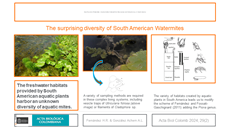
Aquatic mites show a great morphological variability and inhabit a great diversity of freshwater habitats, especially taking advantage of the complexity of resources provided by South American aquatic plants. The relevance of aquatic mites in a microhabitat not studied so far about Amazonian macrophyte plants and Andean filamentous algae is analyzed. A new species of aquatic mite is described, and with it, the genus Piona and Arrenurus amazonicus are recorded for the first time in Colombian rivers; new records of Sperchon neotropicus associated with Cladophora sp. in the Andean subtropical zone of Argentina and Bolivia are reported. The functional classification proposed by Fernández and Fossati-Gaschignard for aquatic mites with their lifestyle and habitat preferences is contrasted and geographically expanded. Contributions such as this one to the knowledge of new species, biological data, and new localities of aquatic organisms are the basis of the urgent agenda of world biodiversity.

Los ácaros acuáticos presentan una gran variabilidad morfológica y habitan en una gran diversidad de hábitats de agua dulce, aprovechando especialmente la complejidad de recursos que brindan las plantas acuáticas sudamericanas. Se analiza la relevancia de ácaros acuáticos en un microhábitat no estudiado hasta el momento en relación con plantas macrófitas amazónicas y algas filamentosas andinas. Se describe una nueva especie de ácaro acuático, y con ello se registra por primera vez el género Piona y a Arrenurus amazonicus en los ríos colombianos; se informan los nuevos registros de Sperchon neotropicus asociados a Cladophora sp. en la zona subtropical andina de Argentina y Bolivia. Se contrasta la actualidad y se amplía geográficamente la clasificación funcional propuesta por Fernández y Fossati-Gaschignard para los ácaros acuáticos en relación con su estilo de vida y preferencias de hábitat. Aportes como este al conocimiento de nuevas especies, datos biológicos y nuevas localidades, de organismos acuáticos, son la base de la agenda urgente de biodiversidad mundial. 

Recibido: 2 de diciembre de 2022; Revisión recibida: 13 de marzo de 2023; Aceptado: 1 de febrero de 2024

ABSTRACT

Aquatic mites show a great morphological variability and inhabit a great diversity of freshwater habitats, especially taking advantage of the complexity of resources provided by South American aquatic plants. The relevance of aquatic mites in a microhabitat not studied so far about Amazonian macrophyte plants and Andean filamentous algae is analyzed. A new species of aquatic mite is described, and with it, the genus Piona and Arrenurus amazonicus are recorded for the first time in Colombian rivers; new records of Sperchon neotropicus associated with Cladophora sp. in the Andean subtropical zone of Argentina and Bolivia are reported. The functional classification proposed by Fernández and Fossati-Gaschignard for aquatic mites with their lifestyle and habitat preferences is contrasted and geographically expanded. Contributions such as this one to the knowledge of new species, biological data, and new localities of aquatic organisms are the basis of the urgent agenda of world biodiversity.

Keywords

Acari, Andean streams, Lotic habitats, Neotropical rivers, Prostigmata.

RESUMEN

Los ácaros acuáticos presentan una gran variabilidad morfológica y habitan en una gran diversidad de hábitats de agua dulce, aprovechando especialmente la complejidad de recursos que brindan las plantas acuáticas sudamericanas. Se analiza la relevancia de ácaros acuáticos en un microhábitat no estudiado hasta el momento en relación con plantas macrófitas amazónicas y algas filamentosas andinas. Se describe una nueva especie de ácaro acuático, y con ello se registra por primera vez el género Piona y a Arrenurus amazonicus en los ríos colombianos; se informan los nuevos registros de Sperchon neotropicus asociados a Cladophora sp. en la zona subtropical andina de Argentina y Bolivia. Se contrasta la actualidad y se amplía geográficamente la clasificación funcional propuesta por Fernández y Fossati-Gaschignard para los ácaros acuáticos en relación con su estilo de vida y preferencias de hábitat. Aportes como este al conocimiento de nuevas especies, datos biológicos y nuevas localidades, de organismos acuáticos, son la base de la agenda urgente de biodiversidad mundial.

Palabras clave

Acari, Hábitat lóticos, Arroyos andinos, Prostigmata, Ríos Neotropicales.

INTRODUCTION

Mites belonging to several unrelated groups are commonly found in freshwater habitats. True watermites comprise three groups of prostatic mites, which are referred to as Hydrachnidia (Goldschmidt and Ramirez Sanchez, 2020). Hydrachnidia has flourished to become by far the most numerous, diverse, and ecologically important group of freshwater arachnids Smith et al., 2010. Compared to Hydrachnidia, other groups of acari that have invaded freshwaters are less diverse taxonomically, usually less abundant, and relatively conservative in morphology and habits. While in Europe the understanding of the importance of ecosystem health has increased in recent decades, the situation in Latin America and parts of the tropics has not improved, even despite increasing pressure on ecosystem services due to rapid population growth and industrial development (Albert et al., 2020). To prevent massive social, economic, and health problems, it is necessary to maintain the sustainable use of these benefits and hence to protect the ecological integrity of freshwater ecosystems and aquatic biodiversity. Therefore, there is a strong need for assessing, monitoring, and evaluating the quality of freshwater habitats and considering the whole spectrum of human impacts.

Various biomonitoring methods are used worldwide to evaluate water quality and the ecological integrity of freshwater habitats. Most of the methods for biological assessment are based on macroinvertebrates (biotic indices), mainly insects, whereas watermites (Hydrachnidia) are widely neglected. Goldschmidt (2016) summarizes the diversity and ecology of water mites and evaluates their potential as bioindicators. We discuss possible constraints on the use of this group as bioindicators and the particular importance of Hydrachnidia in the monitoring of springs, wetlands, hypothermic zones (a novel source of greenhouse gases), tank bromeliads (mosquito breeding sites), and the state of knowledge on the ecology of neotropical watermites. The need for further research is explained and a call for collaboration is expressed.

Water mites exhibit great morphological variability and inhabit a great diversity of freshwater habitats. Depending on the habitat and type of locomotion, the legs can be stout with spine-like setae or slender with swimming hairs. Goldschmidt (2016) affirms that the abundance of water mites in stream riffles can reach up to 5,000 individuals/ m², and the α-diversity in such samples can reach up to 50 species in 30 genera. Similar samples from eutrophic lakes may yield up to 2,000 individuals representing up to 75 species in 25 genera. In some springs, up to 40 species in 25 genera can be found. The overall global diversity of water mites is estimated to be at least 10,000 species. In the neotropicals, a total of 5,500 species (about 1,830 for Central America alone) have been estimated. Aquatic carnivorous plants are well known to have a cosmopolitan distribution but are generally restricted to nutrient-poor water bodies.

A higher investment in carnivory should be expected as the availability of prey and/or nutrients decreases in the water body. The results of a study have shown that U. foliosa has the capacity to vary its investment in carnivory according to the characteristics of its habitat (Guisande et al., 2000).

The richness of South American watermites in tropical streams is higher than that in lower latitudes, as opposed to the widely accepted concept in river ecology theory (Fernandez, 2003). Habitat complexity as provided by aquatic plants is important to explain the number of taxa and invertebrate density in an aquatic ecosystem (Cheruvelil et al., 2002; Thomaz et al., 2008). Aquatic macrophytes have been considered key components of the habitat in aquatic environments because of their importance as a food source and their role in increasing the habitat complexity of a waterscape (Thomaz et al., 2008). Among macrophytes, Utricularia (Lentibulariaceae) is the largest genus of carnivorous plants, and it occurs in fresh waters and wet soil. During an ecological study of bladderwort food preferences in an Amazonian area of Colombia, water mites were found occasionally in bladder traps (Torres-Zambrano, 2008). This natural sampler allowed us to obtain unusually well-conserved water mites. In the same study, water mites were also found in samples of Pistia stratiotes. The long-submerged roots of this macrophyte form a complex system inhabited by many groups of invertebrates and meiofauna. Also, filamentous algae such as Cladophora sp. (Cladophoraceae) represent an important habitat for some species of water mites (Fernandez and Reid, 2012). In streams of northwestern Argentina and Bolivia, we collected individuals of Sperchon neotropicus associated with filamentous algae.

The aims of this study were as follows: (i) to analyze the relevance of the presence of aquatic mites in a microhabitat not studied to date; (ii) to describe a new species of water mites and the discovery of a genus and a species for the first time in Colombian rivers; (iii) to report the finding of another species of wide distribution in America, collected for the first time from streams in the Andean subtropical zone of Argentina and Bolivia; (iv) to contrast and geographically expand the functional classification proposed by Fernandez and Fossati-Gaschignard (2011) for water mites in relation to their life style and habitat preferences.

MATERIALS AND METHODS

Samples were kept in Koenike's liquid (five parts of glycerin, four parts of water, and one part of acetic acid), widely used by water acarologists. The clearing and preparation of specimens for microscopic studies were done according to Rosso de Ferradas and Fernandez (1995, 2009). The terminology used for morphological description follows Cook (1974), Tuzovskij (2013), and Goldschmidt and Ramirez Sanchez (2020). Furthermore, the following abbreviations are used: P-IV, pedipalp segments (trochanter, femur, genu, tibia, and tarsus); I-L, first leg, segments one-six (trochanter, basifemur, telofemur, genu, tibia, and tarsus) e.g., Ill-Leg-four = genu of third leg. Measurements of Piona nedtorresi n. sp. holotype appear first, and measurements in parentheses belong to the paratype. The types and other materials studied are deposited in the collection of Fundacion Miguel Lillo, Tucuman, Argentina. The length of appendage segments was measured along their dorsal side; all measurements are given in micrometers (µm).

RESULTS

Family Pionidae Thor 1900

Pionidae is represented in South America only by species of Piona Koch, 1842, currently with 33 known species (Rosso de Ferradas and Fernandez, 2005). These species inhabit diverse habitats: rivers, ponds, lakes, reservoirs, and creeks. Several species were described from two of the major basins of South America, namely the Amazonas and Parana, and lakes of Argentinian Patagonia.

Piona nedtorresi sp. nov. Male: Body 751 long, 456 wide (Fig. 1). Dorsum with one pair of small platelets, 54 long, 21 wide (Fig. 2). Capitulum: 176 long, 127 wide. Distance between I-Cx tip and IV-Cx posterior extreme 493. The first coxal group separated medially and apodemes extended beyond the anterior margin of third Cx. Third and fourth coxal groups separated medially. Coxal plates contact the genital field, maintaining their suture lines. Genital field 90 long, 197 wide; gonopore short, 55 long, 14 wide. Genital plates not extending laterally beyond the posterior extension of fourth coxal plates, medially not fused with coxal plates. Behind the gonopore is a very shallow depression (Fig. 1). Genital acetabula 18-20 on each side, measurement of the greatest acetabulum: 24 long, 18 wide; excretory pore not fused with genital field (Fig. 1). Palp (Fig. 3): P-I: - ; P-II: 155; P-III: 82; P-IV: 132; P-V: 49. Ventral margin of P-II convex, P-IV with two setal tubercles in the distal half of the segment. Coxoglandularia 1 in II-Cx suture and coxoglandularia two in the limit of IV-Cx and genital field. A pair of postgenital setae is present, behind which is one small platelet. Distal part of genital field connected with IV-Cx angle. Gonopore in anterior half of the genital field, a big oval acetabulum, slightly concave medially and rounded laterally; 18-two genital acetabula on each side, one pair larger than others. III-L-four bearing six swimming hairs; ventral and dorsal margin of III-L-six slightly curved, about half the length III-L-five; one claw elongated and placed at a right angle to the segment (Fig. 4); claw 72 long. Leg IV (Fig. 5) bearing three setae in the proximal part of segment six; swimming setae present distally and proximally in segment five. Four swimming setae in IV-L-four and two distal setae associated with the concave part, four distal blunt setae, and a long setae; the concave part of the segment 45 long. I-L-six with numerous short and slender hairs with strong attachments (Fig. 6). I-L-four: 168; I-leg-five: 168; I-leg-: 152. III-L-four: 180; III-leg-five: 197; III-leg-six: 98. IV-L-four: 176; IV-leg-five: 217; IV-leg-six: 176. Female (Fig. 7): Body 908 (892) long; 702 (520) wide. Distance between I-Cx tip and IV-Cx posterior extreme: 370 (452) long; (509) wide. Capitulum 175 long (Fig. 8). Chelicera (Fig. 9) 166. Genital field: genital plate sickle-shaped and not extending laterally to the posterolateral extension of the Cx-IV. Length (176), width (255), gonopore (21). Egg: 164 (157). Dorsal lengths of the palpal segments: P-I: 28; P-II: 113; P-III: 72; P-IV: 107; P-V: 45. P-II bearing three pairs of short, heavy, and plumose setae. P-III bearing on the dorsal side two pairs of short heavy and plumose setae. Ventral side of P-IV bearing two setae in two heavy tubercles, also in a pair of distal and smaller tubercles bearing two setae. Peg-like setae inserted in the distal extreme of P-IV. The distal extreme of P-V ends in five teeth (Fig. 10). III-L-four with six swimming hairs from the middle to the tip of the segment; III-L-five with five swimming hairs at the tip. Dorsal lengths of the distal segments of the third leg: III-L-four: 160; III-L-five: 172; III-L-six: 164. Material studied. Holotype: Male. Colombia, Dep. Amazonas, Quebrada Yahuaracca in a bladder of Utricularia foliosa, N. N. Torres Zambrano col. 9-4-06, (A40001 IML). Collection site: 4°10′ N and 69°57′ W; 80 m a.s.l.; water temperature: 27.4°C; dissolved oxygen: 2.9 mg L⁻¹; electrical conductivity: 45.9 µS/cm; pH: 6.2. Paratype: two females, same collection data as that of male. N. N. Torres Zambrano leg (A40002 IML; A40003 IML). Etymology: This species is dedicated to Mag. Nestor Ned Torres Zambrano.

Remarks: This is the first Piona species collected in Colombia (Rosso de Ferradas and Fernandez, 2005). The new species differs from the following species geographically closer to the American continent: P. plumannni Lundblad, 1943 presents a small gonopore and acetabula similar in size. It exhibits a posterior gonopore depression. Claws short in size but bigger. Segment III-leg-six is bowed and bearing three short setae. Peg-like set is very small. This species is distributed in the Parana and Amazon basins.

P. praegracilis Viets, 1937 possesses a lesser number of acetabula and a smaller gonopore. IV-leg hollow bearing three setae proximally and two setae distally. Palp setae simple and PIV bearing a small peg-like seta in a rounded base. Claws have clawlets. Collected in still waters of Caatinga and eastern Cerrado.

P. robustipalpis Braun, 1954b presents fewer acetabula in a genital field that are similar in size, and gonopore smaller. Excretory pores present with a chitinous ring close to the genital field. Palp segments stout, ventral surface of PIV convex and bearing two tubercles, peg-like seta smaller without tubercle. It is distributed in standing waters of Amazonia.

P. rotunda Kramer, 1879 has a shorter gonopore and a larger number of similarly sized acetabula. The posterior end of the ventral shield was lightly excavated and excretory pore with a chitin ring. Dorsal projection is present in the distal segment of leg III. Claws are short, and oriented in different ways. The distal part of I-L-five and the proximal part of I-leg six are very thick. Palp setae is short and simple. Tubercles of P-IV have small peg-like setae laterally and distally. It is widely distributed in South America.

Figure 1.

Figure 1.: Figure 1.

Figure 2.

Figure 2.: Figure 2.

P. sudamericana Viets, 1910 presents a smaller number of acetabula. Females and males have very similar genital field and palp. It is widely distributed in South America.

P. mexicana Cook, 1980 has a smaller gonopore, III-leg-four hollow surrounded by numerous long spines. P-IV has two well-developed setal tubercles on the ventral side and a small peg-like seta, dorsal setae simple, and P-II comparatively slender. It was collected in a Mexican stream.

P. venezuelensis Viets, 1956 has very few acetabula, gonopore bigger with a posterior depressed area, posterior margins of the genital field straight, and excretory pore isolated and surrounded by a chitinous ring. Palp stout, P-IV with small tubercles ventrally and with a small peg-like seta. It was collected in Venezuela.

P. amazonica Braun et al., 1954a has a very different palp, slender, and bearing shorter setae. The gonopore and acetabula are smaller. The posterior edge of the genital field is straight. It is distributed in the northern Amazonia.

Family Sperchontidae Thor 1900

This family includes four genera with representatives in South America. Sperchon (Mixosperchon) neotropicus Cook, 1980: 27. Females (N = four from three sites): Body soft and mainly globular (Figs. 11 and 13). Body 600-1280 long, length between anterior end of first coxae and posterior end of fourth coxae, 320-470 (Fig. 11). Capitulum 200-212 long. Genital field 200-207 long and 163-175 wide. Genital acetabula, three on each side (Fig. 12). Dorsal lengths of the palpal segments: P-I, 25-32; P-II, 112-120; P-III, 140; P-IV, 160; P-V, 35-40 (Figs. 14 and 16). Dorsal lengths of the distal segments of the first leg (Figs. 17 and 18): I-L-four, 117-210; I-L-five, 200-205; I-L-six, 180. Dorsal lengths of the distal segments of the fourth leg (Fig. 19): IV-L-four, 250-340; IV-L-five, 287-320; IV-L-six, 230-270. Material studied: one female (A29311 IML). El Sauzal Creek, close to Candado River, Departamento Andalgalá, Catamarca, Argentina. Collection data: 5-22-1997; 27º 24′ S and 66º 15′ W. 2460 m a.s.l.; water temperature: 7.4 ºC; dissolved oxygen: 10.6 mg l⁻¹; electrical conductivity: 177 µS/cm; pH: 7.6. L. E. Grosso and M. Peralta leg. One ovigerous female (A29312 IML), Chasquivil Stream, Tucumán, Argentina. Collection data: 9-24-2003; 26° 38′ S and 65° 38′ W, 2260 m a.s.l. Mean discharge 0.39 m³ s⁻¹; water temperature: 13.6 ºC; electrical conductivity: 33.9 µS/cm. C. Molineri leg. Two females, Piraymiri River, Vallegrande, Bolivia. Collection data: 9-2-1999; 18º 63′ S and 63º 97′ W, 1580 m a.s.l.; water temperature: 23.2 ºC; electrical conductivity: 180 µS/cm; pH: 7.5. G. B. Rocabado Castro leg.

Remarks: The variability in measurements and morphology observed in this species is unsurprising considering the wide range of collected specimens. The most important characteristics are pectinate setae on the palps observed by Rosso de Ferradás (1984) and in a specimen from Catamarca (northwestern Argentina) and Vallegrande (southern Bolivia) treated here. Dorsalia of Andean species are variable in shape and size, as observed by Cook (1980) in other specimens. The coxal group of the specimen from Tucumán seems smaller than other known specimens, but it could be attributed to the specimen being a deformed ovigerous female.

Family Arrenuridae Thor 1900

At present, Arrenurus Dugès includes more than 150 species in South America (Rosso de Ferradás and Fernández, 2005). These species inhabit all freshwater habitats, mainly standing waters. Arrenurus (Megaluracarus) amazonicus Braun 1954a, 1954b; Rosso de Ferradás and Fernández, 2005. Female: Body 875 long, 772 wide. Dorsal plate: 685 long, 636 wide. Distance from tip Cx-I to distal edge Cx-IV 415; IV Coxae 657 wide. Palpal segments: P-I: 26; P-II: 72; P-III: 37; P-IV: 70; P-V: 37. Setae-like blade saber ranges from 41 to 53 in length. Genital field width: 406; genital field length: 127. Egg diameter 152. Dorsal shield with three bright green patches, one of them in central position and the other two posterior. Material studied: one female. Colombia, Amazonia, Chepeten Lake. Collection data: 4-7-2006; 3º 49′ S and 70º 28′ W. Water temperature: 25 ºC; electrical conductivity: 120.3 µS/cm; pH: 6.2; Secchi depth: 0.9 m. Lake area: 355.7 m². Nestor N. Torres Zambrano leg.

Remarks: A. gladiiferus and A. amazonicus are very similar in morphology. The specimen reported here shares a color pattern with the A. gladiiferus female. However, we attributed this specimen to A. amazonicus because the type locality is the closest (approximately 2,000 km) to the new locality in Colombia. During the wet season, the Amazon River is related to Chepeten Lake, contributing to the dispersion of aquatic species of macroinvertebrates (Torres-Zambrano, 2008).

DISCUSSION

The appearance of new species of Piona is striking given the numerous studies that are currently being carried out in South American rivers (Goldschmidt and Ramírez Sánchez, 2020). This underlines the need for further studies about the richness of macroinvertebrates in America, especially in areas of high biodiversity, such as Colombia. The contrast and extension of the functional classification proposed by Fernandez and Fossati-Gaschignard (2011) for water mites make it possible to confirm and extend latitudinally northward the planktonic preference of Piona.

The Arrenurus amazonicus specimen that was collected in association with roots of Pistia stratiotes—a floating plant—shows a wider preference for South American Arrenurus species—for more diverse than benthic habitats—than that attributed by Fernández and Fossati-Gaschignard (2011). Water mite species are frequently distributed over large geographical and climatic ranges (Di Sabatino et al., 2000).

To date, S. neotropicus is known from two widely separated areas: México and Argentina. We collected S. neotropicus from the Andean region for the first time, thereby extending the known distribution of this species. All the specimens were collected in association with Cladophora sp. mats attached to rocks. A species of Sperchon showed a strong affiliation with the medial section of Cladophora and Ellodea mixed mats in a stream in the northwestern USA (Fernández and Reid, 2012). This confirms the preference of Sperchon for the benthic zone (Fernández and Fossati-Gaschignard, 2011) but opens the possibility of an association with filamentous algae.

The geography of South America, with a mountain range to the west and basins flowing westward over long distances, is an interesting setting for the dispersal and speciation of water mites (Fernandez et al., 2009). Dispersal at the regional scale is possibly due to the extended corridor provided by the Andes, maintaining high diversity in communities across ecoregions. Water withdrawals have more than tripled since the mid-20th century, significantly reducing the flow of rivers worldwide (Albert et al., 2020). However, in most South American countries, the most serious threats are related to land uses such as mining, agriculture, and urban expansion (Torremorell et al., 2021). The conservation of species such as macroinvertebrates (including watermites) shows that only a small percentage of the species' average distribution range (−0.01 %) is found within the current protected areas covering a total surface area of 333,833 km² in the northwest of Argentina, mainly in an Andean region (Nieto et al., 2017). The southern part of Colombia (the Amazonian Trapezoid), where the new species described here comes from, is divided into multiple territorial frameworks for management and conservation purposes, which makes the management task difficult, especially for aquatic biodiversity (Portocarrero-Aya and Cowx, 2016).

The highest number of zooplankton captured by bladders belong to the epiphytic fauna which probably feeds on periphyton, and organic matter deposited on the surface of branching stems or stolons, bladders, etc. Periphyton cover could hurt plant photosynthesis, by reducing light as well as nutrient availability. Therefore, the species of zooplankton mainly captured by bladders could also be beneficial for Utricularia foliosa because they might control periphyton biomass on plants. In addition, the periphyton growing on the vegetative structures of U. foliosa would be an attraction for animal species grazing on the macrophytes, which in turn could attract predators such as aquatic mites.

CONCLUSIONS

The contributions made through knowledge of species richness and their distributions in South America entail a matter of urgency that is not yet well understood by science policymakers. Despite this, the contributions to the knowledge of biodiversity continue to add piece by piece, as in this case, a new species of mite for Colombian aquatic ecosystems and increase the knowledge of the distribution of other species for streams in Argentina and Bolivia. Contributions, such as this one, to the knowledge of new species and new localities that broaden the distribution of aquatic organisms are the foundation of the urgent biodiversity agenda. Further studies on the diversity of water mites are needed, and they should consider the wide range of unknown biological aspects of this group to help understand their habitat preferences and eventually contribute to bioindication metrics and even conservation policies (Di Sabatino et al., 2000); (Nieto et al., 2017); (Goldschmidt and Ramírez Sánchez, 2020).

ACKNOWLEDGMENTS

We are deeply grateful to Dr. Beatriz Rosso de Ferradás for her permanent help and encouragement; to Mag. Nestor Ned Torres Zambrano for providing us with the material on water mites from Colombia, and to Dr. Giovanna B. Rocabado for providing us with the material on water mites from Bolivia. We thank the contribution of the referees with their comments. The authors thank Lic. Hugo Pablo Pereyra for editing the images.

REFERENCES

Albert, J. S., Destouni, G., Duke-Sylvester, S. M., Magurran, A. E., Oberdorff, T., Reis, R. E., Winemiller, K. O., and Ripple, W. J. (2020). Scientists warning to humanity on the freshwater biodiversity crisis. Ambio, 50(1):85-94. https://doi.org/10.1007/s13280-020-01318-8[CrossRef]

Braun, R., Sioli, H., and Viets, K. (1954a). Wassermilben aus dem Amazonasgebiet (Hydrachnella, Acari). Schweizerische Zeitschrift für Hydrologie, 16(1-2):78-161. https://doi.org/10.1007/BF02485767[CrossRef]

Braun, R., Sioli, H., and Viets, K. (1954b). Wassermilben aus dem Amazonasgebiet (Hydrachnella, Acari). Schweizerische Zeitschrift für Hydrologie, 16(1-2):161-247. https://doi.org/10.1007/BF02483636[CrossRef]

Cheruvelil, K. S., Soranno, P. A., Madsen, J. D., and Roberson, M. J. (2002). Plant architecture and epiphytic macroinvertebrate communities: the role of an exotic dissected macrophyte. Journal of the North American Benthological Society, 21(2):261-277. https://doi.org/10.2307/1468414[CrossRef]

Cook, D. R. (1974). Water mite genera and subgenera. Memories of the American Entomological Institute, 21:1-860.

Cook, D. R. (1980). Studies on neotropical water mites. Memoirs of American Entomological Institute, 31:1-645.

Di Sabatino, A., Gerecke, R., and Martin, P. (2000). The biology and ecology of lotic water mites (Hydrachnidia). Freshwater Biology, 44(1):47-62. https://doi.org/10.1046/j.1365-2427.2000.00591.x[CrossRef]

Fernández, H. R. (2003). Structure of water mite taxocoenoses in two northwestern Argentinean subtropical sub-catchments. Systematic and Applied Acarology, 8(1):55-66. https://doi.org/10.11158/saa.8.1.6[CrossRef]

Fernández, H. R., Basualdo, C. V., Rocabado, B. G., Rosso de Ferradás, B., and Fossati, O. (2009). Richness and Diversity of Water mite species at local and regional scale in Subtropical Yungas (South America). In A. T. Riley (Ed.) Advances in Environmental Research (3 ed., pp. 1-14).

Fernández, H. R., and Fossati-Gaschignard, O. (2011). An initial classification of neotropical water mites (Acari: Hydrachnidia) based on habitat preferences. International Journal of Ecology, 2011. https://doi.org/10.1155/2011/910540[CrossRef]

Fernández, H. R., and Reid, B. (2012). Invertebrate distribution on a macroalgae/macrophyte mixed mat in flowing water. Fundamental and Applied Limnology-Archiv für Hydrobiologie, 181(4):289-299. https://doi.org/10.1127/1863-9135/2012/0373[CrossRef]

Goldschmidt, T. (2016). Water mites (Acari, Hydrachnidia): powerful but widely neglected bioindicators-a review. Neotropical Biodiversity, 2(1):12-25. https://doi.org/10.1080/23766808.2016.1144359[CrossRef]

Goldschmidt, T., and Ramírez Sanchez, M. M. (2020). Introduction and keys to Neotropical water mites. Spixiana, 43(2):203-303.

Guisande, C., Amdrade-Sessa, S., Granado-Lorencio, C., Duque, S. R., and Núñez-Avellaneda, M. (2000). Effects on zooplankton and conductivity on tropical Utricularia foliosa investment in carnivory. Aquatic Ecology, 34(2):137-142. https://doi.org/10.1023/A:1009966231287[CrossRef]

Kramer, P. (1879). Neue Acariden. Archiv für Naturgeschichte, 45(1):1-18.

Nieto, C., Ovando, X. M., Loyola, R., Izquierdo, A., Romero, F., Molineri, C., Rodríguez, J., Rueda Martín, P., Fernández, H.R., Manzo, V., and Miranda, M. J. (2017). The role of macroinvertebrates for conservation of freshwater systems. Ecology and Evolution, 7(14):5502-5513. https://doi.org/10.1002/ece3.3101[CrossRef]

Portocarrero-Aya, M., and Cowx, I. G. (2016). Conservation of freshwater biodiversity in key areas of the Colombian Amazon. Aquatic Conservation: Marine and Freshwater Ecosystems, 26(2):350-363. https://doi.org/10.1002/aqc.2582[CrossRef]

Rosso de Ferradás, B. E. (1984). Hidracaridos de Copina (Departamento Punilla, Córdoba, Argentina) Acari, Hydrachnellae. I. Comunicaciones del Museo Argentino de Ciencias Naturales "Bernardino Rivadavia". Hidrobiología, 2(11):125-140.

Rosso de Ferradás, B. y Fernández, H. R. (1995). Acari Hydrachnidia. Ecosistemas de aguas continentales. Editorial Sur, Argentina, 819-853.

Rosso de Ferradás, B. y Fernández, H. R. (2005). Elenco y biogeografía de los ácaros acuáticos (Acari, Parasitengona, Hydrachnidia) de Sudamérica. Graellsia, 61(2):181-224. https://doi.org/10.3989/graellsia.2005.v61.i2.19[CrossRef]

Rosso de Ferradás, B., y Fernández, H. R. (2009). Acari, Parasitengona, Hydrachnidia. Macroinvertebrados Bentónicos Sudamericanos: Sistemática y Biología. Fundación Miguel Lillo, Tucumán, Argentina, 497-549.

Thomaz, S. M., Dibble, E. D., Evangelista, L. R., Higuti, J., and Bini, L. M. (2008). Influence of aquatic macrophyte habitat complexity on invertebrate abundance and richness in tropical lagoons. Freshwater Biology, 53(2):358-367. https://doi.org/10.1111/j.1365-2427.2007.01898.x[CrossRef]

Torremorell, A., Hegoburu, C., Brandimarte, A. L., Costa, E. H., Pompéo, M., Cardoso da Silva, S., Moschini-Carlos, V., Caputo, L., Fierro, P., Mojica, J. I., Pantoja Matta, A. L., Donato, J. C., Jiménez-Pardo, P., Molinero, P., Ríos-Touma, B., Goyenola, G., Iglesias, C., López-Rodríguez, A., Meerhoff, M., Pacheco, J. P., Teixeira de Mello, F., Rodríguez-Olarte, D., Barrios, M., Montoya, J. V., López-Doval, J. C., and Navarro, E. (2021). Current and future threats for ecological quality management of South American freshwater ecosystems. Inland Waters, 11(2):125-140. https://doi.org/10.1080/20442041.2019.1608115[CrossRef]

Torres-Zambrano, N. N. (2008). Estructura de los macroinvertebrados acuáticos presentes en la planta carnívora Utricularia foliosa, Quebrada Yahuarcaca (Amazonas, Colombia). Universidad Nacional de Colombia.

Tuzovskij, P. V. (2013). New water mite species of the genus Piona Koch, 1842 (Acari, Hydrachnidia: Pionidae) from Northeastern Russia. Zootaxa, 3664:321-334. https://doi.org/10.11646/zootaxa.3664.3.3[CrossRef]

Viets, K. (1954). Süsswassermilben (Hydrachnellae, Acari) aus Südamerika. Archiv für Hydrobiologie, 49(1-2):1-224.

Viets, K. H. (1956). Wassermilben (Hydrachnellae, Acari) aus Venezuela und Kolumbien. Ergebnisse der deutschen limnologischen Venezuela-Expedition 1952. Band 1. Deutscher Verlag der Wissenschaften, Berlin: 315-327.

The authors declare no conflict of interest.
Hugo R. Fernández: Investigation, Conceptualization, Writing - Original Draft, Writing - Review & Editing, Visualization, Supervision. Ana L. González Achem: Writing - Original Draft, Writing - Review & Editing, Visualization, Supervision.
Fernández H.R. and González Achem A.L. (2024). New Records of Watermites (Hydrachnidia) Collected from Macrophyte and Cladophora sp. in South America. Acta Biol Colomb, 29(2), 109-116 https://doi.org/10.15446/abc.v29n2.105496

Referencias

Albert, J. S., Destouni, G., Duke-Sylvester, S. M., Magurran, A. E., Oberdorff, T., Reis, R. E., Winemiller, K. O., and Ripple, W. J. (2020). Scientists warning to humanity on the freshwater biodiversity crisis. Ambio, 50(1):85-94. https://doi.org/10.1007/s13280-020-01318-8

Braun, R., Sioli, H., and Viets, K. (1954a). Wassermilben aus dem Amazonasgebiet (Hydrachnellae, Acari). Schweizerische Zeitschrift für Hydrologie, 16(1-2):78-161 https://doi.org/10.1007/BF02485767

Braun, R., Sioli, H. and Viets, K. (1954b). Wassermilben aus dem Amazonasgebiet (Hydrachnellae, Acari). Schweizerische Zeitschrift für Hydrologie, 16(1-2):161-247. https://doi.org/10.1007/BF02483636

Cheruvelil, K. S., Soranno, P. A., Madsen, J. D., and Roberson, M. J. (2002). Plant architecture and epiphytic macroinvertebrate communities: the role of an exotic dissected macrophyte. Journal of the North American Benthological Society, 21(2):261-277. https://doi.org/10.2307/1468414

Cook, D. R. (1974). Water mite genera and subgenera. Memories of the American Entomological Institute, 21:1-860

Cook, D. R. (1980). Studies on neotropical water mites. Memoirs of American Entomological Institute, 31:1-645.

Di Sabatino, A., Gerecke, R., and Martin, P. (2000). The biology and ecology of lotic water mites (Hydrachnidia). Freshwater Biology, 44(1):47-62. https://doi.org/10.1046/j.1365-2427.2000.00591.x

Fernández, H. R. (2003). Structure of water mite taxocoenoses in two northwestern Argentinean subtropical subcatchments. Systematic and Applied Acarology, 8(1):55-66. https://doi.org/10.11158/saa.8.1.6

Fernández, H. R., Basualdo, C. V., Rocabado, B. G., Rosso de Ferradás, B., and Fossati, O. (2009). Richness and Diversity of Water mite species at local and regional scale in Subtropical Yungas (South America). In A. T. Riley (Ed.) Advances in Environmental Research (3 ed., pp. 1-14).

Fernández, H. R., and Fossati-Gaschignard, O. (2011). An initial classification of neotropical water mites (Acari: Hydrachnidia) based on habitat preferences. International Journal of Ecology, 2011. https://doi.org/10.1155/2011/910540

Fernández, H. R., and Reid, B. (2012). Invertebrate distribution on a macroalgae/macrophyte mixed mat in flowing water. Fundamental and Applied Limnology-Archiv für Hydrobiologie, 181(4):289-299. https://doi.org/10.1127/1863-9135/2012/0373

Goldschmidt, T. (2016). Water mites (Acari, Hydrachnidia): powerful but widely neglected bioindicators–a review. Neotropical Biodiversity, 2(1):12-25. https://doi.org/10.1080/23766808.2016.1144359.

Goldschmidt, T., and Ramírez Sanchez, M. M. (2020). Introduction and keys to Neotropical water mites. Spixiana, 43(2):203-303.

Guisande, C., Amdrade-Sessa, S., Granado-Lorencio, C., Duque, S. R., and Núñez-Avellaneda, M. (2000). Effects on zooplankton and conductivity on tropical Utricularia foliosa investment in carnivory. Aquatic Ecology, 34(2):137-142. https://doi.org/10.1023/A:1009966231287.

Kramer, P. (1879). Neue Acariden. Archiv für Naturgeschichte, 45(1):1-18.

Nieto, C., Ovando, X. M., Loyola, R., Izquierdo, A., Romero, F., Molineri, C., Rodríguez, J., Rueda Martín, P., Fernández, H.R., Manzo, V., and Miranda, M. J. (2017). The role of macroinvertebrates for conservation of freshwater systems. Ecology and Evolution, 7(14): 5502-5513. https://doi.org/10.1002/ece3.3101

Portocarrero-Aya, M., and Cowx, I. G. (2016). Conservation of freshwater biodiversity in key areas of the Colombian Amazon. Aquatic Conservation: Marine and FreshwaterEcosystems, 26(2): 350-363. https://doi.org/10.1002/aqc.2582

Rosso de Ferradás, B. E. (1984). Hidracaridos de Copina (Departamento Punilla, Córdoba, Argentina) Acari, Hydrachnellae. I. Comunicaciones del Museo Argentino de Ciencias Naturales” Bernardino Rivadavia”. Hidrobiología, 2(11):125-140.

Rosso de Ferradás, B. y Fernández, H. R. (1995). Acari Hydrachnidia. Ecosistemas de aguas continentales. Editorial Sur, Argentina, 819-853.

Rosso de Ferradás, B. y Fernández, H. R. (2005). Elenco y biogeografía de los ácaros acuáticos (Acari, Parasitengona, Hydrachnidia) de Sudamérica. Graellsia, 61(2):181-224. https://doi.org/10.3989/graellsia.2005.v61.i2.19

Rosso de Ferradás, B., y Fernández, H. R. (2009). Acari, Parasitengona, Hydrachnidia. Macroinvertebrados Bentónicos Sudamericanos: Sistemática y Biología. Fundación Miguel Lillo, Tucumán, Argentina, 497-549.

Thomaz, S. M., Dibble, E. D., Evangelista, L. R., Higuti, J., and Bini, L. M. (2008). Influence of aquatic macrophyte habitat complexity on invertebrate abundance and richness in tropical lagoons. Freshwater Biology, 53(2):358-367. https://doi.org/10.1111/j.1365-2427.2007.01898.x

Torremorell, A., Hegoburu, C., Brandimarte, A. L., Costa, E. H., Pompêo, M., Cardoso da Silva, S., Moschini-Carlos, V., Caputo, L., Fierro, P., Mojica, J. I., Pantoja Matta, A. L., Donato, J. C., Jiménez-Pardo, P., Molinero, P., Ríos-Touma, B., Goyenola, G., Iglesias, C., López-Rodríguez, A., Meerhoff, M., Pacheco, J. P., Teixeira de Mello, F., Rodríguez-Olarte, D., Barrios, M., Montoya, J. V., López-Doval, J. C., and Navarro, E. (2021). Current and future threats for ecological quality management of South American freshwater ecosystems. Inland Waters, 11(2):125-140.https://doi.org/10.1080/20442041.2019.1608115

Torres-Zambrano, N. N. (2008). Estructura de los macroinvertebrados acuáticos presentes en la planta carnívora Utricularia foliosa, Quebrada Yahuarcaca (Amazonas, Colombia). Universidad Nacional de Colombia.

Tuzovskij, P. V. (2013). New water mite species of the genus Piona Koch, 1842 (Acari, Hydrachnidia: Pionidae) from Northeastern Russia. Zootaxa, 3664:321-334. https://doi.org/10.11646/zootaxa.3664.3.3

Viets, K. (1954). Süsswassermilben (Hydrachnellae, Acari) aus Südamerika. Archiv für Hydrobiologie, 49(1-2):1- 224

Viets, K. H. (1956). Wassermilben (Hydrachnellae, Acari) aus Venezuela und Kolumbien. Ergebnisse der deutschen limnologischen Venezuela-Expedition 1952. Band 1. Deutscher Verlag der Wissenschaften, Berlin: 315-327.

Cómo citar

APA

Fernández, H. R. & González Achem, A. L. (2023). NEW RECORDS OF WATERMITES (HYDRACHNIDIA) COLLECTED FROM MACROPHYTE AND Cladophora sp. IN SOUTH AMERICA. Acta Biológica Colombiana, 29(2), 109–116. https://doi.org/10.15446/abc.v29n2.105496

ACM

[1]
Fernández, H.R. y González Achem, A.L. 2023. NEW RECORDS OF WATERMITES (HYDRACHNIDIA) COLLECTED FROM MACROPHYTE AND Cladophora sp. IN SOUTH AMERICA. Acta Biológica Colombiana. 29, 2 (dic. 2023), 109–116. DOI:https://doi.org/10.15446/abc.v29n2.105496.

ACS

(1)
Fernández, H. R.; González Achem, A. L. NEW RECORDS OF WATERMITES (HYDRACHNIDIA) COLLECTED FROM MACROPHYTE AND Cladophora sp. IN SOUTH AMERICA. Acta biol. Colomb. 2023, 29, 109-116.

ABNT

FERNÁNDEZ, H. R.; GONZÁLEZ ACHEM, A. L. NEW RECORDS OF WATERMITES (HYDRACHNIDIA) COLLECTED FROM MACROPHYTE AND Cladophora sp. IN SOUTH AMERICA. Acta Biológica Colombiana, [S. l.], v. 29, n. 2, p. 109–116, 2023. DOI: 10.15446/abc.v29n2.105496. Disponível em: https://revistas.unal.edu.co/index.php/actabiol/article/view/105496. Acesso em: 13 jul. 2026.

Chicago

Fernández, Hugo Rafael, y Ana Lucia González Achem. 2023. «NEW RECORDS OF WATERMITES (HYDRACHNIDIA) COLLECTED FROM MACROPHYTE AND Cladophora sp. IN SOUTH AMERICA». Acta Biológica Colombiana 29 (2):109-16. https://doi.org/10.15446/abc.v29n2.105496.

Harvard

Fernández, H. R. y González Achem, A. L. (2023) «NEW RECORDS OF WATERMITES (HYDRACHNIDIA) COLLECTED FROM MACROPHYTE AND Cladophora sp. IN SOUTH AMERICA», Acta Biológica Colombiana, 29(2), pp. 109–116. doi: 10.15446/abc.v29n2.105496.

IEEE

[1]
H. R. Fernández y A. L. González Achem, «NEW RECORDS OF WATERMITES (HYDRACHNIDIA) COLLECTED FROM MACROPHYTE AND Cladophora sp. IN SOUTH AMERICA», Acta biol. Colomb., vol. 29, n.º 2, pp. 109–116, dic. 2023.

MLA

Fernández, H. R., y A. L. González Achem. «NEW RECORDS OF WATERMITES (HYDRACHNIDIA) COLLECTED FROM MACROPHYTE AND Cladophora sp. IN SOUTH AMERICA». Acta Biológica Colombiana, vol. 29, n.º 2, diciembre de 2023, pp. 109-16, doi:10.15446/abc.v29n2.105496.

Turabian

Fernández, Hugo Rafael, y Ana Lucia González Achem. «NEW RECORDS OF WATERMITES (HYDRACHNIDIA) COLLECTED FROM MACROPHYTE AND Cladophora sp. IN SOUTH AMERICA». Acta Biológica Colombiana 29, no. 2 (diciembre 27, 2023): 109–116. Accedido julio 13, 2026. https://revistas.unal.edu.co/index.php/actabiol/article/view/105496.

Vancouver

1.
Fernández HR, González Achem AL. NEW RECORDS OF WATERMITES (HYDRACHNIDIA) COLLECTED FROM MACROPHYTE AND Cladophora sp. IN SOUTH AMERICA. Acta biol. Colomb. [Internet]. 27 de diciembre de 2023 [citado 13 de julio de 2026];29(2):109-16. Disponible en: https://revistas.unal.edu.co/index.php/actabiol/article/view/105496

Descargar cita

CrossRef Cited-by

CrossRef citations1

1. Dante Batista-Ribeiro, Harry Smit. (2025). The genus Sperchon Kramer 1877 in Brazil, with the description of a new species, new records and a key to the Neotropical species of the genus (Acari: Hydrachnidia: Sperchontidae). Acarologia, 65(2), p.373. https://doi.org/10.24349/4ovf-gy3a.

Dimensions

PlumX

Visitas a la página del resumen del artículo

386

Descargas

Los datos de descargas todavía no están disponibles.
