Publicado

2024-01-02

Anomalies in Three Frog Species from Eastern Amazonia

Anomalías en tres especies de ranas de la Amazonía Oriental

DOI:

https://doi.org/10.15446/abc.v29n1.107302

Palabras clave:

abnormalities, conservation, Pristimantis, Rhinella (en)
anormalidades, conservación, Pristimantis, Rhinella (es)

Autores/as

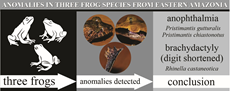
We reported anomalies in three anuran species belonging to two families: Craugastoridae (Pristimantis gutturalis and P. chiastonotus), and Bufonidae (Rhinella castaneotica). All records were found in two conservation units, a well-preserved and protected area of the Amazonian rainforest in the state of Amapa, eastern Amazon. The anomalies detected were anophthalmia (characterized by the absence of one or both eyes) in P. gutturalis and P. chiastonotus, and brachydactyly (digit shortened) in R. castaneotica. Further ecotoxicological studies of anurans populations in protected areas are needed to investigate the causes of anomalies. 

Reportamos anomalias en tres especies de anuros pertenecientes a dos familias: Craugastoridae (Pristimantis gutturalis y P. chiastonotus) y Rhinella castaneotica (Bufonidae). Todos los registros fueron encontrados en dos unidades de conservación, un área protegida bien conservada de selva amazónica en el estado de Amapá, Amazonía oriental. Las anomalias detectadas fueron anoftalmía (caracterizada por la ausencia de uno o ambos ojos) en P. gutturalis y P. chiastonotus, y braquidactilia (dígito acortado) en R. castaneotica. Se necesitan más estudios ecotoxicológicos de las poblaciones de anuros en áreas protegidas para investigar las causas de las anomalías.

Recibido: 15 de marzo de 2023; Revisión recibida: 28 de agosto de 2023; Aceptado: 31 de agosto de 2023

Abstract

We reported anomalies in three anuran species belonging to two families: Craugastoridae (Pristimantis gutturalis and P. chiastonotus), and Bufonidae (Rhinella castaneotica). All records were found in two conservation units, a well-preserved and protected area of the Amazonian rainforest in the state of Amapa, eastern Amazon. The anomalies detected were anophthalmia (characterized by the absence of one or both eyes) in P. gutturalis and P. chiastonotus, and brachydactyly (digit shortened) in R. castaneotica. Further ecotoxicological studies of anurans populations in protected areas are needed to investigate the causes of anomalies.

Keywords

abnormalities, conservation, Pristimantis, Rhinella.

Resumen

Reportamos anomalias en tres especies de anuros pertenecientes a dos familias: Craugastoridae (Pristimantis gutturalis y P. chiastonotus) y Rhinella castaneotica (Bufonidae). Todos los registros fueron encontrados en dos unidades de conservación, un área protegida bien conservada de selva amazónica en el estado de Amapá, Amazonía oriental. Las anomalias detectadas fueron anoftalmía (caracterizada por la ausencia de uno o ambos ojos) en P. gutturalis y P. chiastonotus, y braquidactilia (dígito acortado) en R. castaneotica. Se necesitan más estudios ecotoxicológicos de las poblaciones de anuros en áreas protegidas para investigar las causas de las anomalías.

Palabras clave

anormalidades, conservación, Pristimantis, Rhinella.

Morphological anomalies, both skeletal and non-skeletal, have been reported in natural populations of amphibian anurans from a variety of habitats around the world (Henle et al., 2017a). In Brazil, some previous studies have described these anomalies, and most have focused on specific taxa (e.g., Pedroso-Santos et al., 2020; Souza et al., 2021). Among anomalies in anurans, brachydactyly (defined as normal number of metatarsals but an abnormal number of phalanges) are the most widespread and relatively common in semi-aquatic and terrestrial species, as well as anophthalmia (characterized by the absence of one or both eyes) in juveniles and post-metamorphic individuals (Henle et al., 2017a, b; Souza et al., 2021). Herein we report two records of anophthalmia in the genus Pristimantis Jimenez de la Espada, 1870 and one of brachydactyly in the genus Rhinella Fitzinger, 1826 in eastern Amazonia, Brazil.

Specimens of P. gutturalis were found in 2021 during surveys at Parque Nacional Montanhas do Tumucumaque (1.2699°N, 2.4389°W), and specimens of P. chiastonotus and R. castaneotica were found in 2022 at Parque Natural Municipal do Cancão (0.9027°N, 52.0049°W), both in the municipality of Serra do Navio, state of Amapá, Brazil. Both areas are inserted in the Amazonian rainforest, particularly in upland (non-flooding) primary forest with closed canopy and emergent trees, with climate tropical monsoonal (Am) (according to the Köppen-Geiger classification; Álvares et al., 2013).

On 07 September 2021, we found an anophtalmic P. gutturalis adult male (unvouchered specimen) with a missing left eye and a normal right eye (Fig. 1A). The second anophtalmic individual (P. chiastonotus; HERPLAP 3836; SVL = 32.8 mm) was registered on 30 April 2022, with missing right eye (Fig. 1B), and on 29 June 2022, we found an adult male R. castaneotica (HERPLAP 3913; SVL = 30.0 mm) showing brachydactyly in the right hindlimb (Fig. 1C–D). Classification of anomalies followed Henle et al. (2017b). The specimens were deposited in the Herpetological Collection of Universidade Federal do Amapá, Brazil.

To our knowledge, the data presented here demonstrate the first records of brachydactyly on R. castaneotica and anophthalmia on the frogs P. chiastonotus and P. gutturalis. According to Souza et al. (2021), brachydactyly is common in semi-aquatic and terrestrial species such as toads of the genus Rhinella. On the other hand, the occurrence of only one anomaly (eye colouration abnormal) in the family Craugastoridae (P. reichlei) suggests that anomalies both skeletal and non-skeletal may be rare in arboreal species (see Souza et al., 2021). Therefore, our data reinforce that anecdotal records are important for better knowledge about abnormalities in anurans.

In addition, both protected areas are well-preserved, and, therefore, the causes of the anomalies recorded here are unknown. While cases of anomalies in urban and perturbed areas are related to factors such as chemical contaminants (e.g. Ferrante and Fearnside, 2020), the cases within protected areas could be related to intrinsic genetic and developmental imperfections (Lunde and Johnson, 2012). In this sense, we suggest that all individuals were probably affected during the embryonary developing stage. Thus, future ecotoxicological studies of amphibian populations in protected areas are needed to investigate the causes of anomalies, which will provide important input for the conservation of the anuran population.

Anomalies in three frog species from eastern Amazonia.

Figure 1: Anomalies in three frog species from eastern Amazonia.

ACKNOWLEDGMENTS

This study is part of the results of the “História Natural de Anfíbios Anuros na Amazônia Oriental”. We are grateful to the colleagues of “Laboratório de Herpetologia” for the assistance on the fieldwork. Instituto Chico Mendes de Conservação da Biodiversidade (ICMBio) for providing collection permits (SISBIO # 48102-5). CECC thanks to the Conselho Nacional de Desenvolvimento Científico e Tecnológico – CNPq for the research grant (Proc. 307697/2022-3).

REFERENCIAS

Alvares, C. A., Stape, J. L., Sentelhas, P. C., Goncalves, J. L. M. and Sparovek, G. (2013). Koppen's climate classification map for Brazil. Meteorol. Z, 22(6), 711-728. https://doi.org/10.1127/0941-2948/2013/0507[CrossRef]

Ferrante, L. and Fearnside, P. M. (2020). Evidence of mutagenic and lethal effects of herbicides on Amazonian frogs. Acta Amaz, 50(4), 363-366. https://doi.org/10.1590/1809-4392202000562[CrossRef]

Henle, K., Dubois, A. and Vershinin, V. (2017a). A review of anomalies in natural populations of amphibians and their potential causes. Mertensiella, 25, 57-164.

Henle, K., Dubois, A. and Vershinin, V. (2017b). Commented glossary, terminology and synonyms of anomalies in natural populations of amphibians. Mertensiella, 25, 9-48.

Lunde, K. B. and Johnson, P. T. J. (2012). A Practical Guide for the Study of Malformed Amphibians and Their Causes. J. Herpetol, 46(4), 429-441. https://doi.org/10.1670/10-319[CrossRef]

Pedroso-Santos, F., Sanches, P. R. and Costa-Campos, C. E. (2020). Anomalies in amphibians from the eastern Amazon region. Herpetol. Bull, 153, 22-25. https://doi.org/10.33256/hb153.2225[CrossRef]

Souza, F. C., Silva, A. L. F., Anjos, C. S., Estevinho, T. F., Lisboa, M. O. and Menin, M. (2021). New records of morphological anomalies in anurans, with a review for Brazil. Herpet. Notes, 14, 31-41.

The authors declare no conflicts of interest.
FPS and CECC collected the data; FPS and CECC wrote the original draft; CECC and ILK revised the final draft.
Pedroso-Santos, F., Kaefer, I.L, Costa-Campos, C. E. (2024). Anomalies in Three Frog Species from Eastern Amazonia. Acta Biol Colomb, 29(1), 146-148. https://doi.org/10.15446/abc.v29n1.107302

Referencias

Álvares, C. A., Stape, J. L., Sentelhas, P. C., Gonçalves, J. L. M. and Sparovek G. (2013). Köppen’s climate classification map for Brazil. Meteorol. Z,22(6), 711-728. https://doi.org/10.1127/0941-2948/2013/0507

Ferrante, L. and Fearnside, P. M. (2020). Evidence of mutagenic and lethal effects of herbicides on Amazonian frogs. Acta Amaz, 50(4), 363-366. http://dx.doi.org/10.1590/1809-4392202000562.

Henle, K., Dubois, A. and Vershinin, V. (2017a). A review of anomalies in natural populations of amphibians and their potential causes. Mertensiella, 25, 57-164.

Henle, K., Dubois, A. and Vershinin, V. (2017b). Commented glossary, terminology and synonymies of anomalies in natural populations of amphibians. Mertensiella,25,9-48.

Lunde, K. B. and Johnson, P. T. J. (2012). A Practical Guide for the Study of Malformed Amphibians and Their Causes. J. Herpetol,46(4), 429-441. https://doi.org/10.1670/10-319.

Pedroso-Santos, F., Sanches, P. R. and Costa-Campos, C. E. (2020). Anomalies in amphibians from the eastern Amazon region. Herpetol. Bull, 153, 22-25. https://doi.org/10.33256/hb153.2225.

Souza, F. C., Silva, A. L. F., Anjos, C. S., Estevinho, T. F., Lisboa, M. O, and Menin, M. (2021). New records of morphological anomalies in anurans, with a review for Brazil. Herpet. Notes,14,31-41.

Cómo citar

APA

Pedroso-Santos, F., Kaefer, I. L. & Costa-Campos, C. E. (2024). Anomalies in Three Frog Species from Eastern Amazonia. Acta Biológica Colombiana, 29(1), 146–148. https://doi.org/10.15446/abc.v29n1.107302

ACM

[1]
Pedroso-Santos, F., Kaefer, I.L. y Costa-Campos, C.E. 2024. Anomalies in Three Frog Species from Eastern Amazonia. Acta Biológica Colombiana. 29, 1 (ene. 2024), 146–148. DOI:https://doi.org/10.15446/abc.v29n1.107302.

ACS

(1)
Pedroso-Santos, F.; Kaefer, I. L.; Costa-Campos, C. E. Anomalies in Three Frog Species from Eastern Amazonia. Acta biol. Colomb. 2024, 29, 146-148.

ABNT

PEDROSO-SANTOS, F.; KAEFER, I. L.; COSTA-CAMPOS, C. E. Anomalies in Three Frog Species from Eastern Amazonia. Acta Biológica Colombiana, [S. l.], v. 29, n. 1, p. 146–148, 2024. DOI: 10.15446/abc.v29n1.107302. Disponível em: https://revistas.unal.edu.co/index.php/actabiol/article/view/107302. Acesso em: 13 jul. 2026.

Chicago

Pedroso-Santos, Fillipe, Igor Luis Kaefer, y Carlos Eduardo Costa-Campos. 2024. «Anomalies in Three Frog Species from Eastern Amazonia». Acta Biológica Colombiana 29 (1):146-48. https://doi.org/10.15446/abc.v29n1.107302.

Harvard

Pedroso-Santos, F., Kaefer, I. L. y Costa-Campos, C. E. (2024) «Anomalies in Three Frog Species from Eastern Amazonia», Acta Biológica Colombiana, 29(1), pp. 146–148. doi: 10.15446/abc.v29n1.107302.

IEEE

[1]
F. Pedroso-Santos, I. L. Kaefer, y C. E. Costa-Campos, «Anomalies in Three Frog Species from Eastern Amazonia», Acta biol. Colomb., vol. 29, n.º 1, pp. 146–148, ene. 2024.

MLA

Pedroso-Santos, F., I. L. Kaefer, y C. E. Costa-Campos. «Anomalies in Three Frog Species from Eastern Amazonia». Acta Biológica Colombiana, vol. 29, n.º 1, enero de 2024, pp. 146-8, doi:10.15446/abc.v29n1.107302.

Turabian

Pedroso-Santos, Fillipe, Igor Luis Kaefer, y Carlos Eduardo Costa-Campos. «Anomalies in Three Frog Species from Eastern Amazonia». Acta Biológica Colombiana 29, no. 1 (enero 2, 2024): 146–148. Accedido julio 13, 2026. https://revistas.unal.edu.co/index.php/actabiol/article/view/107302.

Vancouver

1.
Pedroso-Santos F, Kaefer IL, Costa-Campos CE. Anomalies in Three Frog Species from Eastern Amazonia. Acta biol. Colomb. [Internet]. 2 de enero de 2024 [citado 13 de julio de 2026];29(1):146-8. Disponible en: https://revistas.unal.edu.co/index.php/actabiol/article/view/107302

Descargar cita

CrossRef Cited-by

CrossRef citations1

1. Sebastián Cortés-Gallo, Daniel Enrique Espitia-Sanabria, Iván Camilo Pineda-Infante, Pamela Patiño Salazar. (2025). ANOFTALMIA EN ANUROS DE LATINOAMÉRICA: NUEVO CASO EN COLOMBIA, ESTADO DEL CONOCIMIENTO Y PERSPECTIVAS PARA LA CONSERVACIÓN. Revista Latinoamericana de Herpetología, 8(1) https://doi.org/10.22201/fc.25942158e.2025.1.1044.

Dimensions

PlumX

Visitas a la página del resumen del artículo

433

Descargas

Los datos de descargas todavía no están disponibles.
