
Publicado
DIVERSIDAD GENÉTICA Y ESTRUCTURA POBLACIONAL DEL AJÍ PAJARITO (Capsicum annuum var. glabriusculum) EN EL PNR EL VÍNCULO USANDO SSR-HRM.
GENETIC DIVERSITY OF PAJARITO PEPPER (Capsicum annuum var. glabriusculum) IN THE PNR EL VÍNCULO USING SSR-HRM
DOI:
https://doi.org/10.15446/abc.v30n1.114222Palabras clave:
autogamia, genotipos, heterocigosidad, riqueza alélica (es)Allelic richness, autogamy, genotypes, heterozygosity (en)
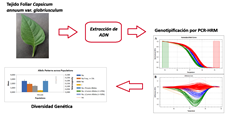
El género Capsicum de la familia Solanaceae contiene varias especies de ají entre las que se encuentran: C. annuum, C. chinense, C. frutescens, C. pubescens y C. baccatum, de las cuales C. annuum es la de mayor importancia económica y mayor diversidad morfológica, siendo C. annuum var. glabriusculum un recurso genético importante para la agricultura al ser el ancestro común de las variedades domésticas de C. annuum. Sin embargo, los estudios poblacionales con esta especie han sido limitados a pesar de su amplia distribución. Por lo anterior, el objetivo de este trabajo fue evaluar la estructura poblacional y la diversidad genética de C. annuum var. glabriusculum en el fragmento de bosque seco más grande del Valle del Cauca, Parque Natural Regional (PNR) El Vínculo. Para ello, se extrajo ADN de tejido foliar joven, y utilizando diez marcadores microsatélites se estimó la diversidad genética y la distribución espacial. Como resultado, todos los microsatélites utilizados fueron polimórficos a excepción de Bd12. El marcador Ng18 fue el que presentó mayor número de alelos, mayor PIC y una heterocigosidad esperada (He) de 0,7 siendo el marcador más informativo. La heterocigosidad observada (Ho) fue de cero para todos los marcadores, y el número de genotipos registrados en la población fue de 17. Finalmente, el análisis de agrupamiento mostró la formación de tres subgrupos; sin embargo, al comparar con los valores de identidad genética de Nei, se concluye que todos los individuos pertenecen a una sola población, aunque son genéticamente diversos.
The Capsicum genus of the Solanaceae family contains several species of peppers, among which are: C. annuum, C. chinense, C. frutescens, C. pubescens and C. baccatum, of which C. annuum is the most economically important and morphologically diverse, being C. annuum var. glabriusculum an important genetic resource for agriculture as it is the common ancestor of the domestic varieties of C. annuum. However, population studies with this species have been limited despite its wide distribution. Therefore, the objective of this work was to evaluate the population structure and genetic diversity of C. annuum var. glabriusculum in the largest dry forest fragment in Valle del Cauca, El Vínculo Regional Natural Park (PNR). For this, DNA was extracted from young leaf tissue, and using 10 microsatellite markers, genetic diversity and spatial distribution were estimated. As a result, all microsatellites used were polymorphic except for Bd12. The Ng18 marker was had the highest number of alleles (5), the highest PIC and an expected heterozygosity (He) of 0.7: being the most informative marker. The observed heterozygosity (Ho) was zero for all the markers, and the number of haplotypes registered in the population was 17. Finally, the cluster analysis showed the formation of 3 subgroups, however, when comparing with the identity values Nei genetics, it is concluded that all individuals belong to a single population, although they are genetically diverse.
Referencias
Abdel-Mawgood, A. L. (2012) DNA Based Techniques for Studying Genetic Diversity. In: Genetic Diversity in Microorganisms, InTech, Rijeka, 95-122. https://doi.org/10.5772/33509
Aguilar-Meléndez, A., Morrell, P. L., Roose, M. L. and Kim, S. C. (2009). Genetic diversity and structure in semiwild and domesti¬cated chiles (Capsicum annuum; Solanaceae) from Mexico. Am. J. Bot., 96(6):1190–1202. https://doi.org/10.3732/ajb.0800155
Ahmed, N. and Tanki, ,M. I. (1994) Effect of planting distance and direction on natural cross pollination and their role in seed production of pepper (Capsicum annuum), Capsicum. Eggplant Newsletter, 13 94–96.
Antonio, A.; Wiedemanna, L. S. M. and Veiga, V. F. (2018). The genus Capsicum: a phytochemical review of bioactive secondary metabolites. The Royal Society of Chemistry, 8, 25767–25784. https://doi.org/10.1039/C8RA02067A
Barboza, G. E., Carrizo García, C., Leiva González, S., Scaldaferro, M. y Reyes, X. (2019). Four new species of Capsicum (Solanaceae) from the tropical Andes and an update on the phylogeny of the genus. PLoS ONE 14(1): e0209792. https://doi.org/10.1371/journal.pone.0209792
Barboza, G. E., García, C. C., Scaldaferro, M., and Bohs, L. (2020). An amazing new Capsicum (Solanaceae) species from the Andean-Amazonian Piedmont. PhytoKeys, 167, 13–29. https://doi.org/10.3897/phytokeys.167.57751
Bio-Rad Laboratories. (2012). Precision Melt Analysis Software Instruction Manual Bio-Rad Laboratories, Inc. Catalog #184-5025 Bulletin 10014811 Rev A US/EG.
Bosland, P. and Votava, E. eds. (2000) Peppers: Vegetable and Spice Capsicum. The Journal of Agricultural Science Cambridge, 136(4), 471-475. https://doi.org/10.1017/S0021859601268932
Campodonico, O. P. (1983). Estimates of natural cross-pollination in serrano pepper (Capsicum annuum L.), Capsicum. Newsletter, 2.106–108.
Carrizo, C., Barfuss, M., Sehr, E., Barboza, G., Samuel, R., Moscone, E. and Ehrendorfer, F. (2016). Phylogenetic relationships, diversification and expansion of chili peppers (Capsicum, Solanaceae). Annals of Botany, 118: 35–51. https://doi.org/10.1093/aob/mcw079
Cascante, A., Quesada, M., Lobo, J. and Fuchs, E. (2002). Effects of Dry Tropical Forest Fragmentation on the Reproductive Success and Genetic Structure of the Tree Samanea saman. Conservation Biology. 16(1): 137-147. https://doi.org/10.1046/j.1523-1739.2002.00317.x
Cifuentes, H. y Viafara, R. Cardenas (2016). Caracterización molecular de Capsicum annuum (solanales, solanaceae), variedad cayena, mediante microsatélites con la técnica HRM. [Tesis de Pregrado]. Universidad del Valle. Cali, Colombia.
Chase, M. W. and Hills, H. H. (1991) Silica gel: An ideal material for field preservation of leaf samples for DNA studies. Taxon 40: 215–220. https://doi.org/10.2307/1222975
D'arcy, W. G. y Eshbaugh, W. H. (1974). New world peppers (Capsicum: Solanaceae) north of Colombia: a resume. Baileya, 19(3): 93-105.
Doyle, J. and Dickson, E. (1987). Preservation of Plant Samples for DNA Restriction Endonuclease Analysis. Taxon, 36(4): 715-722. https://doi.org/10.2307/1221122
Falconer, D. S. y Mackay, T. F. C. 2006. Introducción a la genética cuantitativa. Cuarta edición. Versión traducida: Editorial Acribia, Zaragoza, España. pp. 468. Frayling, I.M., Monk, E., Butler, R. (2006). PCR-Based Methods for Mutation Detection. In: Coleman, W.B.,
Tsongalis, G.J. (eds) Molecular Diagnostics. Humana Press. https://doi.org/10.1385/1-59259-928-1:065
Guillot, G., Mortier, F. y Estoup, A. (2005). GENELAND: A program for landscape genetics. Molecular Ecology Notes, 5, 712-715. https://doi.org/10.1111/j.1471-8286.2005.01031.x González-Jara, P. Moreno-Letelier, A. Fraile, A. Piñero, D. and García-Arenal, F. (2011). Impact of human management on the genetic variation of wild pepper, Capsicum annuum var. glabriusculum. PLoS ONE, 6(12), e28715. https://doi.org/10.1371/journal.pone.0028715
Guzmán, F. A. (2007). Desarrollo de una herramienta molecular para el estudio de la diversidad genética de germoplasma del género Capsicum. [Tesis de maestría]. Universidad del Valle. Facultad de Ciencias Naturales. Colombia. pp 34. Hernández-Verdugo, S., Guevara-González, R. G., Rivera-Bustamante, R. F., Vázquez-Yanes, C. y Oyama, K. (1998). Los parientes silvestres del chile (Capsicum spp.) como recursos genéticos. Boletín de la Sociedad Botánica de México, 62, 171-181. https://doi.org/10.17129/botsci.1559
Hernández-Verdugo, S., Luna-Reyes, R. and Oyama, K. (2001). Genetic structure and differentiation of wild and domesticated populations of Capsicum annuum (Solanaceae) from Mexico. Plant Syst. Evol., 226 129–142. https://doi.org/10.1007/s006060170061
Hernández-Verdugo, S., González-Sánchez, R. A., Porras, Flor., Parra-Terraza, S., Valdez-Ortiz, Á., Pacheco-Olvera, A. y López-España, R. G. (2015). Plasticidad fenotípica de poblaciones de chile silvestre (Capsicum annuum var. glabriusculum) en respuesta a disponibilidad de luz. Botanical Sciences, 93(2), 231-240. https://doi.org/10.17129/botsci.237 Instituto Alexander Von Humboldt, IAVH. (1997). Caracterización ecológica de cuatro remanentes de Bosque seco Tropical de la región Caribe colombiana. Grupo de Exploraciones Ecológicas Rápidas, IAVH, Villa de Leyva.
Jeong, H., Jo, Y. D., Park, S. W. and Kang, B.G. (2010). Identification of Capsicum species using SNP markers based on high resolution melting analysis. Genome, 53(12): 1029–1040. https://doi.org/10.1139/G10-094
Justino, E. V., Fonseca, M. E. N, Ferreira, M. E., Boiteux, L. S. Silva, P. P. and Nascimento, W. M. (2018). Estimate of natural cross-pollination rate of Capsicum annuum using a codominant molecular marker associated with fruit pungency. Genet. Mol. Res. 17(1). https://doi.org/10.4238/gmr16039887
Kim, C. G., Park, K. W., Lee, B., Kim, D. I., Park, J. Y., Kim, H. J., Park, J. E., An, J. H., Cho, K. H., Jeong, S. C., Choi, K. H., Harn, C. H. and Kim, H. M. (2009). Gene flow from genetically modified to conventional chili pep-per (Capsicum annuum L.). Plant Sci. 176(3), 406–412. https://doi.org/10.1016/j.plantsci.2008.12.012
Kosi Doku, S. (2005). Genetic diversity studies in twenty accessions of hot pepper (Capsicum spp L.) in Ghana.
Department of nuclear agriculture and radiation processing school of nuclear and allied sciences University of Ghana. Master of Philosophy in Nuclear Agriculture. University of Ghana. Acra, Ghana. Lee, J. M., Nahm, S. H., Kim, Y. M. and Kim, B. D. (2004). Characterization and molecular genetic mapping of microsatellite loci in pepper. Theoretical and Applied Genetics, 108(4), 619-627. https://doi.org/10.1007/s00122-003-1467-x
López-España, R. G., López-Hernández, E. R., Hernández-Morales, T., Charrez-Cruz, A., González-Guzmán, Y., Muñoz-Jimarez, N. A. and Ortiz-Quintero, J. A. (2017). Effects of temperature wild chili pepper (Capsicum annuum var. glabriusculum) germination grown under two light conditions. Acta Agronómica. 66(1), 69-74. https://doi.org/10.15446/acag.v66n1.50662 Mcleod, M. J., Guttman, S. I. and Eshbaugh, H. (1982). Early Evolution of Chili Peppers (Capsicum). Economic Botany, 36(4), 361-368. https://doi.org/10.1007/BF02862689 Medina, J., Lugo, N., Bonilla, A. y Cortez, D. (2009). Avances del estudio de la variabilidad genética en dos poblaciones
silvestres de Pseudoplastystoma fasciatum (Siluriformes: Pimelodidae), en Venezuela. Actual Biol, 31(1):118-119.
Morgante, M. y Olivieri, A.M. (1993). PCR-amplified Microsatellites as Markers in Plant Genetics. The Plant Journal, 3, 175-182. https://doi.org/10.1111/j.1365-313X.1993.tb00020.x
Muñoz F. J. E., Morillo C. A. C. y Morillo C. Y. (2008). Microsatélites amplificados al azar (RAM) en estudios de diversidad genética vegetal. Acta Agronomica, 57(4), 219-226.
Nagy, I., Stagel, A., Sasvari, Z., Röder, M. and Ganal, M. (2007). Development, characterization, and
transferability to other Solanaceae of microsatellite markers in pepper (Capsicum annuum L.). Genome, 50(7), 668-688. https://doi.org/10.1139/G07-047
Nei, M. 1978. Estimation of average heterozygosity and genetic distance from a small number of individuals. Genetics, 89(3), 583-590. https://doi.org/10.1093/genetics/89.3.583
Nicolai, M., Cantet, M., Lefebvre, V., Sage-Palloix, A. M. and Palloix, A. (2013). Genotyping a large collection of pepper (Capsicum spp.) with SSR loci brings new evidence for the wild origin of cultivated C. annuum and the structuring of genetic diversity by human selection of cultivar types. Genetic Resources and Crop Evolution, 60, 2375–2390.https://doi.org/10.1007/s10722-013-0006-0
Ocampo, G. R. y Cardona, C. H. (2013). La endogamia en la producción animal. Rev. Colombiana cienc. Anim. 5(2), 463-479. https://doi.org/10.24188/recia.v5.n2.2013.458
Odland, M. L. and Porter, A. M. 1941. A study of natural crossing in pepper (Capsicum frutescens L.). J. Amer. Soc. Hort. Sci., 38, 585–588. Ospina, M. V. (2019). Frecuencias alélicas y genotípicas de polimorfismos de genes asociados a la vía de Wnt en individuos sistémicamente sanos y su asociación con variables clínicas periodontales. Unidad de Investigación Básica Oral UIBO. Universidad del Bosque. p. 114.
Oyama, K., Hernández-Verdugo, K., Sánchez, C., González-Rodríguez, A., Sánchez-Peña, P., Garzón-Tiznado, J. A. and Casas, A. (2006). Genetic structure of wild and domesticated populations of Capsicum annuum (Solanaceae) from northwestern Mexico analyzed by RAPDs. Genetic Resources and Crop Evolution, 53, 553–562.
Pacheco-Olvera, A., Hernández-Verdugo, S., Rocha-Ramírez, V., González-Rodríguez, A. and Oyama, K. (2012). Genetic diversity and structure of pepper (Capsicum annuum L.) fromnorthwestern Mexico analyzed by microsatellite markers. Crop Sci, 52(1), 231–241. https://doi.org/10.2135/cropsci2011.06.0319
Peakall, R. and Smouse P. E. (2012) GenAlEx 6.5: genetic analysis in Excel. Population genetic software for teaching and research-an update. Bioinformatics, 28(19), 2537-2539. https://doi.org/10.1093/bioinformatics/bts460
Piñero, D., Caballero-Mellado, J., Cabrera-Toledo, D., Canteros, C., Casas, A., Castañeda, S. A., Castillo, A., Cerritos, R., Chassin-Noria, O., Colunga-García, P., Díaz-Jaimes, P., Eguiarte, L., Escalante, A., Espinoza, B., Fleury, A., Flores-Ramírez, S., Fragoso, G., Arturo, G. y Zúñiga, G. (2008). La diversidad genética como instrumento para la conservación y el aprovechamiento de la biodiversidad: estudios en especies mexicanas. CONABIO, México, pp. 437-494.
Quintero, I. y Barraza, F. (2009). Densidad poblacional y plasticidad fenotípica del ají picante (Capsicum annuum L.) c.v. cayene long slim. Intropica, 4(1), 55–66.
Shirasawa, K., Ban, T., Nagata, N. and Murakana, T. (2019). Impact of Genomics on Capsicum Breeding. In Ramchiary, N., Kole, C. (eds), The Capsicum Genome. Compendium of Plant Genomes. pp. 209-219. Springer, Cham. https://doi.org/10.1007/978-3-319-97217-6_13
Szczecińska, M., Sramkó, G., Wołosz, K. and Sawicki, J. (2016). Genetic Diversity and Population Structure of the Rare and Endangered Plant Species Pulsatilla patens (L.) Mill in East Central Europe. PLoS ONE, 11(3). https://doi.org/10.1371/journal.pone.0151730
Tamura, K., Stecher, G. and Kumar, S. (2022) MEGA11: Molecular Evolutionary Genetics Analysis Version 11. Molecular Biology and Evolution, 38(7), 3022-3027. https://doi.org/10.1093/molbev/msab120
Tanksley, S. D. (1984). High rates of cross-pollination in Chile Pepper. HortScience, 19(4), 580-582. https://doi.org/10.21273/HORTSCI.19.4.580
Toledo-Aguilar, R., López-Sánchez, H., Santacruz-Varela, A., Valadez-Moctezuma, E., López, P. A., Aguilar-Rincón, V. H., González-Hernández, V. A. y Vaquera-Huerta, H. (2016). Characterization of genetic diversity of native ‘Ancho’ chili populations of Mexico using microsatellite markers. Chilean Journal of agricultural research, 76(1), 17-26. https://doi.org/10.4067/S0718-58392016000100003
Tong, S. Y. C. and Giffard, P. M. (2012). Microbiological Applications of High-Resolution Melting Analysis. J Clin Microbiol50. https://doi.org/10.1128/jcm.01709-12
Torres, G. A. M., Adarve, J. B., Cárdenas, M., Vargas, J. A., Londoño, V., Rivera, K., Home, J., Duque, L. D. and María, A. (2012). Dinámica sucesional de un fragmento de bosque seco tropical del Valle del Cauca. Colombia. Biota Colombiana, 13(2), 66-84.
Varshney, R. K., Graner, A. and Sorrells, M. E. (2005). Genic microsatellite markers in plants: Features and applications. Trends in Biotechnology, 23(1), 48-55. https://doi.org/10.1016/j.tibtech.2004.11.005
Wright, S. (1931). Evolution in mendelian populations. Genetics, 16(2), 97-158. https://doi.org/10.1093/genetics/16.2.97
Dimensions
PlumX
Visitas a la página del resumen del artículo
Descargas
Cómo citar
Licencia

Esta obra está bajo una licencia internacional Creative Commons Atribución-NoComercial-CompartirIgual 4.0.
1. La aceptación de manuscritos por parte de la revista implicará, además de su edición electrónica de acceso abierto bajo licencia Attribution-NonCommercial-ShareAlike 4.0 (CC BY NC SA), la inclusión y difusión del texto completo a través del repositorio institucional de la Universidad Nacional de Colombia y en todas aquellas bases de datos especializadas que el editor considere adecuadas para su indización con miras a incrementar la visibilidad de la revista.
2. Acta Biológica Colombiana permite a los autores archivar, descargar y compartir, la versión final publicada, así como las versiones pre-print y post-print incluyendo un encabezado con la referencia bibliográfica del articulo publicado.
3. Los autores/as podrán adoptar otros acuerdos de licencia no exclusiva de distribución de la versión de la obra publicada (p. ej.: depositarla en un archivo telemático institucional o publicarla en un volumen monográfico) siempre que se indique la publicación inicial en esta revista.
4. Se permite y recomienda a los autores/as difundir su obra a través de Internet (p. ej.: en archivos institucionales, en su página web o en redes sociales cientificas como Academia, Researchgate; Mendelay) lo cual puede producir intercambios interesantes y aumentar las citas de la obra publicada. (Véase El efecto del acceso abierto).




