Publicado
RANGE EXTENSION OF Synbranchus marmoratus (SYNBRANCHIDAE) TOWARDS ARGENTINA’S CENTRAL ANDES
Ampliación de distribución de Synbranchus marmoratus (Synbranchidae) hacia los Andes Centrales de Argentina
DOI:
https://doi.org/10.15446/abc.v29n1.98266Palabras clave:
Andes mountains, marbled swamp eel, Neotropical region, San Juan (en)Anguila de pantano veteada, Cordillera de Los Andes, región Neotropical, San Juan (es)
Descargas
This work provides a new record that extends the western limit of the geographic distribution of Synbranchus marmoratus towards the Central Andes of Argentina, in the Department of Calingasta, Province of San Juan. In addition, an update of the geographical distribution map of the species in the country is provided based on this record and a complete literature review. We collected a specimen of this species on 12 September 2016 during an ichthyofaunal survey of high Andean rivers. This record corresponds to the westernmost distribution in the country. This finding is interesting since this species is considered an indicator of the ichthyofauna of the Biogeographic Provinces Greats Rivers and Pampean, while the ichthyofauna of the study area of this new record belongs to the Andean Cuyo Province.
En este trabajo se aporta un nuevo registro que amplía el límite occidental de la distribución geográfica de Synbranchus marmoratus hacia los Andes Centrales de Argentina, en el Departamento de Calingasta, Provincia de San Juan. Además, se brinda una actualización del mapa de distribución geográfica de la especie en el país basado en este registro y en una revisión bibliográfica completa. Recolectamos un espécimen de esta especie el 12 de septiembre de 2016 durante un muestreo de ictiofauna en ríos altoandinos. Este registro corresponde al más occidental en su distribución en el país. Este hallazgo es interesante ya que esta especie es considerada como indicadora de la ictiofauna de las Provincias Biogeográficas Grandes Ríos y Pampeana, mientras que la ictiofauna del área de estudio de este nuevo registro pertenece a la Provincia Andino Cuyana.
Recibido: 25 de noviembre de 2021; Revisión recibida: 16 de diciembre de 2022; Aceptado: 6 de junio de 2023
ABSTRACT
This work provides a new record that extends the western limit of the geographic distribution of Synbranchus marmoratus towards the Central Andes of Argentina, in the Department of Calingasta, Province of San Juan. In addition, an update of the geographical distribution map of the species in the country is provided based on this record and a complete literature review. We collected a specimen of this species on 12 September 2016 during an ichthyofaunal survey of high Andean rivers. This record corresponds to the westernmost distribution in the country. This finding is interesting since this species is considered an indicator of the ichthyofauna of the Biogeographic Provinces Greats Rivers and Pampean, while the ichthyofauna of the study area of this new record belongs to the Andean Cuyo Province.
Keywords
Andes mountains, marbled swamp eel, Neotropical region, San Juan.RESUMEN
En este trabajo se aporta un nuevo registro que amplía el limite occidental de la distribución geográfica de Synbranchus marmoratus hacia los Andes Centrales de Argentina, en el Departamento de Calingasta, Provincia de San Juan. Además, se brinda una actualización del mapa de distribución geográfica de la especie en el país basado en este registro y en una revisión bibliográfica completa. Recolectamos un espécimen de esta especie el 12 de septiembre de 2016 durante un muestreo de ictiofauna en ríos altoandinos. Este registro corresponde al más occidental en su distribución en el país. Este hallazgo es interesante ya que esta especie es considerada como indicadora de la ictiofauna de las Provincias Biogeográficas Grandes Ríos y Pampeana, mientras que la ictiofauna del área de estudio de este nuevo registro pertenece a la Provincia Andino Cuyana.
Palabras clave
Anguila de pantano veteada, Cordillera de Los Andes, región Neotropical, San Juan.The genus Synbranchus Bloch, 1795 is endemic to Central and South America and is characterized by being very specialized in many aspects, including the anatomical, physiological, and behavioral (Rosen and Greenwood, 1976). Currently, it contains three recognized species (Rosen and Greenwood, 1976; Favorito et al., 2005). Synbranchus marmoratus Bloch, 1795, popularly known as the marbled or creole swamp eel, is the only species found in Argentina (Liotta, 2005). It prefers freshwater habitats and lives in muddy areas, riverbanks, streams, and lagoons. It can grow to be approximately 1000 mm long, with body scales. Rayless dorsal and anal fins; represented by long skin folds. No paired fins except for membranous larval pectoral fins (Ringuelet, 1975). It's characterized by having gills reduced to a single branchial membrane and by being able to breathe air through oropharyngeal breathing. It lacks an air bladder and can leave the water and move along the ground until it finds another water body (Fernández, 2018).
Liotta (2005) defined the distribution of this species in Argentina without completing an exhaustive revision of the bibliography, as then it was impossible to obtain old articles that had been published in foreign journals without free or unrestricted access. On the other hand, although the International Union for the Conservation of Nature [IUCN] considers the conservation status of S. marmoratus as "Least Concern", given that it has a wide distribution in Central and South America (Daniels and Maiz-Tome, 2019), we believe that each country where the species is distributed should carry out its own evaluation of the status of conservation.
Therefore, the objective this study is to provide a new latitudinal and altitudinal record that widens the distribution of the species at its most western point towards Argentina's Central Andes in the Calingasta Department of the San Juan Province. Additionally, this new record is at least 300 meters higher than previous records of the species, whose altitudinal range observed in the Colombian and Ecuadorian Andes is above 10 masl and below 1000 masl (Maldonado-Ocampo et al., 2005; Rodríguez-Galarza et al., 2017). Finally, we update the distribution map for S. marmoratus in Argentina based on this record and a complete review of the literature, to generate base information that serves for a future categorization of the conservation status in the country.
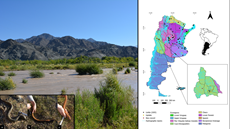
On September 12, 2016, during an ichthyofaunal survey of mountain rivers in the Calingasta Department of San Juan Province, Argentina, we placed tuna as bait in a double cone fish trap for an entire day along the floodplain at the southern edge of the Agua Negra Stream (31°15' S, and 69°25' W, 1330 m. a. s. l.). This body of water's origin is subterranean, and it is the last tributary of the Castano River before it joins the Los Patos River, which later forms the San Juan River downstream. In the trap, we captured an individual of Synbranchus marmoratus (Fig. 1).
Figure 1.: (a) Specimen of Synbranchus marmoratus found in Calingasta Department. (b) Detail of the dorsal view of the fish, showing the coloration pattern of the live specimen. (c) Detail of the ventral view of the fish, showing the coloration pattern of the live specimen.
In addition, we carried out a specific bibliographic search of the keywords "Synbranchus marmoratus" + "Marbled swamp eel" + "Argentina" in Google Scholar. This search turned up 58 papers, for which we obtained data related to geographical distribution whenever possible. With this information, we created a map of the new distribution of S. marmoratus in Argentina, based on that of Liotta (2005) together with the ecoregions of freshwater fish found in the country, as described by Abell et al. (2008). Furthermore, we have provided a table with information on the new points of distribution.
Based on the new record and points of distribution obtained for S. marmoratus through the literature, we have created an updated map with the current distribution of the species in Argentina (Fig. 2). Likewise, in Table 1, we include information on its new locations. The new location of S. marmoratus (Fig. 1) in the Province of San Juan is highly relevant since it corresponds to the most western point of its current distribution known in Argentina (Fig. 2). This new record also widens the distribution of the species in the Province of San Juan approximately 90 to 120 km in a straight line from previous records, which are mentioned for 9 de Julio, 25 de Mayo and Zonda Departments (Murúa and Acosta, 1997; Gómez, 2001; Acosta et al., 2016). Though all the records until now have been found in the San Juan River basin, we must highlight the fact that the new location is found in the Calingasta Valley, between the Andes and the Pre-Andes foothills, while the other records were found east of the Pre-Andes in plains and valleys at lower elevations and in different environments.
Figure 2.: Map of the current distribution of Synbranchus marmoratus based on data obtained from Liotta (2005) and using the Freshwater Ecoregions of the World (sensu Abell et al., 2008) as an ecological unit. (a) Records from the previous study of Liotta (2005) and the updated records. (b) The new records for the Province of San Juan are shown.
Table 1.: Details of the newly updated records of the distribution of Synbranchus marmoratus in Argentina.
This finding is interesting from a biogeographical point of view, as Ringuelet (1975) considers S. marmoratus to be an indicator of the ichthyofauna of the Great River and Pampa Biogeographical Provinces (López et al., 2008), while the ichthyofauna of the Province of San Juan belongs to the Andean Cuyo Province, whose indicator species include Hatcheria macrae, Olivaichthys (Diplomystes) cyuanus and Percichthys trucha (López et al., 2008). Even though these Biogeographical Provinces share S. marmoratus, Ringuelet (1975) believes that the border between the ichthyological territories is determined by an ecological barrier and not by hydrographic basins or physiographic barriers. In this way, we provide a new record latitudinal and altitudinal that allows us to extend the western distribution limit of the species in the country to the Central Andes of Argentina and contribute to the knowledge of the southernmost distribution of this species widely distributed in Central and South America.
ACKNOWLEDGMENTS
We thank Alyson Nuñez for helping us with the English version.
Referencias
Abell, R., Thieme, M. L., Revenga, C., Bryer, M., Kottelat, M., Bogutskaya, N., Coad, B., Mandrak, N., Contreras Balderas, S., Bussing, W., Stiassny, M. L. J., Skelton, P., Allen, G. R., Unmack, P., Naseka, A., Ng, R., Sindorf, N., Robertson, J., Armijo, E., Higgins, J. V., Heibel, T. J., Wikramanayake, E., Olson, D., López, H., Reis, R. E., Lundberg, J. G., Sabaj, M. H., Petry, P.(2008). Freshwater ecoregions of the world: a new map of biogeographic units for freshwater biodiversity conservation. BioScience, 58(5): 403 – 414. https://doi.org/10.1641/B580507
Acosta, J. C., Laspiur, A., Blanco, G. and Villavicencio, H. J. (2016). Ictiofauna de San Juan: Diversidad y Distribución in E. Martínez Carretero and A. García (Eds.). San Juan Ambiental (pp. 237–257). Mendoza, Argentina.
Bertora, A., Grosman, F., Sanzano, P. and Rosso, J. J. (2018). Fish fauna from the Langueyú basin, Argentina: a prairie stream in a heavily modified landscape. Check List, 14(2):461- 470. https://doi.org/10.15560/14.2.461
Daniels, A. and Maiz-Tome, L. (2019). Synbranchus marmoratus. The IUCN Red List of Threatened Species, e.T186540A1814657. https://dx.doi.org/10.2305/IUCN.UK.2019-2.RLTS.T186540A1814657.en
Favorito, S. E., Zanata, A. M. and Assumpção, M. I. (2005). A new Synbranchus (Teleostei: Synbranchiformes: Synbranchidae) from ilha de Marajó, Pará, Brazil, with notes on its reproductive biology and larval development. Neotropical Ichthyology, 3(3):319 – 328. https://doi.org/10.1590/S1679-62252005000300001
Fernández, L. A. (2018). Comentarios ecológicos sobre los peces óseos de Argentina. In R. Montero and A. Autino (Eds.), Sistemática y filogenia de los vertebrados, con énfasis en la fauna argentina (pp. 166–222). Independiente, San Miguel de Tucumán, Argentina.
Gómez, P. F. (2001). Presencia de Symbranchus marmoratus Bloch (Piscis: Symbranchidae) en la red de riego en el departamento 25 de Mayo, San Juan, Argentina. Multequina, 10;79- 80.
Junges, C. M., Lajmanovich, R. C., Peltzer, P. M., Attademo, A. M. and Bassó, A. (2010). Predator–prey interactions between Synbranchus marmoratus (Teleostei: Synbranchidae) and Hypsiboas pulchellus tadpoles (Amphibia: Hylidae): Importance of lateral line in nocturnal predation and effects of fenitrothion exposure. Chemosphere, 81(10):1233 – 1238. https://doi.org/10.1016/j.chemosphere.2010.09.035
Liotta, J. (2005). Distribución geográfica de los peces de aguas continentales de la República Argentina. Probiota, FCNyM, UNLP, Serie Documentos, 3:1-701. DOI: https://doi.org/10.14409/natura.v1i36.3829
Llompart, F., Paracampo, A., Solimano, P. and García, I. (2011). Peces de la Reserva Natural Punta Lara. In I. Roesler and M. G. Agostini (Eds.), Inventario de los vertebrados de la Reserva Natural Punta Lara, Provincia de Buenos Aires, Argentina (pp. 11 – 24). Temas de Naturaleza y Conservación/Monografía de Aves Argentinas N° 8.
Lo Nostro, F., Grier, H., Andreone, L. and Guerrero, G. A. (2003). Involvement of the gonadal germinal epithelium during sex reversal and seasonal testicular cycling in the protogynous swamp eel, Synbranchus marmoratus Bloch 1795 (Teleostei, Synbranchidae). Journal of Morphology, 257(1):107-126. https://doi.org/10.1002/jmor.10105
López, H. L., Menni, R.C., Donato, M. and Miquelarena, A. M. (2008). Biogeographical revision of Argentina (Andean and Neotropical Regions): an analysis using freshwater fishes. Journal of Biogeography, 35(9):1564-1579. https://doi.org/10.1111/j.1365-2699.2008.01904.x
Maldonado-Ocampo, J. A., Ortega-Lara, A., Usma, J. S., Galvis, G., Villa-Navarro, F. A., Vásquez, L., Prada-Pedreros, S., and Ardila, C. (2005). Peces de los Andes de Colombia. Guía de Campo. Instituto de Investigación de Recursos Biológicos “Alexander Von Humboldt”.
Murúa, F. and Acosta, J. C. (1997). Symbranchus marmoratus Bloch (Piscis: Symbranchidae). Nuevo registro para la ictiofauna de San Juan (Argentina). Multequina, 6: 103-104.
Ringuelet, R. A. (1975). Zoogeografía y ecología de los peces de aguas continentales de la Argentina y consideraciones sobre las áreas ictiológicas de América del Sur. Ecosur, 2(3):1-122.
Rodríguez-Galarza, F. E., Valdiviezo-Rivera, J., Reyes-Puig, J. P. and Yánez-Cajo, D. J. (2017). Ictiofauna de los ríos Zuñag y Anzu en el Corredor Ecológico Llanganates–Sangay, Provincias de Pastaza y Tungurahua, Ecuador. Boletín Técnico, Serie Zoológica, 13:33-52.
Rosen, D. E. and Greenwood, P. H. (1976). A fourth Neotropical species of synbranchid eel and the phylogeny and systematics of synbranchiform fishes. Bulletin of American Museum of Natural History, 157:1-70.
Rosen, D. E. and Rumney, A. (1972). Evidence of a second species of Synbranchus (Pisces, Teleostei) in South America. American Museum Novitates, 2497:1-45.
Cómo citar
APA
ACM
ACS
ABNT
Chicago
Harvard
IEEE
MLA
Turabian
Vancouver
Descargar cita
CrossRef Cited-by
1. Marden Seabra Linares, Diego Rodrigues Macedo, Gilberto Nepomuceno Salvador, Carlos Bernardo Mascarenhas Alves, Paulo Santos Pompeu, Marcos Callisto. (2025). How do exergy-based indicators respond to physical habitat changes?. Ecological Indicators, 174, p.113499. https://doi.org/10.1016/j.ecolind.2025.113499.
Dimensions
PlumX
Visitas a la página del resumen del artículo
Descargas
Licencia

Esta obra está bajo una licencia internacional Creative Commons Atribución-NoComercial-CompartirIgual 4.0.
1. La aceptación de manuscritos por parte de la revista implicará, además de su edición electrónica de acceso abierto bajo licencia Attribution-NonCommercial-ShareAlike 4.0 (CC BY NC SA), la inclusión y difusión del texto completo a través del repositorio institucional de la Universidad Nacional de Colombia y en todas aquellas bases de datos especializadas que el editor considere adecuadas para su indización con miras a incrementar la visibilidad de la revista.
2. Acta Biológica Colombiana permite a los autores archivar, descargar y compartir, la versión final publicada, así como las versiones pre-print y post-print incluyendo un encabezado con la referencia bibliográfica del articulo publicado.
3. Los autores/as podrán adoptar otros acuerdos de licencia no exclusiva de distribución de la versión de la obra publicada (p. ej.: depositarla en un archivo telemático institucional o publicarla en un volumen monográfico) siempre que se indique la publicación inicial en esta revista.
4. Se permite y recomienda a los autores/as difundir su obra a través de Internet (p. ej.: en archivos institucionales, en su página web o en redes sociales cientificas como Academia, Researchgate; Mendelay) lo cual puede producir intercambios interesantes y aumentar las citas de la obra publicada. (Véase El efecto del acceso abierto).




