Publicado
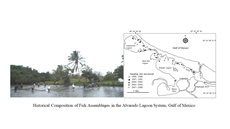
Composición histórica de los ensamblajes de peces en el sistema lagunar de alvarado, golfo de México
HISTORICAL COMPOSITION OF FISH ASSEMBLAGES IN THE ALVARADO LAGOON SYSTEM, GULF OF MEXICO
DOI:
https://doi.org/10.15446/abc.v29n1.98492Palabras clave:
Biodiversity, intertidal zone communities, coastal lagoon, Gulf of México (en)Biodiversidad, comunidades de zonas intermareales, laguna costera, Golfo de México (es)
Descargas
Archivos adicionales
The composition of fish assemblages in the Alvarado Lagoon System was updated with information collected between 1966 and 2008, divided into nine collection periods. A temporal analysis of the variation in species richness, species richness indices, rarity, and composition of ecological and trophic guilds was also carried out. A total of 113 species were recognized, 66 of which were present in most of the collection periods, forming a group with a constant presence in the lagoon system, in which marine and freshwater species predominated. This group showed the highest levels of similarity between collection periods; this was confirmed by the richness and rarity indices. Functionally, the composition of the ecological and trophic guilds did not show significant differences. The composition of the trophic guilds showed a prevalence of invertebrate consumers, macrocrustaceans, and small fish, supporting the fact that migratory marine species were the most numerous, with minor contributions from the other guilds. The contribution of marine or freshwater visitor species was not important in the characteristics of the assemblages. These results suggest that the environmental conditions of the Alvarado Lagoon System have remained without severe changes during the study period, thus allowing both the constancy of the fish community and that of the ecological and trophic guilds.
Se actualizó la composición de los ensamblajes de peces en el Sistema Lagunar de Alvarado con información recopilada entre 1966 y 2008, dividida en nueve períodos de colecta; también se hizo un análisis temporal de la variación de la riqueza de especies, los índices de riqueza de especies, rareza y la composición de los gremios ecológicos y tróficos. Se reconocieron 113 especies, 66 de estas se presentaron en la mayoría de los períodos de colecta, formando un grupo de presencia constante en el sistema lagunar, en el que predominaron especies marinas y dulceacuícolas; este grupo aportó los mayores valores de similitud entre los períodos de colecta; este hecho se confirmó con los índices de riqueza y rareza. Funcionalmente, la composición de los gremios ecológicos y tróficos no mostraron diferencias significativas. La composición de los gremios tróficos mostró una prevalencia de consumidores de invertebrados, macrocrustáceos y pequeños peces, apoyando el hecho que las especies marinas migratorias fueron las más numerosas, con contribuciones menores de los otros gremios. No fue importante la aportación de las especies visitantes marinas o dulceacuícolas en las características de los ensamblajes. Estos resultados sugieren que las condiciones ambientales del Sistema Lagunar de Alvarado han permanecido sin cambios severos durante el período estudiado, permitiendo tanto la constancia de la comunidad de peces y de los gremios ecológicos y tróficos.
Recibido: 12 de enero de 2022; Revisión recibida: 24 de marzo de 2022; Aceptado: 16 de junio de 2022
ABSTRACT
The composition of fish assemblages in the Alvarado Lagoon System was updated with information collected between 1966 and 2008, divided into nine collection periods; a temporal analysis of the variation in species richness, species richness indices, rarity, and composition of ecological and trophic guilds was also carried out. A total of 113 species were recognized, 66 of which were present in most of the collection periods, forming a group with a constant presence in the lagoon system, in which marine and freshwater species predominated. This group showed the highest levels of similarity between collection periods; this was confirmed by the richness and rarity indices. Functionally, the composition of the ecological and trophic guilds did not show significant differences. The composition of the trophic guilds showed a prevalence of invertebrate consumers, macrocrustaceans, and small fish, supporting the fact that migratory marine species were the most numerous, with minor contributions from the other guilds. The contribution of marine or freshwater visitor species was not important in the characteristics of the assemblages. These results suggest that the environmental conditions of the Alvarado Lagoon System have remained without severe changes during the study period, thus allowing both the constancy of the fish community and that of the ecological and trophic guilds.
Keywords
Biodiversity, intertidal zone communities, coastal lagoon, Gulf of Mexico.RESUMEN
Se actualizó la composición de los ensamblajes de peces en el Sistema Lagunar de Alvarado con información recopilada entre 1966 y 2008, dividida en nueve períodos de colecta; también se hizo un análisis temporal de la variación de la riqueza de especies, los índices de riqueza de especies, rareza y la composición de los gremios ecológicos y tróficos. Se reconocieron 113 especies, 66 de estas se presentaron en la mayoría de los períodos de colecta, formando un grupo de presencia constante en el sistema lagunar, en el que predominaron especies marinas y dulceacuícolas; este grupo aportó los mayores valores de similitud entre los períodos de colecta; este hecho se confirmó con los índices de riqueza y rareza. Funcionalmente, la composición de los gremios ecológicos y tróficos no mostraron diferencias significativas. La composición de los gremios tróficos mostró una prevalencia de consumidores de invertebrados, macrocrustáceos y pequeños peces, apoyando el hecho que las especies marinas migratorias fueron las más numerosas, con contribuciones menores de los otros gremios. No fue importante la aportación de las especies visitantes marinas o dulceacuícolas en las características de los ensamblajes. Estos resultados sugieren que las condiciones ambientales del Sistema Lagunar de Alvarado han permanecido sin cambios severos durante el período estudiado, permitiendo tanto la constancia de la comunidad de peces y de los gremios ecológicos y tróficos.
Palabras clave
Biodiversidad, comunidades de zonas intermareales, laguna costera, Golfo de México.INTRODUCTION
Estuaries are highly productive aquatic ecosystems; the combination of marine water masses with variable freshwater flows contributes to the creation of valuable habitats for fauna and flora, including fish species with food and commercial value (Abrantes et al., 2015). The value of these habitats lies in the fact that they serve as nursery grounds for marine, freshwater, and estuarine fish species, providing them with different food sources and as protection sites against predators. Vegetation zones such as mangroves and submerged vegetation beds cover this ecological function, especially for estuarine- dependent fish species that predominate in estuarine assemblages, so changes in their composition provide valuable ecological information about the functioning of these ecosystems (Fodrie et al., 2009). Furthermore, it is assumed that environmental degradation of estuaries is directly reflected in changes in fish community structures, and it is recognized that these effects are difficult to determine because of the mobility between habitats and the migratory movements of estuarine- dependent species. However, it is also a fact that, over time, pollution processes affect the composition of fish species and the ecological processes in which they participate. Therefore, an advantage of determining changes in fish assemblages over time is that it allows for establishing working guidelines for understanding the influence of natural disturbances and anthropogenic impacts, supported by data sets obtained over broad spatial and time scales (Connell et al., 2008). Changes in ecological and feeding guilds can express different responses to disturbances; thus, these analyses allow monitoring the stability of fish communities as an indicator of changes in the health of an estuarine ecosystem (Sheaves et al., 2012). The Alvarado Lagoon System (ALS) is important in the coastal zone of Veracruz for its natural values as an ecosystem; it has been recognized as an area of importance for bird conservation (SEMARNAT, 2010) and for the West Indian manatee Trichechus manatus L. manatus, which is a threatened species (SEMARNAT, 2018). However, fish have not been integrated into these natural values. Therefore, this contribution updates the taxonomic information of fish species and analyzes the composition of the assemblages from 1966 to 2008 based on the comparison of composition, species richness, and estuarine use of ecological and trophic guilds.
MATERIALS AND METHODS
The Alvarado Lagoon System (ALS) is in the southeast of the state of Veracruz between 18°52′15″ N to 18°23′0″ N and 95°5′32″ W to 95°42′2″ W. It extends 26 km from Isla Vives to Camaronera Lagoon, covering an area of 6,200 ha. It is a fluvial- lagoon system formed by a central body connected to the lagoons of Buen Pais, Camaronera, and Taliixoyan; the Blanco, Acula, and Papaloapan rivers drain the system that communicates to the sea through an artificial channel in the Camaronera Lagoon and the natural communication of Boca de Alvarado.
The environmental characteristics of ALS are shown below. The discharge from Papaloapan River is 40 million m³ per day (De la Lanza 2017). The average depth is 2.5 m. The study area has Aw2(i) a climate and three climatic seasons: the dry season occurs from March to June, the average temperature is 32°C and prevailing warm and humid winds are S- SE; the rainy season occurs from July to October, with an average rainfall of 2,100 mm and tropical storms and hurricanes; the cold front season ("north winds") occurs from November to February, the temperature may drop to 18°C, prevailing boreal winds are N- NW and rainfall is low. Vegetation: mangrove; riverine forests occupy an area of 57,713 ha and the dominant species is the red mangrove Rhizophora mangle L. Aquatic vegetation: submerged, meadows of Ruppia maritima L., emergent species such as Typha domingensis Pers. and Cyperus articulates L. are present, and in the rainy season Eichhornia crassipes (Mart.) Solms upwells massively (Garcia, 2004; Moran- Silva et al., 2005).
The collection methods corresponded to the sampling methods reported for the fish collections in the ALS between 1966 and 2008, with respect to frequency, collection timing, and fishing gear. Resendez- Medina (1973) did not present information on the sampling frequency during 1966- 1968, but trawls, throw nets, gillnets, and hooks were used. Chavez- Lopez et al. (2005) sampled bimonthly from 1987- 1991, 2000- 2002, and 2003- 2004 with 0.25″ trawls. Franco- Lopez et al. (2018) sampled bimonthly from 2007- 2008 with 0.25″ trawls. The publications of Resendez- Medina (1973), Chavez- Lopez et al. (2005), and Franco- Lopez et al. (2018) were used to update the fish species list. The validity of taxa and scientific names was verified using reports of Fricke et al. (2022) and Froese and Pauly (2021). The nomenclature of species in the family Cichlidae was updated using reports by Kullander (2003), Schmitter- Soto (2007), McMahan et al. (2015), and Rican et al. (2016). Recently, Tavera et al. (2018) recovered the genus Rhonciscus Jordan et Evermann for the family Haemulidae, in addition to the revision of the genus Bairdella Gill by Marceniuk et al. (2019).
The information was divided into collection periods (CPs) with CP1 corresponding to 1966- 1968; the remaining CPs were defined in periods covering the three climatic seasons. Thus, CP2 to CP5 cover December 1987 to August 1991, CP6 and CP7 from June 2000 to June 2002, CP8 from April 2003 to July 2004, and CP9 from 2007 to 2008. The sampling sites are presented in (Fig. 1).
Figure 1.: Alvarado Lagoon System and sampling sites from 1966 to 2008
Species composition per CP was considered as an assemblage (Fauth et al., 1996). The ecological category of each species was defined using the criteria of Potter et al. (2015), adjusted for the ALS based on the frequency of occurrence and period of estuarine use by the species. The ecological categories were: Estuarine- dependent Marine (EM), Marine Opportunistic (MO), Estuarine Species (ES), and Freshwater Opportunistic (FO). The categories of species permanence in the estuary were defined by the frequency of occurrence of each species in the CPs: recurrent species (r), with frequencies in the CPs ranging from 60 to 100%; persistent species (p), which occurred in frequencies from 31 to 69%; and sporadic species (s) whose frequency is less than 30%. The trophic level of species was compiled using information available in FishBase (https://www.fishbase; Froese and Pauli, 2021). Level one is assigned to primary production sources and level two to herbivorous and detritivores consumers. The remaining levels are assigned by food combinations. Level three corresponds to heterotrophic consumer species of invertebrates, zooplankton, and benthic crustaceans. At level four, species consume fish only or in combinations with minor proportions of macrocrustaceans.
Statistical analysis
With the information on species occurrence and richness per CP, the species richness (li) and rarity (Qi) indices (Chu et al., 2003) were used. This approach uses the presence or absence and frequency of occurrence of species, and therefore it does not require measurements of species abundance or other quantitative measures. High Qi values indicate that low- frequency or rare species predominate in CPs; if values tend to be low, common species predominate in assemblages. Contrasting the two indices, fish assemblages with high li and low Qi values indicate that common species are more numerous and are accompanied by fewer rare species. CPs with low li and high Qi values indicate the presence of numerous rare species.
With the information from the species records in the CPs, a presence- absence matrix was constructed. With the latter, the similarity of the assemblages between the CPs was estimated with the Bray- Curtis index, which produced a semi- matrix of similarity with which a multiple scaling analysis (NMDS) was carried out. The analysis produces a graph showing points in space, each point representing a CP or fish assemblage; the similarity between assemblages is interpreted based on their proximity: those that are closer are more similar. This interpretation is supported by a stress measure, which is a goodness- of- fit statistic. A stress value of less than 0.1 indicates the result to be acceptable. All analyses were performed with PRIMER 6 software (Clarke and Warwick, 2001). To compare the composition of ecological and trophic guilds during the study period, a Kruskall- Wallis test analysis was performed using the PAST program (Hammer et al., 2001).
RESULTS
Based on the information compiled, the fish composition in ALS consists of 113 species, 82 genera, and 39 families. The list of species, ecological guild, and trophic guild by species is presented in Appendix 1; it is important to highlight that only Rhadmia guatemalensis Gunther 1864, is recognized as a threatened species (SEMARNAT, 2018). Species richness ranged from 43 in CP3 and from 55- 60 species in CP1 and CP4 to CP8 as well. In contrast, 45 species were collected in CP9 only during the mouths of the rivers flowed into the ALS.
The index of Species Richness (li) tended to increase from 1 to 2.52; in contrast, the index of Rarity (Qi) ranged from 0.2 to 0.3. The relationship between these indexes indicated that a greater influence of the recurrent and persistent species group on the composition of fish assemblages in the ALS occurred. The range of Qi values indicated the presence of low numbers of sporadic species per CP (Table 1).
Table 1.: Variation of species richness index (li), rarity index (Qi) in fish assemblages of the ALS between 1966 and 2008.
Similarities in species composition were highest among CP2, CP4, and CP5 (0.73 - 0.86); in this group, CP3 was separated. Another group was formed with CP6, CP7, and CP8 (0.82 - 0.78). The least similar assemblages were CP9 (with similarity of 0.64) and CP1(0.48); NMDS analysis reiterated this group formation (Stress = 0.05; Fig. 2).
The comparison of species richness by ecological guild shows that estuarine- dependent marine species were the most numerous in the assemblages, contributing percentages of 40 to 55% per CP. In this guild, the families Gerreidae, Sciaenidae, Mugilidae, and Belonidae stood out. In contrast, the most notable numerical variations occurred in the guild of sporadic marine species, mainly from marine families such as Carangidae, Sciaenidae, Clupeidae, Lutjanidae, Haemulidae, and Sparidae, which were recorded more in CP1, CP2, and CP5. The freshwater species guild also showed changes in specific richness related to variations in the marine guilds, e.g., between CP6 to CP8 the number of freshwater species mainly from the family Cichlidae increased, while marine species decreased. Comparison of species composition by ecological guild by assemblage showed no significant differences (H = 0.944, p > 0.05) (Table 2).
Figure 2.: NMDS analysis chart showing the clustering of collection periods (CPs) according to most fish assemblage similarities. The species composition similarity was highest among CP2, CP4, CP5 and CP3 (0.73 - 0.86). For CP6, CP7, and CP8 similarity was 0.78-0.82. The least similar assemblages were CP9 (0.64) and CP1 (0.48).
During the period analyzed, the ALS fish community was composed of 35 recurrent species, both marine species such as Diapterus auratus Ranzani 1842, Diapterus rhombeus Cuvier 1829, Achirus lineatus L. 1758, Anchoa mitchilli Valenciennes 1848, Ariopsis felis L. 1766, and Hypanus sabinus Lesueur 1824, and freshwater species such as Mayahoros urophthalmus Gunther 1862, the introduced tilapias Oreochromis aureus Steindachner 1864, Oreochromis niloticus L. 1758, and Poecilia mexicana Steindachner 1863, as well as estuarine species of the family Gobiidae such as Gobiionellus oceanicus Pallas 1770, three catadromous species of the genus Centropomus Lacepede and Lutjanus griseus L. 1778, which is considered to be a mainly marine species, among others. In the persistent species group, marine species such as Hemiramphus brasiliensis L. 1758, one catadromous species Centropomus ensiferus Poey 1860, seven species of the families Gobiidae and Eleotridae, as well as seven freshwater species such as Trichromis salvini Gunther 1862, Vieja synspila Hubbs 1935, Belonesox belizanus Kner 1860, Dorosoma spp. and Rhamdia guatemalensis, were found. The group of sporadic species corresponded mainly to marine species of the families Carangidae, Lutjanidae, Sparidae, Clupeidae, and Sciaenidae. In the composition of the trophic guilds, microinvertebrate, macrocrustacean, and fish consumers predominated in all CPs, with no statistical differences (H = 2.077, p > 0.05; Table 3).
Table 2.: Variation in species richness of ecological guilds in ALS from 1966 to 2008. The Comparison of species richness of ecological guilds by assemblage showed no significant differences (H = 0.944, p > 0.05). Abbreviations from appendix 1. Abbreviations: EG: ecological guilds, ME: marine estuarine dependent, MO: marine opportunistic, FO: freshwater opportunistic, ES: estuarine species, CS: catadromous species. Occurrence category (O): r: recurrent, p: persistent, s: sporadic.
Table 3.: Number of fish species by trophic level of the ALS fish species assemblages, without statistical differences (H = 2.077, p > 0.05).
DISCUSSION
The fish species richness of the ALS places it among the most biodiverse estuaries in the Gulf of Mexico, with the caveat that there are few publications on estuarine fish biodiversity for this region (Chavez- Lopez and Rocha- Ramirez, 2020). The ecological composition of the ALS assemblages was dominated by estuarine- dependent marine species, a common feature in estuaries worldwide (Vasconcelos et al., 2015), and together with other freshwater and estuarine species, they form a group of 66 species of common occurrence in the ALS during the period studied. Different studies indicate that sporadically occurring species influence the temporal composition of the assemblages. In the ALS the numbers of these species were low and did not show up in the values of the species richness and rarity indices. However, different studies show that the community composition of estuarine fish over long time periods is strongly influenced by the presence of visiting marine species that are opportunistic and depend on the inter- annual variation of important environmental factors that favor them, such as salinity (Passos et al., 2013; Gonzalez- Sansón et al., 2018). Another notable difference between the fish assemblages of the ALS is the participation of the freshwater guild. For example, in CP6 the richness of opportunistic marine species decreased, but more freshwater species were recorded, such as Astyanax fascatus Cuvier, 1819, Belonesox belizanus, Rhamdia guatemalensis, Trichromis salvini and Thorichtyhs helleri Steindachner 1864, and the introduced tilapia Oreochromis aureus and O. niloticus. This evidence contrasts with that reported by Whitfield (2015), who states that freshwater species have physiological limitations for occupying estuaries. García- Seoane et al. (2016) points out that when salinity increases there is also an increase in the number of species of both estuarine- dependent and occasional marine guilds, with the total absence of freshwater species. Although it is recognized that salinity is the environmental factor that exerts the greatest influence on the composition of estuarine fish communities, in the ALS salinity does not seem to have this influence. For example, Villalobos- Figueroa et al. (1975) report that in the 1960s, river discharge determined the hydrological and salinity patterns of the lagoon system. In 1982, a channel was opened in the Camaronera Lagoon to increase salinity and promote shrimp production. Rosales- Hoz et al. (1986) recorded a substantial change from 4% before the opening to 25% during its operation; however, these events did not produce an effect on the composition of fish assemblages. De la Lanza (2017) noted that an oligohaline- mesohaline salinity pattern has been constant over the last 50 years, which explains the guild combination of the recurrent species group in ALS. This evidence indicates that the fish community in the ALS has been composed of assemblages formed by constant and stable marine and freshwater fish species reflecting the hydrological conditions prevailing during the time span analyzed. Changes in the taxonomic composition of estuarine fish assemblages have been shown to be a sensitive indicator of environmental modifications caused by alteration and degradation of habitats or water quality (Villeger et al., 2010). When these events occur in estuaries, fish assemblages are unstable and show a highly variable species composition over time (Scyphers et al., 2015), severe declines in species richness (Cardoso et al., 2011) and modification of the energetic pathways of the trophic web due to altered food sources (Baptista et al., 2015). In regard to the trophic guilds of ALS, the higher frequency of invertebrate, macroinvertebrate, and fish consumers supports the constancy of the fish community in recent decades; this fact also indicates that the species of the recurrent group of ALS are examples of life histories that have allowed them to tolerate the variations of the estuarine system over time.
CONCLUSIONS
In the ALS, 113 fish species were recognized. The ecological guild of marine species with estuarine dependence was the most numerous; the presence of species of freshwater origin was also notable. The results obtained highlight the importance of the group of 66 recurrent, persistent, marine, and freshwater species that characterized the assemblages and contributed to maintaining the species composition of the community.
This information should not be taken as a guarantee of the environmental health of the ALS, but it can be a basis for proposing guidelines for future research. For example, the effects of human activities on the watershed or on the loss of aquatic vegetation habitats have not yet been assessed, nor have assessments of the potential effects of climate change on the biota of this ecosystem been initiated.
Appendix 1
ACKNOWLEDGMENTS
This study was partially funded by the Facultad de Estudios Superiores Iztacala, Universidad Nacional Autónoma de México, México City, México. Marcia M. Gowing (Seattle, Washington, USA) kindly corrected the English version of this manuscript.
REFERENCES
Referencias
Abrantes, K. G., Barnett, A., Baker, R. y Sheaves, M. (2015). Habitat-specific food webs and trophic interactions supporting coastal-dependent fishery species: an Australian case study. Reviews in Fish Biology and Fisheries, 25, 337-363. https://doi.org/10.1007/s11160-015-9385-y
Baptista, J., Martinho, F., Nyitrai, D., Pardal, M. A. y Dolbeth, M. (2015). Long term functional changes in an estuarine fish assemblage. Marine Pollution Bulletin, 97(1-2), 125-134. https://doi.org/10.1016/j.marpolbul.2015.06.025
Cardoso, I., Franca, S., Pais, M. P., Henriques, S., da Fonseca, L. y Cabral, H. N. (2011). Fish assemblages of small estuaries of Portuguese coast: A functional approach. Estuarine Coastal and Shelf Science, 93(1), 40-46. https://doi.org/10.1016/j.ecss.2011.03.016
Chávez-López, R., Franco-López, J., Morán-Silva, A. y O’Connell, M. S. (2005). Long-term fish assemblage dynamics of the Alvarado Lagoon Estuary, Veracruz, Mexico. Gulf and Caribbean Research, 17(1), 145-156. https://doi.org/10.18785/gcr.1701.15
Chávez-López, R. y Rocha-Ramírez, A. (2020). Composición de la comunidad de peces en el estuario ciego laguna El Llano, Veracruz, México. Revista Mexicana de Biodiversidad, 91, e912494. http://dx.doi.org/10.22201/ib.20078706e.2020.91.2494
Chu, C., Minns, C. K. y Mandrak, N. (2003). Comparative regional assessment of factors impacting freshwater fish biodiversity in Canada. Canadian Journal of Fisheries and Aquatic Sciences, 60(5), 624-634. https://doi.org/10.1139/f03-048
Clarke, K. R. y Warwick, R. M. (2001). Change in marine communities: an approach to statistical analysis and interpretation. Plymouth Marine Laboratory, UK, PRIMER-E Ltd.
Connell, S. D., Russell, B. R., Turner, D. J., Shepherd, S. A., Kildea, T. y Miller, D. (2008). Recovering a lost baseline: missing kelp forests from a metropolitan coast. Marine Ecology Progress Series, 360, 63-72. https://doi.org/10.3354/meps07526
De la Lanza, E. G. (2017). Physicochemical changes of the water of Alvarado Lagoon, Veracruz, Mexico, in interrupted periods in middle century. Journal of Aquaculture & Marine Biology, 5(3), 00118. https://doi.org/10.15406/jamb.2017.05.00118
Fauth, J. E., Bernardo, J., Camara, M., Resetarits, W. J., Van, J. y McCollum, S. A. (1996). Simplifying the jargon of Community Ecology: A Conceptual Approach. American Naturalist, 147(2), 282-286. https://www.jstor.org/stable/2463205 DOI: https://doi.org/10.1086/285850
Fodrie, F. J., Levin, L. A. y Lucas, A. J. (2009). Use of population fitness to evaluate the nursery function of juvenile habitats. Marine Ecology Progress Series, 385, 39-49. https://doi.org/10.3354/meps08069
Franco-López, J., Escobedo-Báez, L., Abarca-Arenas, L. G., Bedia-Sánchez, C., Silva-López, G. y Vázquez-López, H. (2018). Comportamiento estacional de la ictiofauna en bocas de comunicación de los ríos asociados a la Laguna de Alvarado, Veracruz, México. Biologist, 16(1), 139-158. https://doi.org/10.24039/rtb2018161227
Fricke, R., Eschmeyer, W. N. y Van der Laan, R. (eds.). (April 11, 2022). Eschmeyer’s catalog of fishes: Genera, species, references. Available at: http://researcharchive.calacademy.org/research/ichthyology(catalog/fishcatmain.asp ”.
Froese, R. y Pauly, D. (eds.). (April 11, 2022). FishBase. World Wide Web electronic publication. Available at: www.fishbase.org
García, E. (2004). Modificaciones al sistema de clasificación climática de Köppen. 5 ed. México, Instituto de Geografía, Universidad Nacional Autónoma de México.
García-Seoane, E., Dolbeth, M., Silva, C. L., Abreu, A. y Rebelo, J. E. (2016). Changes in the fish assemblages of a coastal lagoon subjected to gradual salinity increases. Marine Environmental Research, 122, 178-187. https://doi.org/10.1016/j.marenvres.2016.10.005
González-Sansón, G., Aguilar-Betancourt, C. M. y Kosonoy-Aceves, D. (2018). Influence of sediment granulometry and salinity on the composition of an estuarine fish assemblage in the Mexican Tropical Pacific. Revista de Biología Tropical, 66(3), 1065-1077. http://dx.doi.org/10.15517/rbt.v66i3.31846
Hammer, O., Harpe, D. A. T. y Ryan, P. D. (2001). PAST: Paleontological statistics software package for education and data analysis. Palaeontologia Electronica, 4(1), 1-9. http://palaeo-electronica.org/2001_1/past/issue1_01.htm
Kullander, S. O. (2003). Cichlidae (Cichlids). En: Checklist of the Freshwater Fishes of South and Central America. R. Reis (Ed). Porto Alegre, Brazil. EDIPUCRS. p. 605-654.
Marceniuk, A. P., Molina, E. G., Caires, R. A., Rotundo, M. M, Wosiacki, W. B. y Oliveira, C. (2019), Revision of Bairdiella (Sciaenidae: Perciformes) from the western South Atlantic, with insights into its diversity and biogeography. Neotropical Ichthyology, 17(1), 1-18. https://doi.org/10.1590/1982-0224-20180024
McMahan, C. D., Matamoros, W. A., Piller, K. R. y Chakrabarty, P. (2015). Taxonomy and systematics of the herichthyins (Cichlidae: Tribe Heroini), with the description of eight new Middle American genera. Zootaxa, 3999(2), 211-234. https://doi.org/10.11646/zootaxa.3999.2.3
Morán-Silva, A., Martínez-Franco, L., Chávez-López, R., Contreras, F., Gutiérrez, F., Brown-Peterson, N. y Peterson, M. S. (2005). Seasonal and spatial patterns in salinity, nutrients, and chlorophyll a in the Alvarado Lagoon System, Veracruz, México. Gulf and Caribbean Research, 17(1), 133-143. https://doi.org/10.18785/gcr.1701.14
Passos, A. C., Contente, R. F., Abbatepaulo, F. V., Spach, H. L., Vilar, C., Joyeux, J. C., Cartagena, B. F. y Fávaro, L. F. (2013). Analysis of fish assemblages in sectors along a salinity gradient based on species, families, and functional groups. Brazilian Journal of Oceanography, 61(4), 251-264. https://doi.org/10.1590/s1679-87592013000400006
Potter, I. C., Tweedley, J. R., Elliott, M. y Whitfield, A. K. (2015). The ways in which fish use estuaries: a refinement and expansion of the guild approach. Fish and Fisheries, 16(2), 230-239. https://doi.org/10.1111/faf.12050
Reséndez-Medina, A. (1973). Estudio de los peces de la laguna de Alvarado, Veracruz, México. Revista de la Sociedad Mexicana de Historia Natural, 31, 183-281.
í an, O., Piálek, L., Dragová, K. y Novák, J. (2016). Diversity and evolution of the Middle American cichlid fishes (Teleostei: Cichlidae) with revised classification. Vertebrate Zoology, 66(1), 1-102. https://doi.org/10.3897/vz.66.e31534
Rosales-Hoz, L., Carranza, E. y Álvarez-Rivera, U. (1986). Estudios sedimentológicos y químicos en los sedimentos del sistema lagunar de Alvarado, Veracruz, México. Anales del Instituto de Ciencias del Mar y Limnología, 13, 19-28.
Schmitter-Soto, J. J. (2007). A systematic revision of the genus Archocentrus (Perciformes: Cichlidae), with the description of two new genera and six new species. Zootaxa, 1603(1), 1-78. https://doi.org/10.11646/zootaxa.1603.1.1
Scyphers, S. B., Gouhier, T. C., Grabowsky, J. H., Beck, M. W. y Powers, S. P. (2015). Natural shorelines promote the stability of fish communities in an urbanized coastal system. PLoS One. 10. https://doi.org/10.1371/journal.pone.0118580
SEMARNAT. Secretaria de Medio Ambiente y Recursos Naturales. (December 30, 2010). Norma Oficial Mexicana NOM-059-SEMARNAT-2010, Protección ambiental-Especies nativas de México de flora y fauna silvestres. Categorías de riesgo especificaciones para su inclusión, exclusión o cambio-Lista de especies en riesgo. Diario Oficial de la Federación, SEMARNAT, México. 2010. Available at: https://www.gob.mx/profepa/documentos/norma-oficial-mexicana-nom-059-semarnat-2010#:~:text=Norma%20Oficial%20Mexicana%20NOM%2D059%2DSEMARNAT%2D2010%2C%20Protecci%C3%B3n,Lista%20de%20especies%20en%20riesgo
SEMARNAT. Secretaria de Medio Ambiente y Recursos Naturales. (2018). Programa de Acción para la Conservación de la Especie Manatí (Trichechus manatus manatus). Semarnat/CONANP. 2018. Available at: https://www.gob.mx/cms/uploads/attachment/file/443941/PACE_Manati.pdf
Sheaves, M., Johnston, R. y Connolly, R. M. (2012). Fish assemblages as indicators of estuary ecosystem health. Wetlands Ecology and Management, 20, 477-490.https://doi.org/10.1007/s11273-012-9270-6
Tavera, J., Acero, P. A. y Wainwright, P. C. (2018). Multilocus phylogeny, divergence times, and a major role for the benthic-to-pelagic axis in the diversification of grunts (Haemulidae). Molecular Phylogenetics and Evolution, 121, 212-223. https://doi.org/10.1016/j.ympev.2017.12.032
Vasconcelos, R. P., Henriques, S., Franca, S., Pasquaud, S., Cardoso, I., Laborde, M. y Cabral, H. N. (2015). Global patterns and predictors of fish species richness in estuaries. Journal of Animal Ecology, 84(5), 1331-1341. https://doi.org/10.1111/1365-2656.12372
Villalobos-Figueroa, A., Gómez, S., Arenas, V., Cabrera, J., de la Lanza, G. y Manrique, F. (1975). Estudios hidrobiológicos de la laguna de Alvarado. Anales del Instituto de Biología, Universidad Nacional Autónoma de México. Serie Zoología, 46, 1-34.
Villeger, S., Ramos-Miranda, J., Flores-Hernández, D. y Mouillot, D. (2010). Contrasting changes in taxonomic vs. functional diversity of tropical fish communities after habitat degradation. Ecological Applications, 20(6), 1512-1522. https://doi.org/10.1890/09-1310.1
Whitfield, A. K. (2015). Why are there so few freshwater fish species in most estuaries? Why are there so few freshwater fish species in most estuaries? Journal of Fish Biology, 86(4), 1227-1250. https://doi.org/10.1111/jfb.12641
Cómo citar
APA
ACM
ACS
ABNT
Chicago
Harvard
IEEE
MLA
Turabian
Vancouver
Descargar cita
Licencia

Esta obra está bajo una licencia internacional Creative Commons Atribución-NoComercial-CompartirIgual 4.0.
1. La aceptación de manuscritos por parte de la revista implicará, además de su edición electrónica de acceso abierto bajo licencia Attribution-NonCommercial-ShareAlike 4.0 (CC BY NC SA), la inclusión y difusión del texto completo a través del repositorio institucional de la Universidad Nacional de Colombia y en todas aquellas bases de datos especializadas que el editor considere adecuadas para su indización con miras a incrementar la visibilidad de la revista.
2. Acta Biológica Colombiana permite a los autores archivar, descargar y compartir, la versión final publicada, así como las versiones pre-print y post-print incluyendo un encabezado con la referencia bibliográfica del articulo publicado.
3. Los autores/as podrán adoptar otros acuerdos de licencia no exclusiva de distribución de la versión de la obra publicada (p. ej.: depositarla en un archivo telemático institucional o publicarla en un volumen monográfico) siempre que se indique la publicación inicial en esta revista.
4. Se permite y recomienda a los autores/as difundir su obra a través de Internet (p. ej.: en archivos institucionales, en su página web o en redes sociales cientificas como Academia, Researchgate; Mendelay) lo cual puede producir intercambios interesantes y aumentar las citas de la obra publicada. (Véase El efecto del acceso abierto).




