Correo Electrónico
 DNINFOA - SIA
 Bibliotecas
 Convocatorias
 Identidad U.N.


Published
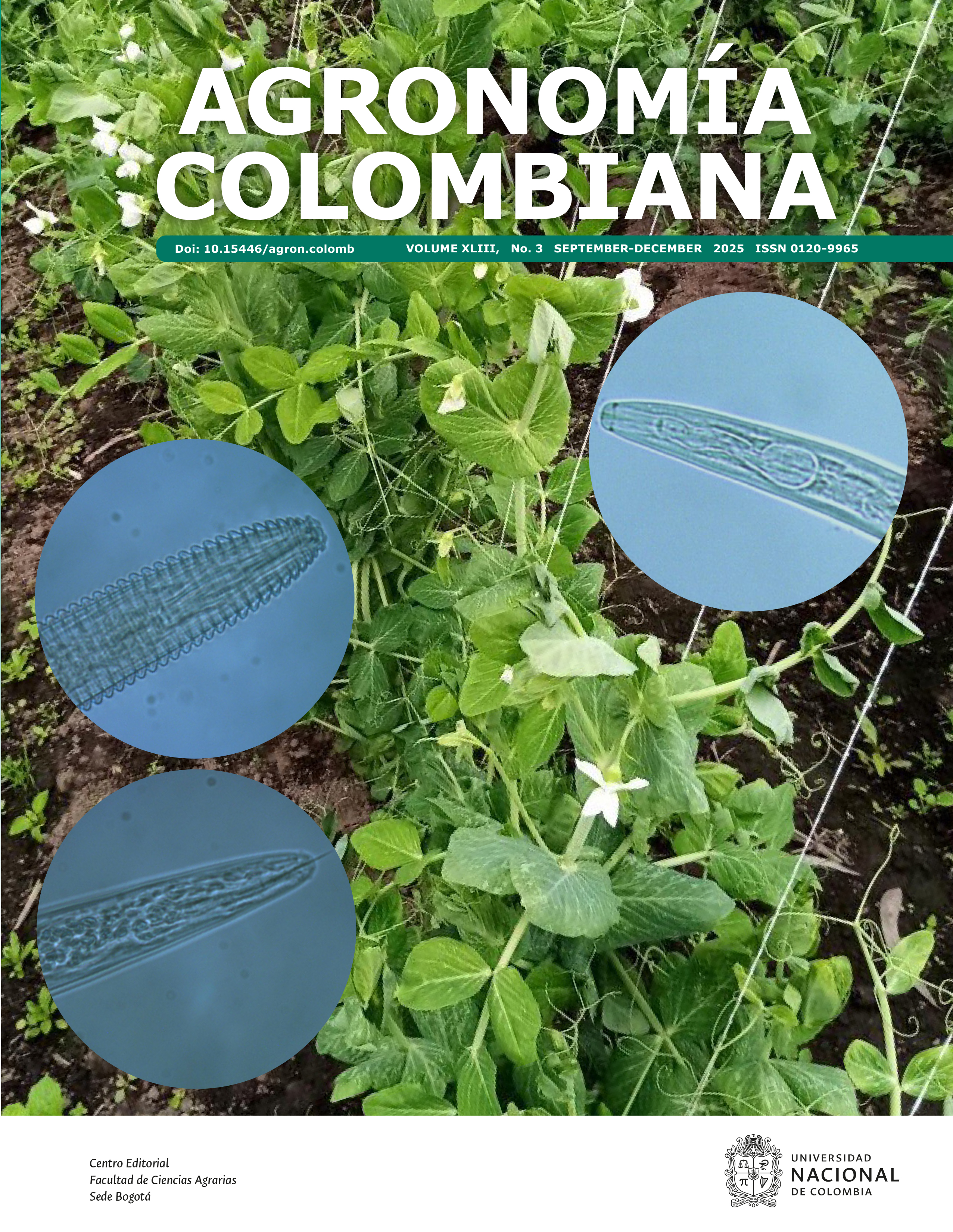
Nematode fauna in pea production areas of Cundinamarca, Colombia
Nematofauna en zonas productoras de arveja en Cundinamarca, Colombia
DOI:
https://doi.org/10.15446/agron.colomb.v43n3.122051Keywords:
ecology, leguminous plants, Simpson diversity index, soil pathogens, trophic levels (en)ecología, leguminosas, índice de diversidad de Simpson, patógenos del suelo, niveles tróficos (es)
Downloads
Despite their importance, the presence of plant-parasitic nematodes that affect pea crops in Colombia remains unknown. To determine the nematode fauna present in the pea crop areas of Cundinamarca (Colombia), 68 soil samples were collected from the municipalities of Une, Subachoque, Madrid, and Mosquera and analyzed. Nematodes were extracted using a sieving centrifugal-flotation technique and identified using standard taxonomic keys. Tylenchus was common across all locations, and Pratylenchus was found in three of the four municipalities under study. In addition, Helicotylenchus, Paratylenchus, and Globodera were found in two of four locations. Rotylenchus and Tylenchorhynchus were only recollected in Subachoque, while Monotrichodorus was found only in Une, and Nothocriconemoides, in Mosquera. Regarding relative abundance: Une, Mosquera, and Subachoque showed high percentages of plant-parasitic nematodes (68.0%, 54.8%, and 35.7%, respectively). In contrast, bacterial feeder nematodes were more abundant in Madrid (51.3%). Subachoque had the greatest diversity (0.83), followed by Une (0.80), Mosquera (0.76), and Madrid (0.59), according to Simpson’s diversity index. The genera Monotrichodorus and Nothocriconemoides, found in pea-producing areas of Colombia, had not been previously reported. The results obtained represent the first approach to nematode fauna in pea-producing regions of Cundinamarca.
A pesar de su importancia, aún se desconoce la presencia de nematodos fitoparásitos que afectan los cultivos de arveja en Colombia. Para determinar la nematofauna presente en zonas de cultivo de arveja de Cundinamarca (Colombia), se recolectaron y analizaron 68 muestras de suelo de los municipios de Une, Subachoque, Madrid y Mosquera. Los nematodos se extrajeron mediante la técnica de tamizado y centrifugación y se identificaron mediante claves taxonómicas estándar. Como resultado, Tylenchus fue común en todas las localidades, Pratylenchus se encontró en tres de los cuatro municipios de estudio, y los géneros Helicotylenchus, Paratylenchus y Globodera, en dos de los cuatro municipios. Rotylenchus y Tylenchorhynchus sólo se encontraron en Subachoque, en tanto, Monotrichodorus solo se encontró en Une y Nothocriconemoides en Mosquera. En cuanto a la abundancia relativa, Une, Mosquera y Subachoque mostraron porcentajes elevados de nematodos fitoparásitos (68,0%, 54,8% y 35,7%, respectivamente), mientras que los nematodos bacteriófagos fueron más abundantes en Madrid (51,3%). Subachoque presentó la mayor diversidad (0,83), seguido de Une (0,79), Mosquera (0,76) y Madrid (0,59) según el índice de diversidad de Simpson. Los géneros Monotrichodorus y Nothocriconemoides identificados en este estudio no han sido previamente reportados en zonas productoras de arveja en Colombia. Los resultados obtenidos son una primera aproximación a la nematofauna presente en zonas productoras de arveja en Cundinamarca.
References
Atira, L. S., & Kakouli-Duarte, T. (2025). Implications of fertilisation on soil nematode community structure and nematode-mediated nutrient cycling. Crops, 5(50), 1–32. https://doi.org/10.3390/crops5040050
Berg, M. P., & Bengtsson, J. (2007). Temporal and spatial variability in soil food web structure. Oikos, 116(11), 1789–1804. https://doi.org/10.1111/j.0030-1299.2007.15748.x
Buriticá, P. (1999). Directorio de patógenos y enfermedades de las plantas de importancia económica en Colombia. Instituto Colombiano Agropecuario & Universidad Nacional de Colombia. http://hdl.handle.net/20.500.12324/16404
Burrows, M., Pasche, J., Harveson, R., Porter, L., & Chen, W. (2020). Diseases of pea (Pisum sativum L.). The American Phytopathological Society. https://www.apsnet.org/edcenter/resources/commonnames/Pages/Pea.aspx
Cares, J. E., & Huang, S. P. (2012). Nematodos del suelo. In F. M. Atira, L. S. Moreira, E. J. Huising, & D. E. Bignell (Eds.), Manual de biología de suelos tropicales: muestreo y caracterización de la biodiversidad bajo suelo (pp. 163–176). Instituto Nacional de Ecología, México D.F. https://books.google.com.co/books?id=m-QMZaBiP0YC&pg=PA17&hl=es&source=gbs_toc_r&cad=2#v=onepage&q&f=false
Castillo, P., Navas-Cortés, J. A., Landa, B. B., Jiménez-Díaz, R. M., & Vovlas, N. (2008). Plant-parasitic nematodes attacking chickpea and their in planta interactions with rhizobia and phytopathogenic fungi. Plant Disease, 92(6), 840–853. https://doi.org/10.1094/PDIS-92-6-0840
Centre for Agricultural Bioscience Internacional (CABI). (2020). Heterodera goettingiana (pea cysteelworm). PlantwisePlus Knowledge Bank. CABI.
Charchar, J. M., Marouelli, W. A., Giordano, L. B., & Aragão, F. A. S. (2005). Reprodução de Meloidogyne incognita raça 1 e produtividade de cultivares de ervilha sob diferentes lâminas de água. Pesquisa Agropecuária Brasileira, 40(10), 989–995. https://doi.org/10.1590/S0100204X2005001000007
Correia, V. R., Rahman Khan, M., Lima, F. S. O., & Ahamad, F. (2023). Nematode problems in vegetable legumes and their sustainable management. In K. M. Rahman, & M. Quintanilla (Eds.), Nematode diseases of crops and their sustainable management (pp. 311–336). Elsevier. https://doi.org/10.1016/B978-0-323-91226-6.00029-8
Coutinho, R. R., Faleiro, V. O., Neto, A. L. F., Meneguci, J. L. P., & Freitas, L. G. (2018). Nematode communities as biological indicators of disturbance in agricultural systems. Nematropica, 48(2), 186–197. https://journals.flvc.org/nematropica/article/view/107831
Coyne, D. L., Nicol, J. M., & Claudius-Cole, B. (2007). Nematología práctica: Una guía de campo y laboratorio. SP-IPM Secretariat, International Institute of Tropical Agriculture (IITA), Cotonou, Benin. https://www.researchgate.net/publication/237249582_Nematologia_practica_Una_guia_de_campo_y_laboratorio
Decraemer, W. (1995). The family Trichodoridae: stubby root and virus vector nematodes. Springer Dordrecht. https://link.springer.com/book/10.1007/978-94-015-8482-1
Decraemer, W., Palomares-Rius, J. E., Cantalapiedra-Navarrete, C., Landa, B. B., Duarte, I., Almeida, T., Vovlas, N., & Castillo, P. (2013). Seven new species of Trichodorus (Diphtherophorina, Trichodoridae) from Spain, an apparent centre of speciation. Nematology, 15(1), 57–100. https://doi.org/10.1163/156854112x645598
Dobosz, R., & Krawczyk, R. (2019). Meloidogyne hapla development on growing legume plants. Short Communication. Plant Protection Science, 55(4), 274–277. https://doi.org/10.17221/156/2018-PPS
Du Preez, G., Daneel, M., De Goede, R., Du Toit, M. J., Ferris, H., Fourie, H., Geisen S., Kakouli Duarte, T., Korthals, G., Sánchez-Moreno, S., & Henrik Schmidt, J. (2022). Nematode-based indices in soil ecology: Application, utility, and future directions. Soil Biology and Biochemistry, 169, Article 108640. https://doi.org/10.1016/j.soilbio.2022.108640
European and Mediterranean Plant Protection Organization (EPPO). (2017). PM 7/40 (4) Globodera rostochiensis and Globodera pallida. EPPO Bulletin, 47(4), 174–197. https://doi.org/10.1111/epp.12391
European and Mediterranean Plant Protection Organization (EPPO). (2024). Globodera rostochiensis. EPPO Global Database. https://gd.eppo.int/taxon/HETDRO/datasheet
Federación Nacional de Cultivadores de Cereales – FENALCE. (2023). Datos al grano: cereales, leguminosas y soya. https://fenalce.co/wp-content/uploads/2024/12/Datos-al-Grano-2024A.pdf
Ferraz, L., & Brown, D. J. F. (2016). Nematologia de plantas: fundamentos e importância. Sociedade Brasileira de Nematologia. https://www.researchgate.net/publication/303825570_Nematologia_de_Plantas_fundamentos_e_importancia
Ferris, H., Goodell, P., & McKenry, M. (1981). Sampling for nematodes. California Agriculture, 35(5), 13–15. https://californiaagriculture.org/article/111194-sampling-for-nematodes
Geraert, E. (2010). The Criconematidae of the world: identification of the family Criconematidae (Nematoda). Academia Press Belgium. https://www.researchgate.net/publication/259653904
Ghaderi, R., Hayden, H. L., Jayaramaiah, R. H., Hu, H. W., & He, J. Z. (2025). An innovative framework fosters the practical application of nematode-based indices in soil health assessment. European Journal of Soil Science, 76(4), Article e70149. https://doi.org/10.1111/ejss.70149
Gomes, G. S., Huang, S. P., & Cares, J. E. (2003). Nematode community, trophic structure, and population fluctuation in soybean fields. Fitopatologia Brasileira, 28(3), 258–266. https://doi.org/10.1590/S0100-41582003000300006
Hassan, S., Al-Gendy, A. A., Abdel-Baset, S. H., Abd El-Kareem, S. M., Massoud, I. S., & Abdallah, M. Y. (2020). Biofumigation potentials of some Brassica crops to control root-knot nematodes, Meloidogyne spp., on tomato under field conditions. Journal of Plant Pathology & Microbiology, 11(12), Article 527. https://www.walshmedicalmedia.com/open-access/biofumigation-potentials-of-some-brassica-crops-to-controlrootknot-nematodes-emmeloidogyneem-spp-on-tomatounder-field-conditions-62392.html
Hernández-Ochandia, D., Rodríguez Hernández, M. G., Miranda Cabrera, I., & Holgado, R. (2016). Métodos para la extracción de nematodos presentes en suelos del agrupamiento Ferralítico en Cuba. Revista Protección Vegetal, 31(3), 228–232. https://www.researchgate.net/publication/317512983_Metodos_para_la_extraccion_de_nematodos_presentes_en_suelos_del_agrupamiento_Ferralitico_en_Cuba
Holguin, C. M., Rojas, D. A., Pérez, O. Y., & Marchant, S. (2023). First detection of the potato cyst nematode, Globodera rostochiensis infecting potato in the Central region of Colombia. Plant Disease, 107(9), Article 2889. https://doi.org/10.1094/PDIS-04-23-0751-PDN
Hu, C., & Qi, C. (2010). Abundance and diversity of soil nematodes as influenced by different types of organic manure. Helminthologia, 47(1), 58–66. https://doi.org/10.2478/s11687-010-0009-8
Hunt, D. (1993). Aphelenchida, Longidoridae and Trichodoridae: Their systematics and bionomics. CAB International. https://www.cabidigitallibrary.org/doi/book/10.1079/9780851987583.0000
Jenkins, W. R. (1964). A rapid centrifugal-flotation technique for separating nematodes from soil. Plant Disease Reporter, 48(9), 692. https://www.cabidigitallibrary.org/doi/full/10.5555/19650801105
Jiang, Y., Zhou, H., Chen, L., Yuan, Y., Fang, H., Luan, L., Chen, Y., Wang, X., Liu, M., Li, H., Peng, X., & Sun, B. (2018). Nematodes and microorganisms interactively stimulate soil organic carbon turnover in the macroaggregates. Frontiers in Microbiology, 9, Article 2803. https://doi.org/10.3389/fmicb.2018.02803
Kimenju, J., Karanja, N., Mutua, G., Rimberia, B., & Wachira, P. (2009). Nematode community structure as influenced by land use and intensity of cultivation. Tropical and Subtropical Agroecosystems, 11, 353–360. https://erepository.uonbi.ac.ke/handle/11295/12158
Lankubee, M. C., Sumita, K., Singh, Y. A., & Patil, A. A. (2024). Management of root-knot nematodes in peas using bacterial and fungal bio-agents: a review. International Journal of Current Microbiology and Applied Sciences, 13(3), 102–112. https://doi.org/10.20546/ijcmas.2024.1303.008
Loof, P. A. A. (1991). The family Pratylenchidae Thorne, 1949. In W. R. Nickle (Ed.), Manual of agricultural nematology (pp. 363–421). CRC Press. https://doi.org/10.1201/9781003066576
Lugo, Z., Crozzoli, R., Greco, N., Perichi, G., & Fernández, A. (2010). Nemátodos fitoparásitos asociados a hortalizas en el estado Falcón, Venezuela. Fitopatología Venezolana, 23, 16–21. https://www.researchgate.net/publication/328368742_NEMATODOS_FITOPARASITOS_ASOCIADOS_A_HORTALIZAS_EN_EL_ESTADO_FALCON_VENEZUELA
Maas, P. W. T., Loof, P. A. A., & De Grisse, A. (1971). Nothocriconemoides lineolatus (n. gen., n. sp. Nematoda: Criconematidae). Mededelingen van de Faculteit Landbouwwetenschappen, Rijksuniversiteit Gent, 36(2), 711–715. https://www.cabidigitallibrary.org/doi/full/10.5555/19722000443
Maria, M., Miao, W., Cai, R., Castillo, P., & Zheng, J. (2020). A new rare nematode Nothocriconemoides hangzhouensis n. sp. (Nematoda: Criconematidae) from Hangzhou, China. Journal of Nematology, 52(1), 1–14. https://doi.org/10.21307/jofnem-2020-006
Mashela, P. W., De Waele, D., Dube, Z., Khosa, M. C., Pofu, K. M., Tefu, G., Daneel, M. S., & Fourie, H. (2017). Alternative nematode management strategies. In H. Fourie, V. Spaull, R. Jones, M. Daneel, & D. De Waele (Eds.), Nematology in South Africa: A view from the 21st century (pp. 151–181). Springer, Cham. https://doi.org/10.1007/978-3-319-44210-5_7
Melo, J. M. M. D., Pedrosa, E. M. R., Lopes, I., Vicente, T. F. S., Morais, T. F., & Rolim, M. M. (2025). How do nematode communities and soil properties interact in riparian areas of Caatinga under native vegetation and agricultural use? Diversity, 17(514), Article 514. https://doi.org/10.3390/d17080514
Mo, Y. X., Mo, A. S., Qiu, Z. Q., Li, B. X., & Wu, H. Y. (2021). Systematic investigation of plant-parasitic nematodes associated with main subtropical crops in Guangxi province, China. Life, 11(11), Article 1177. https://doi.org/10.3390/life11111177
Nisa, R. U., Tantray, A. Y., Kouser, N., Allie, K. A., Wani S. M., Alamri, S. A., Alyemeni, M. N., Wijaya, L., & Shah, A. A. (2021). Influence of ecological and edaphic factors on biodiversity of soil nematodes. Saudi Journal of Biological Science, 28(5), 3049–3059. https://doi.org/10.1016/j.sjbs.2021.02.046
Oliveira, C. M. G., Santos, M. A., & Silva e Castro, L. H. (2016). Diagnose de fitonematoides. Millennium Editora. https://www.researchgate.net/profile/Claudio-Oliveira/publication/307629354_Diagnose_de_Fitonematoides/links/63a0417c40358f78eb015dcc/Diagnose-de-Fitonematoides.pdf
Pen-Mouratov, S., Hu, C., Hindin, E., & Steinberger, Y. (2010). Effect of sand-dune slope orientation on soil free-living nematode abundance and diversity. Helminthologia, 47(3), 179–188. https://doi.org/10.2478/s11687-010-0027-6
Pimentel, C., Khan, M. R., Zheng, Y., & Quintanilla, M. (2023). Nematode problems in forests and their sustainable management, In M. R. Khan, & M. Quintanilla (Eds.), Nematode diseases of crops and their sustainable management (pp. 457–493). Academic Press. https://doi.org/10.1016/B978-0-323-91226-6.00003-1
Pinto, T., Cunha, D., Silva, G., Pinheiro, J., Correia, V., Ragassi, C., & Cares, J. (2024). Reaction of Brazilian genotypes of pulses (pea, chickpea and lentil) to the root-knot nematode Meloidogyne enterolobii. Nematology, 26(3), 299–307. https://doi.org/10.1163/15685411-bja10309
Pires, D., Orlando, V., Collett, R. L., Moreira, D., Costa, S. R., & Inácio, M. L. (2023). Linking nematode communities and soil health under climate change. Sustainability, 15(15), Article 11747. https://doi.org/10.3390/su151511747
Puissant, J., Villenave, C., Chauvin, C., Plassard, C., Blanchart, E., & Trap, J. (2021). Quantification of the global impact of agricultural practices on soil nematodes: A meta-analysis. Soil Biology and Biochemistry, 161, Article 11747. https://doi.org/10.1016/j.soilbio.2021.108383.
R Core Team. (2024). A language and environment for statistical computing. R Foundation for Statistical Computing, Vienna, Austria. https://www.R-project.org
Raski, D. J., & Luc, M. (1987). A reappraisal of Tylenchina (Nemata) 10. The superfamily Criconematoidea Taylor, 1936. Revue de Nématologie, 10(4), 409–444. https://horizon.documentation.ird.fr/exl-doc/pleins_textes/pleins_textes_5/pt5/nemato/27663.pdf
Renčo, M., Gömöryová, E., & Čerevková, A. (2020). The effect of soil type and ecosystems on the soil nematode and microbial communities. Helminthologia, 57(2), 129–144. https://doi.org/doi:10.2478/helm-2020-0014
Rusinque, L., Camacho, M. J., Serra, C., Nobrega, F., & Inacio, M. L. (2023). Root-knot nematode assessment: species identification, distribution, and new host records in Portugal. Frontiers in Plant Science, 14, Article 1230968. https://doi.org/10.3389/fpls.2023.1230968
Sánchez-Moreno, S., Nicola, N. L., Ferris, H., & Zalom, F. G. (2009). Effects of agricultural management on nematode mite assemblages: Soil food web indices as predictors of mite community composition. Applied Soil Ecology, 41(1), 107–117. https://doi.org/10.1016/j.apsoil.2008.09.004
Sánchez-Moreno, S., & Talavera, M. (2013). Los nematodos como indicadores ambientales en agroecosistemas. Ecosistemas, 22(1), 50–55. https://www.revistaecosistemas.net/index.php/ecosistemas/article/view/765
Santos, J. M., Gonzaga, V., & Soares, P. L. M. (2009). Uma chave ilustrada e comentada para identificação das espécies mais comuns de Pratylenchus Filipjev do Brazil. Nematología Brasileira, 33(4), 350–351. https://nematologia.com.br/files/revnb/33_4.pdf
Seinhorst, J. W. (1959). A rapid method for the transfer of nematodes from fixative to anhydrous glycerin. Nematologica, 4, 67–69. https://brill.com/view/journals/nema/4/1/article-p67_9.xml
Singh, S. K, Hodda, M., & Ash, G. J. (2013). Plant-parasitic nematodes of potential phytosanitary importance, their main hosts and reported yield losses. EPPO Bulletin, 43(2), 334–374. https://doi.org/10.1111/epp.12050
Tamayo, P. J. (2000). Enfermedades del cultivo de la arveja en Colombia: Guía de reconocimiento y control. Boletín Técnico. CORPOICA-FENALCE. http://hdl.handle.net/20.500.12324/13448
The Nematode Information System (NEMAPLEX). (2024, December). The “nematode information system” a virtual encyclopediaon nematodes. http://nemaplex.ucdavis.edu
Timper, P., Davis, R., Jagdale, G., & Herbert, J. (2012). Resiliency of a nematode community and suppressive service to tillage and nematicide application. Applied Soil Ecology, 59, 48–59. https://doi.org/10.1016/j.apsoil.2012.04.001
Varela-Benavides, I. (2014). Las comunidades de nemátodos como indicadores ambientales. Tecnología en Marcha, 27, 30–37. https://www.redalyc.org/articulo.oa?id=699878408004
Wiesel, L., Daniell, T. J., King, D., & Neilson, R. (2015). Determination of the optimal soil sample size to accurately characterise nematode communities in soil. Soil Biology and Biochemistry, 80, 89–91. https://doi.org/10.1016/j.soilbio.2014.09.026
Yeates, G. W., Ferris, H., Moens, T., & van der Putten, W. H. (2009). The role of nematodes in ecosystems. In M. J. Wilson, & T. Kakouli-Duarte (Eds.), Nematodes as environmental indicators (pp. 1−44). CAB International. https://doi.org/10.1079/9781845933852.0001
Zhao, D., Wang, Y., Wen, L., Qu, H., Zhang, Z., Zhang, H., Jia, Y., Wang, J., Feng, Y., Li, Y., Yang, F., & Pan, F. (2022). Response of soil nematode community structure and function to monocultures of pumpkin and melon. Life, 12(1), Article 102. https://doi.org/10.3390/life12010102
How to Cite
APA
ACM
ACS
ABNT
Chicago
Harvard
IEEE
MLA
Turabian
Vancouver
Download Citation
License
Copyright (c) 2025 Agronomía Colombiana

This work is licensed under a Creative Commons Attribution-NonCommercial-ShareAlike 4.0 International License.
© Centro Editorial de la Facultad de Ciencias Agrarias, Universidad Nacional de Colombia
Reproduction and quotation of material appearing in the journal is authorized provided the following are explicitly indicated: journal name, author(s) name, year, volume, issue and pages of the source. The ideas and observations recorded by the authors are their own and do not necessarily represent the views and policies of the Universidad Nacional de Colombia. Mention of products or commercial firms in the journal does not constitute a recommendation or endorsement on the part of the Universidad Nacional de Colombia; furthermore, the use of such products should comply with the product label recommendations.
The Creative Commons license used by Agronomia Colombiana journal is: Attribution - NonCommercial - ShareAlike (by-nc-sa)

Agronomia Colombiana by Centro Editorial of Facultad de Ciencias Agrarias, Universidad Nacional de Colombia is licensed under a Creative Commons Reconocimiento-NoComercial-CompartirIgual 4.0 Internacional License.
Creado a partir de la obra en http://revistas.unal.edu.co/index.php/agrocol/.