Correo Electrónico
 DNINFOA - SIA
 Bibliotecas
 Convocatorias
 Identidad U.N.


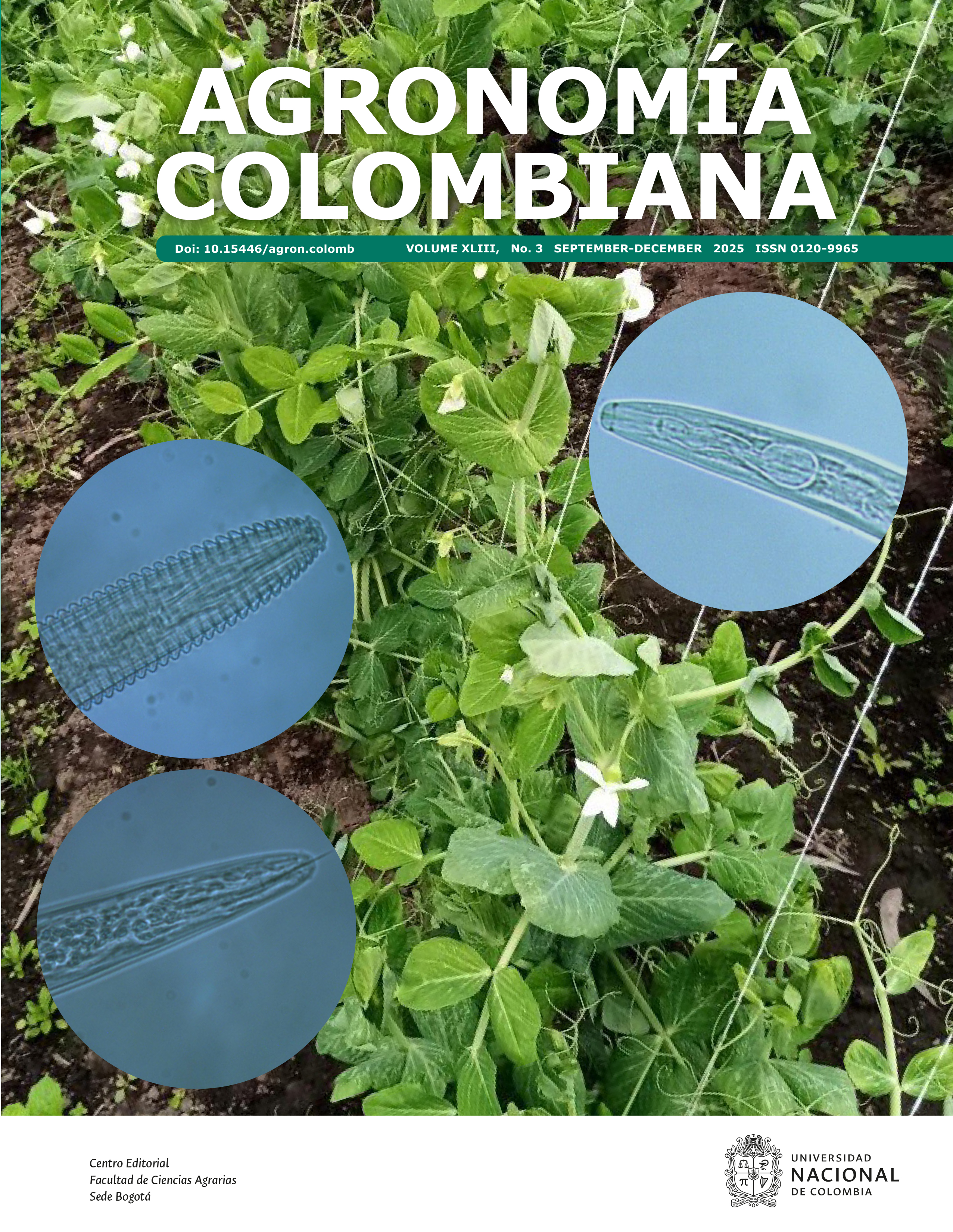
Published
Interactive effects of soil-applied glyphosate concentration and timing of monoammonium phosphate application on rice plants
Efectos interactivos de la concentración del glifosato aplicado al suelo y el momento de aplicación del fosfato monoamónico en plantas de arroz
DOI:
https://doi.org/10.15446/agron.colomb.v43n3.122063Keywords:
phosphate fertilizer, bioavailability, plant metabolism, shikimic acid, soil-plant interaction (en)fertilizante fosfatado, biodisponibilidad, metabolismo vegetal, ácido shikímico, interacción suelo-planta (es)
Downloads
This study evaluated the effect of monoammonium phosphate (MAP) on glyphosate (GLY) bioavailability in soil and its impact on rice plant metabolism and biomass production. A greenhouse experiment was conducted using three Colombian soils (CS1, CS2, CS3), four treatment strategies, and six GLY doses (0-12 L ha⁻¹). Treatments differed in the timing of MAP application relative to GLY: before, simultaneously, or after herbicide application. MAP was applied at 60 kg P ha⁻¹. Results showed that GLY availability in the rhizosphere led to significant increases in leaf shikimic acid (SA), a marker of herbicide-induced stress. SA accumulation and biomass reduction were both dose-dependent, with the greatest physiological impacts observed under simultaneous or post-herbicide phosphate application. MAP addition to soil enhanced GLY mobility by promoting desorption from soil particles, intensifying its uptake and metabolic effects on the plants. While GLY exposure did not induce lethal symptoms, it caused clear sub-lethal alterations in metabolism and growth. These findings highlight the importance of managing phosphate-herbicide interactions to reduce unintended effects on crop performance.
Este estudio evaluó el efecto del fosfato monoamónico (MAP) sobre la biodisponibilidad del glifosato (GLY) en el suelo y su impacto en el metabolismo y la producción de biomasa de las plantas de arroz. Se realizó un experimento en invernadero utilizando tres suelos colombianos (CS1, CS2, CS3), cuatro estrategias de tratamiento y seis dosis de GLY (0-12 L ha⁻¹). Los tratamientos difirieron en el momento de aplicación del MAP en relación con el GLY: antes, simultáneamente o después de la aplicación del herbicida. El MAP se aplicó a una dosis de 60 kg P ha⁻¹. Los resultados mostraron que la disponibilidad de GLY en la rizosfera condujo a aumentos significativos del ácido shikímico (AS) foliar, un marcador de estrés inducido por herbicidas. La acumulación de SA y la reducción de la biomasa fueron dependientes de la dosis, observándose los mayores impactos fisiológicos con la aplicación simultánea o posterior al herbicida del MAP. La adición de MAP al suelo mejoró la movilidad del GLY al promover la desorción de las partículas del suelo, intensificando su absorción y sus efectos metabólicos en las plantas. Si bien la exposición a GLY no indujo síntomas letales, causó alteraciones subletales evidentes en el metabolismo y el crecimiento. Estos hallazgos resaltan la de gestionar las interacciones entre fosfato y herbicida para reducir los efectos no deseados en el rendimiento del cultivo.
References
Belz, R. G., & Duke, S. O. (2014). Herbicides and plant hormesis. Pest Management Science, 70(5), 698–707. https://doi.org/10.1002/ps.3726
Borggaard, O. K., Raben-Lange, B., Gimsing, A. L., & Strobel, B. W. (2005). Influence of humic substances on phosphate adsorption by aluminium and iron oxides. Geoderma, 127(3–4), 270–279. https://doi.org/10.1016/j.geoderma.2004.12.011
Bott, S., Tesfamariam, T., Kania, A., Eman, B., Aslan, N., Römheld, V., & Neumann, G. (2011). Phytotoxicity of glyphosate soil residues re-mobilised by phosphate fertilization. Plant and Soil, 342(1–2), 249–263. https://doi.org/10.1007/s11104-010-0689-3
Brito, I. P. F. S., Tropaldi, L., Carbonari, C. A., & Velini, E. D. (2018). Hormetic effects of glyphosate on plants. Pest Management Science, 74(5), 1064–1070. https://doi.org/10.1002/ps.4523
Bustos López, M. C. (2012). Destino ambiental del glifosato en una zona arrocera del Tolima, Colombia [Doctoral dissertation, Universidad Nacional de Colombia, Bogotá]. https://repositorio.unal.edu.co/bitstream/handle/unal/10422/7797036.2012.pdf?sequence=1
Cakmak, I., Yazici, A., Tutus, Y., & Ozturk, L. (2009). Glyphosate reduced seed and leaf concentrations of calcium, magnesium, manganese, and iron in non-glyphosate-resistant soybean. European Journal of Agronomy, 31(3), 114–119. https://doi.org/10.1016/j.eja.2009.07.001
Calabrese, E. J. (2003). The maturing of hormesis as a credible dose-response model. Nonlinearity in Biology, Toxicology, and Medicine, 1(3), 319–343. https://doi.org/10.1080/15401420390249907
Dotor-Robayo, M. Y., Guerrero-Dallos, J. A., & Martínez-Cordón, M. J. (2022). Influence of monoammonium phosphate on glyphosate adsorption-desorption in tropical soils: effect of the order of sorbate additions. Chemosphere, 303(Part 1), Article 135030. https://doi.org/10.1016/j.chemosphere.2022.135030
Dotor Robayo, M., Martínez Cordón, M., & Okada, E. (2024). Effect of the phosphate and mineralogical composition on the movement and mineralization of glyphosate in clay soils. International Journal of Environmental Science and Technology, 21, 9365–9375. https://doi.org/10.1007/s13762-024-05707-4
Duke, S. O., Lydon, J., Koskinen, W. C., Moorman, T. B., Chaney, R. L., & Hammerschmidt, R. (2012). Glyphosate effects on plant mineral nutrition, crop rhizosphere, microbiota, and plant disease in glyphosate-resistant crops. Journal of Agricultural and Food Chemistry, 60(42), 10375–10397. https://doi.org/10.1021/jf302436u
Fenn, R. A., Kadyampakeni, D. M., Kanissery, R. G., Judy, J., & Bashyal, M. (2023). Phosphorus and glyphosate adsorption and desorption trends across different depths in sandy soil. Agrochemicals, 2(4), 503–516. https://doi.org/10.3390/agrochemicals2040028
Ferreira, M. F., Torres, C., Bracamonte, E., & Galetto, L. (2023). Glyphosate affects the susceptibility of non-target native plant species, depending on their stage of development and degree of exposure in the landscape. Science of The Total Environment, 865, Article 161091. https://doi.org/10.1016/j.scitotenv.2022.161091
Gomes, M. P., Maccario, S., Lucotte, M., Labrecque, M., & Juneau, P. (2015). Consequences of phosphate application on glyphosate uptake by roots: Impacts for environmental management practices. Science of The Total Environment, 537, 115–119. https://doi.org/10.1016/j.scitotenv.2015.07.054
Gomes, M. P., Smedbol, E., Chalifour, A., Hénault‑Ethier, L., Labrecque, M., Lepage, L., Lucotte, M., & Juneau, P. (2014). Alteration of plant physiology by glyphosate and its by‑product aminomethylphosphonic acid: An overview. Journal of Experimental Botany, 65(17), 4691–4703. https://doi.org/10.1093/jxb/eru269
Hannan, A., Hoque, N., Hassan, L., & Robin, A. H. K. (2020). Adaptive mechanisms of the root system of rice for withstanding osmotic stress. In M. Ansari (Ed.), Recent advances in rice research, IntechOpen. https://doi.org/10.5772/intechopen.93815
Hayat, Q., Hayat, S., Irfan, M., & Ahmad, A. (2010). Effect of exogenous salicylic acid under changing environment: A review. Environmental and Experimental Botany, 68(1), 14–25. https://doi.org/10.1016/j.envexpbot.2009.08.005
Hébert, M.-P., Fugère, V., & Gonzalez, A. (2019). The overlooked impact of rising glyphosate use on phosphorus loading in agricultural watersheds. Frontiers in Ecology and the Environment, 17(1), 48–56. https://doi.org/10.1002/fee.1985
Helander, M., Pauna, A., Saikkonen, K., & Saloniemi, I. (2019). Glyphosate residues in soil affect crop plant germination and growth. Scientific Reports, 9, Article 19653. https://doi.org/10.1038/s41598-019-56195-3
Herrmann, K. M., & Weaver, L. M. (1999). The shikimate pathway. Annual Review of Plant Physiology and Plant Molecular Biology, 50, 473–503. https://doi.org/10.1146/annurev.arplant.50.1.473
Jalal, A., Oliveira Junior, J. C., Ribeiro, J. S., Fernandes, G. C., Mariano, G. G., Trindade, V. D. R., & Reis, A. R. (2021). Hormesis in plants: Physiological and biochemical responses. Ecotoxicology and Environmental Safety, 207, Article 111225. https://doi.org/10.1016/j.ecoenv.2020.111225
Jodeh, S., Attallah, M., Haddad, M., Hadda, T. B., Salghi, R., Jodeh, D., & Warad, I. (2014). Fate and mobility of glyphosate leachate in Palestinian soil using a soil column. Journal of Materials and Environmental Science, 5(6), 2008–2016. https://www.jmaterenvironsci.com/Document/vol5/vol5_N6/249-JMES-1313-2014-Jodi.pdf
Kanissery, R., Gairhe, B., Kadyampakeni, D., Batuman, O., & Alferez, F. (2019). Glyphosate: its environmental persistence and impact on crop health and nutrition. Plants, 8(11), Article 499. https://doi.org/10.3390/plants8110499
Mamy, L., & Barriuso, E. (2005). Glyphosate adsorption in soils compared to herbicides replaced by the introduction of glyphosate-resistant crops. Chemosphere, 61(6), 844–855. https://doi.org/10.1016/j.chemosphere.2005.04.051
Matallo, M. B., Almeida, S. D. B., Franco, D. A. S., Cerdeira, A. L., & Gazziero, D. L. P. (2014). Glyphosate as a tool to produce shikimic acid in plants. Planta Daninha, 32(3), 601−608. https://doi.org/10.1590/S0100-83582014000300016
McDowell, R. W., & Haygarth, P. M. (2025). Soil phosphorus stocks could prolong global reserves and improve water quality. Nature Food, 6, 31–35. https://doi.org/10.1038/s43016-024-01086-8
Muindi, E. M. (2019). Understanding soil phosphorus. International Journal of Plant & Soil Science, 31(2), 1−18. https://doi.org/10.9734/ijpss/2019/v31i230208
Okada, E., Pérez, D., De Gerónimo, E., Aparicio, V., Massone, H., & Costa, J. L. (2018). Non-point source pollution of glyphosate and AMPA in a rural basin from the southeast Pampas, Argentina. Environmental Science and Pollution Research, 25, 15120–15132. https://doi.org/10.1007/s11356-018-1734-7
Padilla, J. T., & Selim, H. M. (2019). Time-dependent sorption and desorption of glyphosate in soils: multi-reaction modeling. Vadose Zone Journal, 18(1), 1−10. https://doi.org/10.2136/vzj2018.12.0214
Peixoto, M. M., Bauerfeldt, G. F., Herbst, M. H., Pereira, M. S., & Silva, C. O. (2015). Study of the stepwise deprotonation reactions of glyphosate and the corresponding pKa values in aqueous solution. The Journal of Physical Chemistry B, 119(21), 5241–5249. https://doi.org/10.1021/jp5099552
Pline, W. A., Wilcut, J. W., Edmisten, K. L., & Wells, R. (2002). Physiological and morphological response of glyphosate-resistant and non-glyphosate-resistant cotton seedlings to root-absorbed glyphosate. Pesticide Biochemistry and Physiology, 73(1), 48–58. https://doi.org/10.1016/s0048-3575(02)00014-7
Rashmi, I., Biswas, A. K., Kartika, K. S., & Kala, S. (2018). Phosphorus leaching through column study to evaluate P movement and vertical distribution in black, red, and alluvial soils of India. Journal of the Saudi Society of Agricultural Sciences, 19(3), 241–248. https://doi.org/10.1016/j.jssas.2018.11.002
Saunders, L. E., & Pezeshki, R. (2015). Glyphosate in runoff waters and in the root zone: a review. Toxics, 3(4), 462–480. https://doi.org/10.3390/toxics3040462
Smith, F. W. (2002). The phosphate uptake mechanism. Plant and Soil, 245(1), 105–114. https://doi.org/10.1023/A:1020660023284
Taiz, L., Zeiger, E., Møller, I. M., & Murphy, A. (2017). Fisiologia e desenvolvimento de plantas (6th ed.). Artmed Press.
Tani, E., Chachalis, D., Travlos, I. S., & Bilalis, D. (2016). Environmental conditions influence the induction of key ABC-transporter genes that affect the glyphosate resistance mechanism in Conyza canadensis. International Journal of Molecular Sciences, 17(4), Article 342. https://doi.org/10.3390/ijms17040342
Velini, E. D., Alves, E., Godoy, M. C., Meschede, D. K., Souza, R. T., & Duke, S. O. (2008). Glyphosate applied at low doses can stimulate plant growth. Pest Management Science, 64(4), 489–496. https://pubmed.ncbi.nlm.nih.gov/18293284/
Vereecken, H. (2005). Mobility and leaching of glyphosate: a review. Pest Management Science, 61(12), 1139–1151. https://doi.org/10.1002/ps.1122
Waiman, C. V., Arroyave, J. M., Chen, H., Tan, W., Avena, M. J., & Zanini, G. P. (2016). The simultaneous presence of glyphosate and phosphate at the goethite surface, as observed by XPS, ATR-FTIR, and competitive adsorption isotherms. Colloids and Surfaces A: Physicochemical and Engineering Aspects, 498, 121–127. https://doi.org/10.1016/j.colsurfa.2016.03.049
Wang, Y., Zhou, D., & Sun, R. (2005). Effects of phosphate on the adsorption of glyphosate on three different types of Chinese soils. Journal of Environmental Sciences, 17(5), 711–715. https://pubmed.ncbi.nlm.nih.gov/16312989/
Yamada, T., Kremer, R. J., Camargo e Castro, P. R., & Wood, B. W. (2009). Glyphosate interactions with physiology, nutrition, and diseases of plants: Threat to agricultural sustainability? European Journal of Agronomy, 31(3), 111–113. https://doi.org/10.1016/j.eja.2009.07.004
How to Cite
APA
ACM
ACS
ABNT
Chicago
Harvard
IEEE
MLA
Turabian
Vancouver
Download Citation
License
Copyright (c) 2025 Agronomía Colombiana

This work is licensed under a Creative Commons Attribution-NonCommercial-ShareAlike 4.0 International License.
© Centro Editorial de la Facultad de Ciencias Agrarias, Universidad Nacional de Colombia
Reproduction and quotation of material appearing in the journal is authorized provided the following are explicitly indicated: journal name, author(s) name, year, volume, issue and pages of the source. The ideas and observations recorded by the authors are their own and do not necessarily represent the views and policies of the Universidad Nacional de Colombia. Mention of products or commercial firms in the journal does not constitute a recommendation or endorsement on the part of the Universidad Nacional de Colombia; furthermore, the use of such products should comply with the product label recommendations.
The Creative Commons license used by Agronomia Colombiana journal is: Attribution - NonCommercial - ShareAlike (by-nc-sa)

Agronomia Colombiana by Centro Editorial of Facultad de Ciencias Agrarias, Universidad Nacional de Colombia is licensed under a Creative Commons Reconocimiento-NoComercial-CompartirIgual 4.0 Internacional License.
Creado a partir de la obra en http://revistas.unal.edu.co/index.php/agrocol/.