Published
Genetic variability of Papaya ringspot virus isolates in Norte de Santander - Colombia
Variabilidad genética del virus de la mancha anular de la papaya en Norte de Santander - Colombia
DOI:
https://doi.org/10.15446/agron.colomb.v33n2.50095Keywords:
PRSV, coat protein, recombination, papaya, sequencing (en)PRSV, proteína de la cubierta, recombinación, papaya, secuenciación (es)
Downloads
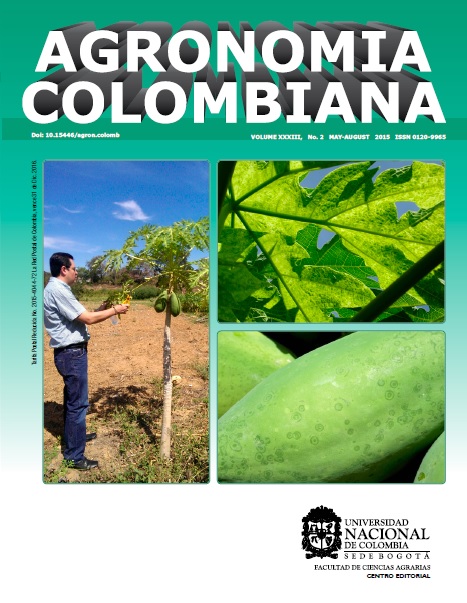
El virus de la mancha anular de la papaya (PRSV), un virus miembro de los potyvirus transmitidos por áfidos dentro de la familia Potyviridae, es el principal factor limitante para los cultivos de papaya (Carica papaya L.) y cucurbitáceas en todo el mundo, llegando a ocasionar pérdidas hasta del 100% de la producción. En este trabajo se realizó el estudio de la diversidad genética de diferentes aislados de PRSV colectados en dos localidades del departamento de Norte de Santander, Colombia. El análisis se realizó comparando las secuencias nucleotídicas de la región que codifica para la proteína de la cubierta (CP) de nueve aislados de la localidad de Villa del Rosario y 12 aislados de la localidad de Campo Hermoso. Para comparación el análisis incluyó tres secuencias de la CP de PRSV de aislados reportados en los departamentos colombianos de Arauca y Valle del Cauca y de otras secuencias informadas en el GenBank. Los análisis bioinformáticos sugieren que los aislados de PRSV de las localidades en Norte de Santander son distintos entre sí agrupándose en grupos filogenéticos diferentes, y se demostró la existencia de eventos de recombinación. Este es el primer estudio de variabilidad genética de PRSV a nivel local en Colombia.
References
Abdalla, O.A. and A. Ali. 2012. Genetic diversity in the 3'-terminal region of papaya ringspot virus (PRSV-W) isolates from watermelon in Oklahoma. Arch. Virol. 157, 405-412. Doi: 10.1007/s00705-011-1184-8
Akhtler, M.S., Y.B. Basavaraj, A.-M. Akanda, B. Mandal, and R.K. Jain. 2013. High incidence of seed transmission of Papaya ringspot virus and Watermelon mosaic virus, two viruses newly identified in Robinia pseudoacacia. Indian J. Virol. 24, 70-73.
Arango, L., C. Román, C. Salamanca, E. Almansa, J. Bernal, and P. Gómez. 2010. El cultivo de la papaya en Los Llanos Orientales de Colombia. Technical Assistance Manual No. 4. Corpoica; Sena; Asohofrucol, Bogota.
Bateson, M.F., J. Henderson, W. Chaleeprom, A.J. Gibbs, and J.L. Dale. 1994. Papaya ringspot potyvirus: isolate variability and the origin of PRSV type P (Australia). J. Gen. Virol. 75, 3547-3553. Doi: 10.1099/0022-1317-75-12-3547
Bateson, M.F., R.E. Lines, P. Revill, W. Chaleeprom, C.V. Ha, A.J. Gibbs, and J.L. Dale. 2002. On the evolution and molecular epidemiology of the potyvirus Papaya ringspot virus. J. Gen. Virol. 83, 2575-2585. Doi: 10.1099/0022-1317-83-10-2575
Bayot, R.G., V.N. Villegas, P.M. Magdalita, M.D. Jovellana, T.M. Espino, and S.B. Exconde. 1990. Seed transmissibility of papaya ringspot virus. Philipp. J. Crop Sci. 15, 107-111.
Benson, D.A., K. Clark, I. Karsch-Mizrachi, D.J. Lipman, J. Ostell, and E.W. Sayers. 2014. GenBank. Nucleic Acids Res. 42, D32-D37. Doi: 10.1093/nar/gkt1030
Bimboim, H.C. and J. Doly. 1979. A rapid alkaline extraction procedure for screening recombinant plasmid DNA. Nucleic Acids Res. 7, 1513-1523. Doi: 10.1093/nar/7.6.1513
Boni, M.F., D. Posada, and M.W. Feldman. 2007. An exact nonparametric method for inferring mosaic structure in sequence triplets. Genetics 176, 1035-1047. Doi: 10.1534/genetics.106.068874
Cabrera M., D., D. García H., M. Caballero Á., P. García M., and O. Portal V. 2011. Manejo de la mancha anular de la papaya mediante el uso de malla antiáfidos en viveros de Carica papaya L. var. Maradol roja. Fitosanidad 15, 241-244.
Chaves-Bedoya, G., M. Guzman-Barney, and L.Y. Ortiz-Rojas. 2013. Genetic structure and evidence of putative Darwinian diversifying selection in the Potato yellow vein virus (PYVV). Agron. Colomb. 31, 161-168.
Chin, M., Y. Rojas, J. Moret, G. Fermin, P. Tennant, and D. Gonsalves. 2007. Varying genetic diversity of Papaya ringspot virus isolates from two time-separated outbreaks in Jamaica and Venezuela. Arch. Virol. 152, 2101-2106. Doi: 10.1007/s00705-007-1035-9
Fernández-Rodríguez, T., L. Rubio, O. Carballo, and E. Marys. 2008. Genetic variation of papaya ringspot virus in Venezuela. Arch. Virol. 153, 343-349. Doi: 10.1007/s00705-007-1091-1
García-Arenal, F., A. Fraile, and J.M. Malpica. 2001. Variability and genetic structure of plant virus populations. Annu. Rev. Phytopathol. 39, 157-186. Doi: 10.1146/annurev.phyto.39.1.157
Gibbs, M.J., J.S. Armstrong, and A.J. Gibbs. 2000. Sister-scanning: a Monte Carlo procedure for assessing signals in recombinant sequences. Bioinformatics 16, 573-582. Doi: 10.1093/bioinformatics/16.7.573
Gonsalves, D. 1998. Control of papaya ringspot virus in papaya. Annu. Rev. Phytopathol. 36, 415-437. Doi: 10.1146/annurev.phyto.36.1.415
Gonsalves, D., S. Tripathi, J.B. Carr, and J.Y. Suzuki. 2010. Papaya ringspot virus. The Plant Health Instructor. The American Phytopathological Society (APS), St. Paul, MN. Doi: 10.1094/PHI-I-2010-1004-01
Jain, R.K., K.M. Nasiruddin, J. Sharma, R.P. Pant, and A. Varma. 2004. First report of occurrence of Papaya ringspot virus in Bangladesh. Plant Dis. 88, 221. Doi: 10.1094/PDIS.2004.88.2.221C
Jensen, D.D. 1949. Papaya virus diseases with special reference to papaya ringspot. Phytopathology 39, 191-211.
Kimura, M. 1980. A simple method for estimating evolutionary rate of base substitutions through comparative studies of nucleotide sequences. J. Mol. Evol. 16, 111-120. Doi: 10.1007/BF01731581
Kosakovsky Pond, S.L., D. Posada, M.B. Gravenor, C.H. Woelk, and S.D. Frost. 2006. Automated phylogenetic detection of recombination using a genetic algorithm. Mol. Biol. Evol. 23, 1891-1901. Doi: 10.1093/molbev/msl051
Kryazhimskiy, S. and J.B. Plotkin. 2008. The population genetics of dN/dS. PLoS Genet. 4, e1000304. Doi: 10.1371/journal.pgen.1000304
Kung, Y.J., H.J. Bau, Y.L. Wu, C.H. Huang, T.M. Chen, and S.D. Yeh. 2009. Generation of transgenic papaya with double resistance to Papaya ringspot virus and Papaya leaf-distortion mosaic virus. Phytopathology 99, 1312-1320. Doi: 10.1094/PHYTO-99-11-1312
Laney, A., M.V. Avanzato, and I.E. Tzanetakis. 2012. High incidence of seed transmission of Papaya ringspot virus and Watermelon mosaic virus, two viruses newly identified in Robinia pseudoacacia. Eur. J. Plant Pathol. 134, 227-230. Doi: 10.1007/s10658-012-9985-5
Lima, R.C., J.R. Souza, G. Pio-Riberro, and J.A. Lima. 2002. Sequences of the coat protein gene from Brazilian isolates of Papaya ringspot virus. Fitopatol. Bras. 27, 174-180. Doi: 10.1590/S0100-41582002000200009
Lole, K.S., R.C. Bollinger, R.S. Paranjape, D. Gadkari, S.S. Kulkarni, N.G. Novak, R. Ingersoll, H.W. Sheppard, and S.C. Ray. 1999. Full-length human immunodeficiency virus type 1 genomes from subtype C-infected seroconverters in India, with evidence of intersubtype recombination. J. Virol. 73, 152-160.
Mangrauthia, S.K., B. Parameswari, R.K. Jain, and S. Praveen. 2008. Role of genetic recombination in the molecular architecture of Papaya ringspot virus. Biochem. Genet. 46, 835-846. Doi: 10.1007/s10528-008-9198-y
Mangrauthia, S.K., P. Singh, and S. Praveen. 2010. Genomics of helper component proteinase reveals effective strategy for papaya ringspot virus resistance. Mol. Biotechnol. 44, 22-29. Doi: 10.1007/s12033-009-9205-5
Martin, D.P., P. Lemey, M. Lott, V. Moulton, D. Posada, and P. Lefeuvre. 2010. RDP3: a flexible and fast computer program for analyzing recombination. Bioinformatics 26, 2462-2463. Doi: 10.1093/bioinformatics/btq467
Martin, D.P., D. Posada, K.A. Crandall, and C. Williamson. 2005. A modified bootscan algorithm for automated identification of recombinant sequences and recombination breakpoints. AIDS Res. Hum. Retroviruses. 21, 98-102. Doi 10.1089/aid.2005.21.98
Moreno, I.M., J.M. Malpica, J.A. Diaz-Pendon, E. Moriones, A. Fraile, and F. García-Arenal. 2004. Variability and genetic structure of the population of watermelon mosaic virus infecting melon in Spain. Virology 318, 451-460. Doi: 10.1016/j.virol.2003.10.002
Moury, B., C. Morel, E. Johansen, and M. Jacquemond. 2002. Evidence for diversifying selection in Potato virus Y and in the coat protein of other potyviruses. J. Gen. Virol. 83, 2563-2573.
Noa-Carrazana, J.C., D. Gonzalez-de-Leon, and L. Silva-Rosales. 2007. Molecular characterization of a severe isolate of papaya ringspot virus in Mexico and its relationship with other isolates. Virus Genes 35, 109-117. Doi: 10.1007/s11262-006-0039-y; 10.1007/s11262-007-0099-7
Olarte Castillo, X.A., G. Fermin, J. Tabima, Y. Rojas, P.F. Tennant, M. Fuchs, R. Sierra, A.J. Bernal, and S. Restrepo. 2011. Phylogeography and molecular epidemiology of Papaya ringspot virus. Virus Res. 159, 132-140. Doi: 10.1016/j.virusres.2011.04.011
Padidam, M., S. Sawyer, and C.M. Fauquet. 1999. Possible emergence of new geminiviruses by frequent recombination. Virology 265, 218-225. Doi: 10.1006/viro.1999.0056
Paéz, A.R. 2003. Manejo del virus de la mancha anular de la papaya en la región Caribe colombiana. Corpoica, Valledupar, Colombia.
Pamilo, P. and N.O. Bianchi. 1993. Evolution of the Zfx and Zfy genes: rates and interdependence between the genes. Mol. Biol. Evol. 10, 271-281.
Posada, D. and K.A. Crandall. 2001. Evaluation of methods for detecting recombination from DNA sequences: computer simulations. Proc. Natl. Acad. Sci. USA 98, 13757-13762. Doi: 10.1073/pnas.241370698
Price, E.W. and I. Carbone. 2005. SNAP: workbench management tool for evolutionary population genetic analysis. Bioinformatics 21, 402-404. Doi: 10.1093/bioinformatics/bti003
Simmons, H.E., J.P. Dunham, K.E. Zinn, G.P. Munkvold, E.C. Holmes, and A.G. Stephenson. 2013. Zucchini yellow mosaic virus (ZYMV, Potyvirus): vertical transmission, seed infection and cryptic infections. Virus Res. 176, 259-264. Doi: 10.1016/j.virusres.2013.06.016
Smith, J.M. 1992. Analyzing the mosaic structure of genes. J. Mol. Evol. 34, 126-129. Doi: 10.1007/BF00182389
Suzuki, J.Y., S. Tripathi, and D. Gonsalves. 2007. Virus-resistant transgenic papaya: Commercial development and regulatory and environmental issues. In: Punja, Z., S.H. De Boer, and H. Sanfacon (eds.). Biotechnology and plant disease management. CABI, Oxfordshire, UK. Doi: 10.1079/9781845932886.0436
Sztuba-Solinska, J., A. Urbanowicz, M. Figlerowicz, and J.J. Bujarski. 2011. RNA-RNA recombination in plant virus replication and evolution. Annu. Rev. Phytopathol. 49, 415-443. Doi: 10.1146/annurev-phyto-072910-095351
Tafur R., R., J.C. Toro, and E. Garcia. 2006. Desarrollo de la fruticultura en el Norte de Santander. Ministerio de Agricultura y Desarrollo Rural; Gobernación de Norte de Santander, Cucuta, Colombia.
Tamura, K., J. Dudley, M. Nei, and S. Kumar. 2007. MEGA4: molecular evolutionary genetics analysis (MEGA) software version 4.0. Mol. Biol. Evol. 24, 1596-1599. Doi: 10.1093/molbev/msm092
Tan, Z., Y. Wada, J. Chen, and K. Ohshima. 2004. Inter- and intralineage recombinants are common in natural populations of Turnip mosaic virus. J. Gen. Virol. 85, 2683-2696. Doi: 10.1099/vir.0.80124-0
Tennant, P.F., C. Gonsalves, K. Ling, M. Fitch, R. Manshardt, J.L. Slightom, and D. Gonsalves. 1994. Differential protection against papaya ringspot virus isolates in coat protein gene transgenic papaya and classically cross-protected papaya. Phytopathology 84, 1359-1366. Doi: 10.1094/Phyto-84-1359
Tripathi, S., J.Y. Suzuki, S.A. Ferreira, and D. Gonsalves. 2008. Papaya ringspot virus-P: characteristics, pathogenicity, sequence variability and control. Mol. Plant Pathol. 9, 269-280. Doi: 10.1111/j.1364-3703.2008.00467.x
Wang, C. and S.D. Yeh. 1997. Divergence and conservation of the genomic RNAs of Taiwan and Hawaii strains of papaya ringspot potyvirus. Arch. Virol. 142, 271-285. Doi: 10.1007/s007050050076
Wilson, C.R. 2014. Applied plant virology. Gutenberg Press, Tarxien, Malta.
Yu, T.A., C.H. Chiang, H.W. Wu, C.M. Li, C.F. Yang, J.H. Chen, Y.W. Chen, and S.D. Yeh. 2011. Generation of transgenic watermelon resistant to Zucchini yellow mosaic virus and Papaya ringspot virus type W. Plant Cell Rep. 30, 359-371. Doi: 10.1007/s00299-010-0951-4
Dimensions
PlumX
Article abstract page views
Downloads
How to Cite
License
Copyright (c) 2015 Agronomía Colombiana

This work is licensed under a Creative Commons Attribution-NonCommercial-ShareAlike 4.0 International License.
© Centro Editorial de la Facultad de Ciencias Agrarias, Universidad Nacional de Colombia
Reproduction and quotation of material appearing in the journal is authorized provided the following are explicitly indicated: journal name, author(s) name, year, volume, issue and pages of the source. The ideas and observations recorded by the authors are their own and do not necessarily represent the views and policies of the Universidad Nacional de Colombia. Mention of products or commercial firms in the journal does not constitute a recommendation or endorsement on the part of the Universidad Nacional de Colombia; furthermore, the use of such products should comply with the product label recommendations.
The Creative Commons license used by Agronomia Colombiana journal is: Attribution - NonCommercial - ShareAlike (by-nc-sa)

Agronomia Colombiana by Centro Editorial of Facultad de Ciencias Agrarias, Universidad Nacional de Colombia is licensed under a Creative Commons Reconocimiento-NoComercial-CompartirIgual 4.0 Internacional License.
Creado a partir de la obra en http://revistas.unal.edu.co/index.php/agrocol/.