Published
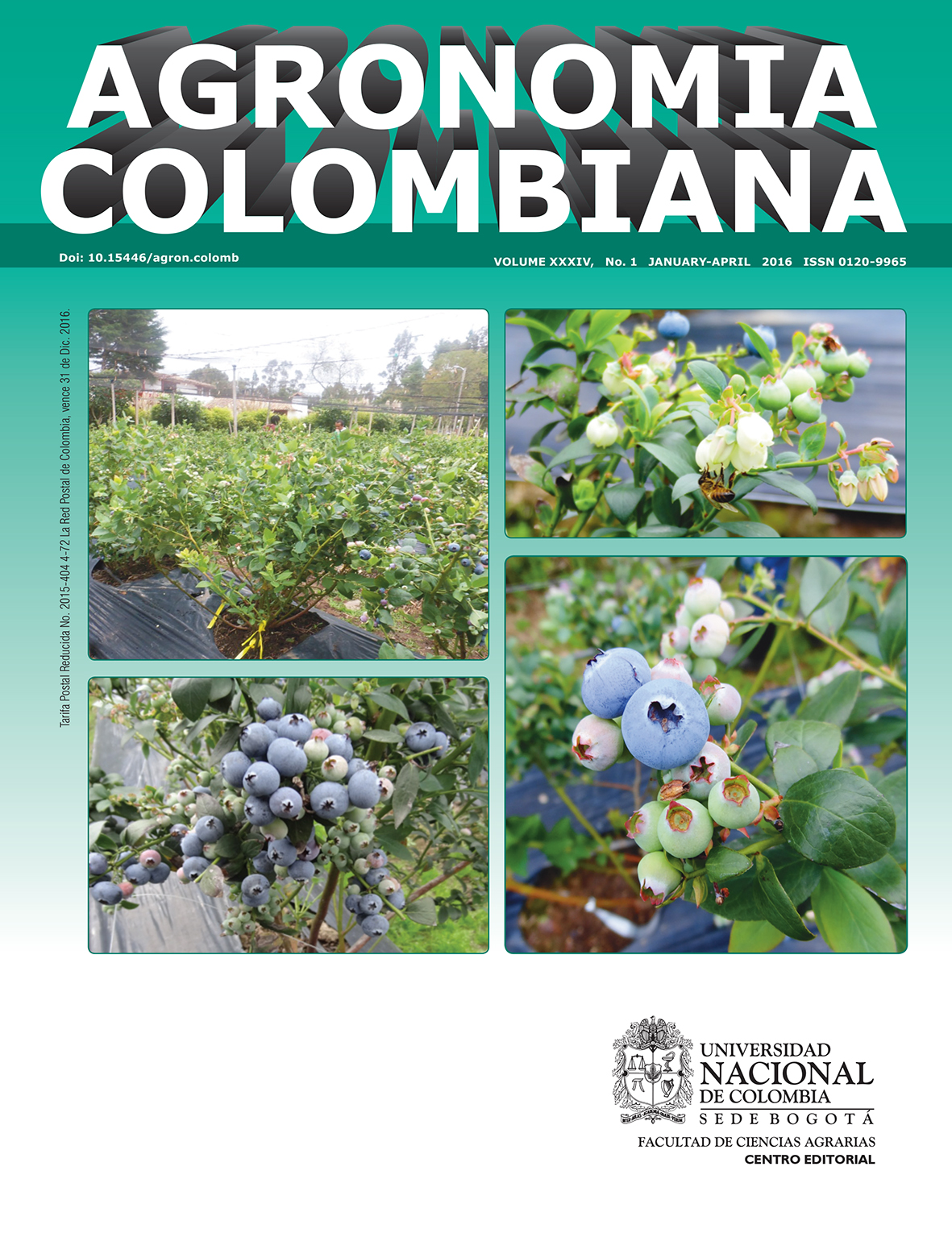
Yield and fruit quality of the blueberry cultivars Biloxi and Sharpblue in Guasca, Colombia
Rendimiento y calidad de frutos de los cultivares de arándano Biloxi y Sharpblue en Guasca, Colombia
DOI:
https://doi.org/10.15446/agron.colomb.v34n1.54897Keywords:
Vaccinium corymbosum × Vaccinium darrowii, highbush blueberries, harvest, crop performance, cultivar selection, soft fruits (en)Vaccinium corymbosum x Vaccinium darrowii, arándanos altos, cosecha, desempeño de cultivos, selección de cultivares, frutas de baya (es)
Downloads
References
Aung, T., Y. Muramatsu, N. Horiuchi, J. Che, Y. Mochizuki, and I. Ogiwara. 2014. Plant growth and fruit quality of blueberry in a controlled room under artificial light. J. Jpn. Soc. Hortic. Sci. 83, 273-281. Doi: 10.2503/jjshs1.CH-110
Borlando V., P. 2012. Comportamiento de las principales variedades de arándanos plantadas en Chile. Rev. Frutic. 3, 8-13.
Brazelton, C. 2013. World blueberry acreage & production. North American Blueberry Council, Folsom, CA.
Chavez, D.J. and P.M. Lyrene. 2009. Interspecific crosses and backcrosses between diploid Vaccinium darrowii and tetraploid southern highbush blueberry. J. Amer. Soc. Hort. Sci. 134, 273-280.
Chilean Blueberry Committe. 2013. Compendio estadístico. In: www.comitedearandanos.cl; consulted: March, 2016.
Erb, W.A., A.D. Draper, and H.J. Swartz. 1993. Relation between moisture stress and mineral soil tolerance in blueberries. J. Amer. Soc. Hortic. Sci. 118, 130-134.
Fernández-Gutiérrez, P. 2014. Seminario arándanos: el negocio en el mundo y la oportunidad en Colombia. Fall Creek Farm and Nursery, Bogota.
Fischer, G., F. Ramírez, and P. Almanza-Merchán. 2012. Inducción floral, floración y desarrollo del fruto. pp. 120-140. In: Fischer, G. (ed.). Manual para el cultivo de frutales en el trópico. Produmedios, Bogota.
Giongo, L., P. Poncetta, P. Loretti, and F. Costa. 2013. Texture profiling of blueberries (Vaccinium spp.) during fruit development, ripening and storage. Postharvest Biol. Technol. 76, 34-39. Doi: 10.1016/j.postharvbio.2012.09.004
Gough, R.E. 1994. The highbush blueberry and its management. The Haworth Press, Binghamton, NY.
Gündüz, K., S. Serçe, and J.F. Hancock. 2015. Variation among highbush and rabbiteye cultivars of blueberry for fruit quality and phytochemical characteristics. J. Food Comp. Anal. 38, 69-79. Doi: 10.1016/j.jfca.2014.09.007
Hancock, J.F. 2009. Highbush blueberry breeding. HortScience 41, 20-21.
Hopkirk, G., D.J. Beever, and C.M. Triggs. 1986. Variation in soluble solids concentration in kiwifruit at harvest. N.Z. J. Agric. Res. 29, 475-484. Doi: 10.1080/00288233.1986.10423500
ICA, Instituto Colombiano Agropecuario. 2006. Colombia podrá exportar arándano ("Blueberry") y agraz hacia los EE.UU. Boletín Informativo No. 11. Centro de Excelencia Fitosanitaria, Bogota.
Jifon, J.L. and J.P. Syvertsen. 2001. Effects of moderate shade on Citrus leaf gas exchange, fruit yield, and quality. Proc. Fla. State Hort. Soc. 114, 177-181.
Jiménez-García, S.N., R.G. Guevara-González, R. Miranda-López, A.A. Feregrino-Pérez, I. Torres-Pacheco, and M. Vásquez-Cruz. 2013. Functional properties and quality characteristics of bioactive compounds in berries: biochemistry, biotechnology, and genomics. Food Res. Int. 54, 1195-1207. Doi: 10.1016/j.foodres.2012.11.004
Jordan, W.C. and L.J. Eaton. 1995. A comparison of first and second cropping years of Nova Scotia lowbush blueberries (Vaccinium angustifolium) Ait. Can. J. Plant Sci. 75, 703-707. Doi: 10.4141/cjps95-120
Kalt, W. and J.E. McDonald. 1996. Chemical composition of lowbush blueberry cultivars. J. Amer. Soc. Hort. Sci. 121, 142-146.
Kalt, W., C.F. Forney, A. Martin, and R.L. Prior. 1999. Antioxidant capacity, vitamin C, phenolics, and anthocyanins after fresh storage of small fruits. J. Agric. Food Chem. 47, 4638-4644. Doi: 10.1021/jf990266t
Lang, G.A. and J. Tao. 1992. Postharvest performance of Southern highbush blueberry fruit. HortTechnol. 2, 366-370.
Link, H. 2000. Significance of f lower and fruit thinning on fruit quality. Plant Growth Regul. 31, 17-26. Doi: 10.1023/A:1006334110068
Mackenzie, S.J., C.K. Chandler, T. Hasing, and V.M. Whitaker. 2011. The role of temperature in the late-season decline in soluble solids content of strawberry fruit in a subtropical production system. HortScience 46, 1562-1566.
Maust, B.E., J.G. Williamson, and R.L. Darnell. 1999. Flower bud density affects vegetative and fruit development in field-grown Southern Highbush Blueberry. HortScience 34, 607-610.
Marzolo, G. and M. Geisler. 2015. Blueberries. In: AgMRC Agricultural Marketing Resource Center, www.agmrc.org/commodities/products/fruits/blueberries-profile; consulted: June, 2013.
Molina, J.M., D. Calvo, J.J. Medina, C. Barrau, and F. Romero. 2008. Fruit quality parameters of some southern highbush blueberries (Vaccinium x corymbosum L.) grown in Andalucia (Spain). Span. J. Agric. Res. 6, 671-676. Doi: 10.5424/sjar/2008064-359
Ogden, A.B. and M.W. Van Iersel. 2009. Southern highbush blueberry production in high tunnels: temperatures, development, yield, and fruit quality during establishment years. Hort-Science 44, 1850-1856.
Parra, R., Z. Díaz L., and B. Valdés. 2007. Fruit size and picking scar size in some blueberry commercial cultivars and hybrid plants grown in SW Spain. Int. J. Food Sci. Technol. 42, 880-886. Doi: 10.1111/j.1365-2621.2006.01299.x
Retamales, J.B. and J.F. Hancock. 2012. Blueberries. CAB International, Wallingford, UK.
Saftner, R., J. Polashock, M. Ehlenfeldt, and B. Vinyard. 2008. Instrumental and sensory quality characteristics of blueberry fruit form twelve cultivars. Postharvest Biol. Technol. 49, 19-26. Doi: 10.1016/j.postharvbio.2008.01.008
Scalzo, J., D. Stevenson, and D. Hedderley. 2013. Blueberry estimated harvest from seven new cultivars: fruit and anthocyanins. Food Chem. 139, 44-50. Doi: 10.1016/j.foodchem.2013.01.091
Sinelli, N., A. Spinardi, V. Di Egidio, I. Mignani, and E. Casiraghi. 2008. Evaluation of quality and nutraceutical content of blueberries (Vaccinium corymbosum L.) by near and midinfrared spectroscopy. Postharvest Biol. Technol. 50, 31-36. Doi: 10.1016/j.postharvbio.2008.03.013
Spann, T.M., J.G. Williamson, and R.L. Darnell. 2003. Photoperiodic effects on vegetative and reproductive growth of Vaccinium darrowi and V. corymbosum interspecific hybrids. HortScience 38, 192-195.
Sterne, D. and M. Liepniece. 2010. Preliminary observations of phenology development, yield and yield quality of some highbush blueberry cultivars in Latvia. p. 60. In: International Scientific Confer. University of Agriculture, Jelgava, Latvia.
Stevenson, D. and J. Scalzo. 2012. Anthocyanin composition and content of blueberries from around the world. J. Berry Res. 2, 179-189. Doi: 10.3233/JBR-2012-038
Strik, B. and G. Buller. 2005. The impact of early cropping on subsequent growth and yield of highbush blueberry in the establishment years at two planting densities is cultivar dependant. HortScience 40, 1998-2001.
Taiz, L. and E. Zeiger. 2010. Plant physiology. 5th ed. Sinauer Associates, Sunderland, MA.
USDA, United States Department of Agriculture. 2013. Cultivated blueberries: Commercial acreage, yield per acre, production, and season-average grower price in the United States, 1980-2012. In: http://usda.mannlib.cornell.edu/MannUsda/viewDocumentInfo.do?documentID=1765, consulted: March, 2016.
Vasconcelos, M.C. and S. Castagnoli. 2000. Leaf canopy structure and vine performance. Am. J. Enol. Vitic. 51, 390-396.
You, Q., B. Wang, F. Chen, Z. Huang, X. Wang, and P.G. Luo. 2011. Comparison of anthocyanins and phenolics in organically and conventionally grown blueberries in selected cultivars. Food Chem. 125, 201-208. Doi: 10.1016/j.foodchem.2010.08.063
Zee, F., K. Hummer, W. Nishijima, R. Kai, A. Strauss, M. Yamasaki, and R. Hamasaki. 2006. Preliminary yields of Southern highbush blueberry in Waimea, Hawai'i. F&N-12. Coop. Ext. Serv. Bull./CTAHR, University of Hawai'i at Mänoa, Honolulu, Hawaii.
Dimensions
PlumX
Article abstract page views
Downloads
How to Cite
License
Copyright (c) 2016 Agronomía Colombiana

This work is licensed under a Creative Commons Attribution-NonCommercial-ShareAlike 4.0 International License.
© Centro Editorial de la Facultad de Ciencias Agrarias, Universidad Nacional de Colombia
Reproduction and quotation of material appearing in the journal is authorized provided the following are explicitly indicated: journal name, author(s) name, year, volume, issue and pages of the source. The ideas and observations recorded by the authors are their own and do not necessarily represent the views and policies of the Universidad Nacional de Colombia. Mention of products or commercial firms in the journal does not constitute a recommendation or endorsement on the part of the Universidad Nacional de Colombia; furthermore, the use of such products should comply with the product label recommendations.
The Creative Commons license used by Agronomia Colombiana journal is: Attribution - NonCommercial - ShareAlike (by-nc-sa)

Agronomia Colombiana by Centro Editorial of Facultad de Ciencias Agrarias, Universidad Nacional de Colombia is licensed under a Creative Commons Reconocimiento-NoComercial-CompartirIgual 4.0 Internacional License.
Creado a partir de la obra en http://revistas.unal.edu.co/index.php/agrocol/.