Published
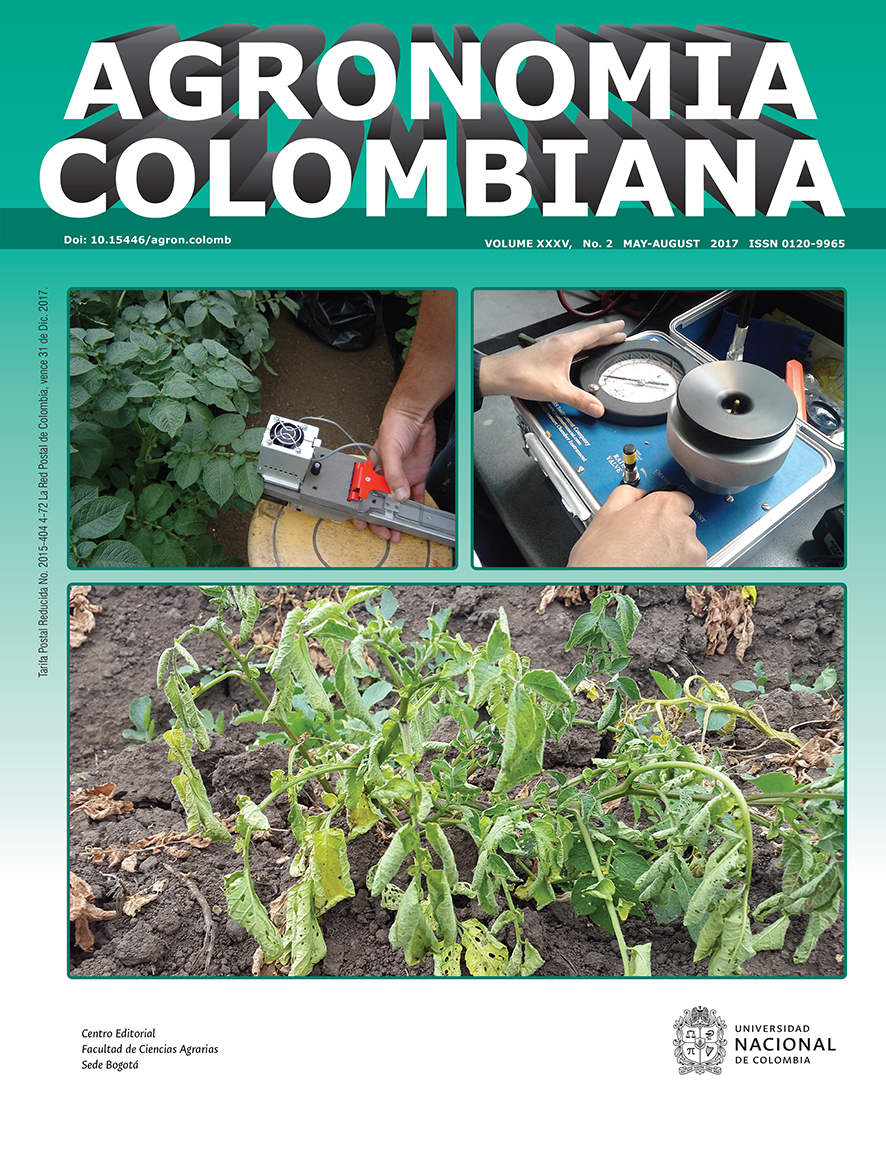
Drought stress affects physiological parameters but not tuber yield in three Andean potato (Solanum tuberosum L.) cultivars
El estrés por sequía afecta los parámetros fisiológicos, pero no el rendimiento de los tubérculos en tres cultivares andinos de papa (Solanum tuberosum L.)
DOI:
https://doi.org/10.15446/agron.colomb.v35n2.65901Keywords:
carotenoid/chlorophyll ratio, electrolyte leakage, photoprotection, water deficit tolerance, leaf temperature (en)radio carotenoides/clorofila, pérdida de electrolitos, fotoprotección, tolerancia al déficit hídrico, temperatura foliar (es)
Downloads
This study evaluated the effect of water deficit on the physiological response and yield of three Andean potato cultivars. Leaf water potential (Ψw), soil matric potential (SMP), photosynthesis (A), stomatal conductance (gs), transpiration (E), intrinsic water use efficiency (WUEi), leaf temperature (LT), chlorophyll fluorescence parameters, chlorophyll (Chl), carotenoids (Car), electrolyte leakage (EL), growth and yield (Y). Parameters were determined in well-watered (WW) and drought-stressed (DS) plants. The three DS cultivars showed a decrease in leaf from the first day of treatment and reached values close to -2.00 MPa 4 days after treatment (DAT) for the Diacol Capiro (DC) cultivar, 5 DAT for the Pastusa Suprema (PS) cultivar and 6 DAT for the Esmeralda (Es) cultivar. The values of A, gsand E in the DS cultivars decreased from the first DAT. The LT reached the highest values when gs showed the lowest values for the three DS cultivars. WUEi was higher in Es under DS plants but lower in DC under DS. The PSII photochemical efficiency (Fv/Fm) showed values greater than 0.8 for all DS cultivars under DS, suggesting the absence of non-stomatal limitations for A. The Chl content increased in the Es cultivar under DS from 5 to 7 DAT compared to WW plants. Carotenoids (Ca) contents, the Car/Chl ratio, and EL increased in the three DS cultivars. There were no differences in yield and growth parameters between WW and DS cultivars. These results suggest that the three cultivars developed mechanisms to overcome the stress. One of these mechanisms could be the early synthesis of Car, which may maintain photosystem II function under water stress.
References
Aksić, M., S. Gudzic, N. Deletic, N. Gudzic, S. Stojkovic, and J. Knezevic. 2014. Tuber yield and evapotranspiration of potato depending on soil matric potential. Bulgarian J. Agric. Sci. 20(1), 122-126.
Ahmadi, S.H., M.N. Andersen, F. Plauborg, R.T. Poulsen, C.R. Jensen, A.L. Sepaskhah, and S. Hansen. 2010. Effects ofirrigation strategies and soils on field-grown potatoes: gas exchange and xylem [ABA]. Agr. Water Manag. 97, 1486-1494. Doi: 10.1016/j.agwat.2010.05.002.
Bajji, M., J.M. Kinet, and S. Lutts. 2002. The use of the electrolyte leakage method for assessing cell membrane stability as a water stress tolerance test in durum wheat. Plant Growth Regul. 36(1), 61-70. Doi: 10.1023/A:1014732714549.
Blum, A. and A. Ebercon. 1981. Cell membrane stability as a measure of drought and heat tolerance in wheat. Crop Sci. 21, 43-47. Doi: 10.2135/cropsci1981.0011183X002100010013x
Boardman, N.K. 1977. Comparative photosynthesis of sun and shade plants. Ann. Rev. Plant Physiol. 28, 355-377. Doi: 10.1146/an-nurev.pp.28.060177.002035.
Cabello, R., P. Monneveux, F. De Mendiburu, and M. Bonierbale. 2013. Comparison of yield-based drought tolerance indices in improved cultivars, genetic stocks, and landraces of potato (Solanum tuberosum L.). Euphytica 193, 147-156. Doi: 10.1007/s10681-013-0887-1.
Cazzonelli, C. 2011. Carotenoids in nature: insights from plants and beyond. Funct. Plant Biol. 38, 833-847. Doi: 10.1071/FP11192.
Chaves, M.M., J.P. Maroco, and J.S. Pereira. 2003. Understanding plant responses to drought: from genes to the whole plant. Funct. Plant Biol. 30, 239-264. Doi: 10.1071/FP02076.
Chaves, M.M ., J.S. Pereira, J. Maroco, M.L. Rodrigues, C.P.P. Ricardo, M.L. Osorio, I. Carvalho, T. Faria, and C. Pinheiro. 2002. How plants cope with water stress in the field. Photosynthesis and growth. Ann. Bot. 89, 907-916. Doi: 10.1093/aob/mcf105.
Cruz de Carvalho, M.H. 2008. Drought stress and reactive oxygen species: production, scavenging and signaling. Plant Signal. Behav. 3, 156-165. Doi: 10.4161/psb.3.3.553.
Deeba, F., A.K. Pandey, S. Ranjan, A. Mishra, R. Singh, Y.K. Sharma, P.A. Shirke, and V. Pandey. 2012. Physiological and proteomic responses of cotton (Gossypium herbaceum L.) to drought stress. Plant Physiol. Bioch. 53, 6-18. Doi: 10.1016/j.plaphy.2012.01.002.
Demidchik, V., D. Straltsova, S.S. Medvedev, G.A. Pozhvanov, A. Sokolik, and Y. Vladimir. 2014. Stress-induced electrolyte leakage: the role of K+-permeable channels and involvement in programmed cell death and metabolic adjustment. J. Exp. Bot. 65(5), 1259-1270. Doi: 10.1093/jxb/eru004.
Devaux, A., P. Kromann, and O. Ortiz. 2014. Potatoes for sustainable global food security. Potato Res. 57(3), 185-199. Doi: 10.1007/s11540-014-9265-1.
Efeoglu, B., Y. Ekmekci, and N. Cicek. 2009. Physiological responses of three maize cultivars to drought stress and recovery. S. Afr. J. Bot. 75(1), 34-42. Doi: 10.1016/j.sajb.2008.06.005.
Farhad, M.S., A.M. Babak, Z.M. Reza, R.S.M. Hassana, and T. Afshin. 2011. Response of proline, soluble sugars, photosynthetic pigments, and antioxidant enzymes in potato (Solanum tuberosum L.) to different irrigation regimes in greenhouse condition. Aust. J. Crop. Sci. 5(1), 55-60.
Farooq, M., A. Wahid, N. Kobayashi, D. Fujita, and S.M. Basra. 2009. Plant drought stress: effects, mechanisms, and management. Agron. Sustain. Dev. 29, 185-212. Doi: 10.1051/agro:2008021.
Flexas, J., J. Bota, J. Cifre, J. Mariano Escalona, J. Galmés, J. Gulías, E.K. Lefi, S. Martínez-Canellas, M. Teresa Moreno, and M. Ribas-Carbó. 2004. Understanding down-regulation of photosynthesis under water stress: future prospects and searching for physiological tools for irrigation management. Ann. Appl. Biol. 144, 273-283. Doi: 10.1111/j.1744-7348.2004.tb00343.x.
Flexas, J., J. Bota, J. Galmés, H. Medrano, and M. Ribas-Carbó. 2006. Keeping a positive carbon balance under adverse conditions: responses of photosynthesis and respiration to water stress. Physiol. Plant. 127, 343-352. Doi: 10.1111/j.1399-3054.2006.00621.x.
Gago, J., C. Douthe, I. Florez-Sarasa, J.M. Escalona, J. Galmes, A.R. Fernie, J. Flexas, and H. Medrano. 2014. Opportunities for improving leaf water use efficiency under climate change conditions. Plant Sci. 226, 108-119. Doi: 10.1016/j.plantsci.2014.04.007.
Ghobadi, M., S. Taherabadi, M.E. Ghobadi, G.R. Mohammadi, and S. Jalali-Honarmand. 2013. Antioxidant capacity. Photosynthetic characteristics and water relations of sunflower (Helianthus annuus L.) cultivars in response to drought stress. Ind. Crop. Prod. 50, 29-38. Doi: 10.1016/j.indcrop.2013.07.009.
Graca, J.P., F.A. Rodrigues, J.R.B. Farias, M.C.N. Oliveira, C.B. Hoffmann-Campo, and S.M. Zingaretti. 2010. Physiological parameters in sugarcane cultivars submitted to water deficit. Braz. J. Plant. Physiol. 22, 189-197. Doi: 10.1590/S1677-04202010000300006.
Hitz, S. and J. Smith. 2004. Estimating global impacts from climate change. Global. Environ. Chang. 14, 201-218. Doi: 10.1016/j.gloenvcha.2004.04.010.
Hu, L., Z. Wang, and B. Huang. 2010. Diffusion limitations and metabolic factors associated with inhibition and recovery of photosynthesis from drought stress in a C3 perennial grass species. Physiol. Plant. 139, 93-106. Doi: 10.1111/j.1399-3054.2010.01350.x.
Hsiao, T.C. 1973. Plant responses to water stress. Ann. Rev. Plant Physiol. 24(1), 519-570. Doi: 10.3389/fpls.2014.00086.
Ierna, A. and G. Mauromicale. 2006. Physiological and growth response to moderate water deficit of off-season potatoes in a Mediterranean environment. Agr. Water Manag. 82, 193-209. Doi: 10.1016/j.agwat.2005.05.005.
Jefferies, R.A. 1993. Responses of potato genotypes to drought. I. Expansion of individual leaves and osmotic adjustment. Ann. Appl. Biol. 122, 93-104. Doi: 10.1111/j.1744-7348.1993.tb04017.x.
Jefferies, R.A. 1995. Physiology of crop response to drought, pp. 61-74. In: Haverkort, A.J. and D.K.L. MacKerron (eds.). Potato ecology and modeling of crops under conditions limiting growth. Wageningen Academic Publishers, The Netherlands. Doi: 10.1007/978-94-011-0051-9.
Kar, R.K. 2011. Plant responses to water stress: role of reactive oxygen species. Plant Signal. Behav. 6, 1741-1745. Doi: 10.4161/psb.6.11.17729.
Lahlou, O., S. Ouattar, and J.F. Ledent. 2003. The effect of drought and cultivar on growth parameters, yield, and yield components of potato. Agron. 23, 257-268. Doi: 10.1051/agro:2002089.
Lichtenthaler, H.K. 1987. Chlorophylls and carotenoids: pigments of photosynthetic biomembranes. Methods Enzymol. 148, 350-382. Doi: 10.1016/0076-6879(87)48036-1.
Liu, F., C.R. Jensen, A. Shahanzari, M.N. Andersen, and S.E. Jacobsen. 2005. ABA-regulated stomatal control and photosynthetic water use efficiency of potato (Solanum tuberosum L.) during progressive soil drying. Plant Sci. 168, 831-836. Doi: 10.1016/j.plantsci.2004.10.016.
Liu, F., A. Shahnazari, M.N. Andersen, S.E. Jacobsen, and C.R. Jensen. 2006. Effects of deficit irrigation (DI) and partial root drying (PRD) on gas exchange, biomass partitioning, and water use efficiency in potato. Sci. Hortic. 109, 113-117. Doi: 10.1016/j.scienta.2006.04.004.
Lim, C.M., W. Baek, J. Jung, J.H. Kim, and S.H. Lee. 2015. Function of ABA in stomatal defense against biotic and drought stresses. Int. J. Mol. Sci. 16, 15251-15270. Doi: 10.3390/ijms160715251.
Mackerran, D.K.L. and R.A. Jefferies. 1986. The influence of early soil moisture stress on tuber numbers in potato. Potato Res. 299-312. Doi: 10.1007/BF02359959.
Monneveux, P., A.D. Ramírez, and M.T. Pino. 2013. Drought tolerance in potato (S. tuberosum L.). Can we learn from drought tolerance research in cereals? Plant Sci. 205-206, 76-86. Doi: 10.1016/j.plantsci.2013.01.011.
Moorby, J., R. Munns, and J. Walcott. 1975. Effect of water deficit on photosynthesis and tuber metabolism in potatoes. Aust. J. Plant Physiol. 2, 323-333. Doi: 10.1071/PP9750323.
Noctor, G., A. Mhamdi, and C.H. Foyer. 2014. The roles of reactive oxygen metabolism in drought: not so cut and dried. Plant Physiol. 164, 1636-1648. Doi: 10.1104/pp.113.233478.
Obidiegwu, J.E., G.J. Bryan, H.G. Jones, and A. Prashar. 2015. Coping with drought: stress and adaptive responses in potato and perspectives for improvement. Front. Plant Sci. 6(542), 1-23. Doi: 10.3389/fpls.2015.00542.
Osakabe, Y., K. Osakabe, K. Shinozaki, and L.S.P. Tran. 2014. Response of plants to water stress. Front. Plant Sci. 5, 1-8. Doi: 10.3389/fpls.2014.00086.
Pallas, J.E., B.E. Michel, and D.G. Harris. 1967. Photosynthesis, transpiration, leaf temperature, and stomatal activity of cotton plants under varying water potentials. Plant Physiol. 42, 76-88. Doi: 10.1104/pp.42.1.76.
Parent, B., C. Hachez, E. Redondo, T. Simonneau, F. Chaumont, and F. Tardieu. 2014. Drought and abscisic acid effects on aquapo-rin content translate into changes in hydraulic conductivity and leaf growth rate: a trans-scale approach. Plant Physiol. 149, 2000-2012. Doi: 10.1104/pp.108.130682.
Porter, G.A., G.B. Opena, W.B. Bradbury, J.C. McBurnie, and J.A. Sisson. 1999. Soil management and supplemental irrigation effects on potato: I. Soil properties, tuber yield, and quality. Agron. J. 91, 416-425. Doi: 10.2134/agronj1999.00021962009100030010x.
Premachandra, G.S., H. Saneoka, M. Kanaya, and S. Ogata. 1991. Cell membrane stability and leaf surface wax content as affected by increasing water deficits in maize. J. Exp. Bot. 42, 167-171. Doi: 10.1093/jxb/42.2.167.
Quan, R., M. Shang, H. Zhang, Y. Zhao, and J. Zhang. 2004. Engineering of enhanced glycinebetaine synthesis improves drought tolerance in maize. Plant Biotechnol. J. 2(6), 477-486. Doi: 10.1111/j.1467-7652.2004.00093.x.
Ramírez, D.A., W. Yactayo, R. Gutiérrez, V. Mares, F. De Mendiburu, A. Posadas, and R. Quiroz, R., 2014. Chlorophyll concentration in leaves is an indicator of potato tuber yield in water-shortage conditions. Sci. Hortic. 168, 202-209. Doi: 10.1016/j.scienta.2014.01.036.
Ramírez, D.A ., W. Yactayo, R.L. Rens, J.J. Rolando, S. Palacios, F. De Mendiburu, V. Mares, C. Barreda, H. Loayza, P. Monneveux, L. Zotarelli, A. Khan, and R. Quiroz. 2016. Defining biological thresholds associated to plant water status for monitoring water restriction effects: stomatal conductance and photosynthesis recovery as key indicators in potato. Agr. Water Manag. 177, 369-378. Doi: 10.1016/j.agwat.2016.08.028.
R Development Core Team. 2010. A language and environment for statistical computing. R foundation for statistical computing. Viena, Austria.
Rolando, J.L., D.A. Ramírez, W. Yactayo, P. Monneveux, and R. Quiroz. 2015. Leaf greenness as a drought tolerance-related trait in potato (Solanum tuberosum L.). Environ. Exp. Bot. 110, 27-35. Doi: 10.1016/j.envexpbot.2014.09.006.
Sánchez-Rodríguez, E., M.M. Rubio-Wilhelmi, L.M. Cervilla, B. Blasco, J.J. Rios, M.E. Rosales, L. Romero, and J.M. Ruiz. 2010. Genotypic differences in some physiological parameters symptomatic for oxidative stress under moderate drought in tomato plants. Plant Sci. 178, 30-40. Doi: 10.1016/j.plantsci.2009.10.001.
Sanda, S., K. Yoshida, M. Kuwano, T. Kawamura, Y. Nakajima, K. Akashi, and Y. Yokota. 2011. Responses of the photosynthetic electron transport system to excess light energy caused by water deficit in wild watermelon. Physiol. Plant. 142, 247-264. Doi: 10.1111/j.1399-3054.2011.01473.x.
Schafleitner, R., A. Gaudin, R.O. Gutierrez Rosales, C.A. Alvarado Aliaga, and M. Bonierbale. 2007. Proline accumulation and real-time PCR expression analysis of genes encoding enzymes of proline metabolism in relation to drought tolerance in Andean potato. Acta Physiol. Plant. 29, 19-26. Doi: 10.1007/s11738-006-0003-4.
Schapendonk, A.H.C.M., J.J. Spitters, and P.J. Groot. 1989. Effects of water stress on photosynthesis and chlorophyll fluorescence of five potato cultivars. Potato Res. 32, 17-32. Doi: 10.1007/BF02365814.
Shao, H.B., L.Y. Chu., C.A. Jaleel, and C.X. Zhao. 2008. Water-deficit stress-induced anatomical changes in higher plants. C. R. Biol. 331, 215-225. Doi: 10.1016/j.crvi.2008.01.002.
Siddique, M.R.B., A. Hamid, and M.S. Islam. 2000. Drought stress effects on water relations of wheat. Bot. Bull. Acad. Sin. 41, 35-39.
Steckel, J.R.A., and D. Gray. 1979. Drought tolerance in potatoes. J. Agric. Sci. 92, 375-381. Doi: 10.1016/j.plantsci.2013.01.011.
Teixeira, J., and S. Pereira. 2007. High salinity and drought act in an organ-dependent manner on potato glutamine synthetase expression and accumulation. Environ. Exp. Bot. 60, 121-126. Doi: 10.1016/j.envexpbot.2006.09.003.
Tourneux, C., A. Devaux, M. Camacho, P. Mamani, and J.F. Ledent. 2003a. Effects ofwater shortage on six potato genotypes in the highlands of Bolivia I: morphological parameters, growth, and yield. Agron. 23, 169-179. Doi: 10.1051/agro:2002079.
Tourneux, C., A. Devaux, M. Camacho, P. Mamani, and J.F. Ledent. 2003b. Effect of water shortage on six potato genotypes in the highlands of Bolivia II: water relations, physiological parameters. Agron. 23(2), 181-190. Doi: 10.1051/agro:2002080.
Valentovic, P., M. Luxová, L. Kolarovic, and O. Gasparíková. 2006. Effect of osmotic stress on compatible solutes content, membrane stability, and water relations in two maize cultivars. Plant Soil Environ. 52, 186-191.
Van Loon, C.D. 1981. The effect of water stress on potato growth, development and yield. Am. Potato J. 58, 51-69. Doi: 10.1007/BF02855380.
Vos, J. and J. Groenwold. 1989. Characteristics of photosynthesis and conductance of potato canopies and the effects of cultivar and transient drought. Field Crops Res. 20(237), 237-250. Doi: 10.1016/0378-4290(89)90068-3.
Vos, J. and A.J. Haverkort. 2007. Water availability and potato crop performance. pp. 333-351. In: Vreugdenhil, D., J. Bradshaw, C. Gebhardt, F. Govers, D.K.L. Mackerron, M.A. Taylor and H.A. Ross (eds.). Potato biology and biotechnology: Advances and perspectives. Elsevier, Italy. Doi: 10.1016/B978-044451018-1/50058-0.
Wang, F.X., Y. Kang, S.P. Liu, and X.Y. Hou. 2007. Effects of soil matric potential on potato growth under drip irrigation in the North China Plain. Agr. Water Manag. 88(1), 34-42. Doi: 10.1016/j.agwat.2006.08.006.
Xu, Z., G. Zhou, and H. Shimizu. 2010. Plant responses to drought and rewatering. Plant Signal. Behav. 5, 649-654. Doi: 10.4161/psb.5.6.11398.
Yordanov, I., V. Velikova, and T. Tsonev. 2003. Plant responses to drought and stress tolerance. Bulg. J. Plant Physiol. Special Issue, 187-206. Doi: 10.1023/A:1007201411474.
Zegada-Lizarazu, W. and A. Monti. 2013. Photosynthetic response of sweet sorghum to drought and re-watering at different growth stages. Physiol. Plant. 149, 56-66. Doi: 10.1111/ppl.12016.
Zoebl, D. 2006. Is water productivity a useful concept in agricultural water management? Agr. Water Manag. 84, 265-273. Doi: 10.1016/j.agwat.2006.03.002.
Dimensions
PlumX
Article abstract page views
Downloads
How to Cite
License
Copyright (c) 2017 Agronomía Colombiana

This work is licensed under a Creative Commons Attribution-NonCommercial-ShareAlike 4.0 International License.
© Centro Editorial de la Facultad de Ciencias Agrarias, Universidad Nacional de Colombia
Reproduction and quotation of material appearing in the journal is authorized provided the following are explicitly indicated: journal name, author(s) name, year, volume, issue and pages of the source. The ideas and observations recorded by the authors are their own and do not necessarily represent the views and policies of the Universidad Nacional de Colombia. Mention of products or commercial firms in the journal does not constitute a recommendation or endorsement on the part of the Universidad Nacional de Colombia; furthermore, the use of such products should comply with the product label recommendations.
The Creative Commons license used by Agronomia Colombiana journal is: Attribution - NonCommercial - ShareAlike (by-nc-sa)

Agronomia Colombiana by Centro Editorial of Facultad de Ciencias Agrarias, Universidad Nacional de Colombia is licensed under a Creative Commons Reconocimiento-NoComercial-CompartirIgual 4.0 Internacional License.
Creado a partir de la obra en http://revistas.unal.edu.co/index.php/agrocol/.