
Publicado
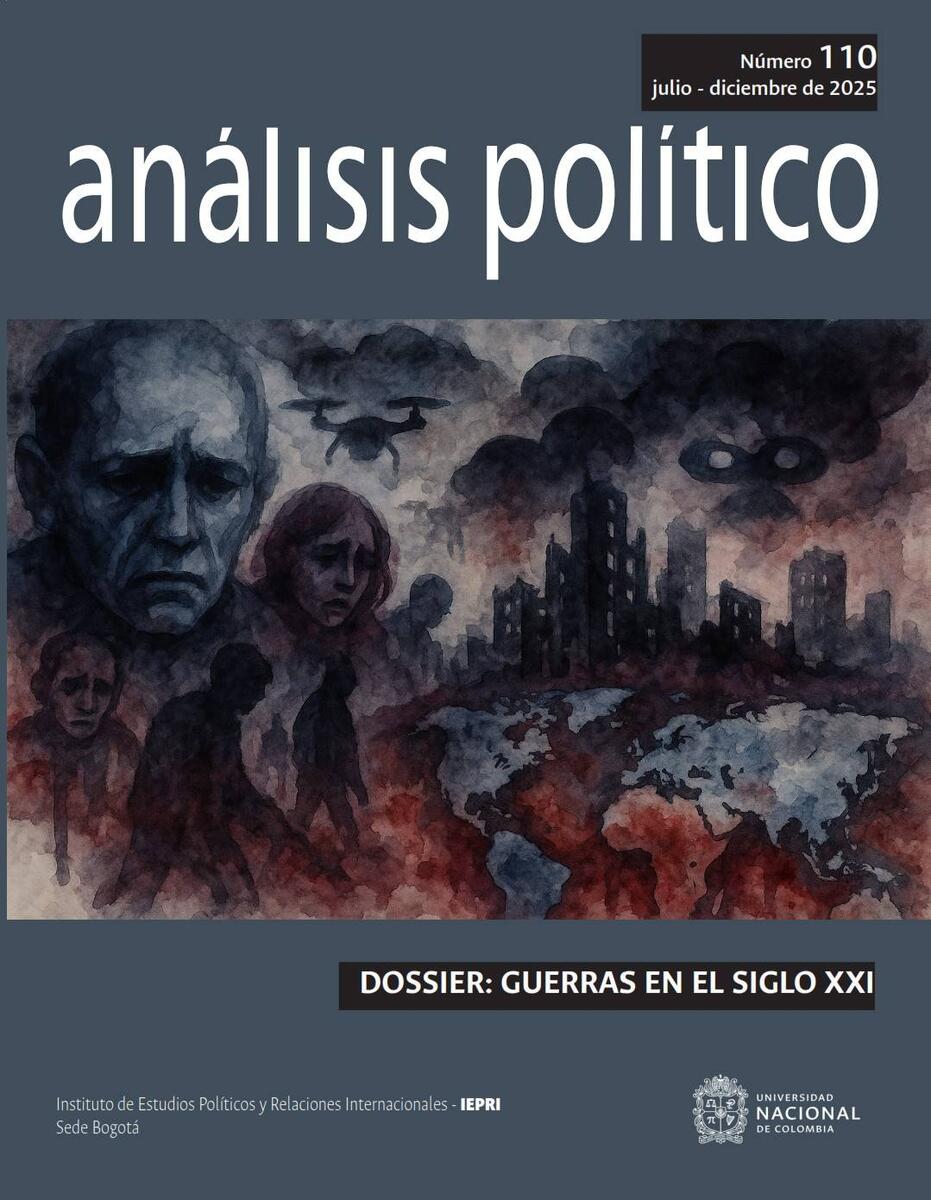
La guerra en el dominio marítimo del siglo XXI
MARITIME DOMINION WARFARE IN THE 21ST CENTURY
DOI:
https://doi.org/10.15446/anpol.v38n110.122245Palabras clave:
Derecho Marítimo, Guerra marítima, Poder marítimo, Conflicto híbrido, Zona gris (es)Maritime Domain, Maritime Warfare, Sea Power, Hybrid Conflict, Grey-Zone (en)
Descargas
Este artículo analiza la transformación de la guerra en el dominio marítimo en el siglo XXI, desde un enfoque transdisciplinar que articula geopolítica, estudios estratégicos, relaciones internacionales, seguridad y derecho internacional. Se argumenta que el mar es hoy un espacio de conflicto híbrido, donde confluyen disputas interestatales, actores no estatales, presiones legales y tecnologías emergentes. A través del estudio de casos como el Mar del Sur de China, el Mar Negro, el Mar Rojo, el Ártico y el Caribe, se evidencian continuidades y rupturas frente a las guerras marítimas tradicionales. El artículo concluye que es necesario fortalecer la gobernanza marítima y adaptar los marcos normativos a las nuevas formas de guerra en el mar.
This article explores the transformation of maritime warfare in the 21st century through a transdisciplinary approach that integrates geopolitics, strategic studies, international relations, security, and international law. It argues that the sea has become a space of hybrid conflict, where state rivalries, non-state actors, legal pressure, and emerging technologies converge. Case studies from the South China Sea, Black Sea, Red Sea, Arctic, and Caribbean illustrate both continuities and changes in maritime conflict. The article concludes that contemporary maritime warfare challenges traditional frameworks and demands the strengthening of governance mechanisms and legal adaptation to address new dynamics and risks in the global maritime domain.
Referencias
Aleksushin, G. V. (2023). The nuclear icebreaker fleet and its role in the economic development of the Northern Sea Route. Arctic and North, 53, 26-32.
Azad, T. M., Haider, M. W., & Sadiq, M. (2023). Understanding gray zone warfare from multiple perspectives. World Affairs, 186(1), 81-104.
Barrett,D. y Bebber, J. (2024). The Navy Is Not Ready for the Information War of 2026. Proceedings, February, Vol. 150/2/1,452.
Bashfield, S. (2024). Defending seabed lines of communication. Australian Journal of Maritime & Ocean Affairs: 1-13.
Behera, L. K. (2023). AUKUS and India's Indo-Pacific Strategy. International Journal, 78(3), 375-393.
Bueger, C., & Edmunds, T. (2020). Blue crime: Conceptualising transnational organised crime at sea. Marine Policy, 119, 104067.
Bueger, C., & Liebetrau, T. (2023). Critical maritime infrastructure protection: What’s the trouble?. Marine policy, 155, 105772.
Bueger, C. (2015). Making things known: Epistemic practices, the United Nations, and the translation of piracy. International Political Sociology, 9(1), 1–18.
Buzan, B., Wæver, O., & De Wilde, J. (1998). Security: A new framework for analysis. Lynne Rienner Publishers.
Cairo-Carou, H. (1993). Elementos para una geopolítica crítica: tradición y cambio en una disciplina maldita. Ería, (32), 195–213.
Chiriac, O. R. (2024). Enemy at the Gates: NATO in the Black Sea. In The Foreign Policy of the Russian Federation: Implications for Black Sea Security (pp. 75-100). Cham: Springer Nature Switzerland.
Convención de las Naciones Unidas sobre el Derecho del Mar [CONVEMAR/82]. Asamblea General de la Organización de las Naciones Unidas. 10 de diciembre de 1982
Corbett, J. (1911). Some Principles of Maritime Strategy. Longmans, Green and Co.
Corbiscello, N. (2021). The Rise of China: The New Global Superpower (Master's thesis, The William Paterson University of New Jersey).
Corte Permanente de Arbitramiento (2016). South China Sea Arbitration Award (Philippines v. China). https://pca-cpa.org/ar/cases/7/
De Souza, P. (2013). War at sea. Capítulo 18 en Campbell, B. y Tritle, L. (eds.) The Oxford Handbook of Warfare in the Classical World. Oxford Academic
Dismukes, B. (2020). The return of great-power competition—Cold war lessons about strategic antisubmarine warfare and defense of sea lines of communication. Naval War College Review, 73(3), 6.
Dodds, K. (2010). Flag planting and finger pointing: The Law of the Sea, the Arctic and the political geographies of the outer continental shelf. Political Geography, 29(2), 63-73.
Erickson, A. S., & Kennedy, C. M. (2016). China’s maritime militia. CNA Corporation, 7, 1-28.
Erickson, A. S. (Ed.). (2017). Chinese naval shipbuilding: An ambitious and uncertain course. Naval Institute Press.
Fanell, J. E. (2019). China’s global naval strategy and expanding force structure. Naval War College Review, 72(1), 10-55.
FAO. (2022). The State of World Fisheries and Aquaculture 2022. Food and Agriculture Organization of the United Nations.
Feenstra, R. (2009). Hugo Grotius Mare Liberum 1609-2009: Original Latin Text and English Translation. Brill.
Fletcher, E. G. (1933). John Selden (author of Mare Clausum) and his contribution to international law. Transactions of the Grotius Society, 1-12.
Freund, E. (2017). Freedom of Navigation in the South China Sea: A Practical Guide [Report]. Junio, https://www.belfercenter.org/publication/freedom-navigation-south-china-sea-practical-guide
Friedman, N. (2014). Fighting the Great War at Sea: Strategy, Tactic and Technology. Seaforth Publishing.
Godio, L. (2015). La Convención de las Naciones Unidas sobre el Derecho del Mar de 1982 y las actividades militares. Revista de la Facultad de Derecho, (39), 97-118.
Goldrick, J. (2018). Grey zone operations and the maritime domain. Special report. Australian Strategic Policy Institute (ASPI).
Gray, C. S. (2010). Strategic thoughts for defence planners. Survival, 52(3), 159-178.
Hattendorf, J. B., & Unger, R. W. (Eds.). (2003). War at Sea in the Middle Ages and the Renaissance (Vol. 14). Boydell Press.
Hoffman, Frank. 2009. Hybrid vs. Compound War. Armed Forces Journal. 1,15
Holmes, J. R., & Yoshihara, T. (2010). History rhymes: The German precedent for Chinese seapower. Orbis, 54(1), 14-34.
Kline, A. (2016). A Tactical Doctrine for Distributed Lethality. Center for International Maritime Security, February, 22.
Kraska, J. (2011). Maritime power and the law of the sea: Expeditionary operations in world politics. Oxford University Press.
Larsson, O. L. (2024). Sea blindness in grey zone preparations. Defence Studies, 24(3), 399-420.
Leander, A. (2005). The power to construct international security: On the significance of private military companies. Millennium: Journal of International Studies, 33(3), 803–825.
Lee, J. Y. (2021). China’s maritime ambition, security dilemma and lack of multilateral framework. Journal of Asian Security and International Affairs, 8(2), 195-217.
Levy, C. D. (2023). The Influence of Sea Power in Iran's Proxy War Part 1: Houthi Aggression in the Red Sea. BESA Center Perspectives, Paper No. 2,244
Liddell-Hart, B.H. (1991). Strategy.First Meridian Printing
Lucas, R. (2024). Conquering the Commons: Coercion in the South China Sea. En China's Use of Armed Coercion (pp. 137-163). Routledge.
Mahan, A. T. (1890). The influence of sea power upon history,1660-1183, Boston, Lile Brown.
McKendry, C. (2023). All is fair in law and war, or is it? Examining the PRC's use of" lawfare" in the South China Sea disputes (Disertación Doctoral, University of Guelph).
Mearsheimer, J. J. (2021). The inevitable rivalry: America, China, and the tragedy of great-power politics. Foreign Affairs, 100, 48.
Mirza, M. N., & Ayub, S. (2022). Heartland, Rimland, and the Grand Chessboard: Deciphering the Great Power Politics in Central Asia. UWJSS, 5(1), 187-204.
Mou, N., Wang, C., Yang, T., Ren, H., Zhang, L., Xu, H., & Liu, W. (2022). Spatiotemporal patterns of maritime trade between China and Maritime Silk Road: Evidence from a quantitative study using social network analysis. Journal of Transport Geography, 102, 103387.
Tuathail, G. Ó., & Toal, G. (1996). Critical geopolitics: The politics of writing global space (Vol. 6). University of Minnesota Press.
O'Rourke, R. (2022). US-China Strategic Competition in South and East China Seas: Background and Issues for Congress. Current Politics and Economics of South, Southeastern, and Central Asia, 31(2/3), 99-294.
Paine, S.C.M. (2021). Maritime Solutions to Continental Conundrums. Continental power conquests; Maritime powers compound wealth. Proceedings, August, Vol. 147/8/1,422.
Pant, H. V. (2022). India and the Quad: Chinese belligerence and Indian resilience. Melbourne Asia Review, 2022(9).
Pedrozo, R. P., & Kraska, J. (2024). US Freedom of Navigation and Forward Presence Operations in the South China Sea and Taiwan Strait, October 2015 to July 2024. International Law Studies, 103(1), 12.
Pejsova, E. (2023). The EU’s Naval Presence in the Indo-Pacific: What is it Worth?. Hague Centre for Strategic Studies (HCSS).
Pincus, R. (2020). Three-way power dynamics in the Arctic. Strategic Studies Quarterly, 14(1), 40-63.
Raine, S. & Le Mière, C. (2013). Regional disorder: The South China Sea disputes. Routledge/IISS.
Ramírez-Cabrales, F., Pedroza-Nieto, W. T., & Forero-Hauzeur, J. C. (2021). Intereses marítimos colombianos. Comisión Colombiana del Océano.
Rodriguez-Diaz, E., Alcaide, J. I., & Garcia-Llave, R. (2024). Challenges and security risks in the red sea: Impact of houthi attacks on maritime traffic. Journal of Marine Science and Engineering, 12(11), 1900.
Rojas-Sánchez, D. A. (2018). Geopolítica marítima del Caribe en Rivera-Páez,S. (Ed.). Intereses de Colombia en el Mar. Reflexiones y propuestas para la construcción de país marítimo. Ediciones Escuela Superior de Guerra. https://doi. org/10.25062/9789585652873.03.
Rothwell, D. R., & Stephens, T. (2016). The international law of the sea (2nd ed.). Hart Publishing.
Sari, A. (2024). Maritime Incidents in the South China Sea: Measures of Law Enforcement or Use of Force?. International Law Studies, 103(1), 14.
Spector, R. H. (2002). At War at Sea: Sailors and naval combat in the twentieth century. Penguin.
Speller, I. (2024). Understanding naval warfare. Third Edition. Routledge.
Srivastava, D. P. (2024). Houthi Attacks and The Growing Instability in the Red Sea. Journal of Indian Ocean Studies, 32(1).
Stopford, M. (2009). Maritime economics (3rd ed.). Routledge.
Strating, B. (2023). Assessing Military and Non-Military Incidents at Sea in the Asia-Pacific (Version 1). La Trobe. https://doi.org/10.26181/24431776.v1
Swissinfo (2025). Soldados estadounidenses y finlandeses se entrenan en el Ártico. https://www.swissinfo.ch/spa/soldados-estadounidenses-y-finlandeses-se-entrenan-en-el-%C3%81rtico/88932015
Till, G. (2018). Seapower: A guide for the twenty-first century (4th ed.). Routledge.
Tran, E., & Zoubir, Y. H. (2023). China in the Mediterranean: An Arena of Strategic Competition?. Mediterranean Politics, 28(5), 685-703.
UNCTAD. (2023). Review of maritime transport 2023. United Nations Conference on Trade and Development.
UNODC (2011). Transnational organized crime in the fishing industry. United Nations Office on Drugs and Crime.
Ushirogata, K. (2025). The Maritime Strategy of China: From Area Denial to Sea Control and Power Projection. In Global Maritime Military Strategy, 1980–2023, pp. 155-169. Singapore: Springer Nature Singapore.
Waltz, K. N. (2010). Theory of international politics. Waveland Press.
Yap, W. Y., & Yang, D. (2024). Geopolitical tension and shipping network disruption: Analysis of the Red Sea crisis on container port calls. Journal of Transport Geography, 121, 104004.
Yin, R., & Zhong, K. (2023). Nord stream explosions and the geopolitical game behind it. Закон и власть, (1), 3-7.
Dimensions
PlumX
Visitas a la página del resumen del artículo
Descargas
Cómo citar
Licencia
Derechos de autor 2025 Análisis Político

Esta obra está bajo una licencia internacional Creative Commons Reconocimiento-NoComercial-SinObraDerivada 3.0.
Todo el contenido de esta revista, excepto dónde está identificado, está bajo una Creative Commons license. Atribution-NonComercial-NonDerivs 3.0 Unported.
