Correo Electrónico
 DNINFOA - SIA
 Bibliotecas
 Convocatorias
 Identidad U.N.


Publicado
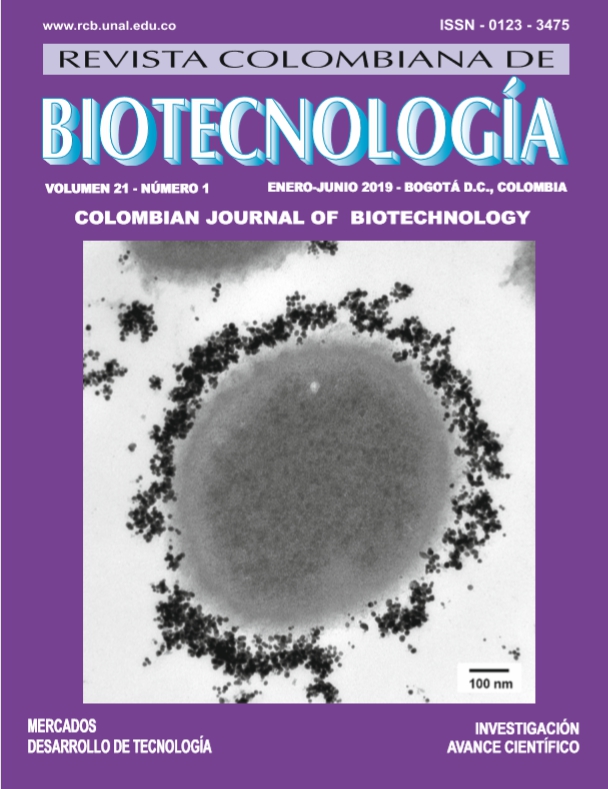
Antibacterial pigment production by Serratia marcescens using different casein types obtained from milk
Producción de un pigmento antibacteriano con Serratia marcescens usando diferentes tipos de caseína obtenida de leche
DOI:
https://doi.org/10.15446/rev.colomb.biote.v21n1.62435Palabras clave:
Bacterial pigments, Serratia marcescens, prodigiosin, protein substrates (en)Pigmentos bacterianos, Serratia marcescens, prodigiosina, sustratos proteicos (es)
Descargas
Referencias
Alihosseini, F., Ju, K.-S., Lango, J., Hammock, B. D., & Sun, G. (2008). Antibacterial colorants: characterization of Prodiginines and their applications on textile materials. Biotechnology Progress, 24(3), 742–7.
Aruldass, C. A., Venil, C. K., Zakaria, Z. A., & Ahmad, W. A. (2014). Brown sugar as a low-cost medium for the production of prodigiosin by locally isolated Serratia marcescens UTM1. International Biodeterioration & Biodegradation, 95, 19–24.
Babitha, S. (2009). Microbial pigments. En P. Nigam & A. Pandey (Eds.), Biotechnology for Agro-Industrial Residues Utilisation (p. 470). Dordrecht: Springer Netherlands.
Bertani, G. (1951). Studies on lysogenesis. I. The mode of phage liberation by lysogenic Escherichia coli. Journal of Bacteriology, 62(3), 293–300.
Bharmal, M. H., Jahagirdar, N., & Aruna, K. (2012). Study on optimization of prodigiosin production by Serratia marcescens MSK1 isolated from air. International Journal of Advanced Biological Research, 2(4), 671–680.
Casullo de Araújo, H. W., Fukushima, K., & Campos Takaki, G. M. (2010). Prodigiosin production by Serratia marcescens UCP 1549 using renewable-resources as a low cost substrate. Molecules, 15(10), 6931–40.
Dalili, D., Fouladdel, S., Rastkari, N., Samadi, N., Ahmadkhaniha, R., Ardavan, A., & Azizi, E. (2012). Prodigiosin, the red pigment of Serratia marcescens, shows cytotoxic effects and apoptosis induction in HT-29 and T47D cancer cell lines. Natural Product Research, 26(22), 2078–83.
Fender, J. E., Bender, C. M., Stella, N. A., Lahr, R. M., Kalivoda, E. J., & Shanks, R. M. Q. (2012). Serratia marcescens quinoprotein glucose dehydrogenase activity mediates medium acidification and inhibition of prodigiosin production by glucose. Applied and Environmental Microbiology, 78(17), 6225–35.
Gargallo, D., Lorén, J. G., Guinea, J., & Viñas, M. (1987). Glucose-6-phosphate dehydrogenase alloenzymes and their relationship to pigmentation in Serratia marcescens . Applied and Environmental Microbiology, 53(8), 1983–6.
Genes, C., Baquero, E., Echeverri, F., Maya, J. D., & Triana, O. (2011). Mitochondrial dysfunction in Trypanosoma cruzi: the role of Serratia marcescens prodigiosin in the alternative treatment of Chagas disease. Parasites & Vectors, 4, 66.
Giri, A. V, Anandkumar, N., Muthukumaran, G., & Pennathur, G. (2004). A novel medium for the enhanced cell growth and production of prodigiosin from Serratia marcescens isolated from soil. BMC Microbiology, 4, 1–10.
Heinemann, B., Howard, A. J., & Palocz, H. J. (1970). Influence of dissolved oxygen levels on production of L-asparaginase and prodigiosin by Serratia marcescens . Applied Microbiology, 19(5), 800–4.
Imhoff, J. F. (2005). Enterobacteriales. In G. Garrity, D. J. Brenner, N. R. Krieg, & J. R. Staley (Eds.), Bergey’s Manual of Systematic Bacteriology. Volume 2: The Proteobacteria Part B The Gammaproteobacteria (2nd ed., pp. 587–850). Boston, MA: Springer US.
Jensen, R. G. (1995). Handbook of Milk Composition. (R. G. Jensen, Ed.). San Diego, USA: Academic Press.
Kalbe, C., Marten, P., & Berg, G. (1996). Strains of the genus Serratia as beneficial rhizobacteria of oilseed rape with antifungal properties. Microbiological Research, 151(4), 433–9.
Kamble, K. D., & Hiwarale, V. D. (2012). Prodigiosin production from Serratia marcescens strains obtained from farm soil. International Journal of Environmental Sciences, 3(1), 631–8.
Kavitha, R., Aiswariya, S., & Ratnavali, C. M. G. (2010). Anticancer activity of red pigment from Serratia marcescens in Human cervix carcinoma. International Journal of PharmTech Research, 2(1), 784–7.
Kim, C.-H., Kim, S.-W., & Hong, S.-I. (1999). An integrated fermentation–separation process for the production of red pigment by Serratia sp. KH-95. Process Biochemistry, 35(5), 485–90.
Lane, D. (1991). 16S/23S rRNA sequencing. En E. Stackebrandt & M. Goodfellow (Eds.), Nucleic Acid Techniques in Bacterial Systematics (pp. 115–175). New York: John Wiley and Sons.
Matsumoto, K., Maeda, H., Takata, K., Kamata, R., & Okamura, R. (1984). Purification and characterization of four proteases from a clinical isolate of Serratia marcescens kums 3958. Journal of Bacteriology, 157(1), 225–32.
Pakhale, S. V., & Bhagwat, S. S. (2016). Purification of serratiopeptidase from Serratia marcescens NRRL B 23112 using ultrasound assisted three phase partitioning. Ultrasonics Sonochemistry, 31, 532–8.
Rahul, S., Chandrashekhar, P., Hemant, B., Chandrakant, N., Laxmikant, S., & Satish, P. (2014). Nematicidal activity of microbial pigment from Serratia marcescens . Natural Product Research, 28(17), 1399–404.
Roberts, D. P., McKenna, L. F., Lakshman, D. K., Meyer, S. L. F., Kong, H., de Souza, J. T., … Chung, S. (2007). Suppression of damping-off of cucumber caused by Pythium ultimum with live cells and extracts of Serratia marcescens N4-5. Soil Biology and Biochemistry, 39(9), 2275–88.
Song, M.-J., Bae, J., Lee, D.-S., Kim, C.-H., Kim, J.-S., Kim, S.-W., & Hong, S.-I. (2006). Purification and characterization of prodigiosin produced by integrated bioreactor from Serratia sp. KH-95. Journal of Bioscience and Bioengineering, 101(2), 157–61.
Southward, C. R. (n.d.). Casein products. Retrieved from http://nzic.org.nz/ChemProcesses/dairy/3E.pdf
Su, W.-T., Tsou, T.-Y., & Liu, H.-L. (2011). Response surface optimization of microbial prodigiosin production from Serratia marcescens . Journal of the Taiwan Institute of Chemical Engineers, 42(2), 217–22.
Sumathi, C., Mohanapriya, D., Swarnalatha, S., Dinesh, M. G., & Sekaran, G. (2014). Production of prodigiosin using tannery fleshing and evaluating its pharmacological effects. The Scientific World Journal, 2014, 8.
Suryawanshi, R. K., Patil, C. D., Borase, H. P., Salunke, B. K., & Patil, S. V. (2014). Studies on production and biological potential of prodigiosin by Serratia marcescens . Applied Biochemistry and Biotechnology, 173(5), 1209–21.
Toro Álvarez, C. M., Patiño Naranjo, P. A., & Ríos Estepa, R. (2001). Formulación de un medio de cultivo para la producción de pigmento a partir de Serratia marcescens . Revista Facultad de Ingeniería - Universidad de Antioquia, (23), 77–81.
Venil, C. K., & Lakshmanaperumalsamy, P. (2009). An insightful overview on microbial pigment, prodigiosin. Electronic Journal of Biology, 5(3), 49–61.
Wei, Y.-H., & Chen, W.-C. (2005). Enhanced production of prodigiosin-like pigment from Serratia marcescens SMdeltaR by medium improvement and oil-supplementation strategies. Journal of Bioscience and Bioengineering, 99(6), 616–22.
Yen, C.-H., Lin, Y.-S., & Tu, C.-F. (2015). A novel method for separation of caseins from milk by phosphates precipitation. Preparative Biochemistry & Biotechnology, 45(1), 18–32.
Cómo citar
APA
ACM
ACS
ABNT
Chicago
Harvard
IEEE
MLA
Turabian
Vancouver
Descargar cita
CrossRef Cited-by
1. Farhan Mohd Said. (2025). Plant Specialized Metabolites. Reference Series in Phytochemistry. , p.1135. https://doi.org/10.1007/978-3-031-51158-5_40.
2. Nazli Pinar Arslan. (2021). Use of wool protein hydrolysate as nitrogen source in production of microbial pigments. Journal of Food Processing and Preservation, 45(7) https://doi.org/10.1111/jfpp.15660.
3. Amin Derakhshanfar, Banafsheh Rastegari, Hossein Sharifi, Hossein Khajeh-Zadeh, Javad Moayedi. (2022). The effectiveness of antimicrobial photodynamic therapy with prodigiosin against reference strains of Staphylococcus aureus, Escherichia coli, and Pseudomonas aeruginosa. Lasers in Medical Science, 37(9), p.3631. https://doi.org/10.1007/s10103-022-03644-7.
4. Anjali Anjali, Vandana Sharma, Deepika Singh, Saurabh Saran. (2026). Enhanced production and purification of prodigiosin from a sequentially mutated strain of Serratia Sp MCA-3 using chia seeds as a substrate. Environmental Sustainability, https://doi.org/10.1007/s42398-025-00409-0.
5. Estrella Cervantes-García. (2024). Working with Vulnerable Populations. , p.19. https://doi.org/10.1007/978-3-031-67710-6_2.
6. Farhan Mohd Said. (2023). Plant Specialized Metabolites. Reference Series in Phytochemistry. , p.1. https://doi.org/10.1007/978-3-031-30037-0_40-1.
Dimensions
PlumX
Visitas a la página del resumen del artículo
Descargas
Licencia
Derechos de autor 2019 Revista Colombiana de Biotecnología

Esta obra está bajo una licencia internacional Creative Commons Atribución 4.0.
Esta es una revista de acceso abierto distribuida bajo los términos de la Licencia Creative Commons Atribución 4.0 Internacional (CC BY). Se permite el uso, distribución o reproducción en otros medios, siempre que se citen el autor(es) original y la revista, de conformidad con la práctica académica aceptada. El uso, distribución o reproducción está permitido desde que cumpla con estos términos.
Todo artículo sometido a la Revista debe estar acompañado de la carta de originalidad. DESCARGAR AQUI (español) (inglés).