Correo Electrónico
 DNINFOA - SIA
 Bibliotecas
 Convocatorias
 Identidad U.N.


Publicado
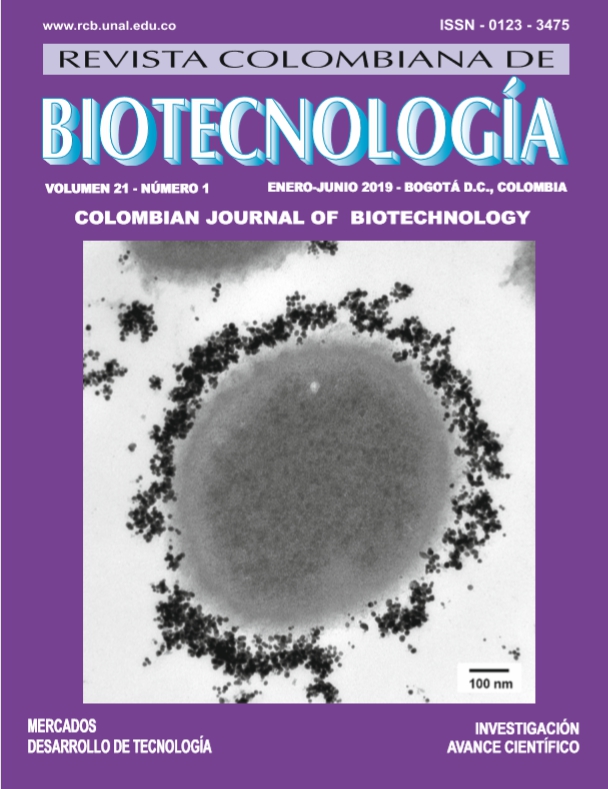
Tolerancia al plomo de aislamientos nativos de Pseudomonas spp. de aguas residuales del Valle de Aburrá
Tolerance lead of native Pseudomonas spp. wastewater from Aburrá Valley
DOI:
https://doi.org/10.15446/rev.colomb.biote.v21n1.65146Palabras clave:
Biorremediación ambiental, metales pesados, contaminantes del agua, microbiología del agua (es)Environmental bioremediation, metals heavy, water pollutants, water microbiology (en)
El plomo (Pb) es un metal pesado cuyas características físico-químicas lo convierten en un contaminante ambiental persistente, bioacumulable y de alta toxicidad. La biorremediación surge como una alternativa con múltiples ventajas en comparación con los tratamientos convencionales para remover contaminantes como metales pesados de aguas residuales, basándose en las capacida-des de tolerancia y mecanismos de resistencia de los microorganismos. Con el fin de conocer la tolerancia de Pseudomonasspp. al plomo presente en aguas contaminadas, se obtuvieron cuatro aislados nativos, procedentes de aguas residuales colectadas en elrío del Valle de Aburrá (zona norte), los cuales se caracterizaron bioquímicamente. Se realizaron bioensayos de tolerancia en diferen-tes concentraciones de plomo por difusión en agar, como prueba tamiz, y determinación de la concentración mínima inhibitoria,determinando la viabilidad del microorganismo en cada exposición. No se presentó diferencia significativa para la tolerancia al plo-mo entre los aislados, identificados bioquímicamente como Pseudomonas aeruginosa, ni entre las diferentes concentraciones de plomo a las cuales fueron expuestos los aislados. A partir de estos resultados, se discute a cerca de los mecanismos reportados por diferentes autores, mediante los cuales Pseudomonasspp. puede actuar en presencia de Plomo. De esta manera, se concluye que los aislados de Pseudomonasspp. presentan mecanismos de tolerancia y/o resistencia hasta concentraciones de 2500 mg/L en presencia de nitrato de plomo, como potenciales agentes que pueden integrarse en procesos que impulsan nuevas tecnologías de biorremediación.
Referencias
Abdel Ghani, N. T., & El Chaghaby, G. A. (2014). Bio-sorption for metal ions removal from aqueous solu-tions: A review of recent studies. International Jour-nal of Latest Research in Science and Technology, 3(1), 24–42. https://doi.org/10.1007/978-3-540-87781-3_47.
Ahmed, E., & Holmström, S. J. M. (2014). Siderophores in environmental research: Roles and applications. Microbial Biotechnology, 7(3), 196–208. https://doi.org/10.1111/1751-7915.12117.
APHA (2005) Standard Methods for the Examination of Water and Wastewater. 21st Edition, American Public Health Association/American Water Works Association/Water Environment Federation, Wa-shington DC.
Ballardo de la Cruz, C. E., Merino Rafael, F. A., & Gutiérrez Moreno, S. M. (2015). Evaluación de la capacidad de bioadsorción de Cadmio (II) y Plomo (II) mediante el uso de biomasa bacteriana muerta en soluciones acuosas. Theorema UNMSM, 2(2), 95–106.
Barakat, M. A. (2011). New trends in removing heavy metals from industrial wastewater. Arabian Journal of Chemistry, 4(4), 361–377. https://doi.org/10.1016/j.arabjc.2010.07.019.
Capdevila, M., Bofill, R., Palacios, O., & Atrian, S. (2012). State-of-the-art of metallothioneins at the beginning of the 21st century. Coordination Chemistry Re-views, 256(1–2), 46–62. https://doi.org/10.1016/j.ccr.2011.07.006.
Chien, C. C., Lin, B. C., & Wu, C. H. (2013). Biofilm for-mation and heavy metal resistance by an environ-mental Pseudomonassp. Biochemical Engineering Journal,78, 132–137. https://doi.org/10.1016/j.bej.2013.01.014.
Fairbrother, A., Wenstel, R., Sappington, K., & Wood, W. (2007). Framework for Metals Risk Assessment. Ecotoxicology and Environmental Safety, 68(2), 145–2 2 7 . https://doi.org/10.1016/j.ecoenv.2007.03.015.
Gabr, R. M., Hassan, S. H. A., & Shoreit, A. A. M. (2008). Biosorption of lead and nickel by living and non-living cells of Pseudomonas aeruginosaASU 6a. International Biodeterioration & Biodegradation, 62(2), 195–203. https://doi.org/10.1016/j.ibiod.2008.01.008.
Garza González, M. T. (2005). Aislamiento de microor-ganismos con alta capacidad de tolerar y remover Pb (II), Cr (VI), Cd (II), Cu (II), Zn (II) y Ni (II). Uni-versidad de la Habana.
Jarosławiecka, A., & Piotrowska-Seget, Z. (2014). Lead resistance in micro-organisms. Microbiology(United Kingdom), 160, 12–25. https://doi.org/10.1099/mic.0.070284-0
Kang, C.-H., Kwon, Y.-J., & So, J.-S. (2016). Bioremedia-tion of heavy metals by using bacterial mixtures. Ecological Engineering, 89, 64–69. https://doi.org/10.1016/j.ecoleng.2016.01.023
Kang, C. H., Oh, S. J., Shin, Y., Han, S. H., Nam, I. H., & So, J. S. (2015). Bioremediation of lead by ureolytic bacteria isolated from soil at abandoned metal mi-nes in South Korea. Ecological Engineering, 74, 402–407. https://doi.org/10.1016/j.ecoleng.2014.10.009.
Li, M., Cheng, X., & Guo, H. (2013). Heavy metal remo-val by biomineralization of urease producing bacte-ria isolated from soil. International Biodeterioration & Biodegradation, 76, 81–85. https://doi.org/10.1016/j.ibiod.2012.06.016
Majumder, S., Gupta, S., Raghuvanshi, S., Gupta, S., & Majumder, S. (2014). Removal of Dissolved Metals by Bioremediation. In S. K. Sharma (Ed.), Heavy Metals in Water: Presence, Removal and Safety (pp. 44–56). Cambridge: The Royal Society of Che-mistry. Retrieved from https://books.google.com.co/books?hl=es&lr=&id=BF_YBAAAQBAJ&oi=fnd&pg=PA44&dq=bioremediation+wastewater+advantage&ots=Bw0F43Ydyo&sig=QwwGxbp45CNzQ4AwUdYleoOpZvM#v=onepage&q=bioremediationwastewa-teradvantage&f=false.
Mancera Rodríguez, N. J., & Álvarez León, R. (2006). Cu-rrent State of Knowledge of the Concentration of Mercury and Other Heavy Metals in Fresh Water Fish in Colombia. Acta Biológica Colombiana, 11(1), 21. https://doi.org/doa.org/toc/1900-1649/11/0.
Mani, D., & Kumar, C. (2014). Biotechnological advan-ces in bioremediation of heavy metals contami-nated ecosystems: An overview with special refe-rence to phytoremediation. International Journal of Environmental Science and Technology, 11(3), 843–872. https://doi.org/10.1007/s13762-013-0299-8
Morales Fonseca, D., Ruiz Tovar, K., Martínez Salgado, M. M., Soto Guzmán, A. B., Falcony Guajardo, C., Rodríguez Vázquez, R., & Pedroza-Rodríguez, A. M. (2010). Desarrollo de un bioadsorbente laminar con Phanerochaete chrysosporiumhipertolerante al cadmio, al níquel y al plomo para el tratamiento de aguas. Revista Iberoamericana de Micologia, 27(3), 111–118. https://doi.org/10.1016/j.riam.2010.02.002.
Muñoz, A. J., Ruiz, E., Abriouel, H., Gálvez, A., Ezzouhri, L., Lairini, K., & Espínola, F. (2012). Heavy metal tole-rance of microorganisms isolated from wastewaters: Identification and evaluation of its potential for bio-sorption. Chemical Engineering Journal, 210, 325–332. https://doi.org/10.1016/j.cej.2012.09.007.
Naik, M. M., & Dubey, S. K. (2011). Lead-enhanced side-rophore production and alteration in cell morpho-logy in a Pb-resistant Pseudomonas aeruginosastrain 4EA. Current Microbiology, 62(2), 409–414. https://doi.org/10.1007/s00284-010-9722-2.
Naik, M. M., & Dubey, S. K. (2013). Lead resistant bacte-ria: Lead resistance mechanisms, their applications in lead bioremediation and biomonitoring. Ecotoxi-cology and Environmental Safety, 98, 1–7. https://doi.org/10.1016/j.ecoenv.2013.09.039.
Naik, M. M., Pandey, A., & Dubey, S. K. (2012). Pseudo-monas aeruginosa strain WI-1 from Mandovi es-tuary possesses metallothionein to alleviate lead toxicity and promotes plant growth. Ecotoxicology and Environmental Safety, 79, 129–133. https://doi.org/10.1016/j.ecoenv.2011.12.015.
OMS. (2014). Centro de prensa: Intoxicación por plomo y salud. Retrieved October 14, 2016, from http://www.who.int/mediacentre/factsheets/fs379/es/
Oves, M., Saghir, M., & Qari, H. A. (2017). Ensifer adhae-rens for heavy metal bioaccumulation, biosorption , and phosphate solubilization under metal stress condition. Journal of the Taiwan Institute of Chemi-cal Engineers, 80, 540–552. https://doi.org/10.1016/j.jtice.2017.08.026.
Xu, X., Liao, W., Lin, Y., Dai, Y., Shi, Z., & Huo, X. (2018). Blood concentrations of lead, cadmium, mercury and their association with biomarkers of DNA oxi-dative damage in preschool children living in an e-waste recycling area. Environmental Geochemistry and Health, 40(4), 1481–1494. https://doi.org/10.1007/s10653-017-9997-3.
Cómo citar
APA
ACM
ACS
ABNT
Chicago
Harvard
IEEE
MLA
Turabian
Vancouver
Descargar cita
CrossRef Cited-by
1. Adriana C. Melo Páez, Silvia Y. Narvaez Flórez, Carmen S. Mosquera Vivas, Maria J. Calvo Saad. (2023). Evaluation of the Biostability of Elodea (Egeria densa) and Orange Peel as Bioadsorbent Materials for Pb (II) and Cr (III) in Solution. Ingeniería e Investigación, 43(1), p.e95432. https://doi.org/10.15446/ing.investig.95432.
2. Jessica M Bedoya Vélez, José Gregorio Martínez, Juliana Tobón Ospina, Susana Ochoa Agudelo. (2021). Bioremediation potential of Pseudomonas genus isolates from residual water, capable of tolerating lead through mechanisms of exopolysaccharide production and biosorption. Biotechnology Reports, 32, p.e00685. https://doi.org/10.1016/j.btre.2021.e00685.
3. Katleen L. Alvarado-Campo, Marynes Quintero, Bernarda Cuadrado-Cano, Manuela Montoya-Giraldo, Elver Luis Otero-Tejada, Lina Blandón, Olga Sánchez, Ana Zuleta-Correa, Javier Gómez-León. (2023). Heavy Metal Tolerance of Microorganisms Isolated from Coastal Marine Sediments and Their Lead Removal Potential. Microorganisms, 11(11), p.2708. https://doi.org/10.3390/microorganisms11112708.
Dimensions
PlumX
Visitas a la página del resumen del artículo
Descargas
Licencia
Derechos de autor 2019 Revista Colombiana de Biotecnología

Esta obra está bajo una licencia internacional Creative Commons Atribución 4.0.
Esta es una revista de acceso abierto distribuida bajo los términos de la Licencia Creative Commons Atribución 4.0 Internacional (CC BY). Se permite el uso, distribución o reproducción en otros medios, siempre que se citen el autor(es) original y la revista, de conformidad con la práctica académica aceptada. El uso, distribución o reproducción está permitido desde que cumpla con estos términos.
Todo artículo sometido a la Revista debe estar acompañado de la carta de originalidad. DESCARGAR AQUI (español) (inglés).