Publicado
Discovery of an isolated population of the dwarf tarantula Homoeomma uruguayense (Araneae, Theraphosidae) in central Argentina
Descubrimiento de una población aislada de la tarántula enana Homoeomma uruguayense (Araneae, Theraphosidae) en el centro de Argentina
DOI:
https://doi.org/10.15446/caldasia.v41n2.71066Palabras clave:
Distribution, natural history, new record, Theraphosinae (en)Distribución, historia natural, nuevo registro, Theraphosinae (es)
Descargas
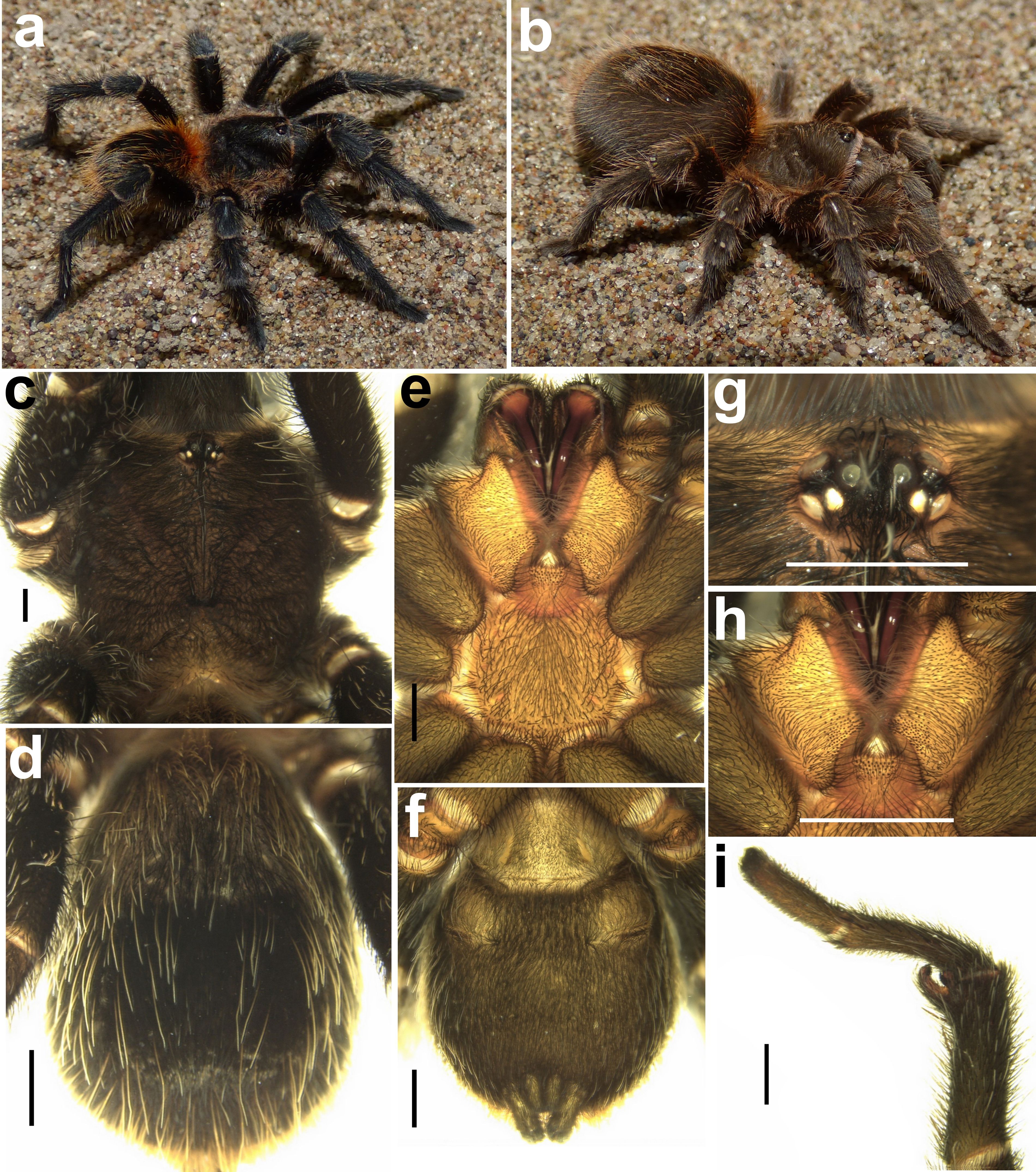
The genus Homoeomma has thirteen species distributed in Argentina, Brazil, Colombia, Peru and Uruguay. In Argentina, two species are recorded, Homoeomma elegans in Misiones province and H. uruguayense in Buenos Aires, Entre Ríos and Santa Fe provinces. The objective of this work is to provide the first record of Homoeomma uruguayense in the mountainous system of central Argentina, belonging to western record of the genus in this country. In addition, we provide data on natural history of the species, some notes on its sexual behavior and through the species distribution modeling we discussed about the geographic distribution of the species and factors that could led to this pattern.
El género Homoeomma presenta trece especies que se distribuyen en Argentina, Brasil, Colombia, Perú y Uruguay. En Argentina, se citan dos especies, Homoeomma elegans en la provincia de Misiones y H. uruguayense en las provincias de Buenos Aires, Entre Ríos y Santa Fe. El objetivo de este trabajo es reportar el primer registro de Homoeomma uruguayense para las sierras centrales de Argentina, lo cual corresponde al registro más occidental del género en este país. Además, se proveen datos sobre la historia natural de la especie, algunas notas sobre el comportamiento sexual y mediante el modelado de distribución de especies se discute sobre la distribución geográfica de la especie y los factores que pudieron conducir a este patrón.
Referencias
Costa F, Pérez-Miles F. 2002. Reproductive biology of Uruguayan theraphosids (Araneae, Mygalomorphae). J. Arachnol. 30(3):571–587. doi: https://doi.org/10.1636/0161-8202(2002)030[0571:RBOUTA]2.0.CO;2.
Elith J, Phillips SJ, Hastie T, Dudík M, Chee YE, Yates CJ. 2011. A statistical explanation of MaxEnt for ecologists. Divers. Distrib. 17(1):43–57. doi: https://doi.org/10.1111/j.1472-4642.2010.00725.x.
Ferretti N, González A, Pérez-Miles F. 2012. Historical biogeog¬raphy of mygalomorph spiders from the peripampasic orogenic arc based on track analysis and PAE as a panbiogeographical tool. Syst. Biodivers. 10(2):179–193. doi: https://doi.org/10.1080/14772000.2012.694375.
Fick SE, Hijmans RJ. 2017. Worldclim 2: New 1-km spatial resolution climate surfaces for global land areas. Int. J. Climatol. 37(12): 4302-4315 doi: https://doi.org/10.1002/joc.5086.
Gerschman BS, Schiapelli RD. 1972. El género Homoeomma Ausserer, 1871 (Araneae: Theraphosidae). Physis. 31(82):237–258.
Ojanguren-Affilastro A, Adilardi RS, Mattoni CI, Ramírez MJ, Ceccarelli MF. 2017. Dated phylogenetic studies of the southernmost American buthids (Scorpiones; Buthidae). Mol. Phylogenet. Evol. 110:39–49. doi: https://doi.org/10.1016/j.ympev.2017.02.018.
Ortíz-Jaureguizar E, Cladera GA. 2006. Paleoenvironmental evolution of southern South America during the Cenozoic. J. Arid Environ. 66(3):498–532. doi: https://doi.org/10.1016/j.jaridenv.2006.01.007.
Otto-Bliesner BL, Marshall SJ, Overpeck JT, Miller GH, Hu A. 2006. Simulating Arctic Climate Warmth and Icefield Retreat in the Last Interglaciation. Science. 311(5768):1751–1753. doi: https://doi.org/10.1126/science.1120808.
Pérez-Miles F, Lucas S, da Silva PI, Bertani R. 1996. Systematic revision and cladistic analysis of Theraphosinae (Araneae: Theraphosidae). Mygalomorph. 1:33–68.
Phillips SJ, Anderson RP, Schapire RE. 2006. Maximum entropy modeling of species geographic distributions. Ecol. Modell. 19:231–259. doi: https://doi.org/10.1016/j.ecolmodel.2005.03.026.
World Spider Catalog c2018. World Spider Catalog, version 19.0. Natural History Museum Bern. [last accessed: 8 Mar 2018]. http://wsc.nmbe.ch
Dimensions
PlumX
Visitas a la página del resumen del artículo
Descargas
Cómo citar
Licencia
Derechos de autor 2019 Caldasia

Esta obra está bajo una licencia internacional Creative Commons Atribución 4.0.
Aquellos autores/as que tengan publicaciones con esta revista, aceptan los términos siguientes:
- Los autores/as conservarán sus derechos de autor y garantizarán a la revista el derecho de primera publicación de su obra, el cual estará simultáneamente sujeto a la Licencia de reconocimiento de Creative Commons que permite a terceros compartir la obra siempre que se indique su autor y su primera publicación esta revista.
- Los autores/as podrán adoptar otros acuerdos de licencia no exclusiva de distribución de la versión de la obra publicada (p. ej.: depositarla en un archivo telemático institucional o publicarla en un volumen monográfico) siempre que se indique la publicación inicial en esta revista.
- Se permite y recomienda a los autores/as difundir su obra a través de Internet (p. ej.: en archivos telemáticos institucionales o en su página web) antes y durante el proceso de envío, lo cual puede producir intercambios interesantes y aumentar las citas de la obra publicada. (Véase El efecto del acceso abierto).