Publicado
Variación de la diversidad taxonómica y funcional de la avifauna en un bosque seco tropical (bs-T) en diferentes estados de sucesión en el sur del Valle del Magdalena, Huila, Colombia
Variation of the taxonomic and functional avian diversity in a dry tropical forest (DTF) at different successional stages in the south of Magdalena Valley, Huila, Colombia
DOI:
https://doi.org/10.15446/caldasia.v41n1.71272Palabras clave:
avifauna, complejidad del hábitat, diversidad funcional, sucesión (es)avifauna, functional diversity, habitat complexity, succession (en)
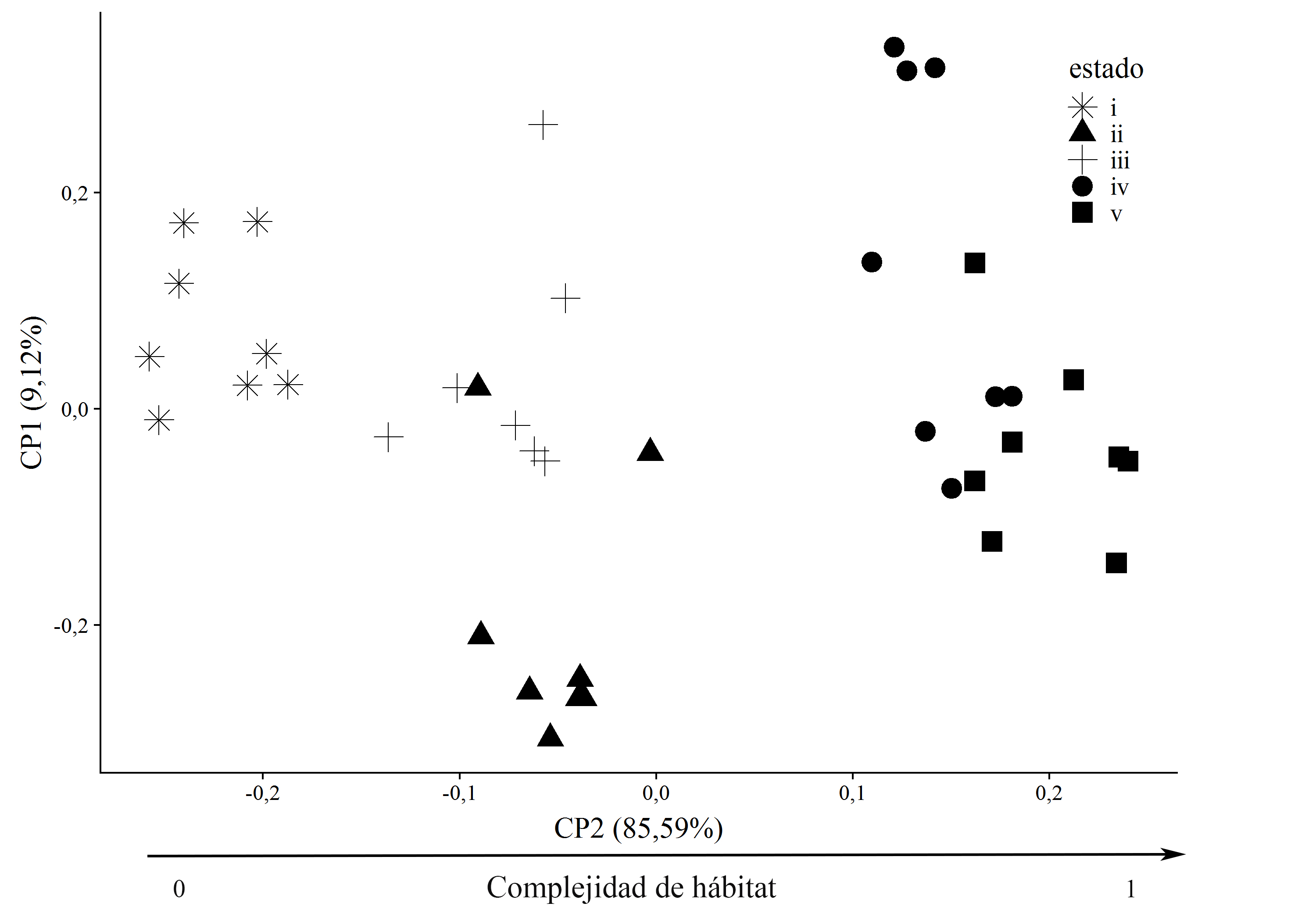
El Bosque Seco Tropical es uno de los ecosistemas más amenazados en Colombia y aún se desconocen diferentes aspectos sobre su avifauna y ecología, especialmente en el sur del Valle del Magdalena en Colombia. En este estudio se evaluaron las variaciones en la diversidad taxonómica y funcional en un ensamblaje de aves en un área con diferentes estados sucesionales en un bosque seco en el sur del valle del río Magdalena. Para la caracterización de la avifauna se llevaron a cabo puntos de conteos de radio fijo y para la complejidad de hábitat se cuantificaron variables estructurales de la vegetación en cada estado sucesional, se realizó un análisis de componentes principales, donde se utilizó el primer componente principal como una medida de la complejidad de hábitat. Los resultados muestran que la diversidad taxonómica medida como riqueza basada en el número efectivo de especies, y la diversidad funcional evaluada mediante el índice de riqueza funcional del ensamblaje se correlacionan significativamente con la complejidad del hábitat, aumentando en estados sucesionales más complejos. Esta tendencia fue positiva para frugívoros e insectívoros, y negativa para los granívoros, por lo que el estado sucesional y la complejidad de hábitat pueden estar jugando un papel clave en la estructuración de las comunidades de avifauna. Estos resultados contribuyen al conocimiento de la avifauna y su relación ecológica con el bosque seco en el sur del valle geográfico del río Magdalena.
The Dry Tropical Forest is one of the most threatened ecosystems in Colombia and there are aspects about their avifauna and ecology still unknown, specially in the south of the Magdalena river. This study evaluated the changes of the taxonomic and functional diversity of a bird assemblage in an area at different successional stages, in a dry tropical forest in the south of Magdalena valley. For the characterization of the avifauna, fixed-radius counting points were carried out and, for the complexity of the habitat, structural variables of the vegetation were quantified in each successional state, a principal component analysis was conducted, where the first principal component was used as a measure of habitat complexity. The results show that the taxonomic diversity measured as richness based on the effective number of species, and the functional diversity evaluated by the functional richness index index of the assemblage were significantly correlated with habitat complexity increasing in more complex successional stages. Those patterns remained at the bird- functional group level, with positive and significant correlations in frugivorous and insectivorous, and negative for the granivores group, so that the successional status and habitat complexity may be playing a key role in the structuring of avifauna communities. These findings contributed to the avian knowledge and their ecological relation with the dry forest in the south of the Magdalena valley.
Referencias
Almazán-Núñez R, Arizmendi M, Eguiarte L, Corcuera P. 2015. Distribution of the community of frugivorous birds along a successional gradient in a tropical dry forest in south-western Mexico. J. Trop. Ecol. 31(1):57–68. doi: 10.1017/S0266467414000601.
Andrade GI, Mejia CA. 1988. Cambios estacionales en la distribución de la avifauna terrestre en el parque nacional natural Macuira, Guajira, Colombia. Trianea 1:145–169.
Arriaga-Weiss SL, Calmé S, Kampichler C. 2008. Bird communities in rainforest fragments: Guild responses to habitat variables in Tabasco, Mexico. Biodivers. Conserv. 17(1):173–190. doi: 10.1007/s10531-007-9238-7.
Avendaño JE, López-O JP, Laverde-R O. 2018. Bird diversity of the Cúcuta valley (Colombia) and biogeographical affinities with dry forest avifaunas of northern South America. Wilson J. Ornithol. 130(1):213–22. doi: 10.1676/16-016.1.
Ayerbe-Quiñones F, López-O JP. 2011. Adiciones a la avifauna del valle alto del río Patía, un área interandina en el suroccidente de Colombia. Boletin SAO 20:1–17.
Blake JG, Loiselle BA. 2001. Bird assemblages in second-growth and old-growth forests, Costa Rica: Perspectives from mist nets and point counts. Auk 118(2):304–326. doi: 10.1642/0004-8038(2001)118[0304:BAISGA ]2.0.CO;2.
Blondel J. 2003. Guilds or functional groups: Does it matter? Oikos 100(2):223–231. doi: 10.1034/j.1600-0706.2003.12152.x.
Bregman TP, Lees AC, MacGregor HEA, Darski B, de Moura NG, Aleixo A, Barlow J, Tobias JA. 2016. Using avian functional traits to assess the impact of land-cover change on ecosystem processes linked to resilience in tropical forests. Proc. R. Soc. B Biol. Sci. 283:20161289. doi: 10.1098/rspb.2016.1289.
Cadotte MW, Carscadden K, Mirotchnick N. 2011. Beyond species: Functional diversity and the maintenance of ecological processes and services. J. Appl. Ecol. 48(5):1079–1087. doi: 10.1111/j.1365-2664.2011.02048.x.
Casas G, Darski B, Ferreira PMA, Kindel A, Müller SC. 2016. Habitat structure influences the diversity, richness and composition of bird assemblages in successional Atlantic rain forests. Trop. Conserv. Sci. 9(1):503–524. doi: 10.1177/194008291600900126.
Castaño-Villa GJ, Ramos-Valencia SA, Fontúrbel FE. 2014. Fine-scale habitat structure complexity determines insectivorous bird diversity in a tropical forest. Acta Oecol. 61:19–23. doi: 10.1016/j.actao.2014.10.002.
Chao A, Jost L. 2012. Coverage-based rarefaction and extrapolation: standardizing samples by completeness rather than size. Ecology 93(12):2533–2547. doi: 10.1890/11-1952.1.
Chao A, Gotelli NJ, Hsieh TC, Sander EL, Ma KH, Colwell RK, Ellison AM. 2014. Rarefaction and extrapolation with Hill numbers: a framework for sampling and estimation in species diversity studies. Ecol. Monogr. 84(1):45-67. doi: 10.1890/13-0133.1.
Chaparro‐Herrera S, Echeverry‐Galvis MA, Córdoba‐Córdoba S, Sua‐Becerra A. 2013. Listado actualizado de las aves endémicas y casi‐endémicas de Colombia. Biota Colomb. 14(2):113–150. doi: 10.21068/bc.v14i2.289.
Chazdon RL. 2008. Chance and determinism in tropical forest succession. En: Carson P, Schnitzer. 2008. Tropical forest community ecology. Oxford: Wiley-Blackwel. p. 384–408.
Clarke KR, Ainsworth M. 1993. A method of linking multivariate community structure to environmental variables. Mar. Ecol. Prog. Ser. 92:205–219.
Collazos‐González S, Echeverry‐Galvis MA. 2017. Comunidad de aves del bosque seco tropical en la mesa de Xéridas, Santander, Colombia. Ornitol. Neotrop. 28:223–235.
Díaz IA, Armesto JJ, Reid S, Sieving KE, Willson MF. 2005. Linking foreststructure and composition: avian diversity in successional forests of Chiloe Island, Chile. Biol. Conserv. 123(1):91–101. doi: 10.1016/j.biocon.2004.10.011.
Díaz S, Cabido M. 2001. Vive la différence: plant functional diversity matters to ecosystem processes. Trends Ecol. Evol. 16(11):646–655. doi: 10.1016/S0169-5347(01)02283-2.
Dirzo R, Young HS, Mooney HA, Ceballos G, editores. 2011. Seasonally dry tropical forests: Ecology and conservation. Washintong DC: Island Press.
Dryflor, Banda-R K, Delgado-Salinas A, Dexter KG, Linares-Palomino R, Oliveira-Filho A, Prado D, Pullan M, Quintan C, Riina R, Rodríguez GM, Weintritt J, Acevedo- Rodríguez P, Adarve J, Álvarez E, Aranguren B. A, Arteaga JC, Aymard G, Castaño A, Ceballos-Mago N, Cogollo A, Cuadros H, Delgado F, Devia W, Dueñas H, Fajardo L, Fernández A, Fernández MA, Franklin J, Freid E, Galetti LA, Gonto R, González-M R, Graveson R, Helmer EH, Idárraga Á, López R, Marcano-Vega H, Martínez OG, Maturo HM, McDonald M, McLaren K, Melo O, Mijares F, Mogni V, Molina D, Moreno NP, Nassar JM, Neves DM, Oakley LJ, Oatham M, Olvera- Luna AR, Pezzini FF, Reyes Dominguez OJ, Ríos ME, Rivera O, Rodríguez N, Rojas A, Särkinen T, Sánchez R, Smith M, Vargas C, Villanueva B, Pennington RT. 2016. Plant diversity patterns in neotropical dry forests and their conservation implications. Science 353(6306):1383–1387. doi: 10.1126/science.aaf5080.
Dunning JB. 2008. Handbook of avian body masses. Boca Raton, Florida: CRC Press.
Etter A, Andrade A, Saavedra K, Cortés J. 2018. Actualización de la Lista Roja de los Ecosistemas Terrestres de Colombia: conocimiento del riesgo de ecosistemas como herramienta para la gestión. En: Moreno LA, Rueda C, Andrade G, editores. Biodiversidad 2017. Estado y tendencias de la biodiversidad continental de Colombia. Bogotá D.C: Instituto de Investigación de Recursos Biológicos Alexander von Humboldt.
García H, Corzo G, Isaacs P, Etter A. 2014. Distribución y estado actual de los remanentes del bioma bosque seco tropical en Colombia: Insumos para su gestión. En: Pizano C, García H, editores. El Bosque Seco Tropical en Colombia. Bogotá, D.C.: Instituto de Investigación de Recursos Biológicos Alexander von Humboldt. p. 228–251.
García-Millán VE, Sánchez-Azofeifa A, Málvarez-García GC, Rivard B. 2014. Quantifying tropical dry forest succession in the Americas using CHRIS/PROBA. Remote Sens. Environ. 144:120–36. doi: 10.1016/j.rse.2014.01.010.
Gillespie TW, Walter H. 2001. Distribution of bird species richness at a regional scale in tropical dry forest of Central America. J. Biogeogr. 28(5):651–662. doi: 10.1046/j.1365-2699.2001.00575.x.
Gómez JP, Robinson SK. 2014. Aves del bosque seco tropical de Colombia: Las comunidades del valle alto del río Magdalena. En: Pizano C, García H, editores. El Bosque Seco Tropical en Colombia. Bogotá, D.C.: Instituto de Investigación de Recursos Biológicos Alexander von Humboldt. p. 94–127.
González-M R, García H, Isaacs P, Cuadros H, López-Camacho R, Rodríguez N, Pérez K, Mijares F, Castaño-Naranjo A, Rúben J, Idárraga-Piedrahíta A, Rojas A, Vergara H, Pizano C. 2018. Disentangling the environmental heterogeneity, floristic distinctiveness and current threats of tropical dry forests in Colombia. Environ. Res. Lett. 13(4):045007.
Gray MA, Baldauf SL, Mayhew PJ, Hill JK. 2007. The response of avian feeding guilds to tropical forest disturbance. Conserv. Biol. 21(1):133–141. doi: 10.1111/j.1523-1739.2006.00557.x.
Guariguata M, Ostergag R. 2001. Neotropical secondary forest succession: changes in structural and functional characteristics. For. Ecol. Manage. 148:185–206.
Holdridge LR. 1967. Life zone ecology. San José, Costa Rica: Tropical Science Center.
Hsieh TC, Ma K, Chao A. 2016. iNEXT: an R package for rarefaction and extrapolation of species diversity (Hill numbers). Methods Ecol. Evol. 7(12):1451–1456. doi: 10.1111/2041-210X.12613.
Jankowski JE, Merkord C, Farfan-Rios W, García-Cabrera K, Salinas N, Silman M. 2012. The relationship of tropical bird communities to tree species composition and vegetation structure along an Andean elevational gradient. J. Biogeogr. 40:950–962. doi: 10.1111/jbi.12041.
Laliberté E, Legendre P, and B Shipley. c2015. FD: measuring functional diversity from multiple traits, and other tools for functional ecology. R package versión 1.0-12. [Revisado en: 17 May 2018]. https://cran.r-project.org/web/packages/FD/FD
Latta SC, Brouwer NL, Mejía DA, Paulino M. 2018. Avian community characteristics and demographics reveal how conservation value of regenerating tropical dry forest changes with forest age. Peer J. 6:353127. doi: 10.7717/peerj.5217.
López-O J, Stiles FG, Parra J. 2015 Protocolo para la medición de rasgos funcionales en aves. En: Salgado-Negret B, editora. La ecología funcional como aproximación al estudio, manejo y conservación de la biodiversidad: protocolos y aplicaciones. Bogotá DC: Instituto de Investigación de Recursos Biológicos Alexander von Humboldt. p. 80–125.
Losada-Prado S, Gonzalez AAC, Molina Y. 2005. Especies endémicas y amenazadas registradas en la cuenca del Rio Coello (Tolima) durante estudios rápidos en 2003. Ornitol. Colomb. 3:76–80.
Losada-Prado S, Molina-Martinez Y. 2011. Avifuna del bosque seco tropical en el departamento del Tolima (Colombia): análisis de la comunidad. Caldasia 33(1):271–294.
Luck GW, Carter A, Smallbone L. 2013. Changes in Bird Functional Diversity across Multiple Land Uses: Interpretations of Functional Redundancy Depend on Functional Group Identity. PLoS One 8(5):e63671. doi: 10.1371/journal.pone.0063671.
Luck GW, Lavorel S, Mcintyre S, Lumb K. 2012. Improving the application of vertebrate trait-based frameworks to the study of ecosystem services. J. Anim. Ecol. 81(5):1065–1076. doi: 10.1111/j.1365-2656.2012.01974.x.
Maldonado-Coelho M, Marini MA. 2000. Effects of forest fragment size and successional stage on mixed-species bird flocks in southeastern Brazil. Condor 102(3):585–594. doi: 10.1650/0010-5422(2000)102[0585:EOFFSA]2.0.
Matlock RB, Edwards PJ. 2006. The influence of habitat variables on bird communities in forest remnants in Costa Rica. Biodivers. Conserv. 15(9):2987–3016. doi: 10.1007/s10531-005-4873-3.
Meynard CN, Quinn JF. 2008. Bird metacommunities in temperate South American forest: vegetation structure, area, and climate effects. Ecology 89:981–90.
Miles L, Newton AC, Defries RS, Ravilious C, May I, Blyth S, Kapos V, Gordon JE. 2006. A global overview of the conservation status of tropical dry forests. J. Biogeogr. 33(3):491–505. doi: 10.1111/j.1365-2699.2005.01424.x.
Mouchet MA, Villéger S, Mason NW, Mouillot D. 2010. Functional diversity measures: an overview of their redundancy and their ability to discriminate community assembly rules. Funct. Ecol. 24(4):867–876. doi: 10.1111/j.1365-2435.2010.01695.x.
Naranjo LG. 1992. Estructura de la avifauna en un area ganadera en el Valle del Cauca, Colombia. Caldasia 17(1):55–65.
Naranjo LG, Amaya‐Espinel JD, Eusse‐González D, Cifuentes-Sarmiento Y, editores. 2012. Guía de las especies migratorias de la biodiversidad en Colombia. Volumen I: Aves. Bogotá D.C: WWF Colombia, Ministerio de Ambiente y Desarrollo Sostenible.
Nassar JM, Stoner KE, Avila-Cabadilla L, Espirito-Santo M, Aranguren CI, González- Carcacía JA, Lobato-García JM, Olívio-Leite L, Álvarez-Añorve M, de Matos Brandao HN, Dolabela-Falcão LA, Rodríguez JP. 2014. Fruit-eating bats and birds of three seasonal Tropical dry forest in the Americas. En: Sanchez-Azofeifa, Powers J, Fernandes G, Quesada M, editores. Tropical Dry Forest in the Americas: Ecology, Conservation, and Management. I Edición. Boca Raton, Florida: CRC Press. p. 173–220.
Newbold T, Scharlemann W, Butchart S, Sekercioglu CH, Joppa L, Alkemade R, Purves W. 2014. Functional traits, land-use change and the structure of present and future bird communities in tropical forests. Global Ecol. Biogeogr. 23(10):1073–1084. doi: 10.1111/geb.12186.
Norden N, Angarita H, Bongers F, Martínez- Ramos R, Granzow-de la Cerda I, van Breugel M, Lebrija-Trejos E, Meave J, Vandermeer J, Williamson B, Finegan B, Mesquita R, Chazdon RL. 2015. Successional dynamics in Neotropical forests are as uncertain as they are predictable. Proc. Natl. Acad. Sci. U.S.A 112(26):8013–8018. doi: 10.1073/pnas.1500403112.
Oksanen J, Blanchet R, Kindt P, Legendre PR, Minchin RB, O’Hara RB, Simpson GL, Solymos P, Stevens M, Szoecs E. c2018. Package ‘Vegan”. Community Ecology Package: versión 2.5-2. [Revisada en: 17 May 2018]. https://cran.r-project.org/web/packages/vegan
Oliver TH, Hear M, Isaac N, Bullock J. 2015. Biodiversity and Resilience of Ecosystem Functions. Trends Ecol. Evol. 30(11):673–684. doi: 10.1016/j.tree.2015.08.009.
Patrignani A, Ochsner TE. 2015. Canopeo: A Powerful New Tool for Measuring Fractional Green Canopy Cover. Agron. J. 107(6):2312–2320. doi: 10.2134/agronj15.0150.
Pearman PB. 2002. The Scale of Community Structure: Habitat Variation and Avian Guilds in Tropical Forest Understory. Ecol. Monogr. 72(1):19–39. doi: 10.2307/3100083.
Pizano C, Garcia H, editores. 2014. El Bosque seco tropical en Colombia. Bogotá, D.C, Colombia: Instituto de Investigación de Recursos Biológicos Alexander von Humboldt (IAvH).
Portillo-Quintero C, Sánchez-Azofeifa G. 2010. Extent and conservation of tropical dry forests in the Americas. Biol. Conserv. 143(1):144–155. doi: 10.1016/j.biocon.2009.09.020.
Quesada M, Sanchez-Azofeifa GA, Alvarez- Añorve M, Stoner KE, Avila-Cabadilla L, Calvo-Alvarado J, Castillo A, Espírito-Santo MM, Fagundes M, Fernandes GW, Gamon J, Lopezaraiza-Mikel M, Lawrence D, Cerdeira Morellato LP, Power J, Neves F, Rosas- Guerrero V, Sayago R, Sanchez-Montoya G. 2009. Succession and management of tropical dry forests in the Americas: Review and new perspectives. For. Ecol. Manage. 258(6):1014–1024. doi: 10.1016/j.foreco.2009.06.023.
R Core Team. c2018. R: A language and environment for statistical computing. R Foundation for Statistical Computing, Vienna, Austria. [Revisada: 30 de Mar 2018]. http:// www.R-project.org/
Ralph CJ, Geupel GR, Pyle P, Martin TE, De Sante DF, Milá B. 1996. Manual de métodos de campo para el monitoreo de aves terrestres. General technical report. Albany, California: Pacific Southwest Research Station, Forest service, United States Department of agriculture.
Raman TRS, Rawat GS, Johnsingh AJT. 1998. Recovery of tropical rainforest avifauna in relation to vegetation succession following shifting cultivation in Mizoram, north-east India. J. Appl. Ecol. 35(2):214–231. doi: 10.1046/j.1365-2664.1998.00297.x.
Remsen JV, Areta I, Cadena CD, Claramunt S, Jaramillo A, Pacheco JF, Robbins MB, Stiles FG, Stotz F, Zimmer K. c2018. A classification of the bird species of South America. South American Classification Committee. American Ornithological Society. [Revisada en: 18 Abr 2018]. http://www.museum.lsu.edu/~Remsen/ SACCBaseline.htm
Restall R, Rodner C, Lentino M. 2007. Birds of Northern South America. An identification guide. Volume 1. New Haven: Yale University Press.
Robinson SK, Terborgh J. 1997. Bird community dynamics along primary successional gradients of Amazonian whitewater river. Ornithol. Monogr. 48:641–672.
Rojas R, Piragua W. 2000. Afinidades biogeográficas y aspectos ecológicos de la avifauna de Caño Limón, Arauca, Colombia. Cron. For. Medio Ambient. 15:1–26.
Sayer CA, Bulloc JM, Martin P. 2017. Dynamics of avian species and functional diversity in secondary tropical forests. Biol. Conserv. 211:1–9. doi: 10.1016/j.biocon.2017.05.004.
Sekercioglu CH. 2006. Increasing awareness of avian ecological function. Trends Ecol. Evol. 21(8):464–471. doi: 10.1016/j.tree.2006.05.007.
Sekercioglu CH. 2012. Bird functional diversity and ecosystem services in tropical forests, agroforests and agricultural areas. J. Ornithol. 153:153–161. doi: 10.1007/s10336-012-0869-4.
Sekercioglu CH, Ehrlich PR, Daily GC, Aygen D, Goehring D, Sandi RF. 2002. Disappearance of insectivorous birds from tropical forest fragments. Proc. Natl. Acad. Sci. U.S.A 99:263–267. doi: 10.1073/pnas.012616199.
Sekercioglu CH, Daily GC, Ehrlich PR. 2004. Ecosystem consequences of bird declines. Proc. Natl. Acad. Sci. U.S.A 101:18042– 18047. doi: 10.1073/pnas.0408049101.
Sitters H, York A, Swan M, Christie F, Di Stefano J. 2016. Opposing Responses of Bird Functional Diversity to Vegetation Structural Diversity in Wet and Dry Forest. PLoS One 11:e0164917. doi: 10.1371/journal.pone.0164917.
Tilman D, Knops J, Wedin D, Reich P, Ritchie M, Siemann E. 1997. The influence of functional diversity and composition on ecosystem processes. Science 277:1300-1302.
Vieira D, Scariot A. 2006. Principles of natural regeneration of tropical dry forests for restoration. Restor. Ecol. 14:11–20. doi: 10.1111/j.1526-100X.2006.00100.x.
Violle C, Navas ML, Vile DM, Kazakou E, Fortunel, Hummel I, Garnier E. 2007. Let the concept of trait be functional! Oikos 116(5):882–892. doi: 10.1111/j.2007.0030-1299.15559.x.
Wilman H, Belmaker M, Simpson J, de La Rosa C, Rivadeneira M, Jetz W. 2014. EltonTraits 1.0: species-level foraging attributes of the world’s birds and mammals. Ecology 95(7):2027. doi: 10.1890/13-1917.1.
Xeno-canto Foundation. c2018. Xeno-canto. Compartiendo cantos de aves de todo el mundo. [Revisada en: 30 May 2016]. http://http://www.xeno-canto.org
Dimensions
PlumX
Visitas a la página del resumen del artículo
Descargas
Cómo citar
Licencia
Derechos de autor 2019 Caldasia

Esta obra está bajo una licencia internacional Creative Commons Atribución 4.0.
Aquellos autores/as que tengan publicaciones con esta revista, aceptan los términos siguientes:
- Los autores/as conservarán sus derechos de autor y garantizarán a la revista el derecho de primera publicación de su obra, el cual estará simultáneamente sujeto a la Licencia de reconocimiento de Creative Commons que permite a terceros compartir la obra siempre que se indique su autor y su primera publicación esta revista.
- Los autores/as podrán adoptar otros acuerdos de licencia no exclusiva de distribución de la versión de la obra publicada (p. ej.: depositarla en un archivo telemático institucional o publicarla en un volumen monográfico) siempre que se indique la publicación inicial en esta revista.
- Se permite y recomienda a los autores/as difundir su obra a través de Internet (p. ej.: en archivos telemáticos institucionales o en su página web) antes y durante el proceso de envío, lo cual puede producir intercambios interesantes y aumentar las citas de la obra publicada. (Véase El efecto del acceso abierto).