
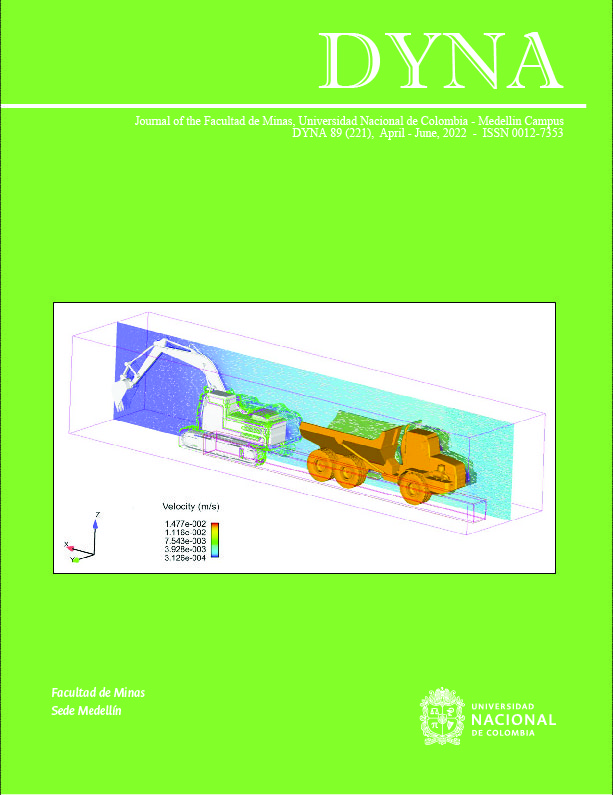
Publicado
Computational Fluid Dynamics (CFD) study to optimize the auxiliary ventilation system in an underground mine
Estudio mediante Mecánica de Fluidos Computacional (CFD) para optimizar el sistema de ventilación auxiliar en una mina subterránea
DOI:
https://doi.org/10.15446/dyna.v89n221.100297Palabras clave:
mine ventilation; CFD model; underground mining; auxiliary ventilation system; efficiency. (en)ventilación de mina; modelo CFD; minería subterránea; sistema de ventilación auxiliar; eficiencia (es)
Descargas
Four different scenarios have been studied in an underground mine, validating the results by actual data. Finding the best ventilation conditions in terms of air velocity and heat load removal. The conditions worsen as the duct is placed further from the face. While the position of the duct regarding cross-section, lower or upper side of the drift, does not give a clear conclusion about the best option, but it depends on the variable used in the analysis, either temperature, air velocity or the specific area in the working face. The findings of this study can be used to implement the most efficient auxiliary ventilation system in the mine considering the potential main issue, whether it is the working face or the place of the equipment. Besides, future scenarios can be also analysed with the model created, providing a good tool to select the auxiliary ventilation layout in each case.
Se han estudiado cuatro escenarios diferentes en una mina subterránea, validando los resultados con datos reales. Se han encontrado las mejores condiciones de ventilación en términos de velocidad del aire y temperatura. Las condiciones empeoran a medida que el conducto se aleja del frente. Mientras que la posición del conducto respecto a la sección transversal, lado inferior o superior de la galería, no da una conclusión clara sobre la mejor opción, sino que depende de la variable utilizada en el análisis, ya sea la temperatura, velocidad del aire o área específica en el frente de trabajo. Las conclusiones de este estudio pueden utilizarse para implantar el sistema de ventilación auxiliar más eficiente en la mina teniendo en cuenta el posible problema principal, ya sea el frente de trabajo o el lugar del equipo. Además, con el modelo creado también se pueden analizar escenarios futuros, proporcionando una buena herramienta para seleccionar la disposición de la ventilación auxiliar en cada caso.
Referencias
Hargreaves, D.M.and Lowndes, I.S., The computational modeling of the ventilation flows within a rapid development drivage. Tunnelling and Underground Space Technology, 22(2) pp. 150-160, 2007. DOI: https://doi.org/10.1016/j.tust.2006.06.002.
Cheng, J., Yan, W., Haiming, X., Jin, L., Yekang, Y., Huangjun, D. and Yi, W., Comprehensive and Integrated Mine Ventilation Consultation Model - CIMVCM. Tunnelling and Underground Space Technology, 45, pp.166-80, 2014. DOI: https://doi.org/10.1016/j.tust.2014.09.004.
Sasmito, A.P., Birgersson, E., Ly, H.C. and Mujumdar, A.S., Some approaches to improve ventilation system in underground coal mines environment - A computational fluid dynamic study. Tunnelling and Underground Space Technology, 34, pp. 82-95, 2013. DOI: https://doi.org/10.1016/j.tust.2012.09.006.
Feroze, T. and Genc, B., Evaluation of line brattice length in an empty heading to improve air flow rate at the face using CFD. International Journal of Mining Science and Technology, 27(2), pp. 253-259, 2017. DOI: https://doi.org/10.1016/j.ijmst.2017.01.012.
Villiers, D.J., Mathews, M.J, Maré, P., Kleingeld, M. and Arndt, D., Evaluating the impact of auxiliary fan practices on localised subsurface ventilation. International Journal of Mining Science and Technology, 29(6), pp. 933-941, 2019. DOI: https://doi.org/10.1016/j.ijmst.2019.02.008.
Isidro, D., Torno, S., Toraño, J., Menéndez, M. and Gent, M., A practical use of CFD for ventilation of underground works. Tunnelling and Underground Space Technology, 26(1), pp. 189-200, 2011. DOI: https://doi.org/10.1016/j.tust.2010.08.002.
George, D., Bahrami D. and Mousset-Jones, P., Ventilation and climate simulation with the Multiflux Code. Journal of Coal Science and Engineering, 17(3), pp. 243-250, 2011. DOI: https://doi.org/10.1007/s12404-011-0304-0.
Sasmito, A.P., Kurnia, J.C., Birgersson, E. and Mujumdar, A.S., Computational evaluation of thermal management strategies in an underground mine. Applied Thermal Engineering, 90, pp. 1144-50, 2014. DOI: https://doi.org/10.1016/j.applthermaleng.2015.01.062.
Saki, S.A., Brune, J.F., Bogin, G.E., Grubb, J.W., Emad, M.Z. and Gilmore, R.C., CFD study of the effect of face ventilation on CH4 in returns and explosive gas zones in progressively sealed longwall gobs. Journal of the Southern African Institute of Mining and Metallurgy, 117(3), pp. 257-262, 2017. DOI: https://doi.org/10.17159/2411-9717/2017/v117n3a7.
Chang, P., Guang X., Fubao Z., Mullins, B., Abishek, S., Chalmers, D., Jong, E.C, Luxbacher, K.D., Ragab, S.A. and Karmis, M.E., Minimizing DPM pollution in an underground mine by optimizing auxiliary ventilation systems using CFD. Tunnelling and Underground Space Technology, 87, pp. 112-21, 2019. DOI: https://doi.org/10.1016/j.tust.2019.02.014.
Cheng, J., Siyuan, L., Fuxi, Z., Changchun, Z., Shengqiang, Y. and Apurna, G., CFD modelling of ventilation optimization for improving mine safety in longwall working faces. Journal of Loss Prevention in the Process Industries, 40, pp. 285-297, 2016. DOI: https://doi.org/10.1016/j.jlp.2016.01.004.
Ren, T. and Zhongwei, W., CFD modelling of ventilation, dust and gas flow dispersion patterns on a longwall face. Proceedings of the 11th International Mine Ventilation Congress, 2019, pp. 198-208, DOI: https://doi.org/10.1007/978-981-13-1420-9_17.
Saad, A., Kumral, M. and Sasmito, A.P., Correlating variability of the leakage characteristics with the hydraulic performance of an auxiliary ventilation system. Building and Environment, 121(8), pp. 200-214, 2017. DOI: https://doi.org/10.1016/j.buildenv.2017.05.029.
Acuña, E. and Allen, C., Ventilation control system implementation and energy consumption reduction at Totten Mine with level 4 tagging and future plans. In: Hudyma, M. and Potvin, Y., (eds), Proceedings of the First International Conference on Underground Mining Technology, UMT 2017, Australian Centre for Geomechanics, Perth, 2017, pp. 89-95. DOI: https://doi.org/10.36487/ACG_rep/1710_06_Acuna.
Develo, E., Pillalamarry, M. and Garab, E., Improving the ventilation system at Rosh Pinah Zinc Mine. Journal of the Southern African Institute of Mining and Metallurgy, 116(4), pp. 301-305, 2016. DOI: https://doi.org/10.17159/2411-9717/2016.
Chatterjee, A., Lijun, Z. and Xiaohua, X., Optimization of mine ventilation fan speeds according to ventilation on demand and time of use tariff. Applied Energy, 146, pp. 65-73, 2015. DOI: https://doi.org/10.1016/j.apenergy.2015.01.134.
Brune, J.F., Mine ventilation networks optimized for safety and productivity. Advances in Productive, Safe, and Responsible Coal Mining, 2019, pp. 83-99, 2019. DOI: https://doi.org/10.1016/B978-0-08-101288-8.00005-5.
Wang, P., Zhu, K., Zhou, Y., Liu, J. and Shi, C., Research and application of controlled circulating ventilation in deep mining. Procedia Engineering, 84, pp. 758-63, 2014. DOI: https://doi.org/10.1016/j.proeng.2014.10.493.
Rozema, W., Verstappen, R.W.C.P., Kok, J.C. and Veldman, A.E.P., A symmetry-preserving discretization and regularization subgrid model for compressible turbulent flow. ERCOFTAC Series, 20, pp. 319-325, 2015. DOI: https://doi.org/10.1007/978-3-319-14448-1_40.
Verstappen, R.W.C.P. and Van Der Velde, R.M., Symmetrypreserving discretization of heat transfer in a complex turbulent flow. Journal of Engineering Mathematics, 54(4), pp. 299-318, 2006. DOI: https://doi.org/10.1007/s10665-006-9035-4.
Moukalled, F., Mangani, L. and Darwish, M., The finite volume method in computational fluid dynamics: an advanced introduction with OpenFOAM and Matlab. Fluid Mechanics and Its Applications, 113, art. 16874-6, 2016. DOI: https://doi.org/10.1007/978-3-319-16874-6_21.
Jasak, H. and Tessa, U., Practical computational fluid dynamics with the finite volume method. CISM International Centre for Mechanical Sciences, Courses and Lectures, 599, pp.103-161, 2020. DOI:https://doi.org/10.1007/978-3-030-37518-8_4.
McPherson, M.J., Subsurface Ventilation and Environmental Engineering, 2009, 834 P. ISBN: 978-94-010-4677-0.
Ali, Z., Tucker, P.G. and Shahpar, S., Optimal mesh topology generation for CFD. Computer Methods in Applied Mechanics and Engineering, 317, pp. 431-57, 2017. DOI: https://doi.org/10.1016/j.cma.2016.12.001.
Edward, T. and Gonzalez, J., Subsurface repository ventilation design. Proceedings - Rapid Excavation and Tunneling Conference, 2009, pp. 646-658. ISBN: 978-0-87335-492-9.
Zhou, G., Zhang, Q., Bai, R., Fan, T. and Wang, G., The diffusion behavior law of respirable dust at fully mechanized caving face in coal mine: CFD numerical simulation and engineering application. Safety and Environmental Protection, 106, pp. 117-28, 2017. DOI: https://doi.org/10.1016/j.psep.2016.12.005.
Dimensions
PlumX
Visitas a la página del resumen del artículo
Descargas
Cómo citar
Licencia

Esta obra está bajo una licencia internacional Creative Commons Atribución-NoComercial-SinDerivadas 4.0.
El autor o autores de un artículo aceptado para publicación en cualquiera de las revistas editadas por la facultad de Minas cederán la totalidad de los derechos patrimoniales a la Universidad Nacional de Colombia de manera gratuita, dentro de los cuáles se incluyen: el derecho a editar, publicar, reproducir y distribuir tanto en medios impresos como digitales, además de incluir en artículo en índices internacionales y/o bases de datos, de igual manera, se faculta a la editorial para utilizar las imágenes, tablas y/o cualquier material gráfico presentado en el artículo para el diseño de carátulas o posters de la misma revista.








