
Publicado
The use of the pile integrity test (PIT) to detect anomaly such as reinforcement exposure in short caissons
El uso de la prueba de integridad de pilotes (PIT) para detectar anomalías, como la exposición de refuerzo, en cajones cortos
DOI:
https://doi.org/10.15446/dyna.v90n229.107942Palabras clave:
integrity test; short caisson; pathology; quality control; geotechnical investigation (en)prueba de integridad; cajón corto; patología; control de calidad; investigación geotécnica (es)
Descargas
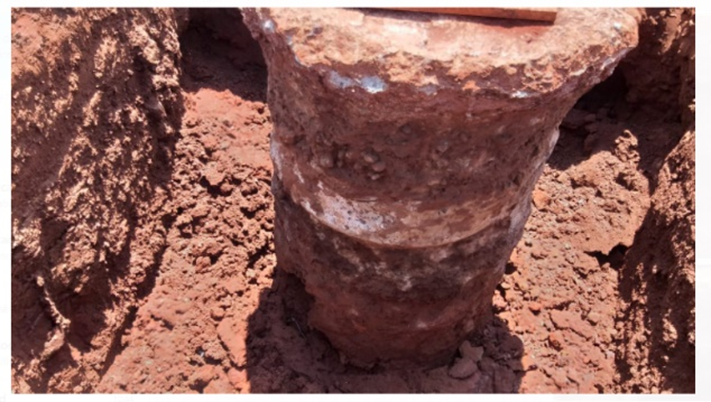
This paper aims to verify the effectiveness of the pile integrity test (PIT) for evaluating the presence of anomaly in short caisson foundation elements, more specifically reinforcement exposure due to an execution problem during concreting. The foundation elements tested belong to the expansion of the structure of an electricity substation in the municipality of Itá, state of Santa Catarina, Brazil. In general, the PIT is not commonly used for caissons, due to the surface irregularities occurring along the shaft in this type of foundation. The obtained results showed that the PIT can promote assertiveness and safety when assessing the integrity of these foundation elements, as later confirmed at the site by excavating the problematic elements and performing visual inspection. Thus, the results may validate the use of the PIT as a tool for optimizing the executive control of cast-in-place foundations, even though a Brazilian technical standard on the use of the low strain integrity test for this purpose is still lacking.
Este trabajo tiene como objetivo verificar la eficacia del ensayo de integridad de pilotes (EIP) para evaluar la presencia de anomalías en elementos de cimentación de cajones cortos, más específicamente la exposición de armaduras debido a un problema de ejecución durante el hormigonado. Los elementos de cimentación ensayados pertenecen a la ampliación de la estructura de una subestación eléctrica en el municipio de Itá, estado de Santa Catarina, Brasil. En general, el PIT no se utiliza habitualmente para cajones, debido a las irregularidades superficiales que se producen a lo largo del fuste en este tipo de cimentación. Los resultados obtenidos mostraron Qya casi salgoue el PIT puede promover la asertividad y la seguridad en la evaluación de la integridad de estos elementos de cimentación, como se confirmó posteriormente en el sitio mediante la excavación de los elementos problemáticos y la realización de una inspección visual. De este modo, los resultados pueden validar el uso del EIF como herramienta para optimizar el control ejecutivo de las cimentaciones coladas in situ, a pesar de que aún no existe una norma técnica brasileña sobre el uso del ensayo de integridad a baja deformación para este fin.
Referencias
Wu, J., Hesham, N., Kuihua, W. and Xin, L., Analytical Study of Employing Low-Strain Lateral Pile Integrity Test on a Defective Extended Pile Shaft. Journal of Engineering Mechanics, 9, pp.146, 2020. DOI: https://doi.org/10.1061/(asce)em.1943-7889.0001841
Kim, H.J., Mission, J.L., Dinoy, P.R., Kim, H.S. and Park, T.W., Guidelines for impact echo test signal interpretation based on wavelet packet transform for the detection of pile defects. Applied Sciences, 10(7), pp. 2633, 2020. DOI: https://doi.org/10.3390/app10072633
Chernauskas, L.R. and Paikowsky, S.G., Deep foundations integrity testing: techniques & case histories. Boston Society of Civil Engineers, 14(1), pp. 39-56, 1999.
Paquet, J., Étude vibratoire des pieux en béton: résponse harmonique. Annales de l'InstitutTechnique du Batîment, Paris, França, 245, pp. 789-803, 1968.
Bourdet, F., Historical overview of pile integrity control by the reflection and impedance methods. CEBTP [Online]. 1998. [date of reference October 24th of 2022]. Available at: http://www.cebtp-solen.com
Pasqual, R.P., Kormann, A.C. and De Souza-Junior, T.F., Proposal of a new system to classify possible damages in piles partially reinforced considering the results of low strain integrity tests. Revista IBRACON de Estruturas e Materiais, 12(6), pp. 1408–1427, 2019. DOI: https://doi.org/10.1590/s1983-41952019000600011
Paraíso, C.S., Costa, C.M.C. and Azevedo, C.M., Ensaio Pit. Congresso Brasileiro de Mecânica dos Solos e Engenharia Geotécnica, 2020. DOI: https://doi.org/10.4322/cobramseg.2022.0384
Pasqual, R.P. and Kormann, A.C., Low strain integrity tests in piles - 1-D and 3-D numerical modeling and comparisons with results obtained in the field. Multi-Science Journal, 2(3), pp. 1-8, 2020. DOI: https://doi.org/10.33837/msj.v2i3.878
Niyama, S., Introdução de ensaios dinâmicos no Brasil - Breve histórico. Workshop de controle de qualidade de fundações através de PDA e PIT. ABMS e Sinduscon-SP, 2002.
Hertlein, B. and Davis, A., Nondestructive testing of deep foundations [Preprint]. 2006 DOI: https://doi.org10.1002/0470034831
Lozovsky, I.N., Zhostkov, R.A. and Churkin, A.A., Numerical simulation of ultrasonic pile integrity testing. Russ J Nondestruct Test 56, 1-11, 2020. DOI: https://doi.org/10.1134/S1061830920010064
NBR 6122 - Projeto e execução de fundações. Associação Brasileira de Normas Técnicas - ABNT, 2019.
Silva, R.R.C., Santos, J.S., Sampaio, G.R., Marcolino, J.C. and Oliveira, R.C., Evaluation of the integrity of root-type piles through non-destructive pile integrity test associated with SPT drilling. Brazilian Applied Science Review, 4(5), pp. 2926-2938, 2020. DOI: https://doi.org/10.34115/basrv4n5-014
NBR 8036 - Programação de sondagem de simples reconhecimento dos solos para fundações de edifícios. Associação Brasileira de Normas Técnicas – ABNT, 1983.
Kormann, A.C.M., Ensaio de integridade de estacas (PIT) - Conceitos básicos. Workshop controle de qualidade de fundações através de provas de carga dinâmicas e verificação de integridade estrutural. ABMS e Sinduscon-SP, pp. 9, 2002.
Dimensions
PlumX
Visitas a la página del resumen del artículo
Descargas
Cómo citar
Licencia
Derechos de autor 2023 DYNA

Esta obra está bajo una licencia internacional Creative Commons Atribución-NoComercial-SinDerivadas 4.0.
El autor o autores de un artículo aceptado para publicación en cualquiera de las revistas editadas por la facultad de Minas cederán la totalidad de los derechos patrimoniales a la Universidad Nacional de Colombia de manera gratuita, dentro de los cuáles se incluyen: el derecho a editar, publicar, reproducir y distribuir tanto en medios impresos como digitales, además de incluir en artículo en índices internacionales y/o bases de datos, de igual manera, se faculta a la editorial para utilizar las imágenes, tablas y/o cualquier material gráfico presentado en el artículo para el diseño de carátulas o posters de la misma revista.








