
Publicado
Evaluación de la eficiencia de molienda y clasificación de materias primas: caso de estudio de una planta cementera
Grinding and classification efficiency evaluation in raw materials: cement plant study
DOI:
https://doi.org/10.15446/dyna.v90n229.110576Palabras clave:
cemento; cortocircuito; índice de trabajo de Bond; molienda; media móvil; Fish-Hook; materias primas (es)cement; bypass; Bond Work Index; grinding; moving average; Fish-Hook; raw materials (en)
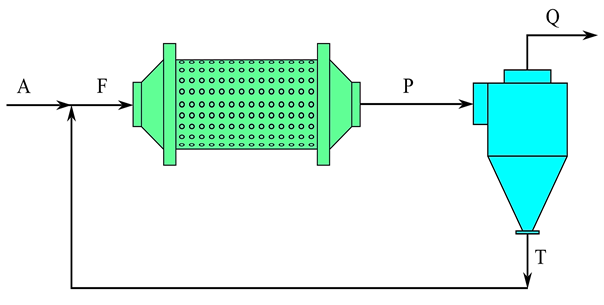
En este estudio se evaluó la eficiencia del sistema de molienda y clasificación en un circuito cerrado para una planta cementera. Se compararon los requerimientos energéticos determinados mediante el modelo de Bond con el consumo de energía calculado en planta utilizando el modelo de media móvil. Se identificaron las causas de las diferencias entre los cálculos teóricos y los valores reales considerando la clasificación de partículas mediante curvas de partición y el efecto Fish-Hook. Se encontró que los requerimientos energéticos de molienda en planta superan el modelo de Bond entre un 125.9-229.3% en términos de consumo de energía, debido a una eficiencia de clasificación bastante baja causada por el alto porcentaje de partículas finas en la corriente de rechazo. Lo anterior se evidenció en las curvas de clasificación a través del cortocircuito, el índice de claridad y el efecto Fish-Hook. Esto proporciona información para tomar medidas y mejorar la eficiencia del proceso.
The efficiency of the grinding and classification system in a closed circuit for a cement plant was evaluated in this study. The energy requirements determined by the Fred Bond model were compared with the energy consumption calculated on-site using the moving average model. The causes of the discrepancies between theoretical calculations and actual values were identified by considering particle classification through partition curves and the Fish-Hook effect. It was found that the energy requirements for grinding in the plant exceed the Bond model by 125.9-229.3% in terms of energy consumption, due to a significantly low classification efficiency caused by a high percentage of fine particles in the grinding underflow stream. This was observed in the classification curves through the bypass, sharpness index, and Fish-Hook effect. This information provides insights for taking measures to improve process efficiency.
Referencias
Hosten, C., Fidan, B., An industrial comparative study of cement clinker grinding systems regarding the specific energy consumption and cement properties. Powder Technology [Online]. 221, pp. 183–8, 2012. DOI: https://doi.org/10.1016/j.powtec.2011.12.065
Altun, O., Energy and cement quality optimization of a cement grinding circuit. Adv Powder Technol. [Online]. 29(7), pp. 1713–1723, 2018. DOI: https://doi.org/10.1016/j.apt.2018.04.006
Jankovic, A., Valery, W., Davis, E., Cement grinding optimisation. MinerEng [Online]. 17(11–12), pp. 1075–1081, 2004 DOI: https://doi.org/10.1016/j.mineng.2004.06.031
Madlool, N.A., Saidur, R., Rahim, N.A., Kamalisarvestani, M., An overview of energy savings measures for cement industries. Renew Sustain Energy Rev [Online]. 19, pp. 18–29, 2013. DOI: https://doi.org/10.1016/j.rser.2012.10.046
Weerasekara, N.S., Powell, M.S., Cleary, P.W., et al. The contribution of DEM to 1the science of comminution. Powder Technology [Online]. 248, pp. 3–24, 2013. DOI: https://doi.org/10.1016/j.powtec.2013.05.032
Celik IB. The effects of particle size distribution and surface area upon cement strength development. Powder Technol. 188(3):272–6. 2009 https://dx.doi.org/10.1016/j.powtec.2008.05.007
Škvára, F., Kolář, K., Novotný, J., Zadák, Z., The effect of cement particle size distribution upon properties of pastes and mortars with low water-to-cement ratio. Cem Concr Res [Online]. 11(2), pp. 247–255, 1981. DOI: https://doi.org/10.1016/0008-8846(81)90066-1
Bond, F.C., The third theory of comminution. Transactions on AIME Mining Engineering. 193, pp. 484-494, 1952.
Austin, L.G., Klimpel, R.R., Luckie, P.T., Process Engineering of size reduction: Ball milling. New York. Society of Mining Eginireers of the AIME. 1984
Bond, F.C., Crushing and Grinding calculations. British Chemical Engineering. 6, pp. 378–385, 543–48. 1961
Austin, l.G., Concha, F.A., Diseño y simulación de circuitos de molienda y clasificación. Pensilvania. CYTED. Programa Iberoamericano de Ciencia y Tecnología para el Desarrollo. Subprograma de Tecnología Mineral. Red de Fragmentación XIII-A, 1994.
Tenti, P., Paredes, H.K.M., Mattavelli, P., Conservative power theory, a framework to approach control and accountability issues in smart microgrids. IEEE Transactions on Power Electronics [Online]. 26(3), pp. 664-673, 2011, DOI: https://doi.org/10.1109/TPEL.2010.2093153.
Menti, A., Zacharias, T., Milias-Argitis, J., Geometric algebra: a powerful tool for representing power under nonsinusoidal condition. IEEE Transactions on Circuits and Systems I: Regular Papers [Online]. 54(3), pp. 601-609, 2007. DOI: https://doi.org/10.1109/TCSI.2006.887608
Mota, D. dosS., Tedeschi, E., On adaptive moving average algorithms for the application of the conservative power theory in systems with variable frequency. Energies [Online]. 14(4), 2021. DOI: https://doi.org/10.3390/en14041201
Alfi, V., Coccetti, F., Marotta, M., Pietronero, L., Takayasu, M., Hidden forces and fluctuations from moving averages: A test study. Phys A Stat Mech its Appl [Online]. 370(1), pp. 30–37, 2006. DOI: https://doi.org/10.1016/j.physa.2006.04.113
Cowpertwait, P.S.P., Metcalfe, A.V, Stationary models, in Introductory time series with R. Springer; 2011. pp. 121-135.
Kraipech, W., Chen, W., Parma, F.J., Dyakowski, T., Modelling the fish-hook effect of the flow within hydrocyclones. Int J Miner Process [Online]. 66(1–4), pp. 49–65, 2002. DOI: https://doi.org/10.1016/S0301-7516(02)00012-1
Luckie P.T., Mathematical analysis of mechanical air separator selectivity curves. AIME, Society of Mining Engineers. 1975.
Kontopoulou, V.I., Panagopoulos, A.D., Kakkos, I., Matsopoulos GK. A Review of ARIMA vs. Machine Learning Approaches for Time Series Forecasting in Data Driven Networks. Futur Internet [Online]. 15(8), pp. 1–31, 2023. DOI: https://doi.org/10.3390/fi15080255
Jalil, A., Rao, N.H., Time Series Analysis (Stationarity, Cointegration, and Causality). Environmental Kuznets Curve (EKC) A Manual [Online]. pp. 85–99, 2019. DOI: https://doi.org/10.1016/B978-0-12-816797-7.00008-4
Montgomery, D.C., Jennings, C.L., Murat, K., Introduction to time series analysis and forescasting. New Jersey. John Wiley & Sons, Inc; 2016.
Menegaki, A., Stationarity and an alphabetical directory of unit roots often used in the energy-growth nexus, in: A Guide to Econometrics Methods for the Energy-Growth Nexus. Academic Press. 2021. pp. 31–61.
Peña, D., Sánchez, I., El análisis de series temporales: situación y perspectivas. Boletín Estadística e Investigación Operativa. 23(4), pp. 4-8, 2007.
Chauhan, N.S.; Kumar, N. Traffic Flow Forecasting Using Attention Enabled Bi-LSTM and GRU Hybrid Model. International Conference on Neural Information Processing. 29th International Conference, ICONIP. pp. 505–517. 2022
Liu, Y., Wu, H., Wang, J., Long, M., Non-stationary transformers: exploring the stationarity in time series forecasting. dvances Neural Inf Process Syst [Online]. 35, 2023. Available at: http://arxiv.org/abs/2205.14415
Fuerstenau, D.W., Abouzeid, A.-Z.M., The energy efficiency of ball milling in comminution. Int J Miner Process [Online]. 67(1–4), pp. 161–185. DOI: https://doi.org/10.1016/S0301-7516(02)00039-X
Gupta, V.K., Energy absorption and specific breakage rate of particles under different operating conditions in dry ball milling. Powder Technology [Online]. 361, pp. 827–835, 2020. DOI: https://doi.org/10.1016/j.powtec.2019.11.033
Hukki, R.T., Proposal for a solomonic settlement between the theories of von Rittinger, Kick and Bond. Transactions of AIME. 220(5), pp. 403-408, 1961.
Deniz, V., The effects of ball filling and ball diameter on kinetic breakage parameters of barite powder. Adv Powder Technol [Online]. 23(5), pp. 640–646, 2012. DOI: https://doi.org/10.1016/j.apt.2011.07.006
Jayasundara, C.T., Yang, R.Y., Yu, A.B., Effect of the size of media on grinding performance in stirred mills. Minerals Engineering [Online]. 33, pp. 66–71, 2012. DOI: https://doi.org/10.1016/j.mineng.2011.10.012
Rivera, I., Quintero, F., Bustamante, O., Análisis del desgaste de medios moledores de acero en un molino de bolas de la compañía Argos S.A. . Prospectiva. 10(1), pp.108–112, 2012.
Chodakowska, E., Nazarko, J., Nazarko, Ł., Arima models in electrical load forecasting and their robustness to noise. Energies [Online]. 14(23), 2021. DOI: https://doi.org/10.3390/en14237952
Zhang, J., Shen, X., Zhang, Q., Maa, J.P.Y., Qiao, G., Bimodal particle size distributions of fine-grained cohesive sediments in a settling column with oscillating grids. Cont Shelf Res [Online]. 174, pp. 85–94, 2019. DOI: https://doi.org/10.1016/j.csr.2019.01.005
Austin, L.G., Bagga, P., An analysis of fine dry grinding in ball mills. Powder Technology [Online]. 28(1), pp. 83–90, 1981. DOI: https://doi.org/10.1016/0032-5910(81)87014-3
Lynch, A.J., Mineral crushing and grinding circuits: Their simulation. Optimization, Design and Control. Elsevier Scientific, 1977.
Hassanzadeh, A., A survey on troubleshooting of closed-circuit grinding system. Canadian Metallurgical Quarterly [Online]. 57(3), pp. 328–340, 2018. DOI: https://doi.org/10.1080/00084433.2018.1464618
Davis, E.W., Ball mill crushing in closed circuit with screens. Minnesota. University of Minnesota. 1925.
Pural, Y.E., Çelik, M., Özer, M., Boylu, F., Effective circulating load ratio in mill circuit for milling capacity and further flotation process - lab scale study. Physicochem Problems of Mineral Process [Online]. 58(5), 2022. DOI: https://doi.org/10.37190/PPMP/149916
Morrell, S., A method for predicting the specific energy requirement of comminution circuits and assessing their energy utilisation efficiency. Minerals Engineering [Online]. 21(3), pp. 224–233, 2008. DOI: https://doi.org/10.1016/j.mineng.2007.10.001
Jankovic, A., Valery, W., Sonmez, B., The Benefits of High Classification Efficiency in Closed Ball Mill Circuits. Proceeding of XV Balk Miner Process Congr. 2013.160–163. 2017.
Belhaj, T.K., Higazy, M.G., Gaafer, A.M., ELMogy, B.A.K., Improvement of Productivity Using Tromp Curve Measurement for Cement Separator Processing Technology. Scientific Journal Oct 6 University [Online]. 3(2), pp. 35–44, 2016. DOI: https://doi.org/10.21608/sjou.2016.31761
Dueck, J., Farghaly, M., Neesse, T., The theoretical partition curve of the hydrocyclone. Miner Eng [Online]. 62, pp. 25–30, 2014. DOI: https://doi.org/10.1016/j.mineng.2013.10.004
Ozcan, O., Performance comparison of a hydrocyclone and crossflow separator–a plant study. Separation Science and Technology [Online]. 55(4), pp. 799–810, 2020. DOI: https://doi.org/10.1080/01496395.2019.1574823
Kumar, C.R., Tripathy, S., Rao, D.S., Characterisation and Pre-concentration of Chromite Values from Plant Tailings Using Floatex Density Separator. J Miner Mater Charact Eng [Online]. 08(05), pp. 367–78, 2009. DOI: https://doi.org/10.4236/jmmce.2009.85033
Wills, B.A., and Finch, J., Will’s Mineral Processing Technology. Butterworth-Heinemann. 2015.
Chica-Osorio, L.M., Bustamante-Rua, O., Estudio del cortocircuito de finos en hidrociclones operados con suspensiones poliminerales en la industria cementera. 56. 2009. Disponible en: http://www.bdigital.unal.edu.co/2461/1/39192498.2009.pdf
Roldán-Villasana, E.J., Williams, R.A., Dyakowski, T., The origin of the fish-hook effect in hydrocyclone separators. Powder Technology [Online]. 77(3), pp. 243–50, 1993. DOI: https://doi.org/10.1016/0032-5910(93)85017-4
Gómez Giraldo, H.A., Modelación de la clasificación de minerales en hidrociclones de diámetro pequeño. Universidad Nacional de Colombia, 2005.
Frachon, M., Cilliers, J.J., A general model for hydrocyclone partition curves. Chem Eng J [Online]. 73(1), pp. 53–9, 1999. DOI: https://doi.org/10.1016/S1385-8947(99)00040-6
Dimensions
PlumX
Visitas a la página del resumen del artículo
Descargas
Cómo citar
Licencia
Derechos de autor 2023 DYNA

Esta obra está bajo una licencia internacional Creative Commons Atribución-NoComercial-SinDerivadas 4.0.
El autor o autores de un artículo aceptado para publicación en cualquiera de las revistas editadas por la facultad de Minas cederán la totalidad de los derechos patrimoniales a la Universidad Nacional de Colombia de manera gratuita, dentro de los cuáles se incluyen: el derecho a editar, publicar, reproducir y distribuir tanto en medios impresos como digitales, además de incluir en artículo en índices internacionales y/o bases de datos, de igual manera, se faculta a la editorial para utilizar las imágenes, tablas y/o cualquier material gráfico presentado en el artículo para el diseño de carátulas o posters de la misma revista.








