
Publicado
Probabilistic Weibull reliability of a shaft design subjected to bending and torsion stress
Confiabilidad probabilística Weibull en el diseño de un eje sometido a esfuerzos de flexión y torsión
DOI:
https://doi.org/10.15446/dyna.v91n232.111361Palabras clave:
probabilistic design; Weibull distribution; reliability; stress-strength (en)diseño probabilístico; distribución de Weibull; fiabilidad; tensión-resistencia (es)
Descargas
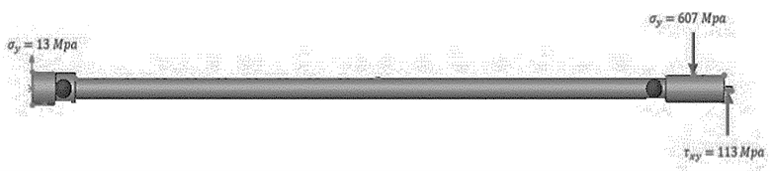
The circular shaft serves as the axis of rotation for the components. It is subjected to flexion and tearing, indicating that fatigue is the mode of failure. The range of stresses resulting from the mean and alternating loads determines the occurrence of fatigue failure. The deterministic fatigue analysis, calculated using the stress average obtained from SN curves, can only represent the mean life. This is because the stress range is not a single number, and therefore it cannot provide the reliability level for the stress. The study employs the Weibull distribution to estimate loads and parameters for a probabilistic shaft design under bending and torsion. The minimum strength is assessed using corresponding stress analysis to determine the reliability index for the designed shaft.
El eje circular sirve de eje de rotación de los componentes. Está sometido a flexión y desgarro, lo que indica que el modo de fallo es la fatiga. El rango de tensiones resultante de las cargas medias y alternas determina la aparición del fallo por fatiga. El análisis determinista de la fatiga, calculado a partir de la tensión media obtenida de las curvas SN, sólo puede representar la vida media. Esto se debe a que el rango de tensiones no es un número único y, por lo tanto, no puede proporcionar el nivel de fiabilidad de la tensión. El estudio emplea la distribución de Weibull para estimar las cargas y los parámetros de un diseño probabilístico de un eje sometido a flexión y torsión. La resistencia mínima se evalúa mediante el correspondiente análisis de tensiones para determinar el índice de fiabilidad del eje diseñado.
Referencias
Khan, A., Das, A., and Bhaskar, A.S., Prediction of fatigue life of glass-vinyl-ester-polyurethane sandwich structure using mathematical model. In: Pal, S., Roy, D., Sinha, S.K. (eds), Processing and Characterization of Materials. Springer Proceedings in Materials, 13, Springer, Singapore. 2021. DOI: https://doi.org/10.1007/978-981-16-3937-1_24
Ebrahimi, A., Effect analysis of RAMS parameter in design & operation of DP system in floating offshroe structure, Royal Institute of Technology, October, 2010.
Rao, B.C., Revisiting classical design in engineering from a perspective of frugality, Heliyon, 3(5), art. e00299, 2017. DOI: https://doi.org/10.1016/j.heliyon.2017.e00299.
Xu, Z., Cui, Y., Li, B., Liu, K., Shi, F., and Cao, P., Impact analysis of initial cracks angle on fatigue failure of flange shafts. Coatings, 12(2), 2022. DOI: https://doi.org/10.3390/coatings12020276
Rexnord Industries G.G., LLC, Gears-Shafts-Bearings-Seals, Failure Analysis Installation & Maintenance, 2(August), 1978, 20 P.
Korczewski, Z. and Marszałkowski, K., Energy analysis of the propulsion shaft fatigue process in a rotating mechanical system. Part III dimensional analysis. Polish Maritime Research, 28(2), pp. 72–77, 2021. DOI: https://doi.org/10.2478/pomr-2021-0023.
Barraza-Contreras, J.M., Piña-Monarrez, M.R., and Molina, A., Fatigue-life prediction of mechanical element by using the Weibull distribution, Applied Sciences (Switzerland), 10(18), art. 6384, 2020. DOI: https://doi.org/10.3390/APP10186384.
Zhao, Y.X., and Liu, H.B., Weibull modeling of the probabilistic S-N curves for rolling contact fatigue, Int J Fatigue, 66, pp. 47–54, 2014. DOI: https://doi.org/10.1016/j.ijfatigue.2014.03.008.
Taketomi, N., Yamamoto, K., Chesneau, C., and Emura, T., Parametric distributions for survival and reliability analyses, a review and historical sketch, Mathematics, 10(20),art. 10203907, 2022. DOI: https://doi.org/10.3390/math10203907.
Matsuda, S. and Ogi, K., Effect analysis of loading rate on relationship between strength and flaw size of ceramics using probabilistic model on the basis of SCG concept, Transactions of the JSME (in Japanese), 83(847), pp. 16-00369-16–00369, 2017. DOI: https://doi.org/10.1299/transjsme.16-00369.
Baro-Tijerina, M., Piña-Monárrez, M.R., and Villa-Covarrubias, B., Stress-strength weibull analysis with different shape parameter β and probabilistic safety factor, DYNA (Colombia), 87(215), pp. 28–33, 2020. DOI: https://doi.org/10.15446/dyna.v87n215.84909.
Aaronson, L.S., Defining and measuring fatigue. Journal of Nursing Scholarship, 31(1), pp. 45–50, 1999. DOI: https://doi.org/10.1111/j.1547-5069.1999.tb00420.x.
Ma, X., Yang, F., Li, J., Xue, Y., and Guan, Z., Fatigue life assessment method of in-service mechanical structure. Advances in Mechanical Engineering, 13(2), pp. 1–9, 2021. DOI: https://doi.org/10.1177/1687814021996524.
Khalaf, M.R. and Al-Ahmed, A.H.A., Effect of large openings on the behavior of reinforced concrete continuous deep beams under static and repeated load. E3S Web of Conferences, 318, pp. 3–10, 2021. DOI: https://doi.org/10.1051/e3sconf/202131803012.
Hosseini, S.M., Azadi, M., Ghasemi-Ghalebahman, A., and Jafari, S.M., Data analysis of striation spacing, lifetime, and crack length in crankshaft ductile cast iron under cyclic bending loading through high-cycle fatigue regime, Data Brief, 45(December), art. 108666, 2022. DOI: https://doi.org/10.1016/j.dib.2022.108666.
Kashyzadeh, K.R., Souri, K., Bayat, A.G., Jabalbarez, R.S, and Ahmad, M., Fatigue life analysis of automotive cast iron knuckle under constant and variable amplitude loading conditions. Applied Mechanics, 3(2), pp. 517–532, 2022. DOI: https://doi.org/10.3390/applmech3020030.
Liu, B., Sun, Y., Wang, J., and Zhang, G., Characteristic analysis of crack initiation and crack damage stress of sandstone and mudstone under low-temperature condition. Journal of Cold Regions Engineering, 34(3), art. 0225, 2020. DOI: https://doi.org/10.1061/(asce)cr.1943-5495.0000225.
Kim, H.S., A practical procedure for predicting the remaining fatigue life at an arbitrary stress ratio, Journal of Composites Science, 6(6), art. 60170, 2022. DOI: https://doi.org/10.3390/jcs6060170.
Kim, J., Anterior cruciate ligament microfatigue damage detected by collagen autofluorescence in situ. J Exp Orthop, 9(1), art. 74, 2022. DOI: https://doi.org/10.1186/s40634-022-00507-6.
Chen, M., Xiong, X., Zhuang, W., and Zeng, F., Fatigue life analysis of automotive glass regulator based on ABAQUS and FE-SAFE. IOP Conf Ser Earth Environ Sci, 571(1), art. 012109, 2020. DOI: https://doi.org/10.1088/1755-1315/571/1/012109.
Alamnie, M.M., and Endalemaw, Y., Fatigue life analysis of rail-welds using linear elastic fracture mechanics, ISEC 2019 - 10th International Structural Engineering and Construction Conference (July), 2019. DOI: https://doi.org/10.14455/isec.res.2019.197.
Wang, S., Tang, S., He, C., and Wang, Q., Cyclic deformation and fatigue failure mechanisms of thermoplastic polyurethane in high cycle fatigue, Polymers (Basel), 15(4), art. 5040899, 2023. DOI: https://doi.org/10.3390/polym15040899.
Chai, Y., Gao, W., Ankay, B., Li, F., and Zhang, C., Aeroelastic analysis and flutter control of wings and panels: a review. International Journal of Mechanical System Dynamics, 1(1), pp. 5–34, 2021. DOI: https://doi.org/10.1002/msd2.12015.
Guo, F., Hu, F., Wu, S., He, F., Liu, J., and Wu, X., System dynamics in structural strength and vibration fatigue life assessment of the swing bar for high‐speed maglev train. International Journal of Mechanical System Dynamics, 2(2), pp. 178–189, 2022. DOI: https://doi.org/10.1002/msd2.12045.
Schneider, J., and Haindl, H., Mechanic treatment of fastener holes: the influence of compressive residual stress on the corrosion behaviour of aluminium alloys, Materials and Corrosion, 59(9), pp. 753–761, 2008. DOI: https://doi.org/10.1002/maco.200804149.
Hirschberg, V., Wilhelm, M., and Rodriguez, D., Cumulative nonlinearity as a parameter to quantify mechanical fatigue. Fatigue Fract Eng Mater Struct, 43(2), pp. 265–276, 2020. DOI: https://doi.org/10.1111/ffe.13120.
Hahn, S., Feldmeth, S., and Bauer, F., Assessment of the lubricity of grease-sealing rotary shaft seals based on grease properties. Chem Eng Technol, 46(1), pp. 53–60, 2023. DOI: https://doi.org/10.1002/ceat.202200382.
Patel, N., Mohebbi, A., Jan, C.D., and Guo, J., Maximum shear-stress method for stable channel design. Guo, 146(12), art. 01827, 2020. DOI: https://doi.org/10.1061/(asce)hy.1943-7900.0001827.
Turbucz, M., and Fayad, J., Can semirigid fixation of the rostral instrumented segments prevent proximal junctional kyphosis in the case of long thoracolumbar fusions? A finite element study, SPIN (March), art. 22931, 2023. DOI: https://doi.org/10.3171/2023.1.SPINE22931.
Joun, M.S., Ji, S.M., Chung, W.J., Cho, G.S., and Lee, K.H., A new general fatigue limit diagram and its application of predicting die fatigue life during cold forging, Materials, 15(79, pp. 1–17, 2022. DOI: https://doi.org/10.3390/ma15072351.
Wang, Y., and Peng, Z., Fatigue life prediction method of mechanical parts based on Weibull distribution. IOP Conf Ser Mater Sci Eng, 782(2), art. 022068, 2020, DOI: https://doi.org/10.1088/1757-899X/782/2/022068.
Pawliczek, R., and Rozumek, D., Limited stress surface model for bending and torsion fatigue loading with the mean load value, Materials, 14(22), art. 227023, 2021. DOI: https://doi.org/10.3390/ma14227023.
Parry, Mohr’s Circles, Stress Paths, and Geotechnics. New York, USA, 2004.
Stresses, P., Stress, Strain, Mohr’ s Circle, 2014, pp. 1–7.
Narayan, K., Behdinan, K., and Vanderpol, P., An equivalent uniaxial fatigue stress model for analyzing landing gear fuse pins, Strength of Materials, 38(3), pp. 278–288, 2006. DOI: https://doi.org/10.1007/s11223-006-0041-6.
Pelleg, J., Mechanical Properties of Materials, Vol. 190, Springer, 2012, 645 P. DOI: https://doi.org/10.1007/978-94-007-4342-7.
Wang, Z., Sun, G., Wang, W., and Zhang, M., Application for surveillance video with tensor factorization in machine learning. SSRN Electronic Journal (February), art. 4218404, 2022. DOI: https://doi.org/10.2139/ssrn.4218404.
Taniguchi, Y., Takizawa, K., Otoguro, Y., and Tezduyar, T.E., A hyperelastic extended Kirchhoff–Love shell model with out-of-plane normal stress: I. Out-of-plane deformation, Comput Mech, 70(2), pp. 247–280, 2022. DOI: https://doi.org/10.1007/s00466-022-02166-x.
Piña-Monarrez, M.R., Weibull stress distribution for static mechanical stress and its stress/strength analysis. Qual Reliab Eng Int, 34(May), pp. 229–244, 2017. DOI: https://doi.org/10.1002/qre.2251.
Li, L., Cao, H., Guan, J., He, S., Niu, L., and Liu, H., A three-parameter Weibull distribution method to determine the fracture property of PMMA Bone Cement, Polymers (Basel), 14(17), pp. 1–17, 2022. DOI: https://doi.org/10.3390/polym14173589.
Menan, F., P-a A., and François, M., The stress-strength interference method applied to fatigue design: the independence of the random variables, Procedia Eng., 133(December), pp. 746–757, 2015. DOI: https://doi.org/10.1016/j.proeng.2015.12.656.
Sugito, P M.A., Ispriyanti, D., and Dewi, L.N., Analysis of geometric and Weibull queuing model. Case study: customer service and electronic ID card recording counters at Dispendukcapil of Semarang City. Journal of Physics: Conference Series, 1943(1), art. 012151, 2021. DOI: https://doi.org/10.1088/1742-6596/1943/1/012151.
Khan, M.G.M. and Ahmed, M.R., Bayesian method for estimating Weibull parameters for wind resource assessment in the Equatorial region: a comparison between two-parameter and three-parameter Weibull distributions, Wind Energy Science, 8, pp. 1277–1298, 2023. DOI: https://doi.org/10.5194/wes-8-1277-2023
Piña-Monarrez, M.R. and Ortiz-Yañez, J.F., Weibull and lognormal Taguchi analysis using multiple linear regression. Reliability Engineering & System Safety, 144, pp. 244–253, 2015. DOI: https://doi.org/10.1016/j.ress.2015.08.004.
Juvinall, R.C., and Saunders, H., Fundamentals of Machine Component Design. J. Mech., Trans., and Automation, 105(4), pp. 607-607, 2012. DOI: https://doi.org/10.1115/1.3258522.
Dimensions
PlumX
Visitas a la página del resumen del artículo
Descargas
Cómo citar
Licencia
Derechos de autor 2024 DYNA

Esta obra está bajo una licencia internacional Creative Commons Atribución-NoComercial-SinDerivadas 4.0.
El autor o autores de un artículo aceptado para publicación en cualquiera de las revistas editadas por la facultad de Minas cederán la totalidad de los derechos patrimoniales a la Universidad Nacional de Colombia de manera gratuita, dentro de los cuáles se incluyen: el derecho a editar, publicar, reproducir y distribuir tanto en medios impresos como digitales, además de incluir en artículo en índices internacionales y/o bases de datos, de igual manera, se faculta a la editorial para utilizar las imágenes, tablas y/o cualquier material gráfico presentado en el artículo para el diseño de carátulas o posters de la misma revista.








