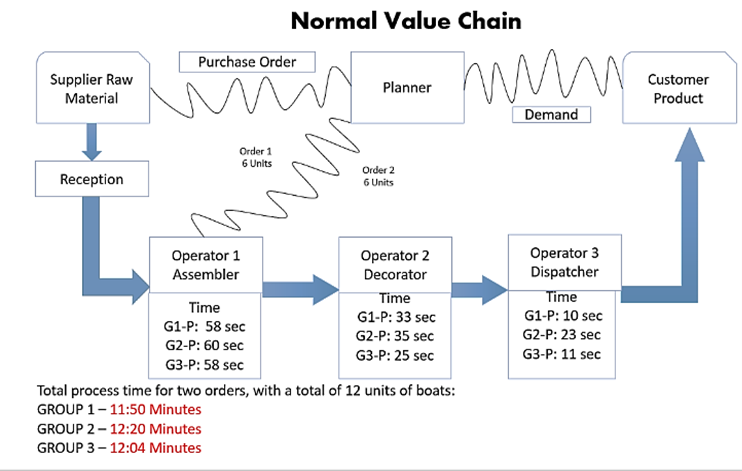
Current Value Stream Map of the paper boat construction process.

Publicado

2025-03-28

Estrategia lúdica para el análisis de un sistema productivo desde un enfoque de manufactura esbelta

Playful strategy for the analysis of a production system from a lean manufacturing approach

DOI:

https://doi.org/10.15446/dyna.v92n235.117207

Palabras clave:

juego educativo, producción, toma de decisiones, cognición, educación (es)
educational game, production, decision making, cognition, education (en)

Autores/as

En este artículo se plantea el desarrollo de una estrategia lúdica de aprendizaje donde se espera que los estudiantes y futuros profesionales de la administración de procesos dentro de una empresa, conozcan lo que es una cadena productiva y la importancia de contar con herramientas para el diagnóstico y mejora de la cadena de valor en una compañía. Asimismo, se espera complementar el aprendizaje sobre herramientas de manufactura esbelta como 5s y mapa de cadena de valor (VSM) para la mejora de la productividad de procesos. La lúdica fue aplicada a distintos grupos del programa de ingeniería industrial de la Corporación Universitaria Minuto de Dios, centro regional Buga y fue liderada por los integrantes del semillero de investigación GLIOSP del mismo programa. Dentro de los principales resultados obtenidos se destaca el fortalecimiento del conocimiento y uso de herramientas de manufactura esbelta como soporte para la mejora de procesos productivos.

This article presents the development of a playful learning strategy where it is expected that students and future professionals in process management within a company understand what a production chain is and the importance of having tools for diagnosing and improving the value chain in a company. Additionally, it aims to complement the learning of lean manufacturing tools such as 5S and value stream mapping (VSM) for process productivity improvement. The playful approach was applied to different groups in the Industrial Engineering program at Corporación Universitaria Minuto de Dios, Buga Regional Center, and was led by members of the GLIOSP research group within the same program. Among the main results obtained, the strengthening of knowledge and the use of lean manufacturing tools as support for improving production processes stands out.

Recibido: 24 de octubre de 2024; Revisión recibida: 3 de marzo de 2025; Aceptado: 10 de marzo de 2025

Abstract

This article presents the development of a playful learning strategy where it is expected that students and future professionals in process management within a company understand what a production chain is and the importance of having tools for diagnosing and improving the value chain in a company. Additionally, it aims to complement the learning of lean manufacturing tools such as 5S and value stream mapping (VSM) for process productivity improvement. The playful approach was applied to different groups in the Industrial Engineering program at Corporación Universitaria Minuto de Dios, Buga Regional Center, and was led by members of the GLIOSP research group within the same program. Among the main results obtained, the strengthening of knowledge and the use of lean manufacturing tools as support for improving production processes stands out.

Keywords:

educational game, production, decision making, cognition, education.

Resumen

En este artículo se plantea el desarrollo de una estrategia lúdica de aprendizaje donde se espera que los estudiantes y futuros profesionales de la administración de procesos dentro de una empresa, conozcan lo que es una cadena productiva y la importancia de contar con herramientas para el diagnóstico y mejora de la cadena de valor en una compañía. Asimismo, se espera complementar el aprendizaje sobre herramientas de manufactura esbelta como 5s y mapa de cadena de valor (VSM) para la mejora de la productividad de procesos. La lúdica fue aplicada a distintos grupos del programa de ingeniería industrial de la Corporación Universitaria Minuto de Dios, centro regional Buga y fue liderada por los integrantes del semillero de investigación GLIOSP del mismo programa. Dentro de los principales resultados obtenidos se destaca el fortalecimiento del conocimiento y uso de herramientas de manufactura esbelta como soporte para la mejora de procesos productivos.

Palabras clave:

juego educativo, producción, toma de decisiones, cognición, educación.

1. Introduction

Within companies, production chains are a set of standardized operations that transform specific inputs into goods and services through the application of techniques according to the company's operational activities [1]. This work aims to identify the actors involved in a production line and their main issues through tools that promote improvement, such as value stream mapping (VSM) and 5S, lean manufacturing techniques applicable to improving time, organization, and resource reduction in a production operation [2].. The following are some studies where Lean tools have been used for process improvement in business contexts.

[3] diagnoses a corrugated logistics process in a glass packaging company using the value stream mapping tool. It identifies time, space, and cost waste inherent in the analyzed activities, and defines a series of improvement strategies to be implemented by the organization. These strategies are then represented in a future value stream map. Similarly, [4] applies the value stream mapping strategy in an automotive company, identifying waste in the process and implementing improvements that reduce delivery time, increase manufacturing speed, and decrease work-in-progress inventory. [5] identifies problems associated with the production process of a tannery using the value stream mapping tool, and validates the proposed improvements through simulation, resulting in a reduction in cycle time and lead time for the company.

Another successful case of using the value stream mapping tool is described by [6], which provides a detailed diagnosis of harvesting and post-harvest operations in a pineapple production company. The aim is to identify the most relevant improvements for the process, which are then simulated using Flexsim software. Following this research line, [7] analyzes the production and commercialization process of Hass avocados using the value stream mapping tool. They not only identify activities that do not add value but also define the most relevant risks for the process. Subsequently, strategies for mitigating these events are established, directly related to Lean techniques.

On the other hand, there are alternative methodologies to value stream mapping that have shown positive results in organizations. For example, [8] propose a framework for implementing manufacturing cells in productive environments as a strategy for improving productivity. In contrast, [9] establish a strategic plan for total productive maintenance (TPM) to reduce production downtime and increase manufacturing speed.

Although lean manufacturing tools emerge as a solution to the waste of time, space, and money within organizations [10], professionals working in companies lack a practical framework that allows them to clearly understand how to execute different Lean tools and the potential impact they can have on process performance indicators. To generate effective learning about the methodology for implementing Lean tools, a playful approach is proposed to actively engage students [11]. The following are some references that have successfully implemented learning processes based on playful strategies [12] establish a playful learning strategy to improve the competencies of Industrial Engineering students in topics related to time standardization and work study. Similarly, [13] create a role-playing game as a strategy to generate meaningful learning in university students in Chile. Conversely, [14] uses a playful strategy with educational robots to teach the importance of technology to elementary education students, aiming to develop competencies necessary for their future as professionals [15] develops a playful activity to explain concepts of production line balancing, using the Bucket Brigades methodology. In contrast, this paper presents a playful learning strategy that simulates a paper boat production line. It describes a system with various difficulties encountered in production processes and then presents an improved line with the application of value stream mapping (VSM) and 5S. The two scenarios are compared to demonstrate the effectiveness achieved by using lean manufacturing tools, and the learning results obtained in the participating group are presented.

2. Methodology

The methodology proposed for the development of the playful learning strategy considers basic concepts in the field of industrial engineering related to the application of lean manufacturing techniques. It aims to strengthen the competencies of future professionals in this field through the simulation of a paper boat construction process, promoting decision-making and teamwork among participants. Therefore, a learning path is presented, consisting of specific criteria de-fined in three phases:

Phase 1: In this stage, the playful activity is developed, taking into account the participants' prior knowledge. The initial understanding of the concepts is measured through a survey. Then, two groups of 4 to 5 people are formed. Three participants will take on the role of operators in the production line, one will be responsible for time measurement, and another will be designated as the quality manager, ensuring that the requested order is fully met. Each team is provided with the necessary materials for the construction of the paper boat and given a 10-minute time frame to fulfill the customer's orders. At the end of the simulation, a discussion session is opened where the participants can share their experiences, and the problems identified in the initial construction process.

Figure 1 shows the overall process of the proposed playful activity's production chain, from the construction of the paper boat to the complete order dispatch to the customer. It is important to consider that validation activities are included in the process to ensure that the customer's requested product is fully met.

General Flowchart of the Paper Boat Construction Process.

Figure 1: General Flowchart of the Paper Boat Construction Process.

Source: The authors.

Phase 2: The entire group of participants is provided with contextualization on the concepts presented in Table 1. Additionally, materials are given to the teams to proceed with the construction of the value stream map (VSM) and the subsequent identification of issues associated with the process. It is important to note that in this case, the creation of the VSM will require calculating indicators such as cycle time, productivity, and lead time.

Table 1: Conceptual Framework.

Concept Definition
Value Stream Map (VSM) A tool used to diagnose the production systems of goods and services through the proper identification of activities that do not add value [16].
5S A lean strategy that aims to increase productivity in workstations through proper organization, cleanliness, and standardization [17].
WP It refers to the inventory that is within the manufacturing process and does not belong to the raw materials inventory or the finished goods inventory [18].

Source: The authors

Phase 3: After the diagnostic stage, each team must adjust the production process to eliminate the identified flaws and implement the techniques explained by the leading team of the activity. In essence, it is necessary to organize the work areas, ensure material availability, and clearly define the role of each operator within the process. Once this simulation is completed, materials are provided to the team to proceed with the construction of the future value stream map, where the proposed indicators for the production chain should be included again. Finally, a comparison of the results before and after the implementation of lean manufacturing techniques is conducted, followed by a final survey to measure the participants' learning.

3. Results

The ludic activity was carried out in different settings, such as the Ninth National Meeting of the Iddeal Network and the Third Meeting of Ludic Activities in Engineering held at the Minuto de Dios University Corporation, Buga Regional Center. It was also applied to students in the industrial engineering program of the same university within the framework of the GLIOSP research group. The most relevant results are presented below:

Figure 2 shows the value stream map constructed in one of the initial simulated scenarios based on the data collected in Phase 1. In this scenario, the production system is unbalanced, and issues related to order errors, delivery delays, and high levels of work-in-process inventory are identified.

Current Value Stream Map of the paper boat construction process.

Figure 2: Current Value Stream Map of the paper boat construction process.

Source: The authors

Subsequently, a discussion is held with the participants to identify problems within the process and address them using Lean philosophy tools such as 5S. Based on this sharing session, the paper boat construction process is modified by each team to eliminate non-value-added activities. Figure 3 presents the future Value Stream Map constructed from the simulation of the process with the improvements implemented by the teams.

Future Value Stream Map

Figure 3: Future Value Stream Map

Source: The authors

In this future value stream map, the process of building paper boats has been further improved based on the implementation of Lean principles and feedback from the participants. The focus is on eliminating waste, reducing lead time, and improving overall efficiency. The activities have been reorganized, and standardization has been implemented to ensure consistent and high-quality output.

Table 2 shows how the cycle time for the three simulated groups is reduced by an average of approximately 44% after the implementation of 5S and the standardization of the production process, thus confirming the effectiveness of using Lean techniques to improve indicators in production processes.

Table 2: Measurement of Cycle Time Before and After Implementation of Lean Techniques in Paper Boat Construction Process.

Group Cycle Time (s) - Phase 1 (without improvements) Cycle Time (s) - Phase 2 (with improvements) % Reduction
1 710 418 41,1%
2 740 394 46,8%
3 724 398 45%

Source: The authors

One of the main objectives of the ludic learning strategy was to generate knowledge among the participants. To achieve this, a measurement of knowledge was conducted at the beginning and end of the activity, aiming to validate the acquisition of new knowledge. The following is a detailed description of the main results obtained.

Initially, the participants were surveyed about their general knowledge of lean production philosophy. As shown in Figure 4, it can be observed that 60% of the students had a general understanding before the ludic activity began. However, after the knowledge sharing session, it was ensured that 100% of the participants were familiar with the central axis of the philosophy, which focuses on reducing non-value-added activities within processes.

Effect of learning on lean manufacturing philosophy.

Figure 4: Effect of learning on lean manufacturing philosophy.

Source: The authors

The game was applied to a group of industrial engineering students from different semesters, and it can be observed that there is not a broad knowledge about some basic techniques of Lean Manufacturing philosophy such as VSM and 5S. In Figure 5, it can be noticed that only 30% of the participants were previously familiar with the value stream mapping technique, and even more specifically, only 20% had a clear understanding of the methodology for diagnosing and improving a process (see Figure 6). After the game activity, it is ensured that 100% of the students not only know the concept associated with the value stream mapping technique but also have a clear roadmap for its implementation in various business contexts.

Learning effect on the concept of value stream mapping.

Figure 5: Learning effect on the concept of value stream mapping.

Source: The authors

Prioritization of humanitarian aid distribution

Figure 6: Prioritization of humanitarian aid distribution

Source: The authors

Figure 7 shows that 64% of the participants had prior knowledge of the 5S, while for the remaining 36%, it was an unfamiliar term. After completing the proposed playful activity, it can be observed that this knowledge gap is closed, and 100% of the participants learn about the concept and its implications in a production process.

Effect of learning on the concept of the 5S technique.

Figure 7: Effect of learning on the concept of the 5S technique.

Source: The authors

In summary, analyzing the learning outcomes, it can be observed that the developed ludic strategy allows closing the knowledge gap regarding various concepts associated with Lean Manufacturing philosophy and the use of some of its key tools, such as the value stream mapping (VSM) and the 5S.

This article presents a methodological framework for the implementation of a ludic learning activity in industrial engineering programs and related fields, aiming to improve the understanding of various concepts associated with the use of Lean Manufacturing philosophy, such as the value stream mapping (VSM) and 5S techniques. It is worth noting that although some previous references have addressed ludic strategies to enhance the competencies of industrial engineering students[19], there has not been a ludic strategy specifically developed to address the use of the value stream mapping technique in conjunction with the 5S methodology in productive environments within an industrial engineering laboratory.

In contrast to where a ludic activity is developed to explain the concept of production line balancing using the bucket brigade’s methodology, this article provides a conceptualization of Lean Manufacturing philosophy, with emphasis on two of its main tools, namely the value stream mapping (VSM) and 5S, through a ludic activity that promotes the simulation of a paper boat construction process in an academic environment. From this simulation, strategies for improving critical indicators of a production process, such as cycle time, delivery time, and work-in-process inventory level, are developed.

4. Conclusions

The ludic learning strategy proposed in this document allows for the acquisition of basic knowledge related to the use of Lean techniques such as value stream mapping (VSM) and 5S. When implemented in a simulation context within an industrial engineering laboratory, these techniques increase the productivity of a paper boat production line by reducing rework and controlling excess inventory.

The implementation of the 5S Lean Manufacturing tool successfully represented the improvement in the paper boat production line. Additionally, thanks to the value stream mapping tool, a detailed analysis of the process was conducted to identify process improvements. Although significant improvements were achieved in the production times of this production chain, it is important to note that any production process can always be further improved by identifying process flaws and utilizing available methods for enhancing organizational productivity.

It should be noted that the methodological framework proposed in this research can be implemented in various professional or educational settings. Therefore, in future research, the aim is to enhance the scope of the ludic approach so that it can be utilized as support for training in Lean topics within the industry.

Future research endeavors could focus on enhancing the scope of the analysis to include not only production activities but also logistical operations, ensuring a systemic view of business processes. This way, the ludic approach can be used not only in classrooms but also as a training tool within the industry to strengthen the knowledge of workers, as suggested by [20]. Expanding the application of the ludic approach to real-world industrial settings would provide valuable insights into the practical implementation of Lean principles and techniques, fostering continuous improvement and enhancing overall organizational performance.

References

[1] Méndez-Prada, M.C., Estrategias competitivas del eslabón primario en la cadena productiva de aguacate de los Montes de María, Revista de Economía & Administración, [Online]. 13(1), pp. 95-110, 2016. Available at: https://revistas.uao.edu.co/ojs/index.php/REYA/article/view/11 [Link]

[2] Ribeiro, P., Sá, J.C., Ferreira, L.P., Silva, F.J.G., Pereira, M.T. and Santos, G., The impact of the application of lean tools for improvement of process in a plastic company: a case study, in Procedia Manufacturing, 38, pp. 765-775, 2019. DOI: https://doi.org./10.1016/j.promfg.2020.01.104 [Link]

[3] Paredes-Rodríguez, A.., Aplicación de la herramienta Value Stream Mapping a una empresa embaladora de productos de vidrio. Entramado, 13(1), pp. 262-277, 2017. DOI: https://doi.org./10.18041/entramado.2017v13n1.25103.[Link]

[4] Gopi, S., Suresh, A., and Sathya, A.J., Value stream mapping & Manufacturing process design for elements in an auto-ancillary unit. A case study, Mater Today Proc, 22, pp. 2839-2848, 2019, DOI: https://doi.org./10.1016/j.matpr.2020.03.416 [Link]

[5] Chud, V.L., Bedoya-Díaz, I.M., y Paredes-Rodríguez, A.M., Simulación de mejoras en el sistema productivo de una curtiembre basada en el mapeo de su cadena de valor, Scientia et Technica, 25(3), pp. 394-403, 2020. DOI: https://doi.org./10.22517/23447214.24231.[Link]

[6] Camacaro-Peña, M.A., Paredes-Rodríguez, A.M., Aulestia-Potes, C.D., y Henao-Guerrero, M.G., Mapa de cadena de valor como una herramienta para la mejora de los procesos de cosecha y postcosecha en una empresa productora de piña, Entramado, 17(02), pp. 226-242, 2021. DOI: https://doi.org./10.18041/1900-3803/entramado.2.7636 [Link]

[7] Paredes-Rodriguez, A.M., Chud-Pantoja, V.L., y Peña-Montoya, C.C., Gestión de riesgos operacionales en cadenas de suministro agroalimentarias bajo un enfoque de manufactura esbelta, Información tecnológica, 33(1), pp. 245-258, 2022. DOI: https://doi.org./10.4067/s0718-07642022000100245.[Link]

[8] Cáceres-Gelvez, S., Arango-Serna, M.D. and Zapata-Cortés, J.A., A conceptual framework for integrating Facility Layout and Production Scheduling in Flowshop Manufacturing Cells decisions, Revista EIA, 19(38), art. 1543, 2022. DOI: https://doi.org./10.24050/reia.v19i38.1543.[Link]

[9] Pinto, G., Silva, F.J.G., Baptista, A., Fernandes, N.O., Casais, R. and Carvalho, C., TPM implementation and maintenance strategic plan. A case study, in Procedia Manufacturing, pp. 1423-1430, 2020. DOI: https://doi.org./10.1016/j.promfg.2020.10.198.[Link]

[10] Ibarra-Balderas, V.M., and Ballesteros-Medina, L.L., Manufactura Esbelta. Conciencia Tecnológica, [online]. 53, 2017. Available at: https://www.redalyc.org/articulo.oa?id=94453640004 [Link]

[11] Morelo, A.L., Andres, E., Ballesteros, M., Luis, J., and Ramos, M., Study of the lean manufacturing through educational- practical practices, (April), pp. 0-5, 2019. DOI: https://doi.org./10.13140/RG.2.2.29412.42886.[Link]

[12] Gómez-Giraldo, L.F., y López-Rivera, Y.M., Propuesta lúdica como herramienta de apoyo al proceso enseñanza - aprendizaje en el estudio del trabajo, enfocada a la estandarización de tiempos, Ingenierías USBMed, 9(2), pp. 34-43, 2018. DOI: https://doi.org./10.21500/20275846.3576.[Link]

[13] Gaete-Quezada, R.A., El juego de roles como estrategia de evaluación de aprendizajes universitarios University education., Educación y Educadores, 14(Pedagogía universitaria), 2011.

[14] Barrera-Lombana, N., Uso de la robótica educativa como estrategia didáctica en el aula, Praxis & Saber, 6(11), pp. 215-234, 2015. DOI: https://doi.org./10.19053/22160159.3582 [Link]

[15] Paredes-Rodriguez, A.M., Pelaez-Mejia, K.A., y Salazar-Ramos, A.F., Propuesta de un juego de mesa como herramienta didáctica para la explicación de conceptos de control de inventarios en programas de ingeniería industrial, Revista Digital Educación en Ingeniería, 11(21), pp. 45-50, 2016.

[16] Pathania, A., Kumar, R., Rojhe, K., Goel, B., Aggarwal, S., and Mahto, D., Value stream mapping - Panacea for lead time reduction in ferrite core industry, in: Materials Today: Proceedings, Elsevier Ltd, 2021, pp. 2456-2461. DOI: https://doi.org./10.1016/j.matpr.2021.01.362.[Link]

[17] Omogbai, O., and Salonitis, K., The implementation of 5S lean tool using system dynamics approach, in: Procedia CIRP, Elsevier B.V., 2017, pp. 380-385. DOI: https://doi.org./10.1016/j.procir.2017.01.057 [Link]

[18] Krajewski, L.J., Ritzman, L.P., Malhotra, M.K., and Krajewski, L.J., Administración de operaciones: procesos y cadenas de valor. Pearson Educación, [online]. 2008. Available at: https://www.gob.mx/cms/uploads/attachment/file/566458/Administracion_De_Operaciones_-_LEE_J._K-comprimido.pdf [Link]

[19] Peláez-Mejía, K.A., Payán-Quevedo, J.L. y Salazar Ramos, A.F., Herramienta didáctica para la explicación de conceptos de balanceo de línea en cursos de producción de los programas de ingeniería industrial, Revista Digital Educación en Ingeniería, 11(21), pp. 51-58, 2016.

[20] De Vin, L.J., Jacobsson, L., Odhe, J.E., and Wickberg, A., Lean production training for the manufacturing industry: experiences from Karlstad Lean Factory, Procedia Manuf, 11, pp. 1019-1026, 2017. DOI: https://doi.org./10.1016/j.promfg.2017.07.208 [Link]

Henao-Ordoñez, F.Y., Ríos-Becerra, B.S., Cardona-Morales, J.D., and Paredes-Rodríguez, A.M., Playful strategy for the analysis of a production system from a lean manufacturing approach. DYNA, 92(235), pp. 110-115, January - March, 2025.

Referencias

[1] Méndez-Prada, M.C., Estrategias competitivas del eslabón primario en la cadena productiva de aguacate de los Montes de María, Revista de Economía & Administración, [Online]. 13(1), pp. 95–110, 2016. Available at: https://revistas.uao.edu.co/ojs/index.php/REYA/article/view/11 DOI: https://doi.org/10.21892/24627593.228

[2] Ribeiro, P., Sá, J.C., Ferreira, L.P., Silva, F.J.G., Pereira, M.T. and Santos, G., The impact of the application of lean tools for improvement of process in a plastic company: a case study, in Procedia Manufacturing, 38, pp. 765–775, 2019. DOI: https://doi.org./10.1016/j.promfg.2020.01.104

[3] Paredes-Rodríguez, A.., Aplicación de la herramienta Value Stream Mapping a una empresa embaladora de productos de vidrio. Entramado, 13(1), pp. 262–277, 2017. DOI: https://doi.org./10.18041/entramado.2017v13n1.25103.

[4] Gopi, S., Suresh, A., and Sathya, A.J., Value stream mapping & Manufacturing process design for elements in an auto-ancillary unit. A case study, Mater Today Proc, 22, pp. 2839–2848, 2019, DOI: https://doi.org./10.1016/j.matpr.2020.03.416

[5] Chud, V.L., Bedoya-Díaz, I.M., y Paredes-Rodríguez, A.M., Simulación de mejoras en el sistema productivo de una curtiembre basada en el mapeo de su cadena de valor, Scientia et Technica, 25(3), pp. 394–403, 2020. DOI: https://doi.org./10.22517/23447214.24231.

[6] Camacaro-Peña, M.A., Paredes-Rodríguez, A.M., Aulestia-Potes, C.D., y Henao-Guerrero, M.G., Mapa de cadena de valor como una herramienta para la mejora de los procesos de cosecha y postcosecha en una empresa productora de piña, Entramado, 17(02), pp. 226–242, 2021. DOI: https://doi.org./10.18041/1900-3803/entramado.2.7636

[7] Paredes-Rodriguez, A.M., Chud-Pantoja, V.L., y Peña-Montoya, C.C., Gestión de riesgos operacionales en cadenas de suministro agroalimentarias bajo un enfoque de manufactura esbelta, Información tecnológica, 33(1), pp. 245–258, 2022. DOI: https://doi.org./10.4067/s0718-07642022000100245.

[8] Cáceres-Gelvez, S., Arango-Serna, M.D. and Zapata-Cortés, J.A., A conceptual framework for integrating Facility Layout and Production Scheduling in Flowshop Manufacturing Cells decisions, Revista EIA, 19(38), art. 1543, 2022. DOI: https://doi.org./10.24050/reia.v19i38.1543.

[9] Pinto, G., Silva, F.J.G., Baptista, A., Fernandes, N.O., Casais, R. and Carvalho, C., TPM implementation and maintenance strategic plan. A case study, in Procedia Manufacturing, pp. 1423–1430, 2020. DOI: https://doi.org./10.1016/j.promfg.2020.10.198.

[10] Ibarra-Balderas, V.M., and Ballesteros-Medina, L.L., Manufactura Esbelta. Conciencia Tecnológica, [online]. 53, 2017. Available at: https://www.redalyc.org/articulo.oa?id=94453640004

[11] Morelo, A.L., Andres, E., Ballesteros, M., Luis, J., and Ramos, M., Study of the lean manufacturing through educational- practical practices, (April), pp. 0–5, 2019. DOI: https://doi.org./10.13140/RG.2.2.29412.42886.

[12] Gómez-Giraldo, L.F., y López-Rivera, Y.M., Propuesta lúdica como herramienta de apoyo al proceso enseñanza – aprendizaje en el estudio del trabajo, enfocada a la estandarización de tiempos, Ingenierías USBMed, 9(2), pp. 34–43, 2018. DOI: https://doi.org./10.21500/20275846.3576.

[13] Gaete-Quezada, R.A., El juego de roles como estrategia de evaluación de aprendizajes universitarios University education., Educación y Educadores, 14(Pedagogía universitaria), 2011.

[14] Barrera-Lombana, N., Uso de la robótica educativa como estrategia didáctica en el aula, Praxis & Saber, 6(11), pp. 215–234, 2015. DOI: https://doi.org./10.19053/22160159.3582

[15] Paredes-Rodriguez, A.M., Pelaez-Mejia, K.A., y Salazar-Ramos, A.F., Propuesta de un juego de mesa como herramienta didáctica para la explicación de conceptos de control de inventarios en programas de ingeniería industrial, Revista Digital Educación en Ingeniería, 11(21), pp. 45–50, 2016.

[16] Pathania, A., Kumar, R., Rojhe, K., Goel, B., Aggarwal, S., and Mahto, D., Value stream mapping - Panacea for lead time reduction in ferrite core industry, in: Materials Today: Proceedings, Elsevier Ltd, 2021, pp. 2456–2461. DOI: https://doi.org./10.1016/j.matpr.2021.01.362.

[17] Omogbai, O., and Salonitis, K., The implementation of 5S lean tool using system dynamics approach, in: Procedia CIRP, Elsevier B.V., 2017, pp. 380–385. DOI: https://doi.org./10.1016/j.procir.2017.01.057

[18] Krajewski, L.J., Ritzman, L.P., Malhotra, M.K., and Krajewski, L.J., Administración de operaciones: procesos y cadenas de valor. Pearson Educación, [onlin]. 2008. Available at: https://www.gob.mx/cms/uploads/attachment/file/566458/Administracion_De_Operaciones_-_LEE_J._K-comprimido.pdf

[19] Peláez-Mejía, K.A., Payán-Quevedo, J.L. y Salazar Ramos, A.F., Herramienta didáctica para la explicación de conceptos de balanceo de línea en cursos de producción de los programas de ingeniería industrial, Revista Digital Educación en Ingeniería, 11(21), pp. 51–58, 2016.

[20] De Vin, L.J., Jacobsson, L., Odhe, J.E., and Wickberg, A., Lean production training for the manufacturing industry: experiences from Karlstad Lean Factory, Procedia Manuf, 11, pp. 1019–1026, 2017. DOI: https://doi.org./10.1016/j.promfg.2017.07.208

Cómo citar

IEEE

[1]
F. Y. Henao-Ordoñez, B. S. Ríos-Becerra, J. D. Cardona-Morales, y A. M. Paredes-Rodríguez, «Estrategia lúdica para el análisis de un sistema productivo desde un enfoque de manufactura esbelta», DYNA, vol. 92, n.º 235, pp. 110–115, ene. 2025.

ACM

[1]
Henao-Ordoñez, F.Y., Ríos-Becerra, B.S., Cardona-Morales, J.D. y Paredes-Rodríguez, A.M. 2025. Estrategia lúdica para el análisis de un sistema productivo desde un enfoque de manufactura esbelta. DYNA. 92, 235 (ene. 2025), 110–115. DOI:https://doi.org/10.15446/dyna.v92n235.117207.

ACS

(1)
Henao-Ordoñez, F. Y.; Ríos-Becerra, B. S.; Cardona-Morales, J. D.; Paredes-Rodríguez, A. M. Estrategia lúdica para el análisis de un sistema productivo desde un enfoque de manufactura esbelta. DYNA 2025, 92, 110-115.

APA

Henao-Ordoñez, F. Y., Ríos-Becerra, B. S., Cardona-Morales, J. D. & Paredes-Rodríguez, A. M. (2025). Estrategia lúdica para el análisis de un sistema productivo desde un enfoque de manufactura esbelta. DYNA, 92(235), 110–115. https://doi.org/10.15446/dyna.v92n235.117207

ABNT

HENAO-ORDOÑEZ, F. Y.; RÍOS-BECERRA, B. S.; CARDONA-MORALES, J. D.; PAREDES-RODRÍGUEZ, A. M. Estrategia lúdica para el análisis de un sistema productivo desde un enfoque de manufactura esbelta. DYNA, [S. l.], v. 92, n. 235, p. 110–115, 2025. DOI: 10.15446/dyna.v92n235.117207. Disponível em: https://revistas.unal.edu.co/index.php/dyna/article/view/117207. Acesso em: 11 ago. 2026.

Chicago

Henao-Ordoñez, Frank Yinner, Brayan Steeven Ríos-Becerra, Juan David Cardona-Morales, y Andrés Mauricio Paredes-Rodríguez. 2025. «Estrategia lúdica para el análisis de un sistema productivo desde un enfoque de manufactura esbelta». DYNA 92 (235):110-15. https://doi.org/10.15446/dyna.v92n235.117207.

Harvard

Henao-Ordoñez, F. Y., Ríos-Becerra, B. S., Cardona-Morales, J. D. y Paredes-Rodríguez, A. M. (2025) «Estrategia lúdica para el análisis de un sistema productivo desde un enfoque de manufactura esbelta», DYNA, 92(235), pp. 110–115. doi: 10.15446/dyna.v92n235.117207.

MLA

Henao-Ordoñez, F. Y., B. S. Ríos-Becerra, J. D. Cardona-Morales, y A. M. Paredes-Rodríguez. «Estrategia lúdica para el análisis de un sistema productivo desde un enfoque de manufactura esbelta». DYNA, vol. 92, n.º 235, enero de 2025, pp. 110-5, doi:10.15446/dyna.v92n235.117207.

Turabian

Henao-Ordoñez, Frank Yinner, Brayan Steeven Ríos-Becerra, Juan David Cardona-Morales, y Andrés Mauricio Paredes-Rodríguez. «Estrategia lúdica para el análisis de un sistema productivo desde un enfoque de manufactura esbelta». DYNA 92, no. 235 (enero 27, 2025): 110–115. Accedido agosto 11, 2026. https://revistas.unal.edu.co/index.php/dyna/article/view/117207.

Vancouver

1.
Henao-Ordoñez FY, Ríos-Becerra BS, Cardona-Morales JD, Paredes-Rodríguez AM. Estrategia lúdica para el análisis de un sistema productivo desde un enfoque de manufactura esbelta. DYNA [Internet]. 27 de enero de 2025 [citado 11 de agosto de 2026];92(235):110-5. Disponible en: https://revistas.unal.edu.co/index.php/dyna/article/view/117207

Descargar cita

CrossRef Cited-by

CrossRef citations0

Dimensions

PlumX

Visitas a la página del resumen del artículo

447

Descargas

Los datos de descargas todavía no están disponibles.



