
Publicado
Evaluación de la conectividad portuaria y su impacto en la competitividad: el caso de Buenaventura, Colombia
Port connectivity assessment and its impact on competitiveness: the case of Buenaventura, Colombia
DOI:
https://doi.org/10.15446/dyna.v93n240.122803Palabras clave:
puertos marítimos, conectividad espacial, competitividad, red marítima, región pacífica (es)seaports, spatial connectivity, competitiveness, maritime network, pacific region (en)
Descargas
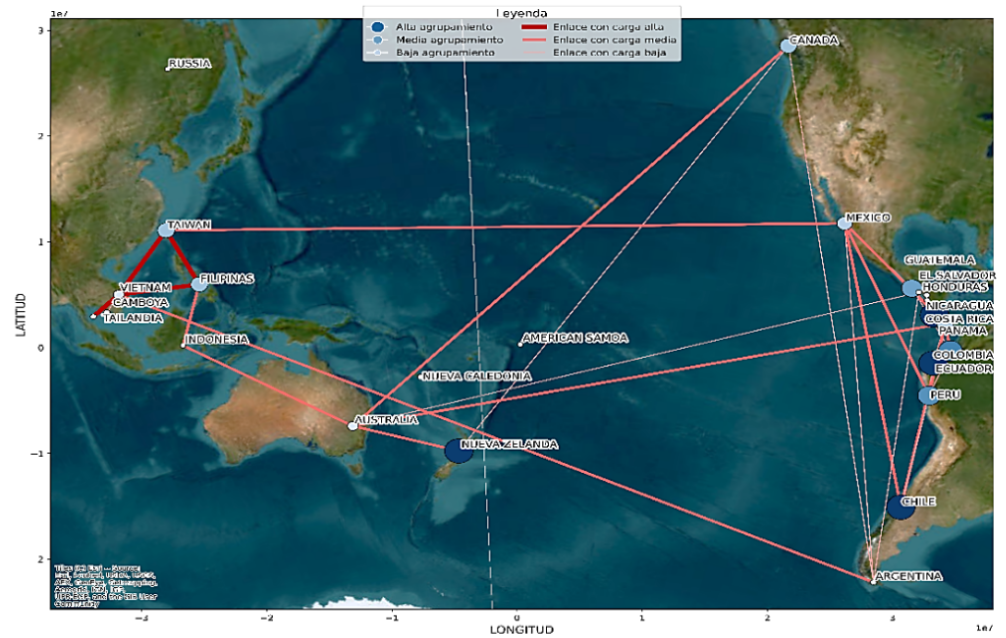
Este estudio evalúa la conectividad portuaria del puerto de Buenaventura en el contexto de la cuenca del Pacífico, comparándolo con puertos homólogos, mediante un enfoque combinado de teoría de grafos, análisis espacial y análisis de componentes principales (PCA). Se utilizaron indicadores topológicos de centralidad, intermediación, coeficiente de agrupamiento e índices estructurales (β, γ, α, µ), además del índice de competitividad LSBCI para evaluar escenarios prospectivos. Los resultados revelan que Buenaventura posee ventajas geográficas, pero una conectividad limitada frente a nodos clave como Panamá, México y Vietnam. La evaluación de una nueva conexión con México mejora significativamente su centralidad en la red y se concluye que una mayor integración de Buenaventura en rutas estratégicas puede potenciar su competitividad regional, y que el enfoque metodológico aplicado es replicable en otros estudios portuarios.
This study evaluates the port connectivity of the port of Buenaventura in the context of the Pacific basin, comparing it with similar ports, using a combined approach of graph theory, spatial analysis, and principal component analysis (PCA). Topological indicators of centrality, intermediation, clustering coefficient, and structural indices (β, γ, α, µ) were used, in addition to the LSBCI competitiveness index to evaluate prospective scenarios. The results reveal that Buenaventura has geographical advantages but limited connectivity to key nodes such as Panama, Mexico, and Vietnam. The evaluation of a new connection with Mexico significantly improves its centrality in the network, and it is concluded that greater integration of Buenaventura into strategic routes can enhance its regional competitiveness and that the methodological approach applied is replicable in other port studies.
Referencias
[1] TTovar, B., Hernández, R., and Rodríguez-Déniz, H., Container port competitiveness and connectivity: the Canary Islands main ports case. Transport Policy, 38, pp 40–51, 2015. DOI: https://doi.org/10.1016/j.tranpol.2014.11.001
[2] Oportus, O.S., and Echeverría, P.C., External connectivity analysis of the ports of Chile as a factor of competitiveness. Ingeniare, 20(1), pp 25–39, 2012. DOI: https://doi.org/10.4067/s0718-33052012000100004
[3] Rodríguez, D., García, C., and Jaramillo, C., La accesibilidad terrestre a los puertos marítimos de Colombia. Una aproximación desde la equidad territorial. En Entorno Geográfico, 15, pp. 8–46, 2018.
[4] García, N., Adenso-Díaz, B., and Calzada-Infante, L., Identifying port maritime communities: application to the Spanish case. European Transport Research Review, 13(1), 36, 2021.
[5] Cantillo, J., Cantillo-García, V., Cantillo, V., and Arellana, J., Port choice using aggregate open data: an application to Colombian port zones. Maritime Economics and Logistics, 25(3), pp 520–548, 2023. DOI: https://doi.org/10.1057/s41278-022-00235-9
[6] Castro-Castell, O., Soler-Niño, E., and Umaña-Castellanos, R., Asimetrías entre el puerto de Buenaventura y el puerto de Cartagena para el año 2015. Infraestructura Portuaria en Colombia, 19(32), pp 87–106, 2017.
[7] JJenss, A., Global flows and everyday violence in urban space: the port-city of Buenaventura, Colombia. Political Geography, 77, Art. 102113, 2020. DOI: https://doi.org/10.1016/j.polgeo.2019.102113
[8] Ministerio de Transporte de Colombia. Boletín estadístico, tráfico portuario en Colombia, pp 1–45, [en línea]. 2022. Disponible en: https://www.supertransporte.gov.co/documentos/2022/Febrero/Puertos_07/BOLETIN-TRAFICO-PORTUARIO-2022.pdf
[9] Martínez, J.H., Costes de transporte y conectividad en el comercio internacional entre la Unión Europea y Latinoamérica. pp 1–59, 2007.
[10]Rizaldi, A., Muzwardi, A., Santoso, E., Iffan, M., and Fera, M., The strategic development of maritime connectivity in the border area in Indonesia. Journal of Eastern European and Central Asian Research (JEECAR), 10(4), pp. 701-711, 2023.
[11] Arrieta-Tejada, A.C., Cure-Gaviria, J.S., and Pérez-Buelvas, P.C., Análisis teórico de la conectividad portuaria, 2017.
[12] Liu, C., Wang, J., and Zhang, H., Spatial heterogeneity of ports in the global maritime network detected by weighted ego network analysis. Maritime Policy and Management, 45(1), pp 89–104, 2018.
[13] Rodrigue, J., The geography of maritime ranges: interfacing global maritime shipping networks with hinterlands. GeoJournal, 87(2), pp 1231–1244, 2022.
[14] Del-Rosal, I., Trade effects of liner shipping across world regions. Maritime Business Review, 9(1), pp. 2–16, 2024.
[15] Mareï, N., and Ducruet, C., The regionalization of maritime networks: evidence from a comparative analysis of maritime basins. En Maritime Networks, pp. 330–350, 2015.
[16] Tovar, B., and Wall, A., The relationship between port-level maritime connectivity and efficiency. Journal of Transport Geography, 98, art. 103213, 2022.
[17] Asariotis, R., Benamara, H., Hoffmann, J., Misovicova, M., Núñez, E., Premti, A., Sitorus, B., Valentine, V., and Violh, B., El transporte marítimo en 2010, [en línea]. 2011. Disponible en: https://www.un-ilibrary.org/content/books/9789213634493/read
[18] UNCTAD, Review of Maritime Transport, pp. 1–26, 2023. DOI: https://doi.org/10.18356/9789213584569c006
[19] Ji, Z., Wu, X., Chen, X., Zhou, W., and Song, M., Finding green performance targets globally closest to management goals for ports experiencing similar circumstances. Resources Policy, 85, art. 103897, 2023. DOI: https://doi.org/10.1016/j.resourpol.2023.103897
[20] Tongzon, J.L., Determinants of port performance and efficiency. Transportation Research Part A: Policy and Practice, 29(3), pp. 245–252, 1995. DOI: https://doi.org/10.1016/0965-8564(94)00032-4
[21] Notteboom, T., and Rodrigue, J.P., Maritime container terminal infrastructure, network corporatization, and global terminal operators: Implications for international business policy. Journal of International Business Policy, 6(1), pp 67–83, 2023.
[22] Rodrigue, J.P., and Notteboom, T., Regionalización basada en el foreland: integración de los centros intermedios con el hinterland portuario. Investigación en Economía del Transporte, 27(1), pp 19–29, 2010.
[23] Nunn, P.D., Classifying Pacific islands. Geoscience Letters, 3(7), art. 8, 2016. DOI: https://doi.org/10.1186/s40562-016-0041-8
[24] COSCO, Shipping Lines inauguró el servicio WSA5 con recalada en el Puerto de Buenaventura y conexión con Shanghái y Chancay, COSCO SHIPPING Lines News Center, [en línea]. 2025. Disponible en: https://en.coscoshipping.com/col/col6923/art/2025/art_c0cc7b98fe13464aa473c271ede75adf.html
[25] Saito, T., Shibasaki, R., Murakami, S., Tsubota, K., and Matsuda, T., Global maritime container shipping networks 1969–1981: emergence of container shipping and reopening of the Suez Canal. Journal of Marine Science and Engineering, 10(5), art. 602, 2022. DOI: https://doi.org/10.3390/jmse10050602
[26] Sarkar, B.D., and Shankar, R., Understanding the barriers of port logistics for effective operation in the industry 4.0 era: Data-driven decision making. International Journal of Information Management Data Insights, 1(2), art. 100031, 2021. DOI: https://doi.org/10.1016/j.jjimei.2021.100031
Dimensions
PlumX
Visitas a la página del resumen del artículo
Descargas
Cómo citar
Licencia
Derechos de autor 2026 DYNA

Esta obra está bajo una licencia internacional Creative Commons Atribución-NoComercial-SinDerivadas 4.0.
El autor o autores de un artículo aceptado para publicación en cualquiera de las revistas editadas por la facultad de Minas cederán la totalidad de los derechos patrimoniales a la Universidad Nacional de Colombia de manera gratuita, dentro de los cuáles se incluyen: el derecho a editar, publicar, reproducir y distribuir tanto en medios impresos como digitales, además de incluir en artículo en índices internacionales y/o bases de datos, de igual manera, se faculta a la editorial para utilizar las imágenes, tablas y/o cualquier material gráfico presentado en el artículo para el diseño de carátulas o posters de la misma revista.








