
Publicado
Study of the variability of physicochemical parameters in different fractions of corn and espartillo intended for the production of solid biofuels
Estudio de variabilidad de parámetros fisicoquímicos en diversas fracciones de maíz y espartillo destinadas a la generación de biocombustibles sólidos
DOI:
https://doi.org/10.15446/dyna.v93n240.123717Palabras clave:
corn stover, espartillo, physicochemical characterization, solid biofuels, combustibility (en)rastrojo de maíz, espartillo, caracterización fisicoquímica, biocombustibles sólidos, combustibilidad (es)
Descargas
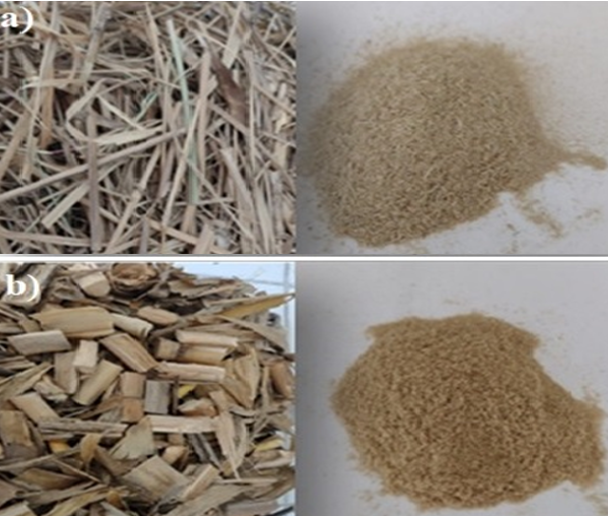
The current context of the energy transition is driving the development of alternative fuels, such as lignocellulosic materials of agricultural origin. This study analyzed the variation in physicochemical parameters in fractions of espartillo (E) and corn stover (RM) according to particle size. It was observed that reducing the particle size in RM increased the ash and extractive content, while E only showed an increase in ash. Pure materials and hybrid mixtures of E/RM 1:1 and 1:3 were evaluated in combustion. The 1:1 mixture reached a higher combustion temperature, exhibited a longer flame duration, and had an optimized heating value, although it had a higher ash content that could be reduced by removing particles smaller than 149 μm. The results obtained demonstrate that E and RM are viable alternatives as solid biofuels through synergistic mixtures and granulometric control, favoring the revaluation of agricultural waste and naturally growing species in the region for energy purposes.
El contexto actual de transición energética impulsa el desarrollo de combustibles alternativos, como los basados en materiales lignocelulósicos de origen agrícola. Este estudio analizó la variación de parámetros fisicoquímicos en fracciones de espartillo (E) y rastrojo de maíz (RM) según granulometría. Se observó que al reducir el tamaño de partícula en RM aumenta el contenido de cenizas y extraíbles, mientras que E solo presentó incremento de cenizas. En la combustión se evaluaron materiales puros y mezclas híbridas E/RM 1:1 y 1:3. La mezcla 1:1 alcanzó una temperatura de combustión superior, mayor duración de llama y poder calorífico optimizado, aunque presentó mayor contenido de cenizas que podría reducirse eliminando las partículas menores a 149 μm. Los resultados obtenidos demuestran que E y RM son alternativas viables como biocombustibles sólidos mediante mezclas sinérgicas y control granulométrico, favoreciendo la revalorización de residuos agrícolas y especies de crecimiento natural de la
región para aprovechamiento energético.
Referencias
[1] Jozami, E., Di-Leo, N., Barbona, I., and Feldman S., Modelos predictivos para la estimación de biomasa de “Spartina argentinensis”, Ciencias Agronómicas, 45(25), art. e047, 2025. DOI: https://doi.org/10.35305/agro45.e047
[2] Jozami, E., Sosa, L.L., and Feldman, S.R., Spartina argentinensis as feedstock for bioethanol, ATI - Appl. Technol. Innov., 9(2), pp. 37–44, 2013. DOI: https://doi.org/10.15208/ati.2013.8
[3] García-Stepien, E.L., Variabilidad del germoplasma de Maíz (Zea mays L.) en Argentina: la aptitud forrajera asociada a la producción de bioetanol lignocelulósico, Phd Thesis, Universidad Nacional de la Plata, La Plata, Buenos Aires, Argentina, 2020.
[4] Montemarani, A., Sartori, M., Nesci, A., Etcheverry, M., and Barros, G., Influence of crop residues, matric potential and temperature on growth of Exserohilum turcicum an emerging maize pathogen in Argentina, Lett. Appl. Microbiol. 67, pp. 614–619, 2018. DOI: https://doi.org/10.1111/lam.13076
[5] Kumar, P., Kumar, S., and Joshi, L., The extent and management of crop stubble, springer briefs in environmental science (Ed.), Springer, Nueva Delhi. [online]. pp. 13–34, 2015. Available at: https://link.springer.com/chapter/10.1007/978-81-322-2014-5_2
[6] Idígoras, G., Prospectiva tecnológica al 2025 del complejo de semillas, Análisis tecnológicos y prospectivos sectoriales, Ministerio de Ciencia, Tecnología e Innovación Productiva, Buenos Aires, Argentina, [online]. 2016. Available at: https://www.argentina.gob.ar/sites/default/files/5._agro_atypsii_semillas.pdf
[7] Menéndez, J.E., and Hilbert, J.A., Cuantificación y uso de Biomasa de residuos de cultivos en Argentina para bioenergía, Inf. Técnicos Bioenergía, 2(4), 2013, 48P.
[8] Richmond, S.N., and Rillo, P.F., Caracterización de la dinámica de incorporación de residuos de cosecha al suelo en un sistema agrícola en siembra directa en el centro-oeste de Buenos Aires, LACS, IPNI Informaciones Agronómicas Hisp., [online]. 43, pp. 22–26, 2009. Available at: https://fertilizar.org.ar/wp-content/uploads/2009/09/22.pdf
[9] Lopez, L., Vega, L., Rendon, C., y Tobon, S., Aprovechamiento de residuos madereros, Corporación Universitaria de Remington, Medellín, Colombia, [online]. 2019. Available at: https://www.uniremington.edu.co/wp-content/uploads/libros-de-investigacion/aprovechamiento-de-residuos-madereros.pdf
[10] Granada-Álvarez, E., Febrero-Garrido, L., Eguía-Oller, P., Regueiro Pereira, A., y Patiño-Vilas, D., Análisis del “fouling” procedente de la combustión de pellet de pino y pellet de paja en una caldera de baja potencia: influencia de los parámetros de combustión, IX Congr. Nac. Ing. Termodinámica, Cartagena, Colombia, pp. 1226–1234. art. 9941, 2024. DOI: https://doi.org/10.31428/10317/9941
[11] Wang, S., Zou, C., Lou, C., Yang, H.M., and Mei-Jing, H., Effects of hemicellulose, cellulose and lignin on the ignition behaviors of biomass in a drop tube furnace, Bioresour. Technol., 310, art. 123456, 2020. DOI: https://doi.org/10.1016/j.biortech.2020.123456
[12] Vieira, T.A.S., Trugilho, P.F., Carabineiro, S.A.C., Zanuncio, A.J.V., Carvalho, A.G., and Branco-Vieira M., Impact of chemical composition on eucalyptus wood clones for sustainable energy production, Forests, 14(11), pp. 1–12, 2023. DOI: https://doi.org/10.3390/f14112240
[13] Whittaker, C., and Shield, I., Factors affecting wood, energy grass and straw pellet durability–A review, Renew. Sustain. Energy Rev. 71, pp.1–11, 2017. DOI: https://doi.org/10.1016/j.rser.2016.12.119
[14] Montenegro-Mateos, L., PhD Thesis, Determinación del riesgo de auto-combustión en almacenamiento de biomasas para la producción de gas mediante gasificación. Escuela Técnica Superior de Ingenieros de Minas y Energía, Universidad Politécnica de Madrid, España, 2014.
[15] Demirbas, A., Relationships between heating value and lignin, moisture, ash and extractive contents of biomass fuels. Energy Explor. Exploit. 20, pp. 105–111, 2002. DOI: https://doi.org/10.1260/014459802760170420
[16] Beltrón-Vinces, I.C., Palacios Bravo, H.E., y Rosero Delgado, E., Evaluación energética de biocombustibles sólidos elaborados a partir de mezclas de biomasa lignocelulósica, RIEMAT. [online]. 4, pp. 33–38, 2019. Available at: https://revistas.utm.edu.ec/index.php/Riemat/article/view/2192
[17] Kirsten, C., Lenz, V., Schröder, H., and Repke, J., The influence of particle size reduction on their physical–mechanical quality and energy demand during production, Fuel Process. Technol. 148, pp. 163–174, 2016. DOI: https://doi.org/10.1016/j.fuproc.2016.02.013
[18] Mlonka, A., Magdziarz, A., Dziok, T., and Nowak, W., Laboratory studies on the influence of biomass particle size on pyrolysis and combustion using TG-GC/MS, Fuel, 252, pp. 635–645, 2019. DOI: https://doi.org/10.1016/j.fuel.2019.04.091
[19] Correa-Méndez, F., Carrillo-Parra, A., Rutiaga-Quiñones, J.G., Márquez-Montesino, F., González-Rodríguez, H., Ybarra, E.J., and Garza-Ocañas, F., Granulometric distribution in timber byproducts for potential use in pellets and briquettes. Rev. Mex. Ciencias For. [online]. 5, pp. 52–63, 2014. Available at: https://www.scielo.org.mx/scielo.php?pid=S2007-11322014000500005&script=sci_abstract&tlng=en
[20] Telmo, C., and Lousada, J., The explained variation by lignin and extractive contents on higher heating value of wood, Biomass and Bioenergy. 35, pp. 1663–1667, 2011. DOI: https://doi.org/10.1016/j.biombioe.2010.12.038
[21] Dula, M., Kraszkiewicz, A., and Parafiniuk, S., Combustion efficiency of various forms of solid biofuels in terms of changes in the method of fuel feeding into the combustion chamber, energies, 17, pp. 1–21, 2024. DOI: https://doi.org/10.3390/en17122853
[22] Hillis, W.E., Distribution, properties and formation of some wood extractives, Wood Sci. Technol. 5, pp. 272–289, 1971. DOI: https://doi.org/10.1007/BF00365060
[23] Li, Z., Zhai, H., Zhang, Y., and Yu, L., Cell morphology and chemical characteristics of corn stover fractions, Ind. Crops Prod. 37, pp. 130–136, 2012. DOI: https://doi.org/10.1016/j.indcrop.2011.11.025
[24] Ottone, S.P., and Baldwin, R.C., The relationship of extractive content to particle size distribution in milled yellow-poplar. Wood and Fiber, [online]. 13(2) pp. 74–85, 1981. Available at: https://share.google/p5Ih9QgC5tF4Ewk4p
[25] Miranda, I., Gominho J., Mirra I., and Pereira, H., Chemical characterization of barks from picea abies and pinus sylvestris after fractioning into different particle sizes. Ind. Crops Prod. 36, pp. 395–400, 2012. DOI: https://doi.org/10.1016/j.indcrop.2011.10.035
[26] Nielsen, N.P.K., Gardner, D.J., and Felby C., Effect of extractives and storage on the pelletizing process of sawdust, Fuel. 89, pp. 94–98, 2010. DOI: https://doi.org/10.1016/j.fuel.2009.06.025
[27] Li, S.X., Huang, and R., Zheng, Xylem plasticity of root, stem, and branch in Cunninghamia lanceolata under drought stress: implications for whole-plant hydraulic integrity, Front Plant Sci, 15, Art. 1308360, 2024. https://doi.org/10.3389/fpls.2024.1308360.
[28] Sun, S., Ahmad, N., Callenius, H., Uslu, V.V., Rey, J.C., Zhao, F., and Rajab, H., “The plastid cysteine synthase complex regulates ABA biosynthesis and stomatal closure in Arabidopsis,” Nat. Comun., 16(8960), Art. 3, 2025. DOI: https://doi.org/10.1038/s41467-025-64705-3.
[29] Djatkov, D., Martinov, M., and Kaltschmitt, M., Biomass and Bioenergy Influencing parameters on mechanical–physical properties of pellet fuel made from corn harvest residues, Biomass and Bioenergy, 119, pp. 418–428, 2018. DOI: https://doi.org/10.1016/j.biombioe.2018.10.009.
[30] Mani, S., Tabil, L.G., and Sokhansanj S., Specific energy requirement for compacting corn stover, Bioresour. Technol., 97, pp. 1420–1426, 2006. DOI: https://doi.org/10.1016/j.biortech.2005.06.019.
[31] Kaliyan, N., and Morey, R.V., Densification characteristics of corn stover and switchgrass, ASABE, 52(3), pp. 907–920, 2009. DOI: https://doi.org/10.13031/2013.21202.
[32] Crawford, N.C., Ray, A.E., Yancey, N.A., and Nagle, N., Evaluating the pelletization of “pure” and blended lignocellulosic biomass feedstocks, Fuel Process. Technol. 140, pp. 46–56, 2015. DOI: https://doi.org/10.1016/j.fuproc.2015.08.023
Dimensions
PlumX
Visitas a la página del resumen del artículo
Descargas
Cómo citar
Licencia
Derechos de autor 2026 DYNA

Esta obra está bajo una licencia internacional Creative Commons Atribución-NoComercial-SinDerivadas 4.0.
El autor o autores de un artículo aceptado para publicación en cualquiera de las revistas editadas por la facultad de Minas cederán la totalidad de los derechos patrimoniales a la Universidad Nacional de Colombia de manera gratuita, dentro de los cuáles se incluyen: el derecho a editar, publicar, reproducir y distribuir tanto en medios impresos como digitales, además de incluir en artículo en índices internacionales y/o bases de datos, de igual manera, se faculta a la editorial para utilizar las imágenes, tablas y/o cualquier material gráfico presentado en el artículo para el diseño de carátulas o posters de la misma revista.








