Publicado
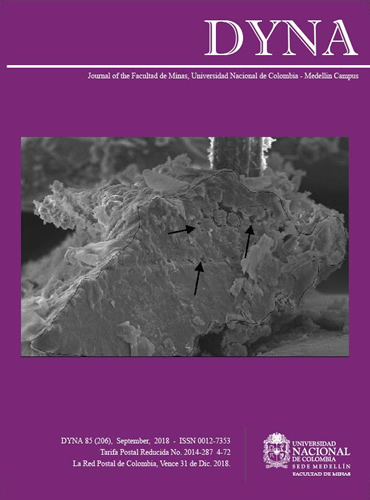
Palladium nanoparticles from a surfactant-modified hydroxysalt exchanged with tetrachloropalladate
Nanopartículas de paladio a partir de una hidroxisal modificada con surfactante intercambiada con tetracloropaladato
DOI:
https://doi.org/10.15446/dyna.v85n206.68132Palabras clave:
surfactant-modified zinc hydroxychloride, palladium nanoparticles, tetrachloropalladate, anionic clays (en)hidroxicloruro de zinc modificado con surfactante, nanopartículas de paladio, tetracloropaladato, arcillas aniónicas (es)
Descargas
Referencias
Carmo, D. M., Oliveira, M. G. and Soares, B. G. Effect of the dispersive method in the preparation of the polyurethane/hydrotalcite nanocomposites by in situ polymerization. Applied Clay Science, 101, pp. 128-135, 2014. http://dx.doi.org/10.1016/j.clay.2014.07.027
Ambrogi, V., Perioli, L., Ricci, M., Pulcini, L., Nocchetti, M., Giovagnoli, S. and Rossi, C. Eudragit® and hydrotalcite-like anionic clay composite system for diclofenac colonic delivery. Microporous and Mesoporous Materials, 115 (3), pp. 405-415, 2008. http://dx.doi.org/10.1016/j.micromeso.2008.02.014
Monteiro, M., Lunz, J., Veiga, Sebastião, P. and Tavares, M. Evaluation of Nevirapine Release Kinetics from Polycaprolactone Hybrids. Materials Sciences and Applications, 7 (11), pp. 680-701, 2016. http://dx.doi.org/10.4236/msa.2016.711055
An, Z., Zhang, W., Shi, H. and He, J. An effective heterogeneous L-proline catalyst for the asymmetric aldol reaction using anionic clays as intercalated support. Journal of Catalysis, 241 (2), pp. 319-327, 2006. http://dx.doi.org/10.1016/j.jcat.2006.04.035
Burrueco, M. I., Mora, M., Jiménez-Sanchidrián, C. and Ruiz, J. R. Hydrotalcite-supported palladium nanoparticles as catalysts for the Suzuki reaction of aryl halides in water. Applied Catalysis A: General, 485, pp. 196-201, 2014. http://dx.doi.org/10.1016/j.apcata.2014.07.031
Chen, X., Mi, F., Zhang, H. and Zhang H. Facile synthesis of a novel magnetic core-shell hierarchical composite submicrospheres Fe3O4@CuNiAl-LDH under ambient conditions. Materials Letters, 69, pp. 48-51, 2012. http://dx.doi.org/10.1016/j.matlet.2011.11.052
Diao, Z. Zhang, Y. Hao, X. Wen, Z. Facile synthesis of CoAl-LDH/MnO2 hierarchical nanocomposites for high-performance supercapacitors. Ceramics International, 40 (1), pp. 2115-2120, 2014. http://dx.doi.org/10.1016/j.ceramint.2013.07.127
Xie, L., Sun, G., Xie, L., Su, F., Li, X., Liu, Z., Kong, Q., Lu, C., Li, K. and Chen, C. A high energy density asymmetric supercapacitor based on a CoNi-layered double hydroxide and activated carbon. New Carbon Materials, 31 (1), pp. 37-45, 2016. http://dx.doi.org/10.1016/S1872-5805(16)60003-3
Ma, J., Ding, J., Li, L., Zou, J., Kong, Y. and Komameni, S. In situ reduction for synthesis of nano-sized Cu2O particles on MgCuAl-LDH layers for degradation of orange II under visible light. Ceramics International, 41 (2), pp. 3191-3196, 2014. http://dx.doi.org/10.1016/j.ceramint.2014.10.172
Hoessle, F., Plank, J. and Leroux, F. Intercalation of sulfonated melamine formaldehyde polycondensates into a hydrocalumite LDH structure. Journal of Physics and Chemistry of Solids, 80, pp. 112-117, 2015. http://dx.doi.org/10.1016/j.jpcs.2015.01.008
Chakraborty, S., Kumar, M., Suresh, K. and Pugazhenthi, G. Influence of organically modified NiAl layered double hydroxide (LDH) loading on the rheological properties of poly (methyl methacrylate) (PMMA)/LDH blend solution. Powder Technology, 256, pp. 196-203, 2014. http://dx.doi.org/10.1016/j.powtec.2014.02.035
Zhou, J., Xu, Z. P., Qiao, S., Liu, Q., Xu, Y. and Qian, G. Enhanced removal of triphosphate by MgCaFe-Cl-LDH: Synergism of precipitation with intercalation and surface uptake. Journal of Hazardous Materials, 189 (1-2), pp. 586-594, 2011. http://dx.doi.org/10.1016/j.jhazmat.2011.02.078
Lakshmi Kantam, M., Parsharamulu, T. and Manorama, S. V. Layered double hydroxides supported nano palladium: An efficient catalyst for the chemoselective hydrogenation of olefinic bonds. Journal of Molecular Catalysis A: Chemical, 365, pp.115-119, 2012.
http://dx.doi.org/10.1016/j.molcata.2012.08.017
de Rezende, S. M., Franchini, C. A., Dieuzeide, M. L., Duarte de Farias, A. M., Amadeo, N. and Fraga, M. A. Glycerol steam reforming over layered double hydroxide-supported Pt catalysts. Chemical Engineering Journal, 272, pp.108-118, 2015. http://dx.doi.org/10.1016/j.cej.2015.03.033
Li, Z., Xi, W. and Lu, C. Hydrotalcite-supported gold nanoparticle catalysts as a low temperature cataluminescence sensing platform. Sensors and Actuators B: Chemical, 219, pp. 354-360, 2015. http://dx.doi.org/10.1016/j.snb.2015.05.030
Huang, L., Zhou, J., Hsu, A.T. and Chen, R. Catalytic partial oxidation of n-butanol for hydrogen production over LDH-derived Ni-based catalysts. International Journal of Hydrogen Energy, 38 (34), pp. 14550-14558, 2013. http://dx.doi.org/10.1016/j.ijhydene.2013.09.068
Sahoo, M. and Parida, K. M. Pd(II) loaded on diamine functionalized LDH for oxidation of primary alcohol using water as solvent. Applied Catalysis A: general, 460-461, pp. 36-45, 2013. http://dx.doi.org/10.1016/j.apcata.2013.04.003
Saber, O., Goraba, H. M. and Jaafari, A. A. Catalytic activity and surface characteristics of layered Zn–Al–Si materials supported platinum. Applied Clay Science, 53, pp. 317-325, 2011. http://dx.doi.org/10.1016/j.clay.2010.12.026
Cavani, F., Trifirò, F. and Vaccari, A. Hydrotalcite-type anionic clays: preparation, properties and applocations. Catalysis Today, 11 (2), pp. 173-301, 1991. http://dx.doi.org/10.1016/0920-5861(91)80068-K
Ahmed, I. M. and Gasser, M. S. Adsorption study of anionic reactive dye from aqueous solution to Mg–Fe–CO3 layered double hydroxide (LDH). Applied Surface Science. 259, pp. 650-656. 2012. http://dx.doi.org/10.1016/j.apsusc.2012.07.092
Nityashree, N. and Rajamathi, M. Interstratified composite of the anionic clays, Zn5(OH)8(NO3)2∙2H2O and Ni3Zn2(OH)8(NO3)2∙2H2O, by delamination-costacking. Journal of Physics and Chemistry of Solids. 74 (8) pp. 1164-1168, 2013. http://dx.doi.org/10.1016/j.jpcs.2013.03.015
Khamlich, S., Abdullaeva, Z., Kennedy, J. V. and Maaza, M. High performance symmetric supercapacitor based on zinc hydroxychloride nanosheets and 3D graphene-nickel foam composite. Applied Surface Science, 405, pp. 329-336, 2017. http://dx.doi.org/10.1016/j.apsusc.2017.02.095
Li, B., Wang, C., Chen, G., and Zhang, Z. Palladium-phosphinous acid complexes catalyzed Suzuki cross-coupling reaction of heteroaryl bromides with phenylboronic acid in water/alcoholic solvents. Journal of Environmental Sciences, 25 (6), pp. 1083-1088, 2013. http://dx.doi.org/10.1016/S1001-0742(12)60132-6
Negishi, E. I. Palladium- or nickel-catalyzed cross coupling. A new selective method for carbon-carbon bond formation Acc. Chem. Res., 15, pp. 340-348, 1982. http://dx.doi.org/10.1021/ar00083a001
Moore, D. M. and Reynolds, R. C., Jr. X-ray diffraction and the identification and analysis of clay minerals, 2nd ed. Oxford: University Press, 1998.
Chui, S. S.-Y., Lo, S. M.-F., Charmant, J. P. H., Orpen, A. G. and Williams, I. D. A chemically functionalizable nanoporous material [Cu3(TMA)2(H2O)3]n. Science, 283 (5405), pp. 1148-1150, 1999. http://dx.doi.org/10.1126/science.283.5405.1148
Tanaka, H., Futoyu, A., Fujioka, A., Kandori, K. and Ishikawa, T. Influence of Ti(IV) on the structure and properties of zinc hydroxychloride. Corrosion Science, 50 (11), pp. 3154-3159, 2008. http://dx.doi.org/10.1016/j.corsci.2008.08.022
Tanaka, H., Tashima, K., Kandori, K., Ishikawa, T. and Nakayama, T. Structure and properties of Ti (IV)-doped zinc hydroxychloride rusts formed at various temperatures. Corrosion Science, 53 (2), pp. 696-702, 2011. http://doi.org/10.1016/j.corsci.2010.10.018
Demel, J., Hynek, J., Kovaŕ, P., Dai, Y., Taviot-Guého, C., Demel, O., Pospíšil, M. and Lang, K. Insight into the Structure of Layered Zinc Hydroxide Salts Intercalated with Dodecyl Sulfate Anions. Journal of Physical Chemistry C, 118 (46), pp. 27131-27141, 2014. http://dx.doi.org/10.1021/jp508499g
Papp, S., Szücs, A. and Dékány, I. Preparation of Pd0 nanoparticles stabilized by polymers and layered silicate. Applied Clay Science, 19 (1-6), pp. 155-172, 2001. http://dx.doi.org/10.1016/S0169-1317(01)00048-5
Pavan, P. C., Gomes, G. de A. and Valim, J. B. Adsorption of sodium dodecyl sulfate on layered double hydroxides. Microporous and Mesoporous Materials. 21 (4-6), pp. 659-665, 1998. https://doi.org/10.1016/S1387-1811(98)00054-7
Wibulswas, R., White, D. A. and Rautiu, R. Adsorption of Phenolic Compounds from Water by Surfactant-Modified Pillared Clays. Process Safety and Environmental Protection, 77 (2), pp. 88-92, 1999. http://dx.doi.org/10.1205/095758299529857
Liu, S., Zhou, Q., Jin, Z., Jiang, H. and Jiang, X. Dodecylsulfate Anion Embedded Layered Double Hydroxide Supported Nanopalladium Catalyst for the Suzuki Reaction, Chinese Journal of Catalysis, 31 (5), pp. 557-561, 2010. http://dx.doi.org/10.1016/S1872-2067(09)60072-3
Dimensions
PlumX
Visitas a la página del resumen del artículo
Descargas
Cómo citar
Licencia
Derechos de autor 2018 DYNA

Esta obra está bajo una licencia internacional Creative Commons Atribución-NoComercial-SinDerivadas 4.0.
El autor o autores de un artículo aceptado para publicación en cualquiera de las revistas editadas por la facultad de Minas cederán la totalidad de los derechos patrimoniales a la Universidad Nacional de Colombia de manera gratuita, dentro de los cuáles se incluyen: el derecho a editar, publicar, reproducir y distribuir tanto en medios impresos como digitales, además de incluir en artículo en índices internacionales y/o bases de datos, de igual manera, se faculta a la editorial para utilizar las imágenes, tablas y/o cualquier material gráfico presentado en el artículo para el diseño de carátulas o posters de la misma revista.