
Publicado
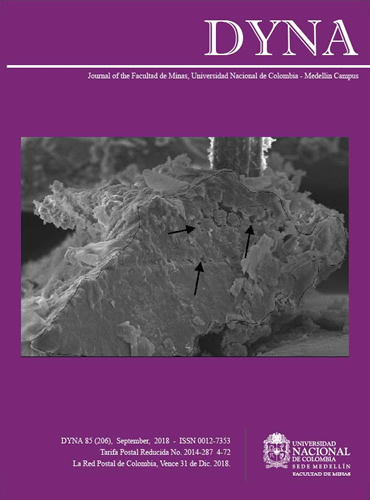
Sugarcane molasses and vinasse as a substrate for polyhydroxyalkanoates (PHA) production
Melazas y vinaza de la caña de azúcar como sustrato para la producción de polihidroxialcanoatos (PHA)
DOI:
https://doi.org/10.15446/dyna.v85n206.68279Palabras clave:
biopolymers, polyhydroxyalkanoates, Ralstonia, sugarcane molasses, sugarcane vinasse (en)biopolímeros, polihidroxialcanoatos, Ralstonia, melaza de caña de azúcar y vinaza de caña de azúcar (es)
Descargas
Referencias
Mozumder, M.S.I., De Wever, H., Volcke, E.I.P. and Garcia-Gonzalez, L., A robust fed-batch feeding strategy independent of the carbon source for optimal polyhydroxybutyrate production, Process Biochem., 49(3), pp. 365-373, 2014. DOI: 10.1016/j.procbio.2013.12.004
Costa, M.M.E., Cabral-Albuquerque, E.C.M., Alves, T.L.M., Pinto, J.C. and Fialho, R.L., Use of polyhydroxybutyrate and ethyl cellulose for coating of urea granules, J. Agric. Food Chem., 61(42), pp. 9984-9991, 2013. DOI: 10.1021/jf401185y
Bressan, E., Favero, V., Gardin, C., Ferroni, L., Iacobellis, L., Favero, L., Vindigni, V., Berengo, M., Sivolella, S. and Zavan, B., Biopolymers for hard and soft engineered tissues: application in odontoiatric and plastic surgery field, Polymers (Basel)., 3, pp. 509-526, 2011. DOI: 10.3390/polym3010509
Esha, M., Tissue engineering applications of polyhydroxybutyrate, MSc. Thesis. Cornell University, Nueva York, EE.UU., 2008.
Castilho, L.R., Mitchell, D.A. and Freire, D.M.G., Production of polyhydroxyalkanoates (PHAs) from waste materials and by-products by submerged and solid-state fermentation, Bioresour. Technol., 100(23), pp. 5996-6009, 2009. DOI: 10.1016/j.biortech.2009.03.088
Du, C., Sabirova, J., Soetaert, W. and Ki C., Lin, S., Polyhydroxyalkanoates production from low-cost sustainable raw materials, Curr. Chem. Biol., 6(1), pp. 14-25, 2012. DOI: 10.2174/187231312799984394
Mozumder, S.I., De Wever, H., Volcke, E.I.P. and Garcia-Gonzalez, L., A robust fed-batch feeding strategy independent of the carbon source for optimal polyhydroxybutyrate production, Process Biochem., 49(3), pp. 365-373, 2014. DOI: 10.1016/j.procbio.2013.12.004
Chanprateep, S., Current trends in biodegradable polyhydroxyalkanoates, J. Biosci. Bioeng., 110(6), pp. 621-632, 2010. DOI: 10.1016/j.jbiosc.2010.07.014
Naranjo-Vasco, J.M., Design and analysis of the polyhydroxybutyrate (PHB) production from agroindustrial wastes in Colombia, PhD. Thesis, Universidad Nacional de Colombia, Colombia, 2014.
Fajardo-Castillo, E.E. y Sarmiento-Forero, S.C., Evaluación de melaza de caña como sustrato para la producción de Saccharomyces cerevisiae, Thesis, Pontificia Universidad Javeriana, Bogotá, Colombia, 2007.
Zúñiga-Cerón, V. and Gandini-Ayerbe M.A., Environmental characterization of stillage from sugar cane waste from the production of ethanol, DYNA, [en linea], 80(177), pp. 124-131, 2013. [Consulted: August 27th of 2018] Availavle at: en:
http://www.redalyc.org/articulo.oa?id=49625661016. ISSN: 0012-7353
Dávila, J., Machuca, F. y Marrianga, N., Peroxidación y flotación electrolítica de vinazas de destilería, Rev. Ing., [online]. 32, pp. 38-44, 2010. [Retrieved: August 27th of 2018]. Available at: http://www.scielo.org.co/scielo.php?script=sci_arttext&pid=S0121-49932010000200005&lng=en&tlng=.
Minambiente, Resolución 0631 -17 Marzo 2015, Ministerio de Ambiente y Desarrollo Sostenible, Bogotá, Colombia, ., [online]. 2015. [Retrieved: August 27th of 2018]. Available at: http://www.minambiente.gov.co/images/normativa/app/resoluciones/d1-res_631_marz_2015.pdf
Ramsay, B.A., Lomaliza, K., Chavarie, C., Dube, B., Bataille, P. and Ramsay, J.A., Production of poly- (beta-Hydroxybutyric-Co-beta-Hydroxyvaleric) acids, Appl. Environ. Microbiol., 56(7), pp. 2093-2098, 1990.
Yu, J. and Chen, L.X.L., Cost-effective recovery and purification of polyhydroxyalkanoates by selective dissolution of cell mass, Biotechnol. Prog., 22(2), pp. 547-553, 2006. DOI: 10.1021/bp050362g
dos Santos, E., Gai, C., Zanfonato, K., Martinhago, F., Steffen, W. and Quines, L.K., Production of polyhydroxyalkanoate biopolymer from vinasse using Ralstonia eutropha, BMC Proc., 8(Suppl 4), pp. P132, 2014. DOI: 10.1186/1753-6561-8-S4-P132
Nonato, R.V., Mantelatto, P.E. and Rossell, C.E.V, Integrated production of biodegradable plastic, sugar and ethanol, Appl. Microbiol. Biotechnol., 57(1-2), pp. 1-5, 2001. DOI: 10.1007/s002530100732
Sayed, El-, Azhar, A., Abdelhady, H.M., Abdel-Hafez, A.M. and Khodair, T.A., Batch production of polyhydroxybutyrate (PHB) by Ralstonia Eutropha and Alcaligenes latus using bioreactor different culture strategies, J. Appl. Sci. Res., [online]. 5(5), pp. 556-564, 2009. [Retrieved: August 27th of 2018]. Available at: https://docplayer.net/48081542-Batch-production-of-polyhydroxybutyrate-phb-by-ralstonia-eutropha-and-alcaligenes-latus-using-bioreactor-different-culture-strategies.html
Pramanik, A., Mitra, A., Arumugam, M. et al., Utilization of vinasse for the production of polyhydroxybutyrate by Haloarcula marismortui, Folia Microbiol. (Praha)., 57(1), pp. 71-79, 2012. DOI: 10.1007/s12223-011-0092-3
Aarthi, N. and Ramana, K.V., Identification and characterization of polyhydroxybutyrate producing Bacillus cereus and Bacillus mycoides strains, Int. J. Environ. Sci., [online]. 1(5), pp. 744-756, 2011. [Retrieved: August 27th of 2018]. Available at: http://www.ipublishing.co.in/jesvol1no12010/EIJES2030.pdf
Barbosa, M., Espinosa-Hernández, A., Malagón-Romero, D. and Moreno-Sarmiento, N., Producción de Poli- β -Hidrobutirato (PHB) por Ralstonia eutropha ATCC 17697, Univ. Sci. Rev. la Fac. Ciencias. Pontif. Univ. Javeriana., [online]. 10(1), pp. 45-54, 2005. [Retrieved: August 27th of 2018]. Available at: http://revistas.javeriana.edu.co/index.php/scientarium/article/view/4936
Saratale, G.D. and Oh, M.K., Characterization of poly-3-hydroxybutyrate (PHB) produced from Ralstonia eutropha using an alkali-pretreated biomass feedstock, Int. J. Biol. Macromol., 80, pp. 627-635, 2015. DOI: 10.1016/j.ijbiomac.2015.07.034
El-Hadi, A., Schnabel, R., Straube, E., Muller, G. and Henning S., Correlation between degree of crystallinity, morphology, glass temperature, mechanical properties and biodegradation of poly (3-hydroxyalkanoate) PHAs and their blends, Polym. Test., 21(6), pp. 665-674, 2002. DOI: 10.1016/S0142-9418(01)00142-8
Vroman, I. and Tighzert, L., Biodegradable polymers, Materials (Basel)., 2(2), pp. 307-344, 2009. DOI: 10.3390/ma2020307
Priyadarshi S, Shukla, A and Bhaskarrao-Borse, B. Polyhydroxyalkanoates: Role of Ralstonia eutropha. Int J Biomed Adv Res. 05(02), pp. 68-76, 2014. DOI: 10.7439/ijbar
Wu, Q., Wang, Y. and Chen, G.-Q., Medical application of microbial biopolyesters polyhydroxyalkanoates, Artif. Cells Blood Substitutes Immobil. Biotechnol., 37(1), pp. 1-12, 2009. DOI: 10.1080/10731190802664429
Dimensions
PlumX
Visitas a la página del resumen del artículo
Descargas
Cómo citar
Licencia
Derechos de autor 2018 DYNA

Esta obra está bajo una licencia internacional Creative Commons Atribución-NoComercial-SinDerivadas 4.0.
El autor o autores de un artículo aceptado para publicación en cualquiera de las revistas editadas por la facultad de Minas cederán la totalidad de los derechos patrimoniales a la Universidad Nacional de Colombia de manera gratuita, dentro de los cuáles se incluyen: el derecho a editar, publicar, reproducir y distribuir tanto en medios impresos como digitales, además de incluir en artículo en índices internacionales y/o bases de datos, de igual manera, se faculta a la editorial para utilizar las imágenes, tablas y/o cualquier material gráfico presentado en el artículo para el diseño de carátulas o posters de la misma revista.








