
Publicado
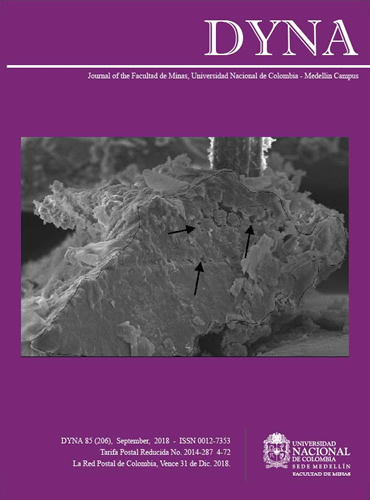
Electrochemical analysis of the degradation of nitrided zirconia 3Y-TZP
Análisis electroquímico de la degradación de circonia 3Y-TZP nitrurada
DOI:
https://doi.org/10.15446/dyna.v85n206.68296Palabras clave:
3Y-TZP, nitriding, aging, artificial saliva, EIS (en)3Y-TZP, nitruración, envejecimiento, saliva artificial, EIE (es)
Descargas
Referencias
Chevalier, J. and Gremillard, L., 1.6 Zirconia as a biomaterial, in: Compr. Biomater. II, Elsevier, pp. 122-144, 2017. DOI: 10.1016/B978-0-12-803581-8.10245-0.
Yin, L., Nakanishi, Y., Alao, A.R., Song, X.F, Abduo, J. and Zhang, Y., A review of engineered zirconia surfaces in biomedical applications, Procedia CIRP. 65, pp. 284-290, 2017. DOI: 10.1016/J.PROCIR.2017.04.057.
Pieralli, S., Kohal, R.J., Lopez Hernandez, E., Doerken, S. and Spies, B.C., Osseointegration of zirconia dental implants in animal investigations: A systematic review and meta-analysis, Dent. Mater. 34, pp. 171-182, 2018. DOI: 10.1016/J.DENTAL.2017.10.008.
Cattani-Lorente, M., Durual, S., Amez-Droz, M, Wiskott, H.W.A. and Scherrer, S.S., Hydrothermal degradation of a 3Y-TZP translucent dental ceramic: a comparison of numerical predictions with experimental data after 2 years of aging, Dent. Mater. 32, pp. 394-402, 2016. DOI: 10.1016/J.DENTAL.2015.12.015.
Pandoleon, P., Kontonasaki, E., Kantiranis, N., Pliatsikas, N., Patsalas, P., Papadopoulou, L., Zorba, T., Paraskevopoulos, K.M. and Koidis, P., Aging of 3Y-TZP dental zirconia and yttrium depletion, Dent. Mater. 33, pp. e385-e392, 2017. DOI: 10.1016/J.DENTAL.2017.07.011.
Bartolo, D., Cassar, G., Al-Haj Husain, N., Özcan, M. and Camilleri, J., Effect of polishing procedures and hydrothermal aging on wear characteristics and phase transformation of zirconium dioxide, J. Prosthet. Dent. 117, pp. 545-551, 2017. DOI: 10.1016/j.prosdent.2016.09.004.
Sivaraman, K., Chopra, A., Narayan, A.I. and Balakrishnan, D., Is zirconia a viable alternative to titanium for oral implant? A critical review, J. Prosthodont. Res., 62(2), pp. 121-133, 2017. DOI: 10.1016/J.JPOR.2017.07.003.
Abd El-Ghany, O.S. and Sherief, A.H., Zirconia based ceramics, some clinical and biological aspects: Review, Futur. Dent. J. 2, pp. 55-64, 2016. DOI: 10.1016/J.FDJ.2016.10.002.
Berendts, S., Eufinger, J.P., Valov, I., Janek, J. and Lerch, M., Ionic conductivity of low yttria-doped cubic zirconium oxide nitride single crystals, Solid State Ionics. 296, pp. 42-46, 2016. DOI: 10.1016/J.SSI.2016.08.015.
Liu, H., Zhao, W., Ji, Y., Cui, J., Chu, Y. and Rao, P., Determination of fracture toughness of zirconia ceramics with different yttria concentrations by SEVNB method, Ceram. Int. 43, pp. 10572-10575, 2017. DOI: 10.1016/J.CERAMINT.2017.04.064.
Almeida, P.J., Silva, C.L., Alves, J.L., Silva, F.S. and Martins, R.C., Sampaio-Fernandes, J., Analysis of the stability of 3Y-TZP zirconia abutments after thermocycling and mechanical loading, Rev. Port. Estomatol. Med. Dentária E Cir. Maxilofac. 57, pp. 197-206, 2016. DOI: 10.1016/J.RPEMD.2016.07.003.
Cotič, J., Jevnikar, P. and Kocjan, A., Ageing kinetics and strength of airborne-particle abraded 3Y-TZP ceramics, Dent. Mater. 33, pp 847-856, 2017. DOI: 10.1016/J.DENTAL.2017.04.014.
Cattani-Lorente, M., Scherrer, S.S., Durual, S, Sanon, C., Douillard, T., Gremillard, L., Chevalier, J. and Wiskott, A., Effect of different surface treatments on the hydrothermal degradation of a 3Y-TZP ceramic for dental implants, Dent. Mater. 30, pp. 1136-1146, 2014. DOI: 10.1016/j.dental.2014.07.004.
Pajkossy, T. and Jurczakowski, R., Electrochemical impedance spectroscopy in interfacial studies, Curr. Opin. Electrochem. 1, pp. 53-58, 2017. DOI: 10.1016/J.COELEC.2017.01.006.
Gan, K., Liu, H., Jiang, L., Liu, X., Song, X., Niu, D., Chen, T. and Liu, C., Bioactivity and antibacterial effect of nitrogen plasma immersion ion implantation on polyetheretherketone, Dent. Mater. 32, pp. e263-e274, 2016. DOI: 10.1016/J.DENTAL.2016.08.215.
Romonti, D.E., Gomez-Sanchez, A.V., Milošev, I., Demetrescu, I. and Ceré, S., Effect of anodization on the surface characteristics and electrochemical behaviour of zirconium in artificial saliva, Mater. Sci. Eng. C. 62, pp. 458-466, 2016. DOI: 10.1016/j.msec.2016.01.079.
Platt, P., Mella, R., DeMaio, W., Preuss, M. and Wenman, M.R., Peridynamic simulations of the tetragonal to monoclinic phase transformation in zirconium dioxide, Comput. Mater. Sci. 140, pp. 322-333, 2017. DOI: 10.1016/J.COMMATSCI.2017.09.001.
Zhang, F., Batuk, M., Hadermann, J., Manfredi, G., Mariën, A., Vanmeensel, A., Inokoshi, M., Van Meerbeek, B., Naert, I. and Vleugels, J., Effect of cation dopant radius on the hydrothermal stability of tetragonal zirconia: Grain boundary segregation and oxygen vacancy annihilation, Acta Mater. 106, pp. 48-58, 2016. DOI: 10.1016/J.ACTAMAT.2015.12.051.
Wei, C. and Gremillard, L., Towards the prediction of hydrothermal ageing of 3Y-TZP bioceramics from processing parameters, Acta Mater. 144, pp. 245-256, 2018. DOI: 10.1016/J.ACTAMAT.2017.10.061.
Boccaccini, D.N., Frandsen, H.L, Soprani, S., Cannio, M., Klemensø, T., Gil, V. and Hendriksen, P.V., Influence of porosity on mechanical properties of tetragonal stabilized zirconia, J. Eur. Ceram. Soc. 38, pp. 1720-1735, 2018. DOI: 10.1016/J.JEURCERAMSOC.2017.09.029.
Lee, J.S., Lerch, M. and Maier, J., Nitrogen-doped zirconia: A comparison with cation stabilized zirconia, J. Solid State Chem. 179, pp. 270-277, 2006. DOI: 10.1016/j.jssc.2005.10.012.
Lee, J.S., Fleig, J., Maier, J., Chung, T.J. and Kim, D.Y., Microcontact impedance spectroscopy in nitrogen-graded zirconia, Solid State Ionics. 176, pp. 1711-1716, 2005. DOI: 10.1016/j.ssi.2005.04.036.
Dimensions
PlumX
Visitas a la página del resumen del artículo
Descargas
Cómo citar
Licencia
Derechos de autor 2018 DYNA

Esta obra está bajo una licencia internacional Creative Commons Atribución-NoComercial-SinDerivadas 4.0.
El autor o autores de un artículo aceptado para publicación en cualquiera de las revistas editadas por la facultad de Minas cederán la totalidad de los derechos patrimoniales a la Universidad Nacional de Colombia de manera gratuita, dentro de los cuáles se incluyen: el derecho a editar, publicar, reproducir y distribuir tanto en medios impresos como digitales, además de incluir en artículo en índices internacionales y/o bases de datos, de igual manera, se faculta a la editorial para utilizar las imágenes, tablas y/o cualquier material gráfico presentado en el artículo para el diseño de carátulas o posters de la misma revista.








