
Publicado
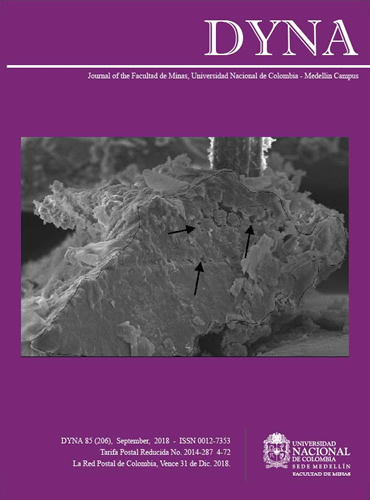
Morphological and nanomechanical characterization of Guadua Angustifolia kunth fiber by means of SEM and AFM
Caracterización morfológica y nanomecánica de la fibra de Guadua Angustifolia kunth mediante SEM y AFM
DOI:
https://doi.org/10.15446/dyna.v85n206.70889Palabras clave:
fibers of Guadua Angustifolia kunth, morphology, nanoindentation, SEM, AFM (en)fibras de Guadua Angustifolia kunth, morfología, nanoindentación, SEM, AFM (es)
Descargas
Referencias
Hidalgo, M.A., Muños, M.F. and Quintana, K.J. Desempeño mecánico del compuesto aluminio reforzado con agro fibras contínuas de fique. Revista Latinoamericana de Metalurgia y Materiales, 31 (2), pp. 187-194, 2011.
Ru-Min, W., Shui Rong Z. and Ya Ping, Z. Polymer matrix composites and technology. Georgia: Woodhead Publishing, 1, pp. 1-28, 2011.
Baptista, R., Mendão, A., Rodrigues, F., Figueiredo, C. G., Guedes, M. and Marat, R. Effect of high graphite filler contents on the mechanical and tribological failure behavior of epoxy matrix composites. Theoretical and Applied Fracture Mechanics, 85, pp. 113-124, 2016. DOI: http://doi.org/10.1016/j.tafmec.2016.08.013
Khalili, P., Tshai, K.Y. and Kong, I., Natural fiber reinforced expandable graphite filled composites: evaluation of the flame retardancy, thermal and mechanical performances. Composites: Part A, 100, pp. 194-205, 2017. DOI: 10.1016/j.compositesa.2017.05.015
Pedrazzoli, D. and Pegoretti, A., Expanded graphite nanoplatelets as coupling agents in glass fiber reinforced polypropylene composites. Composites: Part A, 66, pp. 25-34, 2014. DOI: 10.1016/j.compositesa.2014.06.016
Papageorgiou, D.G., Kinloch, I.A. and Young, R.J., Hybrid multifunctional graphene/glass-fibre polypropylene composites. Composites Science and Technology, 137, pp. 44-51, 2016. DOI: 10.1016/j.compscitech.2016.10.018
Kwan, K., Hye, L., Jeong, A., Dong, C., Kay, A. and Byung, K., Recycling and characterization of carbon fibers from carbon fiber reinforced epoxy matrix composites by a novel super-heated-steam method. Journal of Environmental Management, 203, pp. 872-879, 2017. DOI: 10.1016/j.jenvman.2017.05.015
Sharma, M., Rao, I. and Bijwe, J., Influence of orientation of long fibers in carbon fiber-polyetherimide composites on mechanical and tribological properties. Wear, 267, pp. 839-845, 2009. DOI: 10.1016/j.wear.2009.01.015
Serrano, R., Cobo, A., Prieto, M.I. and González, M., Analysis of fire resistance of concrete with polypropylene or steel fibers. Construction and Building Materials, 122, pp. 302-309, 2016. DOI: /10.1016/j.conbuildmat.2016.06.055
Kakooe, S., Md-Akil, H., Jamshidi, M. and Rouhi, J., The effects of polypropylene fibers on the properties of reinforced concrete structures. Construction and Building Materials, 27, pp. 73-77, 2012. DOI: 10.1016/j.conbuildmat.2011.08.015
Amine, M., Hegde, K., Rouissi, T., Kaur, S., Galves, R., Sorelli, L., Ben, R., Paiva, M. and Abokitse, K., Green synthesis of novel biocomposites from treated cellulosic fibers and recycled bio-plastic polylactic acid. Journal of Cleaner Production, 164, pp. 575-586, 2017. DOI: 10.1016/j.jclepro.2017.06.235
Ramos, J. and Cely, M., Exposición personal a asbestos en dos talleres de frenos para vehículos de flota pesada en la ciudad de Bogotá. Fundación Mapfre, [Online]. 2011. [date of reference: November 4th of 2017]. Available at: https://es.scribd.com/document/ 384252215/ASBESTO-EN-LOS-TALLERS-DE-VEHICULOS
Jaramillo, G. y Zapata, L.M., Aprovechamiento de los residuos sólidos orgánicos en Colombia, Esp. Tesis, Facultad de Ingeniería, Universidad de Antioquia, Medellín, Colombia, 2008.
Águila, I. y Sosa, M., Evaluación físico química de cenizas de cascarilla de arroz, bagazo de caña y hoja de maíz y su influencia en mezclas de mortero, como materiales puzolánicos. Revista de la Facultad de Ingeniería U.C.V [Online]. 23(4), 2008. [date of reference November 4th of 2017]. Available at: http://saber.ucv.ve/ojs/ index.php/rev_fiucv/article/view/5078
Bordoloi, S., Hussain, R., Garg, A., Sreedeep, S. and Zhou, W.-H., Infiltration characteristics of natural fiber reinforced soil. Transportation Geotechnics, 12, pp. 37-44, 2017. DOI: 10.1016/j.trgeo.2017.08.007
Steffens, F., Steffens, H. and Ribeiro, F., Applications of natural fibers on architecture. Procedia Engineering, 200, pp. 317-324, 2017. DOI: 10.1016/j.proeng.2017.07.045
Balakrishnan, P., John, M., Pothen, L., Sreekala, M. and Thomas, S., Natural fibre and polymer matrix composites and their applications in aerospace engineering. Advanced Composite Materials for Aerospace Engineering, pp. 365-383, 2016. DOI: 10.1016/B978-0-08-100037-3.00012-2
Ashik, K.P. and Sharma, R., A review on mechanical properties of natural fiber reinforced hybrid polymer composites. Journal of Minerals and Materials Characterization and Engineering, 3, pp. 420-426, 2015. DOI: 10.1016/j.matpr.2017.11.276
Rodríguez, L., Sarache, W. and Orrego, C., Compuestos de poliéster reforzados con fibra de plátano/banano (musa paradisiaca) modificada químicamente. Comparación con Fibra de Vidrio y Fique (Furcraea andina). Información tecnológica, 25(5), pp. 27-34, 2014. DOI: 10.4067/S0718-07642014000500005
Danso, H., Properties of coconut, oil palm and bagasse fibres: as potential building materials. Procedia Engineering, 200, pp. 1-9, 2017. DOI: 10.1016/j.proeng.2017.07.002
Wang, W. and Chouw, N., The behaviour of coconut fibre reinforced concrete (CFRC) under impact loading. Construction and Building Materials, 134, pp. 452-461, 2017. DOI: 10.1016/j.conbuildmat. 2016.12.092
Mwaikambo, L., Review of the history, properties and application of plant fibres. African Journal of Science and Technology (AJST) [Online]. 7(2), 2006. [date of reference November 17th of 2017]. Available at: https://www.researchgate.net/publication/284760719_ Review_of_the_history_properties_and_application_of_plant_fibres
Hidalgo, M., Muñoz, M. y Quintana, K., Análisis mecánico del compuesto polietileno aluminio reforzado con fibras cortas de fique en disposición bidimensional. Revista Latinoamericana de Metalurgia y Materiales [Online]. 32(1), 2012. [date of reference November 19th of 2017]. Available at: http://www.rlmm.org/ojs/index.php/rlmm/ article/view/117
Pietroniro, M. y Bloem, C., Ventajas del algodón frente al fique como refuerzo en compuestos poliméricos. Ciencia e Ingeniería [Online]. 36(1), 2015. [date of reference November 20th of 2017]. Available at: http://erevistas.saber.ula.ve/index.php/cienciaeingenieria/article/view/5495/0
Karaduman, Y., Gokcan, D. and Onal, L., Effect of enzymatic pretreatment on the mechanical properties of jute fiber-reinforced polyester composites. Journal of Composite Materials, 47(10), pp. 1293-1302, 2012. DOI: 10.1177/0021998312446826
Bursi, N., Gualtieria, A.F., Pollastria, S. and Tibaldib, E., Assessment of asbestos body formation by high resolution FEG-SEM after exposure of Sprague-Dawley rats to chrysotile, crocidolite, orerionite. Journal of Hazardous Materials, 306, pp. 95-104, 2016. DOI: 10.1016/j.jhazmat.2015.11.050
Fang, C.-H., Jiang, Z.-H., Sun, Z.-J., Liu, H.-R., Zhang, X.-B., Zhang, R. and Hua Fei, B., An overview on bamboo culm flattening. Construction and Building Materials, 171, pp. 65-74, 2018. DOI: 10.1016/j.conbuildmat.2018.03.085
Kaminski, S., Lawrence, A. and Trujillo, D., Structural use of bamboo: Part 1: Introduction to bamboo. The Structural Engineer [Online]. 94(8), 2016. [date of reference November 20th of 2017]. Available at: https://www.researchgate.net/publication/305808084_Structural_use_of_bamboo_Part_1_Introduction_to_bamboo
Zakikhani, P., Zahari, R., Sultan, M. and Majid, D., Extraction and preparation of bamboo fibre-reinforced composites. Materials & Design, 63, pp. 820-828, 2014. DOI: /10.1016/j.matdes.2014.06.058
Valarezco, L.E., Obtención experimental de un material biocompuesto a base de una matriz polimérica y reforzada con fibras naturales de guadúa angustifolia proveniente del Ecuador,
Pregrado. Tesis, Facultad de Ingeniería, Universidad Politécnica Salesiana, Cuenca, Ecuador, 2013.
Luna, P., Marriaga, J. and Mariño, A., Guadua angustifolia bamboo fibers as reinforcement of polymeric matrices: An exploratory study. Construction and Building Materials, 116, pp. 93-97, 2016. DOI: 10.1016/j.conbuildmat.2016.04.139
AL-Oqla, F.M. and Sapuan, S.M., Natural fiber reinforced polymer composites in industrial applications: feasibility of date palm fibers for sustainable automotive industry. Journal of Cleaner Production, 66, pp. 347-354, 2014. DOI: 10.1016/j.jclepro.2013.10.050
Salas, E., Actualidad y futuro de la arquitectura de bambú en Colombia, PhD. Tesis, Departamento de Construcciones Arquitectónicas, Universidad Politécnica de Cataluña, Barcelona, España, 2006.
Hao, H., Tam, L.-H., Lu, Y. and Lau, D., An atomistic study on the mechanical behavior of bamboo cell wall constituents. Composites Part B: Engineering, In Press, 2018. DOI: /10.1016/j.compositesb.2018.05.046
Rao, J., Bao, L. Wang, B., Fan, M. and Feo, L., Plasma surface modification and bonding enhancement for bamboo composites. Composites Part B: Engineering, 138, pp. 157-167, 2018. DOI: 10.1016/j.compositesb.2017.11.025
Mohanty, A., Khan, M. and Hinrichsen, G., Influence of chemical surface modification on the properties of biodegradable jute fabrics—polyester amide composites. Composites Part A: Applied Science and Manufacturing, 31(2), pp. 143-150, 2000. DOI: /10.1016/S1359-835X(99)00057-3
Herrera, P. and Valadez, A., Mechanical properties of continuous natural fibre-reinforced polymer composites. Composites Part A: Applied Science and Manufacturing, 35(3), pp. 339-345, 2004. DOI: 10.1016/j.compositesa.2003.09.012
Focher, B., Palma, M., Canetti, M., Torri, G., Cosentino, C. and Gastaldi, G., Structural differences between non-wood plant celluloses: evidence from solid state NMR, vibrational spectroscopy and X-ray diffractometry. Industrial Crops and Products, 13, pp. 193-208, 2001. DOI: /10.1016/S0926-6690(00)00077-7
Shanmugasundaram, N., Rajendran, I. and Ramkumar, T., Characterization of untreated and alkali treated new cellulosic fiber from an Areca palm leaf stalk as potential reinforcement in polymer composites. Carbohydrate Polymers, 195, pp. 566-575, 2018. DOI: 10.1016/j.carbpol.2018.04.127
Chegdani, F. and El Mansori, M., Friction scale effect in drilling natural fiber composites. Tribology International, 119, pp. 622-630, 2018. DOI: 10.1016/j.triboint.2017.12.006
Sreenivasulu, S. and Chennakeshava, A., Mechanical properties evalution of bamboo fiber reinforced composite materials. International Journal of Engineering Research, [Online]. 3(1), pp. 187-194, 2014. [date of reference November 20th of 2017]. Available at: https://www.researchgate.net/publication/269412 025_Mechanical_ Properties_Evaluation_of_Bamboo_Fiber_
Huanga, Y., Benhua, F., Penglian, W. and Chang, Z., Mechanical properties of bamboo fiber cell walls during the culmdevelopment by nanoindentation. Industrial Crops and Products, 92, pp. 102-108, 2016. DOI: 10.1016/j.indcrop.2016.07.037
Arroyave, M., Nanocaracterización estructural y macánica de recubrimeintos duros de TiN y ZrN producidos por descarga de arco pulsado, MSc. Tesis, Departamento de física y química, Facultad de Ciencias y Administración, Universidad Nacional de Colombia, Manizales, Colombia, 2004.
Dimensions
PlumX
Visitas a la página del resumen del artículo
Descargas
Cómo citar
Licencia
Derechos de autor 2018 DYNA

Esta obra está bajo una licencia internacional Creative Commons Atribución-NoComercial-SinDerivadas 4.0.
El autor o autores de un artículo aceptado para publicación en cualquiera de las revistas editadas por la facultad de Minas cederán la totalidad de los derechos patrimoniales a la Universidad Nacional de Colombia de manera gratuita, dentro de los cuáles se incluyen: el derecho a editar, publicar, reproducir y distribuir tanto en medios impresos como digitales, además de incluir en artículo en índices internacionales y/o bases de datos, de igual manera, se faculta a la editorial para utilizar las imágenes, tablas y/o cualquier material gráfico presentado en el artículo para el diseño de carátulas o posters de la misma revista.








