
Publicado
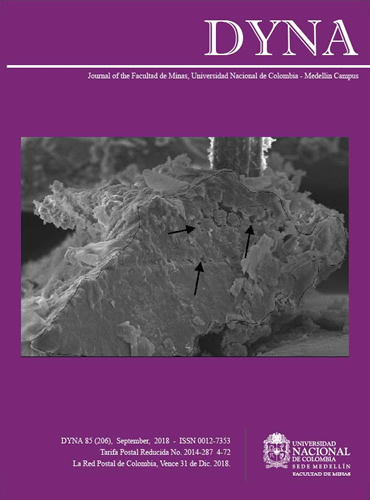
Structural, thermal, rheological, morphological and mechanical properties of thermoplastic starch obtained by using hyperbranched polyester polyol as plasticizing agent
Propiedades térmicas, reológicas, morfológicas y mecánicas de almidón termoplástico obtenido usando un poliéster poliol altamente ramificado como agente plastificante
DOI:
https://doi.org/10.15446/dyna.v85n206.71819Palabras clave:
starch, hyperbranched polyester polyol, TPS, plasticization, properties (en)almidón, poliéster poliol altamente ramificado, TPS, plastificación, propiedades (es)
Descargas
Referencias
Ma, X.F, Yu, J.G. and Wan, J., Urea and ethanolamine as a mixed plasticizer for thermoplastic starch. Carbohydrate Polymers, 64(2), pp. 267-273, 2006. DOI: 10.1016/j.carbpol.2005.11.042
Vaverková, M., Toman F., Adamcová, D. and Kotovicová, J., Study of the biodegrability of degradable/biodegradable plastic material in a controlled composting environment. Ecological Chemistry and Engineering, 19(3), pp. 347-358, 2012. DOI: 10.2478/v10216-011-0025-8.
Bertolini, A., Starches, characterization, properties and applications. Editorial CRC Press, United States, [online]. 2009, 6 P. Available at: https://books.google.com.co/books/about/Starches.html?id=iv2u5fM2as8C&source=kp_cover&redir_esc=y. DOI: 10.1201/9781420080247
Huang, M., Yu, J. and Ma, X.F., Ethanolamine as a novel plasticizer for thermoplastic starch. Polymer Degradation Stability, 90(3), pp. 501-507, 2005. DOI: 10.1016/j.polymdegradstab.2005.04.005
Yang, J., Yu, J. and Ma, X., Study on the properties of ethylenebisformamide and sorbitol plasticized corn starch (ESPTPS). Carbohydrate Polymers, 66(1), pp. 110-116, 2006. DOI: 10.1016/j.carbpol.2006.02.029
Mesias, R. and Murillo, E., Hyperbranched polyester polyol modified with polylactic acid as a compatibilizer for plasticized tapioca starch/polylactic acid blends. Polímeros, 28(1), pp. 44-52, 2018. DOI: 10.1590/0104-1428.09516
Janssen, L. and Moscicki, L., Thermoplastic starch. Editorial Wiley, Germany, [online]. 2009, 4 P. Available at: https://books.google.com.co/books?id=nHbLfoCoMvQC&pp=PA218&lpg=PA218&dq=Janssen+L.+and+Moscicki+L.,+%22Thermoplastic+starch%22.&source=bl&ots=sHq0LxS7nk&sig=6tE-Djg QFg8y5A109zj9gy8Q4Q&hl=en&sa=X&ved=0ahUKEwjRmry77MnaAhVQvVMKHaLpD
Murillo, E.A., Vallejo, P.P. and López, B.L., Characterization of hydroxylated hyperbranched polyesters of fourth and fifth generation. E-Polymer, 10(1), pp.1347-1358, 2010. DOI: 10.1515/epoly.2010.10.1.1347
Murillo, E.A., Vallejo, P.P., Sierra, L. and López B.L., Characterization of hyperbranched polyol polyesters based on 2,2-bis (methylol Propionic Acid) and pentaerythritol. Journal of Applied Polymer Science, 112(1), pp. 200-207, 2009. DOI: 10.1002/app.29397
Murillo, E.A., Cardona, A. and López B.L. Rheological behavior in the molten state and solution of hyperbranched polyester of fourth and fifth generation. Journal of Applied Polymer Science, 119(2), pp. 929-935, 2011. DOI: 10.1002/app.32774
Zagar, E. and Zigon, M., Aliphatic hyperbranched polyesters based on 2,2 bis(methylol)propionic acid—Determination of structure, solution and bulk properties. Progress in Polymer Science, 36(1), pp. 53-88, 2011. DOI: 10.1016/j.progpolymsci.2010.08.004
Guzmán, M. and Murillo, E.A., The properties of blends of maleic anhydride-grafted polyethylene and thermoplastic starch using hyperbranched polyester polyol as a plasticizer. Polymer Engineering and Science, 55(11), pp. 2526-2533, 2015. DOI: 10.1002/pen.24143
Zhang, K., Cheng, X., Cheng, F., Lin, Y., Zhou, M. and Zhu, P., Poly(citrate glyceride): a hyperbranched polyester for starch plasticization. Polymer International, 67(4), pp. 399-404, 2018. DOI: 10.1002/pi.5520
Zhang, K., Cheng, F., Lin, Y., Zhou, M. and Zhu, P., Effect of hyperbranched poly(trimellitic glyceride) with different molecular weight on starch plasticization and compatibility with polyester. Carbohydrate Polymers, 195 (1), pp. 107-113, 2018. DOI: 10.1016/j.carbpol.2018.04.080
Chang, P., Jian, R., Zheng, P., Yu, J. and Ma, X., Preparation and properties of glycerol plasticized-starch (GPS)/cellulose nanoparticle (CN) composites. Carbohydrate Polymers, 79(2), pp. 301-305, 2010 DOI: 10.1016/j.carbpol.2009.08.007.
Zobel, H.F., Starch crystal transformations and their industrial importance. Starch/Stärke, 40(1), pp. 1-7, 1988. DOI: 10.1002/star.19880400102.
Da Roz, A.L., Carvalho, A., Gandini, A. and Curvelo, A., The effect of plasticizers on thermoplastic starch compositions obtained by melt processing. Carbohydrate Polymers, 63(3), pp. 417-424, 2006. DOI: 10.1016/j.carbpol.2005.09.017.
Yoon, S.D., Chough, S.H., and Park, H.R., Properties of starch‐based blend films using citric acid as additive. II. Journal of Applied Polymer Science, 100(3), pp. 2554-2560, 2006. DOI: 10.1002/app.23783.
Mathew, A.P., and Dufresne, A., Plasticized waxy maize starch: effect of polyols and relative humidity on material properties. Biomacromolecules, 3(5), pp. 1101-1108, 2002. DOI: 10.1021/bm020065p
Kaur, L., Singh, J. and Singh N., Effect of glycerol monostearate on the physico-chemical, thermal, rheological and noodle making properties of corn and potato starches. Food Hydrocolloids, 19(5), pp. 839-849, 2005. DOI: 10.1016/j.foodhyd.2004.10.036.
Guzmán, M., Obtención y caracterización de mezclas de polietileno de baja densidad modificado con anhídrido maleico y almidón termoplástico. Trabajo de Investigación, Universidad de Antioquia, 2013, pp. 56-63.
Canché, G., Canché, M., Duarte, S., Cáceres, M. and Borges, R., Mechanical properties and biodegradation of thermoplastic starches obtained from grafted starches with acrylics. Carbohydrate Polymers, 86(4), pp. 1501-1508, 2011. DOI: 10.1016/j.carbpol.2011.06.052.
Rao, M. and Tattiyakul, J., Granule size and rheological behavior of heated tapioca starch dispersions. Carbohydrate Polymers, 38(2), pp. 123-132, 1999. DOI: 10.1016/S0144-8617(98)00112-X.
Rodríguez, F.J., Ramsay, B.A. and Favis, B.D., Rheological and thermal properties of thermoplastic starch with high glycerol content. Carbohydrate Polymers, 58(2), pp. 139-147, 2004. DOI: 10.1016/j.carbpol.2004.06.002.
Nagano, T., Tamaki, E. and Funami T., Influence of guar gum on granule morphologies and rheological properties of maize starch. Carbohydrate Polymers, 72(1), pp. 95-101, 2008. DOI: 10.1016/j.carbpol.2007.07.028.
Jagadish, R.S., and Raj, B., Properties and sorption studies of polyethylene oxide-starch blended films. Food Hydrocoloids. 25(6), 1572-1580, 2011. DOI: 10.1016/j.foodhyd.2011.01.009
Basiak, E., Lenart, A. and Debeaufort, F., How glycerol and water contents affect the structural and functional properties of starch-based edible films. Polymers, 10(4), pp. 412-429, 2018 DOI: 10.3390/polym10040412
Dimensions
PlumX
Visitas a la página del resumen del artículo
Descargas
Cómo citar
Licencia
Derechos de autor 2018 DYNA

Esta obra está bajo una licencia internacional Creative Commons Atribución-NoComercial-SinDerivadas 4.0.
El autor o autores de un artículo aceptado para publicación en cualquiera de las revistas editadas por la facultad de Minas cederán la totalidad de los derechos patrimoniales a la Universidad Nacional de Colombia de manera gratuita, dentro de los cuáles se incluyen: el derecho a editar, publicar, reproducir y distribuir tanto en medios impresos como digitales, además de incluir en artículo en índices internacionales y/o bases de datos, de igual manera, se faculta a la editorial para utilizar las imágenes, tablas y/o cualquier material gráfico presentado en el artículo para el diseño de carátulas o posters de la misma revista.








