
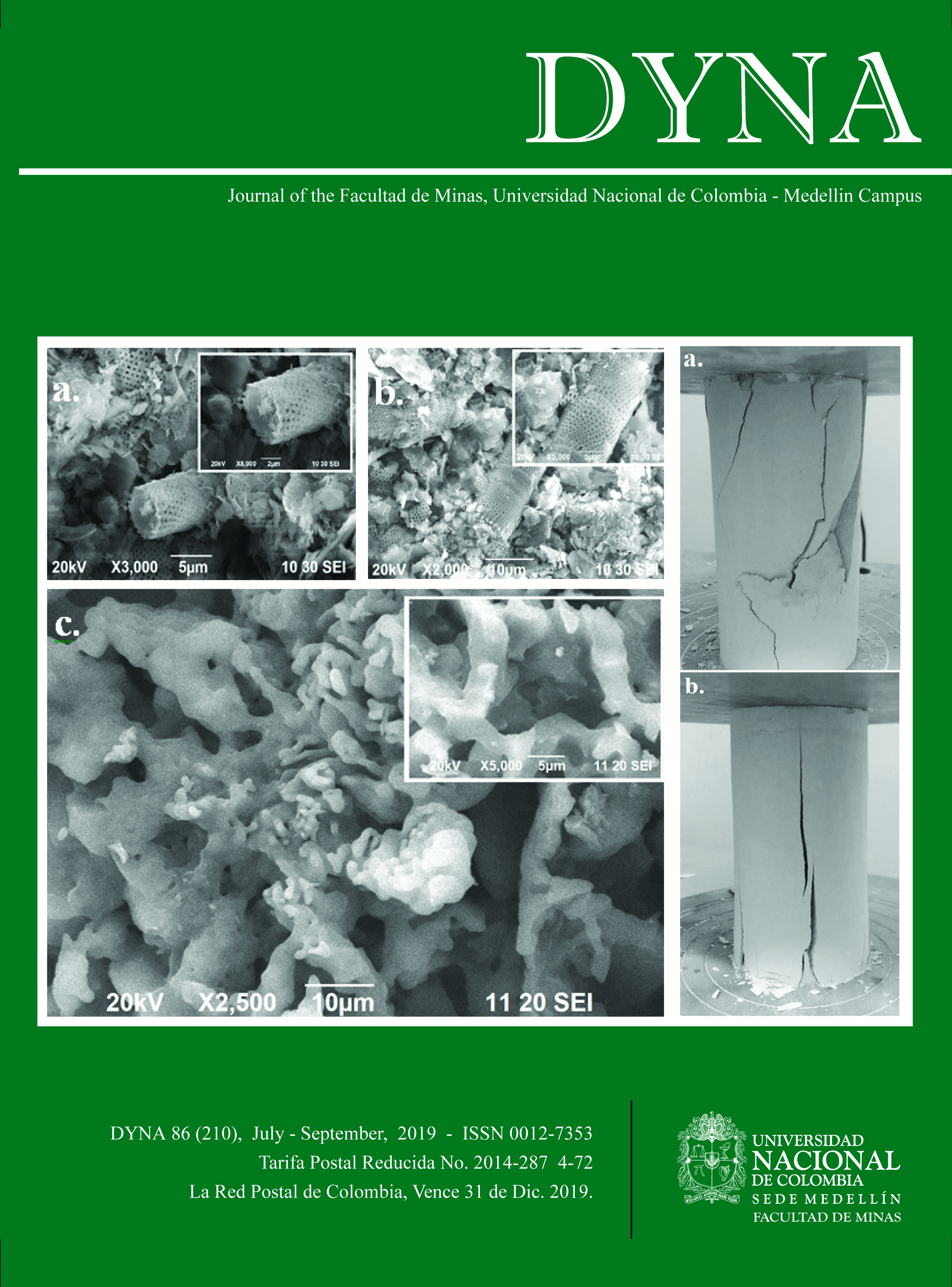
Publicado
Significant enzymatic activities in the residues hydrolysis of the sugar cane harvest
Actividades enzimáticas significativas en la hidrólisis de residuos de la cosecha de caña de azúcar
DOI:
https://doi.org/10.15446/dyna.v86n210.75286Palabras clave:
top cane, leaves, sugar cane, hemicellulose, cellulases, enzymatic hydrolysis (en)tallo, hojas, caña de azúcar, hemicelulasas., celulasas, hidrólisis enzimática (es)
Descargas
In the production of ethanol from agroindustrial crop residues, one of the critical stages in the process is the conversion of lignocellulosic material to simple sugars, which can be done chemically or enzymatically. In this research, the enzymatic activities of commercial enzymes were evaluated for their influence on the degradation of lignocellulosic materials from sugar cane harvest residues (leaves and top cane). Eight substrates were pretreated with different delignification methods. Likewise, five enzymatic preparations were configured. An analysis of the enzyme-substrate interactions was conducted through fuzzy system analysis. The results showed regions of maximum enzymatic activity for residues of the sugarcane harvest, between 20-30 Filter Paper Units (FPU) /mL values lower than 500 pNPG (p-Nitrofenol-α-D-Glucopyranoside) U / mL of activity beta-glucosidase and hemicellulase activity between 50 and 70 IU / mL, confirming that the use of large amounts of cellulolytic enzymes is not necessary.
En la producción de etanol a partir de residuos agroindustriales, una de las etapas críticas en el proceso es la conversión del material lignocelulósico a azúcares simples, que puede realizarse química o enzimáticamente. En esta investigación, se evaluó la influencia de las actividades enzimáticas de las enzimas comerciales para degradar materiales de residuos de cosecha de la caña de azúcar (hojas y cogollos). Ocho sustratos fueron pretratados con diferentes métodos de deslignificación, con cinco preparaciones enzimáticas. Se utilizó un análisis de las interacciones enzima-sustrato, a través del análisis del sistema difuso. Los resultados mostraron regiones de actividad enzimática entre 20-30 FPU / mL y valores inferiores a 500 pNPG U / mL de actividad beta-glucosidasa y para actividad hemicelulasa entre 50 y 70 IU / mL, confirmando que el uso de grandes cantidades de enzimas celulolíticas no es necesario.
Referencias
FEPA - Fondo de estabilización de los precios del azúcar, [en líena]. 2014. Disponible en: http://www.fepa.com.co
CENICAÑA - Centro de Investigación de la Caña de Azúcar. Indicadores de productividad de la industria azucarera colombiana entre enero y agosto de 2006 - 2007 [en línea]. Florida, Valle del Cauca. Disponible en: http://www.cenicana. org/ web/
Simas-Días, D., Acevedo-Jaramillo, L.Y., Vasconcelos, U. and Pereira, N., Characterization of glucosidases produced by Aspergillus niger Atcc 1004 in submerged fermentation from sugarcane bagasse. Revista Mexicana de Ingeniería Química. [online]. 17, pp. 365-377, 2018. Available at: http://www.rmiq.org/ojs311/index.php/rmiq/article/view/45
Peña-Maravilla, M., Calixto-Romo, M.A., K. Guillén-Navarro, K., Sánchez, J.E. and Amaya-Delgado, L., Cellulases and xylanases production by Penicillium citrinum CGETCR using coffee pulp in solid-state fermentation. Revista Mexicana de Ingeniería Química, [online]. 16(3), pp. 757-769, 2017. Available at: http://www.redalyc.org/articulo.oa?id=62053304006
Chylenski, P., Forsberg, Z., St Ahlberg, J., V´Arnai, A., Lersch, M., Bengtsson, O., Sæbø, S., Jarle-Horn, S. and Eijsink, V., Development of minimal enzyme cocktails for hydrolysis of sulfite-pulped lignocellulosic biomass. Journal of Biotechnology, 20, pp. 16-23, 2017. DOI: 10.1016/j .jbiotec. 2017.02.009
Peciulyte, A., Pisano, M., De Vries, R. and Olsson, O., Hydrolytic potential of five fungal supernatants to enhance a commercial enzyme cocktail Biotechnol Lett. 39, pp. 1403-1411, 2007. DOI: 10.1007/s 10529-017-2371-9
Bhatia, L., Chandel, A.K., Singh, A.K. and Singh, O.V., Biotechnological advances in lignocellulosic ethanol production. In: Singh, O. and Chandel, A. (eds), Sustainable biotechnology- Enzymatic resources of renewable energy. Springer, Cham, 2018, pp 57-82, DOI: 10.1007/978-3-319-95480-6_3
Meng, X. and Ragauskas, A.J., Recent advances in understanding the role of cellulose accessibility in enzymatic hydrolysis of lignocellulosic substrates. Curr Opin. Biotechnol. 27, pp. 150-158, 2014. DOI: 10.1016/ j.copbio.2014.01.014
Sadaf, A. and Khare, S.K., Production of Sporotrichum thermophile xylanase by solid state fermentation utilizing deoiled Jatropha curcas seed cake and its application in xylooligosachharide synthesis. Bioresour. Technol., 153, pp. 126-130, 2014. DOI: 10.1016/j. biortech.2013 .11.058.
Marembo, C, Mamphweli, S. and Okoh, O., Bioethanol production from lignocellulosic sugarcane leaves and tops, Journal of Energy in Southern Africa. 28, pp. 1-11, 2017, DOI: 10.17159/2413-3051/2017 /v28i3a2354
Chapla, D., Divecha, J., Madamwar, D. and Shah, A., Utilization of agro-industrial waste for xylanase production by Aspergillus foetidus MTCC 4898 under solid state fermentation and its application in saccharification. Biochem. Eng. J., 49, pp. 361-369, 2010. DOI: 10.1016/j.bej.2010.01.012.
Hongdan, Z., Shaohua, X. and Shubin, W., Enhancement of enzymatic saccharification of sugarcane bagasse by liquid hot water pretreatment. Bioresour. Technol., 143, pp. 391-396, 2013. DOI: 10.1016 /j.biortech .2013.05.103
Pensupa, N., Jin, M., Kokolski, M., Archer, D.B. and Du, C., A solid state fungal fermentation-based strategy for the hydrolysis of wheat straw. Bioresour. Technol., 149, pp. 261-267, 2013. DOI: 10.1016/j. biortech. 2013.09.061.
Bátori, V., Ferreira, J.A., Taherzadeh, M.J. and Lennartsson, P.R., Ethanol and protein from ethanol plant by-products using edible fungi Neurospora intermedia and Aspergillus oryzae. BioMed. Res. Int., 15, pp. 1-10, 2015. DOI: 10.1155/2015 /176371
Nair, R.B., Lundin, M., Brandberg, T., Lennartsson, P.R. and Taherzadeh, M.J., Dilute phosphoric acid pretreatment of wheat bran for enzymatic hydrolysis and subsequent ethanol production by edible fungi Neurospora intermedia. Ind. Crops Prod., 69, pp. 314-323, 2015. DOI: 10.1016/j.indcrop. 2015. 02.038.
Knawang-Chhunji, K.I., Madhao, M. and Rintu-Banerjee, R., Optimization of saccharification of enzymatically pretreated sugarcane tops by response surface methodology for ethanol production, Biofuels, 10, pp. 73-80, 2019, DOI: 10.1080/ 17597269. 2017.1409058.
Mokomele, T., Da Costa Sousa, L., Balan, V., Van -Rensburg, E., Dale, D. and Görgens., J., Ethanol production potential from AFEX™ and steam-exploded sugarcane residues for sugarcane biorefiner, Biotechnol Biofuels, 11 pp. 11-17, 2018, DOI: 10.1186/s13068-018-1130-z
Sanchez, O. and Cardona, C., Trends in biotechnological production of fuel ethanol from different feedstocks. Bioresource Technology, 99, pp. 5270-5295, 2008. DOI: 10.1016/j.biortech. 2007.11.013
Malgas, S., Chandra, R., Van- Dyk, J.S., Saddler, J.N. and Pletschke, B.I., Formulation of an optimized synergistic enzyme cocktail, HoloMix, for effective degradation of various pre-treated hardwoods,Bioresource Technology, 245, pp.46-52, 2017 DOI: 10.1016/j.biortech. 2017.08.186
Eveling, D., Mandels, M., Andreotti, R. and Rocche, C., Measurement of saccharifiying cellulose. Biothecnology for biofuels. pp. 2-21, 2009. DOI: 10.1186/1754-6834-2-21
Bailey, M., Biely, P. and Pountanen, K., Interlaboratory testig of methods for assay of xylanase activity. Journal of Biotechnology, 23, pp. 257-270, 1992. DOI: 10.1016/0168-1656(92)90074-J
Megazyme International Ireland Limited Ltda., Assay of endo 1-4-β-D Galactanase using azo -galactan (agalp), Assay of 1-4-β- endo Mannanase using AZO- carob galactomannan, Assay of Rhamnogalacturonanase Using Azo- Rhamnogalacturonan AZRH [online]. (11/99). 2009. Available at: https://secure.megazyme.com /files/Booklet
Ghose, T.K., Measure cellulose activities, Pure & Appl. Chem. [online]. 59, pp. 257-268. Avaqilable at: https://www.iupac.org/publications. 1987
Salcedo, J., Enzymatic hydrolysis of sugarcane crop residues (leaves and top cane) for the production of ethanol. Thesis PhD in Engineering. Escuela de Ingeniería Química, Universidad del Valle, Colombia. 2011.
Van-Soest, P., Use of detergents in the analysis of fibrous feeds. I. Preparation of fiber residues of low nitrogen content, Journal of the AOAC, 46, pp. 829-835, 1987.
Xiaolu, W., Bin, Y. and Su, X., Linking enzymatic oxidative degradation of lignin to organics detoxification. Int. J. Mol. Sci., 19, pp. 2-17, 2018, DOI: 10.3390/ijms19113373
Jong-Rok, J., Murugesan, K., Kim, Y., Kim, E. and Chang, Y., Synergistic effect of laccase mediators on entachlorophenol removal by Ganoderma lucidum laccase. Appl Microbiol Biotechnol., 81, pp. 783-790, 2008. DOI: 10.1007/s00253-008-1753-2
Mutis, D., Delignification of sugar cane residues (leaves and top cane) with chemical processes, Thesis. Escuela de Ingeniería Química, Universidad del Valle, Colombia. 2009.
Bhattacharya, D., Germinario, L. and Winter, W., Isolation, preparation and characterization of cellulose microfibers obtained from bagasse, Carbohydrate Polymers, 73, pp. 371-377, 2008. DOI: 10.1016/j.carbpol. 2007.12.005
Miller, G., Use of dinitrosalicylic acid reagent for determination of reducing sugars. Analytical chemistry, 31, pp. 426- 426, 1959. DOI: 10.1021/ ac60147a030
Patel, H., Chapla, D., Divecha, J. and Shah, A., Improved yield of α- l - arabinofuranosidase by newly isolated Aspergillus niger ADH-11 and synergistic effect of crude enzyme on saccharification of maize stover. Bioresour Bioproces, 2, pp. 2-14, 2015. DOI: 10.1186/s40643-015-0039-7
Silverstein, R.A., Chen, Y., Sharma-Shivappa, R.R., Boyette, M.D. and Osborne, J., A comparison of chemical pretreatment methods for improving saccharification of cotton stalks. Bioresour Technol., 98, pp. 3000-3011, 2007. DOI: 10.1016/j .biortech. 2006.10.022
Kubicek, C.P. and Penttilä, M.E., Regulation of production of plant polysaccharide degrading enzymes by Trichoderma. In: Harman, G.E. and Kubicek, C.P. (Eds.), Trichoderma and Gliocladium: enzymes, Biological Control and Commercial Applications, 2, pp. 49-72, 1998.
Gasparotto, J.M., Werle, L.B., Foletto, E.L., Kuhn, R.C., Jahn, S.L. and Mazutti, M.A., Production of cellulolytic enzymes and application of crude enzymatic extract for sacchar- ification of lignocellulosic biomass. Appl Biochem Biotechnol., 72, pp. 175-560, 2005. DOI: 10.1007/s12010- 014- 1297- 0
Zhang, L., Liu, Y., Niu, X., Liu, Y. and Liao, W., Effects of acid and alkali treated lignocellulosic materials on cellulase/xylanase production by Trichoderma ree- sei Rut C-30 and corresponding enzymatic hydrolysis. Biomass Bioenergy, 37, pp. 16-24, 2012. DOI: 10.1016/j.biombioe. 2011.12.044
Adsula, MG., Ghuleb, J., Shaikhb, H., Singhb, R., Bastawdea, K.B., Gokhalea, D.V. and Varma, A.J., Enzymatic hydrolysis of delignified bagasse polysaccharides, Carbohydrate Polymers, 62, pp. 6-10, 2005. DOI: 10.1016/j.carbpol. 2005. 07.010
Millett, M., Effland, M. and Caulfield, D., Influence of fine grinding on the hydrolysis of cellulosic materials—Acid Vs. Enzymatic. Advances in Chemistry, 181, pp. 71-89, 1979. DOI: 10.1021/ba-1979-0181.ch004
Mais, U., Esteghlalian, A., Saddler, J. and Mansfield, S., Enhancingthe enzymatic hydrolysis of cellulosic materials using simultaneous ball milling. Applied Biochemistry and Biotechnology - Part A. Enzyme Engineering and Biotechnology, 98, pp. 815-832, 2002. DOI: 10.1385/ABAB:98- 100:1-9:815
Wyman, C., Handbook on Bioethanol: production and utilization. Taylor & Francis, Washinnton, DC, USA, 1996.
Galbe, M. and Zacchi, G., A review of the production of ethanol from softwood. Appl. Microbial Biotechnol, 5, pp. 618-628, 2002. DOI: 10.1007 /s00253-002-1058-9
Mosier, N., Hall, P., Ladisch, C. and Ladisch, M., Reacction kinetics, molecular action and mechanisms of cellulolytic proteins. Adv Biochem Eng Biotechnol., 65, pp. 23-40, 1999. DOI: 10.1007/3-540-49194-5-2
Dimensions
PlumX
Visitas a la página del resumen del artículo
Descargas
Cómo citar
Licencia
Derechos de autor 2019 DYNA

Esta obra está bajo una licencia internacional Creative Commons Atribución-NoComercial-SinDerivadas 4.0.
El autor o autores de un artículo aceptado para publicación en cualquiera de las revistas editadas por la facultad de Minas cederán la totalidad de los derechos patrimoniales a la Universidad Nacional de Colombia de manera gratuita, dentro de los cuáles se incluyen: el derecho a editar, publicar, reproducir y distribuir tanto en medios impresos como digitales, además de incluir en artículo en índices internacionales y/o bases de datos, de igual manera, se faculta a la editorial para utilizar las imágenes, tablas y/o cualquier material gráfico presentado en el artículo para el diseño de carátulas o posters de la misma revista.








