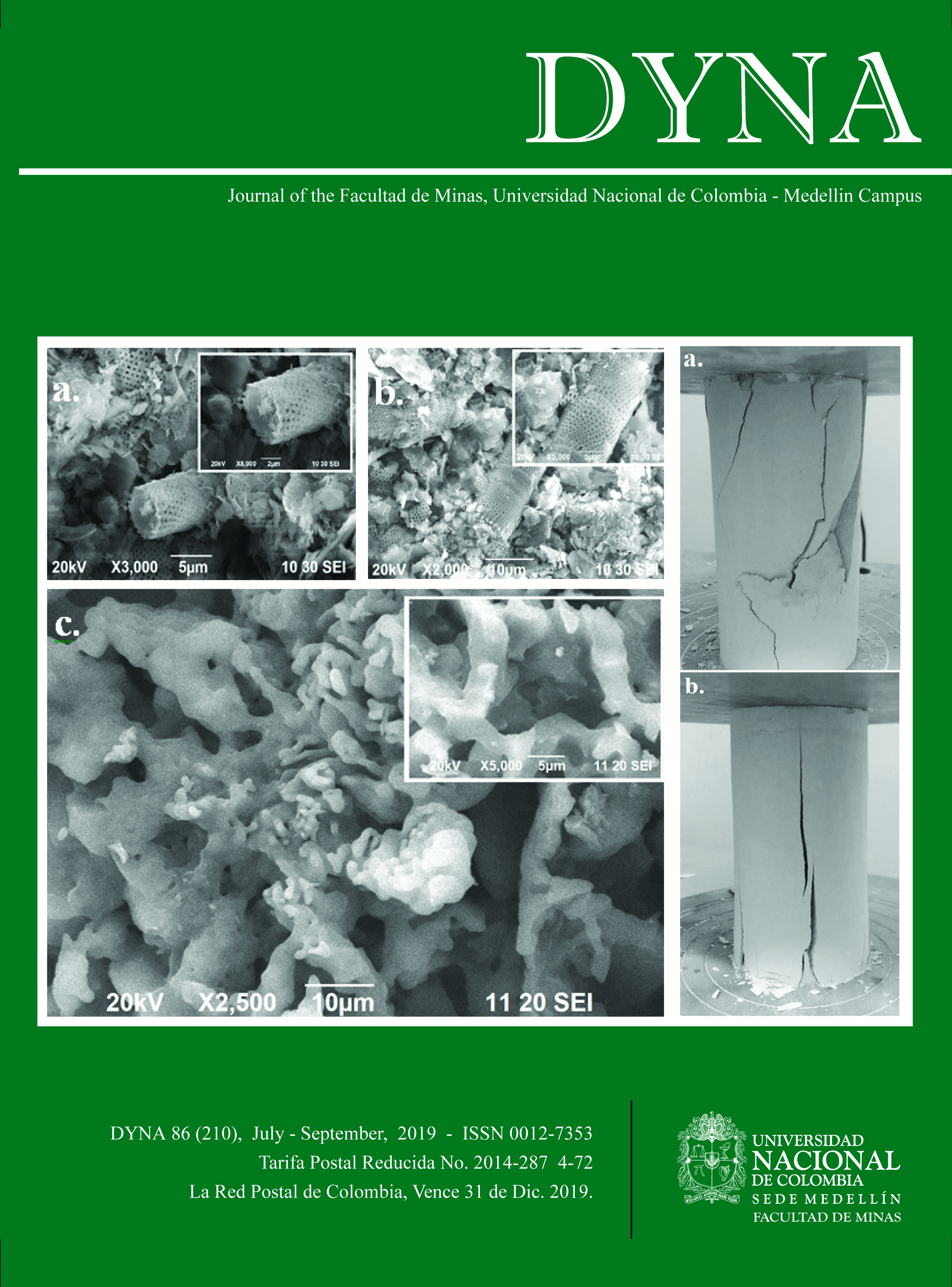
Mechanisms of encapsulation of bacteria in self-healing concrete: review
Mecanismos de encapsulación de bacterias destinados a la autorreparación de concreto: una revisión
DOI:
https://doi.org/10.15446/dyna.v86n210.75343Palabras clave:
encapsulation, bacteria, resistance, compression, self-healing concrete, cracks (en)encapsulación, bacterias, resistencia, compresión, concreto autorreparable, fisuras (es)
Descargas
Referencias
Wang, J., Van Tittelboom, W., De Belie, N. and Verstraete, W., Use of silica gel or polyurethane immobilized bacteria for self-healing concrete, Construction and Building Materials, pp. 532-540, 2012. DOI: 10.1016/j.conbuildmat.2011.06.054
Barlow, P. and Darwin, D., ACI 224.1R-93 causes, evaluation and repair of cracks in concrete structures, 1993.
Toirac-Corral, J., Patología de la construcción, grietas y fisuras en obras de hormigón. Origen y prevención. Ciencia y Sociedad, 29(1), pp. 72-114, 2004.
Neville, A.M., Properties of concrete, in: Properties of concrete, Pearson, England, 2012, pp. 1706-1713.
Luo, J., Chen, X., Crump, J., Davies, D., Zhou, G., Zhang, N. and Jin, C., Screening of Fungi for self-healing of concrete cracks, 2017. DOI: 10.1007/s00253-016-7382-2
Yang, Y., Lepech, M.D., Yang, E-H. and Li, V.C., Autogenous healing of engineered cementitious composites under wet–dry cycles, Cement and Concrete Research, 39(5), pp. 382-390, 2009. DOI: 10.1016/j.cemconres.2009.01.013
Hilloulin, B., Van Tittelboom, K., Gruyaert, E., De Belie, N. and Loukili, A., Design of polymeric capsules for self-healing concrete, Cement and Concrete Composites, 55, pp. 298-307, 2015. DOI: 10.1016/j.cemconcomp.2014.09.022
Seifan, M., Samani, A.K. and Berenjian, A., Bioconcrete: next generation of self-healing concrete, Applied Microbiology and Biotechnology, 100(6), pp. 2591-2602, 2016. DOI: 10.1007/s00253-016-7316-z
Alazhari, M.S.A., The effect of microbiological agents on the efficiency of bio-based repair systems for concrete, PhD dissertation, Department of Architecture and Civil Engineering, University of Bath, Bath, Somerset, UK, 2017.
Wang, J., Cagatay-Ersan, Y. Boon, N. and De Belie, N., Application of microorganisms in concrete: a promising sustainable strategy to improve concrete durability, Applied Microbiology and Biotechnology, 100(7), pp. 2993-3007, 2016. DOI: 10.1007/s00253-016-7370-6
Bai, C. and Varghese, S., An experimental investigation on the strength properties of fly ash based bacterial concrete, International Journal of Innovative Research in Advanced Engineering (IJIRAE), pp. 64-69, 2016. DOI: 10.6084/M9.FIGSHARE.3837999.V1
Jonkers, H.M. and Schlangen, E., Self-healing of cracked concrete: a bacterial approach, Fracture mechanics of concrete and concrete structures, pp. 1821-1826, 2007.
Jonkers, H.M., Thijssen, A., Muyzer, G., Copuroglu, O. and Schlangen, E., Application of bacteria as self-healing agent for the development of sustainable concrete, Ecological Engineering, 36(2), pp. 230-235, 2010. DOI: 10.1016/j.ecoleng.2008.12.036
De Koster, S.A.L., Morsb, R.M., Nugteren, H.W., Jonkers, H.M., Meesters, G.M.H. and Van Ommen, J.R., Geopolymer coating of bacteria-containing granules for use in self-healing concrete, Procedia Engineering, 102, pp. 475-484, 2015. DOI: 10.1016/j.proeng.2015.01.193
Williams, S.L., Kirisits, M.J. and Ferron, R.D., Influence of concrete-related environmental stressors on biomineralizing bacteria used in self-healing concrete, Construction and Building Materials, 139, pp. 611-618, 2017. DOI: 10.1016/j.conbuildmat.2016.09.155
Vijay, K., Murmu, M. and Deo, S.V., Bacteria based self-healing concrete – A review, Construction and Building Materials, 152(15) pp. 1008-1014, 2017. DOI: 10.1016/j.conbuildmat.2017.07.040
Jonkers, H., Bacteria-based self-healing concrete, HERON, 2011, pp. 1-12.
Wang, J.Y., Soens, H., Verstraete, W. and De Belie, N., Self-healing concrete by use of microencapsulated bacterial spores, Cement and Concrete Research, 56, pp. 139-152, 2014. DOI: 10.1016/j.cemconres.2013.11.009
Wang, J., De Belie, N. and Verstraete, W., Diatomaceous earth as a protective vehicle for bacteria applied for self-healing concrete, Journal of Industrial Microbiology, 39(4), pp. 567-577, 2011. DOI: 10.1007/s10295-011-1037-1
Jonkers, H. and Wiktor, V., Quantification of crack-healing in novel bacteria-based self-healing concrete, Cement and Concrete Composites, 33(7), pp. 763-770, 2011. DOI: 10.1016/j.cemconcomp.2011.03.012
Zhang, J., Liu, Y., Feng, T., Zhou, M., Zhao, L., Zhou, A. and Li, Z., Immobilizing bacteria in expanded perlite for the crack self-healing in concrete, Construction and Building Materials, 148, pp. 610-617, 2017. DOI: 10.1016/j.conbuildmat.2017.05.021
Alazhari, M., Sharma, T., Heath, A., Cooper, R. and Paine, K., Application of expanded perlite encapsulated bacteria and growth media, Construction and Building Materials, 160, pp. 610-619, 2018. DOI: 10.1016/j.conbuildmat.2017.11.086
Sierra, G., Mera, W. and Jonkers, H., Self-healing concrete with bacteria and reinforced with natiralfibers: principles and applications in Ecuador, Alternativas, pp. 207-214, 2015.
Chen, H., Qian, C. and Huang, H., Self-healing cementitious materials based on bacteria and nutrients immobilized respectively, Construction and Building Materials, 126, pp. 297-303, 2016. DOI: 10.1016/j.conbuildmat.2016.09.023
Wang, J., Snoeck, D., Van Vlierberghe, S., Verstraete, W. and De Belie, N., Application of hydrogel encapsulated carbonate precipitating bacteria for approaching a realistic self-healing in concrete, Construction and Building Materials, 68, pp. 110-119, 2014. DOI: 10.1016/j.conbuildmat.2014.06.018
Souradeep, G., Dai, P.S. and Wei, K.H., Autonomous healing in concrete by bio-based healing agents – A review, Construction and Building Materials, 146, pp. 419-428, 2017. DOI: 10.1016/j.conbuildmat.2017.04.111
Khaliq, W. and Ehsan, M.B., Crack healing in concrete using various bio influenced self-healing techniques, Construction and Building Materials, 102(Part 1), pp. 349-357, 2016. DOI: 10.1016/j.conbuildmat.2015.11.006
Hosseini-Balam, N., Mostofinejad, D. and Eftekhar, M., Effects of bacterial remediation on compressive strength, water absorption, and chloride permeability of lightweight aggregate concrete, Construction and Building Materials, 145, pp. 107-116, 2017. DOI: 10.1016/j.conbuildmat.2017.04.003
Cómo citar
IEEE
ACM
ACS
APA
ABNT
Chicago
Harvard
MLA
Turabian
Vancouver
Descargar cita
CrossRef Cited-by
1. Alan Rodrigo Sorce, Giovanna Raizer da Silva, Igor Rafael Buttignol de Oliveira, Sylma Carvalho Maestrelli. (2025). Bio-UHPC: analysis of the addition of alginate-sodium capsules with Lysinibacillus sphaericus in ultra-high-performance concrete. Revista IBRACON de Estruturas e Materiais, 18(5) https://doi.org/10.1590/s1983-41952025000500005.
2. M. Omar Osta, Faisal Mukhtar. (2024). Effect of bacteria on uncracked concrete mechanical properties correlated with damage self-healing efficiency – A critical review. Developments in the Built Environment, 17, p.100301. https://doi.org/10.1016/j.dibe.2023.100301.
3. Nancy Hammad, Amr El-Nemr, Ibrahim G. Shaaban. (2024). Bacillus subtilis as a Novel Biological Repair Technique for Alkali-Activated Slag Towards Sustainable Buildings. Sustainability, 17(1), p.48. https://doi.org/10.3390/su17010048.
4. Ajitanshu Vedrtnam, Kishor Kalauni, M. T. Palou. (2025). Validated thermal model for bacterial survival in fire-resistant self-healing concrete. Scientific Reports, 15(1) https://doi.org/10.1038/s41598-025-13562-7.
5. Yimtar L. Pongen, Saivenkatesh Kiran Bollapragreate, Balachandar Chinnappa, Thanigaivel Sundaram, Lalitha Gnanasekaran, Saranya Vinayagam, Mukunthan Kuppusamy Selvam, Thirumurugan Durairaj. (2026). Biomineralizing bacteria in self healing concrete for sustainable durability enhancement and current perspectives. Discover Materials, 6(1) https://doi.org/10.1007/s43939-025-00533-y.
6. Olja Šovljanski, Ana Tomić, Siniša Markov. (2022). Relationship between Bacterial Contribution and Self-Healing Effect of Cement-Based Materials. Microorganisms, 10(7), p.1399. https://doi.org/10.3390/microorganisms10071399.
7. Haleh Nassirian, Abbas Ali Tasnimi, Bita Bakhshi, Mozhgan Derakhshan-sefidi. (2025). Application of alginate sodium- carbonate calcium hydrogel capsules as a carrier of healing bacteria in concrete. Construction and Building Materials, 488, p.142084. https://doi.org/10.1016/j.conbuildmat.2025.142084.
8. Goodnews E. Amieghemen, J. Jeffrey Morris, Muhammad M. Sherif. (2026). Compressive response of bio-strengthened engineered cementitious composites (ECC) with self-healing characteristics. Composite Structures, 375, p.119802. https://doi.org/10.1016/j.compstruct.2025.119802.
9. Roberto Rosario D, Marc John Viado, A.K. Pandey, Z. Said, V.V. Tyagi. (2024). Encapsulating immobilized ureolytic bacteria yields self-healing concrete apropos sustainable transportation materials: A review. E3S Web of Conferences, 488, p.03019. https://doi.org/10.1051/e3sconf/202448803019.
10. Muzey Desta Gebremedhin, Kağan Eryürük. (2025). Novel Strategies for Concrete Restoration: a Deep Dive into Microbially Induced Calcite Precipitation Technology. Iranian Journal of Science and Technology, Transactions of Civil Engineering, 49(3), p.2123. https://doi.org/10.1007/s40996-024-01587-3.
11. Chaturi B. Rajapur, Dinakar Pasla, Anush K. Chandrappa. (2025). Experimental investigations on biochar immobilized bacteria based self-healing concrete. Mechanics of Time-Dependent Materials, 29(2) https://doi.org/10.1007/s11043-025-09789-6.
12. Junjie Zhang, Jixin Deng, Yang He, Jiahui Wu, Marta Filipa Simões, Bo Liu, Yunjian Li, Shengen Zhang, André Antunes. (2024). A review of biomineralization in healing concrete: Mechanism, biodiversity, and application. Science of The Total Environment, 917, p.170445. https://doi.org/10.1016/j.scitotenv.2024.170445.
13. Jade Vanessa Ching, Bernardo A. Lejano. (2025). Proceedings of 7th International Conference on Civil Engineering and Architecture, Volume 2. Lecture Notes in Civil Engineering. 641, p.63. https://doi.org/10.1007/978-981-96-6111-4_7.
14. Asif Hossain Abir. (2026). Engineered microbial self-healing strategies in low-carbon concrete: A critical review. Next Materials, 10, p.101443. https://doi.org/10.1016/j.nxmate.2025.101443.
15. Madhan Padmanaban, Jegatheeswaran Dhanapal. (2024). Prediction of optimal biomaterial and curing duration for self-healing concrete through designed experiments and decision tree algorithm. Matéria (Rio de Janeiro), 29(2) https://doi.org/10.1590/1517-7076-rmat-2024-0002.
16. Rasha A. El-Sadany, Hossam El-Din M. Sallam, Mohamed A. R. Elmahdy. (2025). Synergistic effect of cement mortar types and encapsulated healing agents on crack healing in sustained notched concrete beams subjected to flexural loads. Scientific Reports, 15(1) https://doi.org/10.1038/s41598-025-25912-6.
17. Giuliano Aretusi, Christian Cardillo, Larry Murcia Terranova, Ewa Bednarczyk. (2024). A dissipation model for concrete based on an enhanced Timoshenko beam. Networks and Heterogeneous Media, 19(2), p.700. https://doi.org/10.3934/nhm.2024031.
18. Sunantha B, Praveen Nagarajan, J. Sudhakumar, Blessen Skariah Thomas, Pooja Sankaranarayanan, Sasikumar Pitchaikani, Suchithra T.V. (2025). A comprehensive screening on the effect of Bacillus cereus and Vibrio natriegens bacterial consortia in cement mortar. Scientific Reports, 15(1) https://doi.org/10.1038/s41598-025-94641-7.
19. Yasmeena Javeed, Yingxin Goh, Kim Hung Mo, Soon Poh Yap, Bey Fen Leo. (2024). Microbial self-healing in concrete: A comprehensive exploration of bacterial viability, implementation techniques, and mechanical properties. Journal of Materials Research and Technology, 29, p.2376. https://doi.org/10.1016/j.jmrt.2024.01.261.
20. Ranjith A., B.B. Das. (2025). Self-healing bacterial concrete: A bibliometric overview and state-of-the-art review on fundamentals, techniques and future perspectives. Journal of Building Engineering, 104, p.112324. https://doi.org/10.1016/j.jobe.2025.112324.
21. Larry Murcia Terranova, Christian Cardillo, Giuliano Aretusi. (2025). An enhanced beam model incorporating a hysteresis-based solid friction damping mechanism for cementitious materials. Continuum Mechanics and Thermodynamics, 37(1) https://doi.org/10.1007/s00161-024-01335-y.
22. Vanessa Cappellesso, Davide di Summa, Pardis Pourhaji, Niranjan Prabhu Kannikachalam, Kiran Dabral, Liberato Ferrara, Maria Cruz Alonso, Esteban Camacho, Elke Gruyaert, Nele De Belie. (2023). A review of the efficiency of self-healing concrete technologies for durable and sustainable concrete under realistic conditions. International Materials Reviews, 68(5), p.556. https://doi.org/10.1080/09506608.2022.2145747.
23. Yea Shiuan Kho, Kwong Soon Wong, Nurul Noraziemah Mohd Pauzi, Meheron Selowara Joo, Tony Hadibarata. (2025). Self-Healing Concrete Utilizing Ureolysis Mechanism of Microbially Induced Calcite Precipitation (MICP): a Review. Iranian Journal of Science and Technology, Transactions of Civil Engineering, 49(4), p.3189. https://doi.org/10.1007/s40996-024-01660-x.
24. Taeuk Lim, Hao Cheng, Jie Hu, Yeongjun Lee, Sangyou Kim, Jangheon Kim, Wonsuk Jung. (2023). Development of 3D-Printed Self-Healing Capsules with a Separate Membrane and Investigation of Mechanical Properties for Improving Fracture Strength. Materials, 16(16), p.5687. https://doi.org/10.3390/ma16165687.
25. Mouna A. Reda, Samir E. Chidiac. (2022). Performance of Capsules in Self-Healing Cementitious Material. Materials, 15(20), p.7302. https://doi.org/10.3390/ma15207302.
26. Dalia Said, Sahar M. Ibrahim, Mohamed Heikal, Mohamed O. Abdel-Monem, Ghada E. Dawwam. (2025). Bio-mineralization process of CaCO3 induced by bacteria isolated from Egypt for sustainable bio-concrete. Microbial Cell Factories, 24(1) https://doi.org/10.1186/s12934-025-02837-3.
27. Mehrab Nodehi, Togay Ozbakkaloglu, Aliakbar Gholampour. (2022). A systematic review of bacteria-based self-healing concrete: Biomineralization, mechanical, and durability properties. Journal of Building Engineering, 49, p.104038. https://doi.org/10.1016/j.jobe.2022.104038.
Dimensions
PlumX
Visitas a la página del resumen del artículo
Descargas
Licencia
Derechos de autor 2019 DYNA

Esta obra está bajo una licencia internacional Creative Commons Atribución-NoComercial-SinDerivadas 4.0.
El autor o autores de un artículo aceptado para publicación en cualquiera de las revistas editadas por la facultad de Minas cederán la totalidad de los derechos patrimoniales a la Universidad Nacional de Colombia de manera gratuita, dentro de los cuáles se incluyen: el derecho a editar, publicar, reproducir y distribuir tanto en medios impresos como digitales, además de incluir en artículo en índices internacionales y/o bases de datos, de igual manera, se faculta a la editorial para utilizar las imágenes, tablas y/o cualquier material gráfico presentado en el artículo para el diseño de carátulas o posters de la misma revista.





