
Publicado
A case study on causation of the landslide on 26 October 2016 in the northern Colombian Andes
Caso de estudio de las causas del deslizamiento en octubre 26 de 2016 en el norte de los Andes Colombianos
DOI:
https://doi.org/10.15446/dyna.v88n216.88600Palabras clave:
Landslide Susceptibility, Failure Mechanism, Ground Water Table (en)Susceptibilidad a Deslizamientos, Mecanismo de Falla, Nivel freático (es)
Descargas
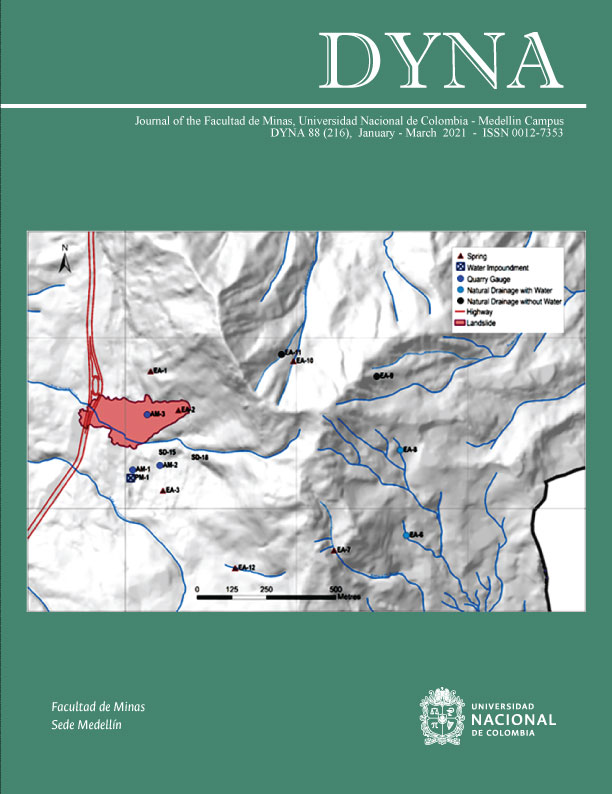
This paper presents the results of a technical investigation on the causation of the landslide that occurred in Las Nieves quarry on October 26, 2016 in the municipality of Copacabana, located in the northern part of the Colombian Andes. This landslide caused the highest number of fatalities in Colombia in 2016, totalling 16 deaths. The study included field visits, soil sampling, study of the geology and geomorphology, as well as analysis of rainfall and groundwater flows presented in the area. The information collected in this study is consistent with the hypothesis that the regional groundwater flow which comes from recharge zones, generated an increase in water levels in the landslide zone thus triggering the landslide. Finally, a stability analysis (statistical analysis and sensitivity analysis) was performed using the limit equilibrium method, where the effect of the rise in the ground water table was modelled as the trigger. The results of the stability analysis showed a low safety factor for the slope, even when low water levels were considered.
Este artículo presenta los resultados de la investigación de las causas del deslizamiento que ocurrió en la cantera Las Nieves en octubre 26, de 2016, en el municipio de Copacabana, localizado en la parte norte de los Andes Colombianos. Este deslizamiento de tierra causó el mayor número de muertes en Colombia en 2016, con un total de 16 muertes. El estudio incluyó visitas de campo, muestreo del suelo, estudio de la geología y la geomorfología, así como análisis de las precipitaciones y los flujos de aguas subterráneas presentados en la zona. La información recolectada en este estudio es coherente con la hipótesis de que el flujo regional de aguas subterráneas que proviene de las zonas de recarga, generó un aumento de los niveles de agua en la zona de deslizamiento, desencadenando así el deslizamiento. Por último, se realizó un análisis de estabilidad (análisis estadístico y análisis de sensibilidad) utilizando el método de equilibrio de límite, en el que se modeló el efecto del aumento del nivel de agua como el factor desencadenante. Los resultados del análisis de estabilidad mostraron un bajo factor de seguridad para el talud, incluso cuando se consideraron niveles bajos de agua.
Referencias
Schuster, R.L. and Fleming, R.W., Economic losses and fatalities due to landslides. B. Eng. Geol. Environ. 23(1), pp. 11-28, 1986. DOI: 10.2113/gseegeosci.xxiii.1.11
Sidle, R. and Ochiai, H., Processes, prediction, and land use. Water resources monograph. American Geophysical Union, Washington. 2006.
Centre for Research on the Epidemiology of Disasters (CRED) Natural Disasters Brussels: CRED 2019, [online]. 2018. Available at: https://emdat.be/ sites/default/files/adsr_2018.pdf
Petley, D., Global patterns of loss of life from landslides. Geology 40(10), pp. 927-930, 2012. DOI: 10.1130/G33217.1
Sepúlveda, V. and Petley, D.N., Regional trends and controlling factors of fatal landslides in Latin America and the Caribbean. Nat. Hazards Earth Syst. Sci. 15, pp. 1821-1833, 2015. DOI: 10.5194/nhess-15-1821-2015
Aristizábal, E. and Sánchez, O., Spatial and temporal patterns and socioeconomic impact of landslides in the tropical and mountainous Colombian Andes. Disasters, 44(3), pp. 596-618, 2020. DOI: 10.1111/disa.12391
Aristizábal, E., González, T., Montoya, J.D., Vélez, J.I., Martínez, H. y Guerra, A., Análisis de umbrales empíricos de lluvia para el pronóstico de movimientos en masa en el Valle de Aburrá, Colombia. Revista EIA 15, pp. 95-111, 2011. DOI: 10.24050/reia.v8i15.249
Berti, M., Martina, M.L.V., Franceschini, S., Pignone, S., Simoni, A. and Pizziolo, M., Probabilistic rainfall thresholds for landslide occurrence using a Bayesian approach. J. Geophys. Res-Earth, 117(F4), pp. 1-20, 2012. DOI: 10.1029/2012JF002367
Crosta, G., Regionalization of rainfall thresholds: an aid to landslide hazard evaluation. Environ. Geol. 35(2-3), pp. 131-145, 1998. DOI: 10.1007/s002540050300
Campbell, R.H., Soil slips, debris flows, and rainstorms in the Santa Monica Mountains and vicinity, southern California. Vol. 851. US Government Printing Office, 1975. DOI: 10.3133/pp851
Fredlund, D.G. and Morgenstern, N.R., Stress state variables for unsaturated soils. J. Geotech. Geoenviron. 103(5), pp. 447-466, 1977.
Vinasco, C.J., Cordani, U.G., González, H., Weber, M. and, Pelaez, C., Geochronological, isotopic, and geochemical data from Permo-Triassic granitic gneisses and granitoids of the Colombian Central Andes. J. S. Am. Earth Sci 21(4), pp. 355-371, 2006. DOI: 10.1016/j.jsames.2006.07.007
Dearman, W.R., Description and classification of weathered rocks for engineering purposes: the background to the BS5930: 1981 proposals. Q. J. Eng. Geol. 28(3), pp. 267-276, 1995. DOI: 10.1144/GSL.QJEGH.1995.028.P3.05
Cruden, D.M. and Varnes, D.J., Landslides: investigation and mitigation. Chapter 3-Landslide types and processes. Transportation research board special report, (247), 1996.
AMVA., Directrices y lineamientos para la elaboración de los estudios geológicos geomorfológicos, hidrológicos, hidráulicos, hidrogeológicos y geotécnicos para intervenciones en zonas de ladera, en el Valle de Aburrá. Documento Técnico, Área Metropolitana del Valle de Aburrá, Medellín, Colombia, 2012.
Grohmann, C.H., Morphometric analysis in geographic information systems: applications of free software GRASS and R. Comput. Geosci. 30(9-10), pp. 1055-1067, 2004. DOI: 10.1016/j.cageo.2004.08.002
Singhal, B.B.S. and Gupta, R.P., Applied hydrogeology of fractured rocks. Springer Science & Business Media, 2010.
Whitman, R.V. and Bailey, W.A., Use of computers for slope stability analysis. Journal of Soil Mechanics and Foundations Division 93(4), pp. 475-498, 1967.
Marinos, VIII., Marinos, P. and Hoek, E., The geological strength index: applications and limitations. Bull Eng Geol Environ 64(1), pp. 55-65, 2005. DOI: 10.1007/s10064-004-0270-5
Rocscience Inc., Slide version 7.0. Toronto, ON, Canada, 2016.
Dimensions
PlumX
Visitas a la página del resumen del artículo
Descargas
Cómo citar
Licencia
Derechos de autor 2021 DYNA

Esta obra está bajo una licencia internacional Creative Commons Atribución-NoComercial-SinDerivadas 4.0.
El autor o autores de un artículo aceptado para publicación en cualquiera de las revistas editadas por la facultad de Minas cederán la totalidad de los derechos patrimoniales a la Universidad Nacional de Colombia de manera gratuita, dentro de los cuáles se incluyen: el derecho a editar, publicar, reproducir y distribuir tanto en medios impresos como digitales, además de incluir en artículo en índices internacionales y/o bases de datos, de igual manera, se faculta a la editorial para utilizar las imágenes, tablas y/o cualquier material gráfico presentado en el artículo para el diseño de carátulas o posters de la misma revista.








