Publicado
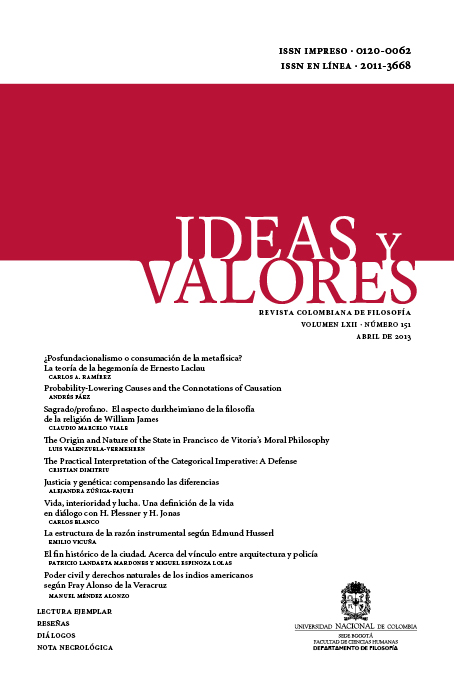
The Origin and Nature of the State in Francisco de Vitoria’s Moral Philosophy
Palabras clave:
F. de Vitoria, catholic theology, natural law, political theory, spanish political philosophy, Thomism. (es)
Referencias
Alfonso X "el Sabio". "Espéculo". Códigos españoles concordados y anotados. Vol. VI. Madrid: Imprenta de la Publicidad, 1851.
Barker, E. Introduction. Aristotle Politics. Barker, E. (trans.). Oxford: The Clarendon Press, 1946.
Brett, A. Liberty, Right, and Nature: Individual Rights in Later Scholastic Thought. New York: Cambridge University Press, 1997.
Brufau, J. "La noción analógica del Dominium en Santo Tomás, Francisco de Vitoria y Domingo de Soto", Salmanticensis 4/1 (1957): 96-136.
Carro, V. "Los fundamentos teológicos-jurídicos de las Doctrinas de Vitoria", Ciencia Tomista 72/223 (1947): 95-122.
Davidson, J. S. "The Rights of Indigenous Peoples in Early International Law", Canterbury Law Review 5/3 (1994): 391-423.
Enrique IV. Memorias de don Enrique IV de Castilla. Vol. II. Madrid: Establecimiento tipográfico de Fortanet, 1835-1913.
García y García, A. "The Spanish School of the Sixteenth and Seventeenth Centuries: A Precursor of the Theory of Human Rights", Ratio Juris 10/1 (1997): 25-35.
Hobbes, T. Leviathan, Macpherson, C. (ed.). London: Penguin Classics, 1985.
Lissarrague, S. La teoría del poder en Francisco de Vitoria. Madrid: Instituto de Estudios Políticos, 1947.
Luscombe, D. E. "The state of nature and the origin of the state". The Cambridge History of Later Medieval Philosophy: From the Rediscovery of Aristotle to the Disintegration of Scholasticism 1100-16001, Kretzmann, N., Kenny, A. & Pinborg, J. (eds.). Cambridge: Cambridge University Press, 1982. 757-770.
Mirete, J. L. "Maquiavelo y la recepción de su teoría del Estado en España (siglos XVI y XVII)", Anales de Derecho 19 (2001): 139-146.
Naszalyi, E. El Estado según Francisco de Vitoria. Madrid: Ediciones Cultura Hispánica, 1948.
Pagden, A. R., & Lawrence, J. (eds.) Francisco de Vitoria. Political Writings. Cambridge: Cambridge University Press, 1991.
Rommen, H. A. The natural law: a study in legal and social history and philosophy. Hanley, T. (trans.). Indianapolis: Liberty Fund, 1998.
Sánchez, L. El concepto del Estado en el pensamiento español del siglo XVI. Madrid: Instituto de Estudios Políticos, 1959.
Scott, J. B. The Spanish Origin of International Law: Francisco de Vitoria and his Law of nations. Oxford: Clarendon Press; London: H. Milford, 1934.
Skinner, Q. The Foundations of Modern Political Thought. Vol. 2. Cambridge: Cambridge University Press, 1980.
Skinner, Q. "A Genealogy of the Modern State", Proceedings of the British Academy 162 (2009): 325-370.
Vitoria, F. de. Obras de Francisco de Vitoria: Relecciones Teológicas, Urdanoz, T. (ed.). Madrid: Biblioteca de Autores Cristianos, 1960.
Vitoria, F. de. "On Civil Power (De potestate civili)". Political Writings, Pagden, A. R. & Lawrence, J. (eds.). Cambridge: Cambridge University Press, 1991a. 1-44.
Vitoria, F. de. "On the American Indians (De Indis)". Political Writings, Pagden, A. R. & Lawrence, J. (eds.). Cambridge: Cambridge University Press, 1991b. 231-292.
Vitoria, F. de. "On the Law of War (De iure belli)". Political Writings, Pagden, A. R. & Lawrence, J. (eds.). Cambridge: Cambridge University Press, 1991c. 293-328.
Visitas a la página del resumen del artículo
Descargas
Cómo citar
Licencia
Derechos de autor 2016 Universidad Nacional de Colombia

Esta obra está bajo una licencia internacional Creative Commons Atribución 4.0.
De acuerdo con la Licencia Creative Commons Atribución-No Comercial-SinDerivar 4.0 Internacional. Se autoriza copiar, redistribuir el material en cualquier medio o formato, siempre y cuando se conceda el crédito a los autores de los textos y a Ideas y Valores como fuente de publicación original. No se permite el uso comercial de copia o distribución de contenidos, así como tampoco la adaptación, derivación o transformación alguna de estos sin la autorización previa de los autores y de la dirección de Ideas y Valores. Para mayor información sobre los términos de esta licencia puede consultar: http://creativecommons.org/licenses/by-nc-nd/4.0/legalcode.








.jpg)