Publicado
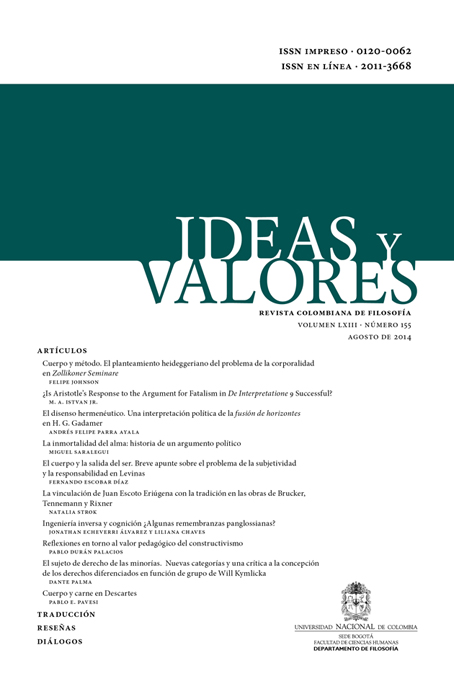
Is Aristotle’s Response to the Argument for Fatalism in De Interpretatione 9 Successful?
DOI:
https://doi.org/10.15446/ideasyvalores.v63n155.33178Palabras clave:
Aristotle, fatalism (es)
The goal of this paper is to figure out whether Aristotle’s response to the argument for fatalism in De Interpretatione 9 is a success. By “response” it is meant not simply the reasons Aristotle offers to highlight why fatalism does not accord with how we conduct our lives, but also the solution he devises to block he argument for fatalism. This paper finds that a) Aristotle’s argument for fatalism is essentially bivalence plus that the truth of a proposition implies necessity, b) that Aristotle’s solution is to restrict bivalence, c) that this solution is coherent, and d) that while this solution does not rule out the possibility of fatalism, it does succeed in blocking the argument for fatalism offered within chapter 9.
Referencias
Ackrill, J.L. "Notes De interpretation". Aristotle: Categories and De Interpretation. Trans. Ackrill, J.L. Oxford: Clarendon Press, 1993. 113-155.
Albritton, R. "Present Truth and Future Contingency". Philosophical Review 66.1 (1957): 29-46.
Anscombe, G. E. M. "Aristotle and the Sea Battle". Mind 65.257 (1956): 1-15.
Aristotle. "De Interpretation". Aristotle: Categories and De Interpretation. Trans. Ackrill, J.L. Oxford: Clarendon Press, 1993. 43-68.
Baylis, C.A. "Are Some Propositions Neither True nor False?" Philosophy of Science 3.2 (1936): 156-166.
Bernstein, M. "Fatalism". The Oxford Handbook of Free Will. Ed. Kane, R. Oxford: Oxford University Press, 2002. 65-81.
Bourne, C. "Future Contingents, Non-Contradiction, and the Law of Excluded Middle". Analysis 64.2 (2004): 122-128.
Brogaard, B. "Sea Battle Semantics". Philosophical Quarterly 58.231 (2007): 326-335.
Cicero, M.T. De fato. Cambridge: Harvard University Press, 1992.
Frede, D. "The Sea-Battle Reconsidered: A Defense of the Traditional Interpretation". Oxford Studies in Ancient Philosophy. Vol. 3 (1985): 31-87.
Hintikka, J. "The Once and Future Sea Fight: Aristotle´s Discussion of Future Contingents in De Interpretatione IX". The Philosophical Review 73.4 (1964): 461-492.
Kneale, W. and Kneale, M. The Development of Logic. Oxford: Oxford University Press, 1962.
Lukasiewicz, J. "On Three-Valued Logic". Polish Logic 1920-1939. Ed. McCall. S. Oxford: Oxford University Press, 1967a. 45-70.
Lukasiewicz, J. "Philosophical Remarks on Many-Valued Systems of Propositional Calculus". Polish Logic 1920-1939. Ed. McCall, S. Oxford: Oxford University Press, 1967b. 40-65.
MacFarlane, J."Future Contingents and Relative Truth". The Philosophical Quarterly 53.212 (2003): 221-336.
Prior, A. "Three-Valued Logic and Future Contingents". Philosophical Quarterly 3.13 (1953): 317-326.
Prior, A. Past, Present and Future. Oxford: Oxford University Press, 1967.
Sorabji, R. "Tomorrow´s Sea-Battle: An Argument from Past Truth". Necessity, Cause, and Blame: Perspectives on Aristotle´s Theory. Ed. Sorabji, R. New York: Cornell University Press, 1980. 91-103.
Strang, C. "Aristotle and the Sea Battle". Mind 69.276 (1960): 447-465.
Taylor, R. "The Problem of Future Contingencies".Philosophical Review 66.1 (1957): 1-28.
Tweedale, M. "Future Contingents and Deflated Truth-Value Gaps". Noûs 38.2 (2004): 233-265.
Whitaker, C.W.A. Aristotle´s de Interpretatione: Contradiction and Dialectic. Oxford: Oxford University Press, 1996.
Williams, D.C. "The Sea Fight Tomorrow". Structure, Method, and Meaning: Essays in Honor of Henry M. Sheffer. Eds. Henle, P., Kallen, H. M. and Langer, S. New York: Liberal Arts Press, 1951. 282-306.
Dimensions
PlumX
Visitas a la página del resumen del artículo
Descargas
Cómo citar
Licencia
Derechos de autor 2016 Universidad Nacional de Colombia

Esta obra está bajo una licencia internacional Creative Commons Atribución 4.0.
De acuerdo con la Licencia Creative Commons Atribución-No Comercial-SinDerivar 4.0 Internacional. Se autoriza copiar, redistribuir el material en cualquier medio o formato, siempre y cuando se conceda el crédito a los autores de los textos y a Ideas y Valores como fuente de publicación original. No se permite el uso comercial de copia o distribución de contenidos, así como tampoco la adaptación, derivación o transformación alguna de estos sin la autorización previa de los autores y de la dirección de Ideas y Valores. Para mayor información sobre los términos de esta licencia puede consultar: http://creativecommons.org/licenses/by-nc-nd/4.0/legalcode.









.jpg)