Correo Electrónico
 DNINFOA - SIA
 Bibliotecas
 Convocatorias
 Identidad U.N.


Published
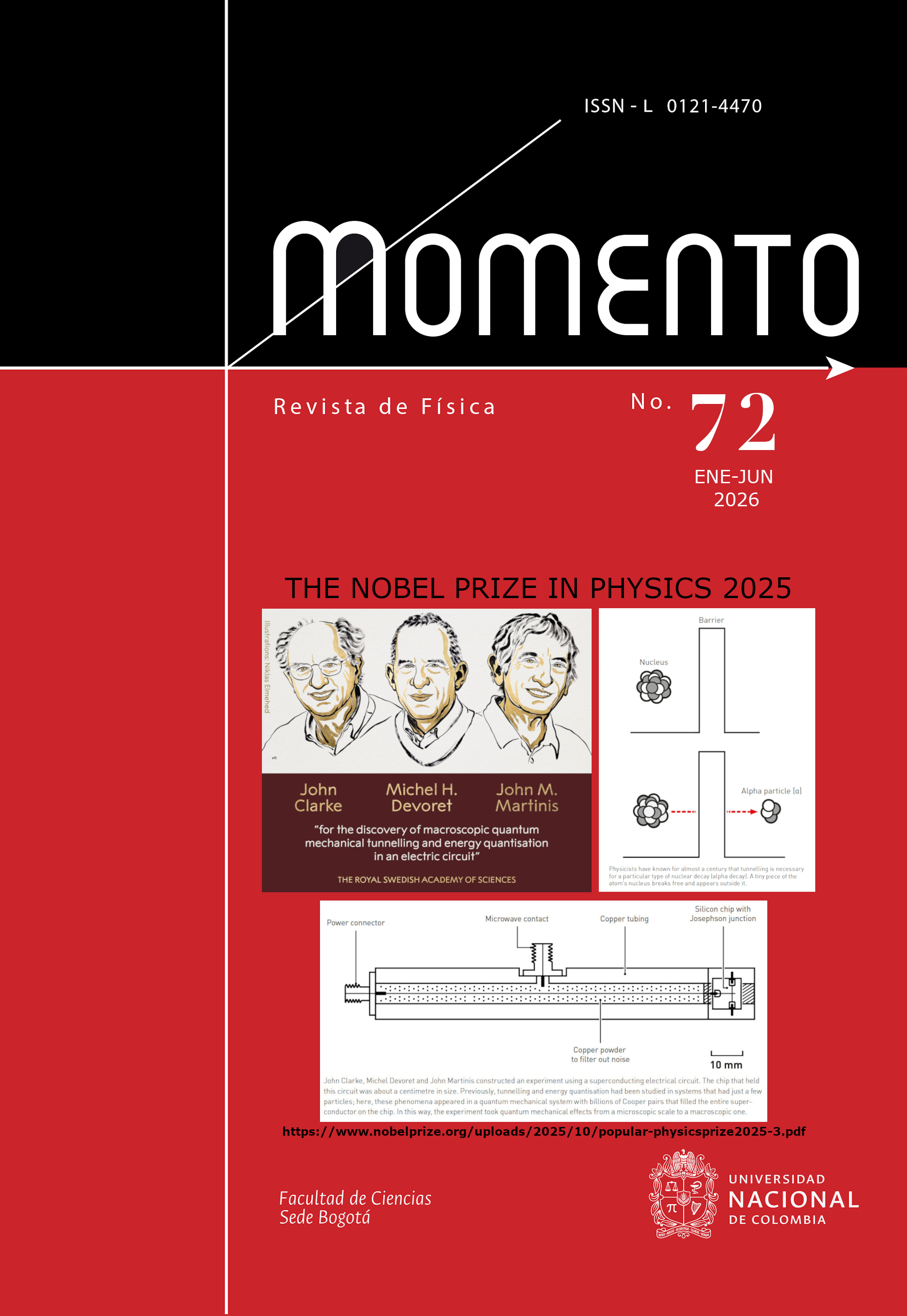
The 2025 Nobel Prize in Physics or the Consolidation of the Macroscopic Quantum Era
El Premio Nobel de Física 2025 o la consolidación de la era cuántica macroscópica
Keywords:
The 2025 Nobel Prize in Physics (en)El Premio Nobel de Física de 2025 (es)
Downloads
The 2025 Nobel Prize in Physics was awarded to John Clarke, Michel H. Devoret, and John M. Martinis for their discoveries of macroscopic quantum tunneling and the quantization of energy in electrical circuits.
El Premio Nobel de Física de 2025 fue otorgado a John Clarke, Michel H. Devoret y John M. Martinis por sus descubrimientos del efecto túnel cuántico macroscópico y la cuantificación de la energía en circuitos eléctricos.
References
Clarke, J., & Braginski, A. I. (2006). The SQUID handbook. Wiley-VCH.
Devoret, M. H., & Schoelkopf, R. J. (2013). Superconducting circuits for quantum information: An outlook. Science, 339(6124), 1169–1174. https://doi.org/10.1126/science.1231930
Devoret, M. H., Wallraff, A., & Martinis, J. M. (2004). Superconducting qubits: A short review. arXiv. https://arxiv.org/abs/cond-mat/0411174
Martinis, J. M. (2015). Qubit metrology for building a fault-tolerant quantum computer. npj Quantum Information, 1, 15005.
Nakamura, Y., Pashkin, Y. A., & Tsai, J. S. (1999). “Coherent control of macroscopic quantum states in a single-Cooper-pair box”. Nature, 398, 786–788.
How to Cite
APA
ACM
ACS
ABNT
Chicago
Harvard
IEEE
MLA
Turabian
Vancouver
Download Citation
Article abstract page views
Downloads
License

This work is licensed under a Creative Commons Attribution-NoDerivatives 4.0 International License.
Those authors who have publications with this journal, accept the following terms:
a. The authors will retain their copyright and will guarantee the publication of the first publication of their work, which will be subject to the Attribution-SinDerivar 4.0 International Creative Commons Attribution License that permits redistribution, commercial or non-commercial, As long as the Work circulates intact and unchanged, where it indicates its author and its first publication in this magazine.
b. Authors are encouraged to disseminate their work through the Internet (eg in institutional telematic files or on their website) before and during the sending process, which can produce interesting exchanges and increase appointments of the published work.