Correo Electrónico
 DNINFOA - SIA
 Bibliotecas
 Convocatorias
 Identidad U.N.


Published
VIDRIOS DE ESPÍN
SPIN GLASS
Keywords:
Spin glass, frustración, susceptibilidad magnética, resistividad eléctrica (es)Spin glass, frustration, magnetic susceptibility, electrical resistivity (en)
Downloads
Los sistemas spin glass (SG) han sido objeto de múltiples investigaciones durante más de cuatro décadas, conocidos como sistemas de comportamiento complejo, consecuencia del carácter aleatorio en la disposición de sus espines; este comportamiento inicialmente investigado en sistemas binarios ha sido identificado en más de 500 sistemas. Experimentalmente a partir de mediciones de susceptibilidad magnética y resistividad eléctrica ha sido posible identificar este comportamiento, aunque con el tiempo han sido incluidas otras técnicas de caracterización. Se presenta un breve recorrido por lo que ha sido el desarrollo de la investigación en los SG que lejos de proporcionar información técnica o detallada del mismo, busca darle al lector una vista general de lo que ha sido la investigación en SG a nivel experimental hasta ahora.
Palabras Clave:
Spin glass systems (SG) have been the subject of multiple investigations for more than four decades, known as complex systems behavior, due to the randomness in the arrangement of their spins, this behavior initially investigated in binary systems has been identified in more than 500 systems. Experimentally from measurements of magnetic susceptibility and electrical resistivity has been possible to identify this behavior, but over time have been included other characterization techniques. We present a brief overview of what has been the development of research in the SG that far from providing technical or detailed information, it seeks to give the reader an overview of what research has been SG experimentally so far.
Keywords:
VIDRIOS DE ESPÍN
SPIN GLASS
Anggie Acero, Hernán Sánchez
Grupo de Superconductividad y Nuevos Materiales, Departamento de Física, Universidad Nacional de Colombia, Bogotá
Contacto: Anggie Acero amaceroo@unal.edu.co
Hernán Sánchez: phsanchezm@unal.edu.co
Cómo citar: Acero. A., Sánchez, H., Momento, 42, 51 (2011)
(Recibido: 01/2011. Aceptado: 05/2011)
Resumen
Los sistemas spin glass (G) han sido objeto de múltiples investigaciones durante más de cuatro décadas, conocidos como sistemas de comportamiento complejo, consecuencia del carácter aleatorio en la disposición de sus espines; este comportamiento inicialmente investigado en sistemas binarios ha sido identificado en más de 500 sistemas. Experimentalmente a partir de mediciones de susceptibilidad magnética y resistividad eléctrica ha sido posible identificar este comportamiento, aunque con el tiempo han sido incluidas otras técnicas de caracterización. Se presenta un breve recorrido por lo que ha sido el desarrollo de la investigación en los SG que lejos de proporcionar información técnica o detallada del mismo, busca darle al lector una vista general de lo que ha sido la investigación en SG a nivel experimental hasta ahora.
Palabras claves: spin glass, frustración, susceptibilidad magnética, resistividad eléctrica
Abstract
Spin glass systems (SG) have been the subject of multiple investigations for more than four decades, known as complex systems behavior, due to the randomness in the arrangement of their spins, this behavior initially investigated in binary systems has been identified in more than 500 systems. Experimentally from measurements of magnetic susceptibility and electrical resistivity has been possible to identify this behavior, but over time have been included other characterization techniques. We present a brief overview of what has been the development of research in the SG that far from providing technical or detailed information, it seeks to give the reader an overview of what research has been SG experimentally so far.
Keywords: spin glass, frustration, magnetic susceptibility, electrical resistivity
Introducción
A principios de los años 70 el comportamiento de sistemas de espines desordenados llamó la atención de varios científicos, los cuales intentaron sin éxito añadir desorden a los sistemas ordenados, como cristales, para estudiarlo. Esta búsqueda se inicia de forma experimental con el estudio de los materiales que presentan un comportamiento Spin Glass (SG), que más adelante despierta el interés de matemáticos por postular una teoría que explique con éxito sus características básicas.
Un Spin glass presenta un comportamiento complejo, que se caracteriza no solamente por la aleatoriedad en la orientación de los espines, sino además por la frustración entre las interacciones magnéticas en el sistema, la cual es la responsable que en estos sistemas se presente más de un estado de mínima energía. Adicionalmente, estos sistemas presentan propiedades magnéticas muy particulares, debidas a la aleatoriedad en la disposición de los espines. El desarrollo teórico realizado para explicar el comportamiento de estos sistemas ha sido de gran utilidad en otras áreas en las cuales los sistemas complejos y aleatorios están presentes, por citar un ejemplo en la neurología, la bioquímica y para tratar problemas de evolución.[1–3]
Sistemas Spin Glass
Las propiedades magnéticas de un SG, se vuelven de gran interés debido a que no presentan un ordenamiento de largo alcance uniforme o periódico como el observado en los sistemas convencionales ferro– y antiferromagnético, por el contrario en un SG los espines a bajas temperaturas presentan presentan un estado congelado desordenado. Es así como se puede decir que para crear un sistema magnético desordenado que exhiba características de SG, son necesarias dos condiciones: aleatoriedad de las interacciones entre los momentos magnéticos y competencia entre las diferentes interacciones magnéticas.
Un sistema se encuentra en un estado frustrado cuando no existe una única configuración favorable para todas las interacciones de espines 1. La frustración favorece el aumento de configuraciones posibles con la misma energía. Para crear aleatoriedad, se puede distribuir aleatoriamente especies magnéticas en una red patrón de especies no magnéticas. Las aleaciones magnéticas con estas características están compuestas por impurezas magnéticas teniendo un momento magnético o espín localizado que ocupa aleatoriamente la red en un metal huésped no magnético, estos son conocidos como SG canónicos o magnéticos.
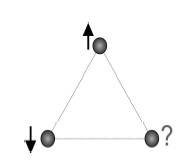
Figura 1. Esquema de frustración de las interacciones antiferromagnética de espines en un arreglo triangular.

Figura 2. Contribuciones en el desarrollo del estudio del Spin glass, organizados cronológicamente. [4–6]
En un sistema SG, cuando se pasa de una alta temperatura a una baja, éste experimenta una transición de fase vítrea a la temperatura TSg. Por encima de esta temperatura el sistema se encuentra en un estado magnético definido (paramagnético, ferromagnético o antiferromagnético). Al disminuir la temperatura a TSg, los espines comienzan a interactuar con sus vecinos cercanos. En la búsqueda del estado de mínima energía para la distribución de los espines y sus interacciones de intercambio, el sistema pasa por la frustración presentándose estados base multidegenerados, encontróndose varias configuraciones metaestables posibles, en las cuales se puede encontrar el sistema.[4, 7]
En la figura 2 se presentan algunas de las contribuciones reportadas en el estudio y desarrollo de las teorías que buscan explicar este comportamiento, organizadas de manera cronológica. A nivel experimental se destacan los trabajos de Cannella y Mydosh precursores del estudio de este tipo de materiales, y a nivel teórico las contribuciones más importantes son debidas a Edwars, Anderson, Sherrington y Kirkpatrick, siendo el modelo propuesto por Sherrington y Kirkpatrick (SK), el modelo base para nuevos modelos propuestos posteriormente para el estudio de los SG.[5]
La característica importante del modelo de Sherrington Kirkpatrick es que en este modelo se incluye la frustración. A cada átomo i se le asigna un σi correspondiente al momento magnético, la interacción entre estos momentos se representa por medio de la interacción de intercambio Jij, que son valores aleatorios e independientes, que en los sistemas SG se relaciona con una interacción tipo ferromagnética (Jij > 0) cuando los momentos son de igual signo o antiferromagnética (Jij < 0) cuando los momentos son de signos opuestos. Siendo el Hamiltoniano del sistema

el último término de la ecuación 1 representa la acción de un campo externo, N—1/2 un factor de normalización, la energía del sistema depende así de los Jij introduciéndose así el desorden.[5]
En las décadas de los 70 y 80 el trabajo experimental en los materiales SG fue significativo, inicialmente la investigación se centro en aleaciones binarias, impurezas magnéticas en materiales metálicos no magnéticos, debido a que las impurezas magnéticas están distribuidas aleatoriamente en el material, el signo y el valor de las interacciones es sensible a la distancia entre las impurezas. Cannella y Mydosh estudiaron el efecto de campos magnéticos externos aplicados sobre el valor de la susceptibilidad magnética, esto permitió evidenciar experimentalmente un cambio de fase, que lleva al sistema a la fase SG; ellos estudiaron SG magnéticos (canónicos) como aleaciones AuFe y CuFe.[8]

Figura 3. Susceptibilidad a bajo campo χ(T) para aleaciones AuFe con concentraciones de Fe = 1, 2, 5 y 8% [8]
A altas temperaturas los SG se caracterizan por ser paramagnéticos, siguiendo la ley de Curie–Weiss y para temperaturas cercanas a la de Curie, se comienzan a formar dominios magnéticos en el material lo cual ocasiona desviaciones en esta ley. En la referencia [9] se reportan mediciones de la susceptibilidad magnética de la aleación CuMn para diferentes concentraciones de Mn, en las que se aprecia un corrimiento de la temperatura de Curie en función de la concentración de Mn en la aleación. De mediciones de susceptibilidad magnética realizadas por Cannella y Mydosh [8] se obtienen las gráficas de la Fig.3 en la cual se aprecia un pico agudo, a una determinada temperatura la cual es nombrada como temperatura de congelamiento y denotada por Tf, Tgg o TSg.
La existencia de estos picos fue interpretada por muchos teóricos como un nuevo tipo de transición de fase a TSg, por debajo de esta temperatura los momentos magnéticos están congelados en una orientación determinada sin ningún ordenamiento de largo alcance, estos son los sistemas que se encuentran en fase SG.

Figura 4. Dependencia de la temperatura de la susceptibilidad AC en EuxSr1—xS con diferentes concentraciones x de Eu [10]
Maletta investigó las propiedades de los SG aislantes en los cuales los momentos magnéticos se agrupan en dominios finitos, se desacoplan del alineamiento ferromagnético con un ordenamiento de largo alcance; al ser diluido un material aislante en un material no magnético, se pierde el ordenamiento ferromagnético y el ordenamiento SG aparece como resultado de los efectos de la frustración [10]. De las investigaciones realizadas por él, se presentan las gráficas de la Fig.4 de mediciones de susceptibilidad AC a 117 Hz para cuatro muestras SG EuxSr1—xS, en las cuales se aprecia un máximo que define TSg.
La susceptibilidad magnética en los SG presenta una dependencia con la frecuencia, cuyo efecto es el corrimiento de la TSg, la cual se incrementa con el aumento de la frecuencia como se aprecia en la Fig.5

Figura 5. Susceptibilidad AC para EuxSr1—xS con x = 0,44 con ν = 17, 198, 2013Hz [11]
Otros autores [12] han reportado comportamientos inesperados de la susceptibilidad magnética (Χ) AC en presencia de campos magnéticos. La figura 6 muestra mediciones de la susceptibilidad magnética AC en función de campos magnéticos externos débiles, los cuales suprimen la influencia de las paredes de Bloch en el estado ferromagnético. Ellos detectaron tres picos en las mediciones de Χ', el primero en la temperatura de Curie TC, el segundo en la temperatura en la cual se presenta un máximo en la magnetización espontánea Tm la cual se puede interpretar como una fase mixta entre un estado ferromagnético y uno de SG, se la denota como TR temperatura SG reentrante; y el tercero en la temperatura donde inicia un estado irreversibilidad magnética, la temperatura TSG, las cuales tienen una dependencia con un campo externo aplicado. [12–15]

Figura 6. Susceptibilidad AC en función de la temperatura en campos DC externos. A 2mT se presentan 2 picos bien definidos a TR y TC. [12]
Mediciones de resistividad eléctrica han servido como indicador del comportamiento de los electrones de conducción, se ha encontrado que al realizar mediciones de resistividad se presenta un mínimo que está correlacionado con la transición de fase magnética al estado SG [16]. Se reporta una fuerte correlación entre la resistividad y la estructura magnética de espín en aleaciones que presentan una fase SG reentrante, que es un estado mixto en el cual la correlación ferromagnética de largo alcance coexiste con la de ordenamiento spin glass [17], o un SG puro.[18, 19]
En la referencia [20] se investigó el comportamiento eléctrico de la aleación (Fe0,65Ni0,35)1—xMnx, de los resultados obtenidos se encuentra un mínimo al normalizar las mediciones de resistividad en función de la temperatura respecto a un valor común, con diferentes concentraciones de Mn, tal mínimo (Fig.7) se aprecia a bajas temperaturas, es atribuible a la competencia entre al menos dos procesos: el primero relacionado con la disminución del proceso de dispersión fonónica cuando la temperatura desciende. El segundo debido a un incremento en la resistividad, similar al efecto Kondo, que está acompañado por cambios en el orden magnético con transición de un estado ferromagnético a SG y/o de paramagnético a SG.[20]
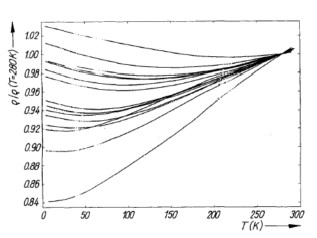
Figura 7. Normalización de la resistividad para la aleación (Fe0,65Ni0,35)1—xMnx en función de la temperatura [20]
El incremento de la resistividad después de pasar por un mínimo al decrecer la temperatura fue atribuido a cambios en el ordenamiento de los espines, como en un proceso re–entrante.
En la figura 8 se presenta el ajuste de la curva medida, mostrando las contribuciones de los fonones y la del proceso re–entrante, suprimiendo la resistividad residual.[20]
En Colombia los sistemas de espin glass también han sido estudiados. En la referencia [21] se presenta una revisión de este tipo de materiales. Varios trabajos han sido presentados en congresos nacionales en los cuales se han caracterizado entre otras propiedades la de la relajación magnética [22, 23]. Además usando técnicas como la resonancia magnética [24] se ha estudiado el efecto de la dilución de un elemento no magnético (Zn) y su concentración en un sistema magnetico (CdCr2S4)[24].

Figura 8. Ajuste de la resistividad eléctrica medida en función de la temperatura [20]
Actualmente se conocen más de 500 sistemas que presentan el comportamiento SG entre los que se encuentran: solutos de metales de transición – metal noble, Combinaciones de tierras raras binarias y pseudo binarias, Perovskitas dobles [25], Cupratos superconductores [26], spin glasses metálicos amorfos binarios y pseudo binarios, Spin glass semiconductores [27, 28], Spin glass aislantes. También han sido trabajados SG en películas delgadas [29, 30] y se ha encontrado superconductores que presentan este comportamiento antes de llegar a la fase superconductora. [31–34]. La dinámica de los SG también ha sido ampliamente estudiada desde diferentes modelos teóricos, esto debido a las diversas formas de plantear el Hamiltoniano para sistemas desordenados, así mismo han sido discutidas teorías de fluctuaciones fuera del equilibrio en los modelos de campo medio y de dimensiones finitas, la respuesta de relajación magnética en estos materiales ha sido medida por diferentes procedimientos experimentales lo cual ha dado lugar a publicaciones e inclusive a trabajos doctorales. [4, 35–37]
Una de las características que más han llamado la atención en los SG es la memoria que ha sido observada en estos sistemas [38–41], ya que presentan una memoria multivaluada permitiendo el almacenamiento de datos superpuestos, así como una memoria asociada con la posibilidad de tener relaciones jerárquicas entre estas; esto hace interesante y promisorio su uso en dispositivos de spintrónica [42] y multiferroicos [43], por lo cual el interés despertado por estos materiales seguirá vigente.
Conclusiones
La investigación en torno a los materiales con comportamiento SG continuará acaparando la atención no solo de quienes hacen investigación básica sino también de aquellos interesados en aplicaciones con fines tecnológicos como lo es el desarrollo de dispositivos de almacenamiento de información y la spintrónica.
Referencias
[1] J. Hopfield, Proc. Natl. Acad. Sci. USA 79, 2554 (1982).
[2] D. Amit, H. Gutfreund, and H. Sompolinsky, Phys. Rev. A 32, 1007 (1987).
[3] A. I. Tsapin and L. A. Blumenfeld, Journal of Applied Physics 75, 7183 (1994).
[4] L. Dawei, Relaxation Dynamics in Some Reentrant Disordered Magnetic Systems: FeNiCr, FeNiMn,CrFe, Ph.D. thesis, Department of physics, Winnipeg, Manitoba (1997).
[5] E. Bolthausen and A. Bovier, Spin Glasses (Springer–Verlag Berlin Heidelberg, 2007).
[6] C. Huang, in Conference: Workshop on relaxation in disordered systems, Vol. LA–UR–84–3497; CONF–8307145–1 (Los Alamos National Lab., NM (USA), 1983).
[7] M. Talagrand, Mean Field Models for Spin Glasses, Vol. Volume I: Basic Examples (Springer–Verlag Berlin Heidelberg, 2011).
[8] V. Cannella, J. A. Mydosh, and J. I. Budnick, Journal of Applied Physics 42, 1689 (1971).
[9] A. F. J. Morgownik and J. A. Mydosh, Phys. Rev. B 24, 5277 (1981).
[10] H. Maletta and W. Felsch, Phys. Rev. B 20, 1245 (1979).
[11] F. Holtzberg, T. L. Francavilla, C. Y. Huang, and J. L. Tholence, Journal of Applied Physics 53, 2229 (1982).
[12] Huck, B., Landes, J., Stasch, R., and Hesse, J., J. Phys. Colloques 49, C8 (1988).
[13] A. Deryabinn and A. T'kov, Journal of Experimental and Theoretical Physics Letters 39, 129 (1984).
[14] M. Getzlaff, Fundamentals of Magnetism (Springer–Verlag Berlin Heidelberg, 2008).
[15] T. V. Káganov M., La naturaleza del magnetismo (Editorial Mir Moscu, 1985).
[16] S. B. Roy, A. K. Majumdar, N. C. Mishra, A. K. Raychaudhury, and R. Srinivasan, Phys. Rev. B 31, 7458 (1985).
[17] T. Sato, T. Ando, T. Ogawa, S. Morimoto, and A. Ito, Phys. Rev. B 64, 184432 (2001).
[18] S. Blundell, Magnetism in Condensed Matter, 1st ed., Oxford master series in condensed matter physics (Oxford ; New York: Oxford University Press, 2001).
[19] C. Böttger and J. Hesse, Zeitschrift für Physik B Condensed Matter 75, 485 (1989), 10.1007/BF01312527.
[20] A. Höfer, M. Fricke, C. Böttger, and J. Hesse, physica status solidi (a) 148, 551 (1995).
[21] J. Guzman, J. Díaz, J. Vallejo, M. Díaz, J. Rodríguez, H. Sánchez, I. Concha, G. Gomez, and M. De Granados, VI Escuela Nacional de Física Teórica. Universidad Nacional de Colombia. (Colombia, 1989).
[22] J. Guzman, M. Balaguera, and G. Mendoza, XVIII Congreso Nacional de Física, Sociedad Colombiana De Fisica (Colombia, 1995).
[23] M. Balaguera, M. Díaz, and J. Guzman, XVI Congreso Nacional de Física, Sociedad Colombiana De Fisica (Colombia, 1999).
[24] J. Guzman, H. Ariza, P. Prieto, and G. Mendoza, Journal Of Applied Physics 97, 507 (2005).
[25] J. E. Greedan, S. Derakhshan, F. Ramezanipour, J. Siewenie, and T. Proffen, Journal of Physics: Condensed Matter 23, 164213 (2011).
[26] P. G. Freeman, A. T. Boothroyd, D. Prabhakaran, and J. Lorenzana, Phys. Rev. B 73, 014434 (2006).
[27] N. Numata, K. Komatu, and T. Sato, Journal of Physics: Conference Series 200, 032054 (2010).
[28] L. Kilanski, R. Szymczak, W. Dobrowolski, K. Sza lowski, V. E. Slynko, and E. I. Slynko, Phys. Rev. B 82, 094427 (2010).
[29] R. Stubi, J. A. Cowen, L. Hoines, M. L. Wilson, W. A. Fowler, and J. Bass, Phys. Rev. B 44, 5073 (1991).
[30] F.–T. Yuan, J.–K. Lin, Y. D. Yao, and S.–F. Lee, Applied Physics Letters 96, 162502 (2010).
[31] W. Joiner and J. Wang, Solid State Communications 93, 837 (1995).
[32] F. Cordero, A. Paolone, and R. Cantelli, Journal of Magnetism and Magnetic Materials 272–276, Part 1, 185 (2004).
[33] W. Stephan and J. P. Carbotte, Journal of Low Temperature Physics 83, 131 (1991), 10.1007/BF00682114.
[34] V. M. Galitski and A. I. Larkin, Phys. Rev. B 66, 064526 (2002).
[35] S. D. Tiwari and K. P. Rajeev, Phys. Rev. B 72, 104433 (2005).
[36] Z. Kai–Cheng and S. Peng–Yun, Chinese Physics B 19, 97105 (2010).
[37] A. Boutet and A. Bovier, Spin Glasses:Statics and Dynamics,Summer School, Paris 2007 (Birkhäser Verlag AG, Basel Boston Berlin, 2009).
[38] S. Harikrishnan, S. Röβler, C. M. N. Kumar, Y. Xiao, H. L. Bhat, U. K.Röβler, F. Steglich, S. Wirth, and S. Elizabeth, Journal of Physics: Condensed Matter 22, 346002 (2010).
[39] R. Mathieu, M. Hudl, and P. Nordblad, EPL (Europhysics Letters) 90, 67003 (2010).
[40] K. Jonason, E. Vincent, J. Hammann, J. P. Bouchaud, and P. Nordblad, Phys. Rev. Lett. 81, 3243 (1998).
[41] L. Lundgren, P. Nordblad, and L. Sandlund, EPL (Europhysics Letters) 1, 529 (1986).
[42] H. Katayama–Yoshida and K. Sato, Physica B: Condensed Matter 327, 337 (2003), proceedings of the International Symposium on Advanced Magnetic Materials.
[43] S. Y. Jang, D. Lee, J.–H. Lee, T. W. Noh, Y. Jo, M.–H. Jung, and J.–S. Chung, Applied Physics Letters 93, 162507 (2008).
How to Cite
APA
ACM
ACS
ABNT
Chicago
Harvard
IEEE
MLA
Turabian
Vancouver
Download Citation
Article abstract page views
Downloads
License
Those authors who have publications with this journal, accept the following terms:
a. The authors will retain their copyright and will guarantee the publication of the first publication of their work, which will be subject to the Attribution-SinDerivar 4.0 International Creative Commons Attribution License that permits redistribution, commercial or non-commercial, As long as the Work circulates intact and unchanged, where it indicates its author and its first publication in this magazine.
b. Authors are encouraged to disseminate their work through the Internet (eg in institutional telematic files or on their website) before and during the sending process, which can produce interesting exchanges and increase appointments of the published work.