Correo Electrónico
 DNINFOA - SIA
 Bibliotecas
 Convocatorias
 Identidad U.N.


Published
MEDICIÓN DE CÉLULAS SANGUÍNEAS HUMANAS IRRADIADAS POR LÁSER DE BAJA POTENCIA
MEASUREMENT OF HUMAN BLOOD CELLS IRRADIATED BY LOW-POWER LASER
DOI:
https://doi.org/10.15446/mo.n53.61025Keywords:
Radiación, plaquetas, sistema sanguíneo, plasma sanguíneo, láser Helio-Neón, incremento celular (es)Radiation, platelets, blood system, blood plasma, helium-neon laser, cell increase. (en)
Downloads
El láser de baja potencia se ha implementado dentro del campo médico, como una alternativa segura para influir en el comportamiento de las células del organismo humano. Se ha sugerido que la radiación de baja potencia reduce agentes patógenos, actúa como protector ante radiación ionizante e incrementa la población de plaquetas en sangre. Este trabajo tiene como objetivo analizar la tasa de crecimiento de las plaquetas humanas luego de aplicar radiación láser de baja potencia.
The low-power laser has been implemented within the medical field as a safe alternative for influencing the behavior of cells of the human body. It has been suggested that low power radiation reduces pathogens and acts as a shield against ionizing radiation and increases the platelets population in blood. This study aims to analyze the rate of growth of human platelets after applying low power laser radiation.
MEDICIÓN DE CELULAS SANGUÍNEAS HUMANAS IRRADIADAS POR LÁSER DE BAJA POTENCIA
MEASUREMENT OF HUMAN BLOOD CELLS IRRADIATED BY LOW-POWER LASER
Constanza N. Parra1, Juan M. Quiroga1 y Lisbeth L. Martínez2
1 Grupo de Investigación en Ingeniería Biomédica GIIB, Universidad Manuela Beltrán, Bogotá, Colombia.
2 Grupo de Investigación en Ingeniería Electrónica, Industrial y Ambiental GIEIAM, Universidad Santiago de Cali, Colombia.
Lisbeth L. Martínez: lisbethortega7@gmail.com
(Recibido: Noviembre/2015. Aceptado: Junio/2016)
Resumen
El láser de baja potencia se ha implementado dentro del campo médico, como una alternativa segura para influir en el comportamiento de las células del organismo humano. Se ha sugerido que la radiación de baja potencia reduce agentes patógenos, actúa como protector ante radiación ionizante e incrementa la población de plaquetas en sangre. Este trabajo tiene como objetivo analizar la tasa de crecimiento de las plaquetas humanas luego de aplicar radiación láser de baja potencia.
Palabras clave: Radiación, plaquetas, sistema sanguíneo, plasma sanguíneo, tóser Helio-Neon e incremento celular.
Abstract
The low-power laser has been implemented within the medical field as a safe alternative for influencing the behavior of cells of the human body. It has been suggested that low power radiation reduces pathogens and acts as a shield against ionizing radiation and increases the platelets population in blood. This study aims to analyze the rate of growth of human platelets after applying low power laser radiation.
Keywords: Radiation, platelets, blood system, blood plasma, helium-neon laser and cell increase.
Introducción
El láser "Light amplification by stimulated emission of radiation", es un dispositivo el cual estimula longitudes de onda de 780 nm (rojo), 622 nm (naranja), 597 nm (amarillo), 577 nm (verde), 492 nm (azul) y 390 nm (Violeta) de forma independiente, con el objetivo de interactuar en reacciones moleculares, cambios celulares y tejidos, con la posibilidad de proporcionar energía en un área específica gracias a sus propiedades de coherencia monocromaticidad y paralelismo[1, 2].
Existen muchas aplicaciones de la radiación Mser de baja intensidad en el campo de la medicina. Hamblin [3], Molina et al. [4] y Pinazo et al. [5], establecieron a partir de sus investigaciones que el láser de baja potencia a diferentes longitudes de onda, podría ser implementado como tratamiento para la osteoartritis [3], el síndrome de transfusión fetofetal [4] y la retinopatía diabíetica [5], mejorando sin dolor ni efectos secundarios, la calidad de vida de los pacientes. Por otra parte, Alves et al. [6] y Yanhong et al. [7], utilizaron el láser como modificador del comportamiento y estructura de neutrofilos, macráfagos [6] y eritrocitos [5], para influenciar el proceso de inflamación que se presenta en la artritis [6]. A partir de los estudios de Alves et al. [6] y Yanhong et al. [7], es posible concluir que la luz láser logra alterar un padecimiento con mayor eficacia si son tratados en primera instancia los componentes celulares que influyen en la aparición de la enfermedad.
El objetivo del presente estudio es analizar la tasa de crecimiento de las plaquetas humanas (PTL) luego de emitir radiación Mser de baja potencia, por medio del conteo estadístico realizado por el examen clínico de Cuadro Hemático Completo (CBC), con el fin de establecer los cambios cuantitativos entre el grupo control y los grupos de estudio.
Efectos de la radiación láser de baja potencia
Hamblin [3], informó sobre un estudio donde inyectaron dentro del cartílago de ratones una enzima degradadora que causa osteoartritis. Los ratones fueron expuestos ante radiación láser de baja potencia de longitud de onda de 810 nm produciendo 24 horas después de la emisión, desinflamación del área afectada. Molina et al. [4], Informaron la realización de la primera cirugía donde se emplea la técnica de fotocoagulación con láser argán para salvar a dos gemelos en gestación diagnosticados con síndrome de transfusión feto fetal. Los bebés nacieron por cesárea sin anomalías. Pinazo et al. [5], Describen los fundamentos implementados en la cirugía fotocoagulante con láser para evitar la evolución de la enfermedad diabética retiniana y reducir la pérdida de la visión. Respecto a los tratamientos desarrollados con células sanguíneas, Alves et al. [6], sometieron células rr (neutrofilos y monocitos) de ratones Wistar ante radiación Mser de A = 808 nm con una potencia de 50 mW y 100 mW, con la finalidad de determinar cual de los dos niveles de potencia reduce los niveles de células inflamatorias presentes en lesiones articulares. Por último Yanhong et al. [7], sometieron eritrocitos humanos con deformidades en la membrana por acción de radicales libres liberados por reacción fenton, ante radiación láser Helio - Neón de 9 mW y 18 mW, para que fuera reparada la ultra estructura de los eritrocitos.
Estrategia de selección
La selección de voluntarios se realizó entre los meses de febrero y marzo del año 2013. Se convocó en las instalaciones de la Universidad Manuela Beltran (UMB) sede Bogotá, a participar en el experimento a hombres y mujeres entre las edades de 18 años a 60 años. Se presentaron 6 hombres y 4 mujeres, los cuales fueron remitidos al laboratorio Fundemos IPS de la UMB en la ciudad de Bogotá, con el fin de realizar las pruebas sanguíneas previas correspondientes.
Selección de las muestras
En las instalaciones del laboratorio Fundemos IPS de la UMB en la ciudad de Bogotá, fue practicada a 10 voluntarios en ayunas la prueba de Conteo Sanguíneo Completo (CBC), la cual detecta enfermedades de la sangre como anemia, infecciones, problemas de coagulación, cáncer en sangre o problemas inmunológicos.
Finalmente 4 voluntarios continuaron en el experimento teniendo en cuenta el proceso de inclusión y de exclusión descrito en la figura 1.

Comité de Bioética
Para la presente investigación, se obtuvo la aprobación del Comité de Bioética de la UMB, quienes vigilaron la colecta de muestras sanguíneas y revisaron los procedimientos que se llevaron a cabo a lo largo del experimento. Asá mismo, en todos los casos, se solicitó por escrito el consentimiento de los donadores, quienes tuvieron conocimiento de los objetivos y alcances del estudio.
Materiales y métodos
Se extrajeron 120 ml de sangre venosa de 4 voluntarios sanos (2 mujeres y 2 hombres). Se obtuvieron muestras de sangre de pacientes desde los 18 a los 35 años de edad y se etiquetaron con los sistemas de codificación de acuerdo a la edad, el género, el grupo sanguíneo y tipo de radiación. Todos los sujetos dieron su consentimiento informado para la participación en el estudio. La muestra total fue dividida en muestra control (4 alícuotas de 10 ml) y las muestras fueron radiadas con láser (8 alícuotas de 10 ml).
Radiación láser
Fueron implementados dos punteros láser de He-Ne (Helio-Neoán) de λ = 632 nm (luz roja) y λ = nm (luz verde) con una potencia de 6 mW. Durante los experimentos, el rayo laser fue dirigido a los tubos de muestras de sangre a una distancia de 5 cm de distancia. El tiempo de emisión fue de tres intervalos 0 minutos, 30 minutos y 60 minutos. Las muestras de sangre fueron irradiadas a temperatura ambiente (23 ± 2 °C).
Las plaquetas y la radiación
Las 12 muestras de sangre fueron distribuidas por género, tipo y tiempo de radiación, como se aprecia en la tabla 1. Las alícuotas del paciente Femenino A (F.A) y del paciente Masculino A (M.A) fueron seleccionadas para el experimento con el láser color verde (R.V). El láser de color rojo (R.R) fue emitido sobre las muestras del paciente Femenino B (F.B) y del paciente Masculino B (M.B). Una vez clasificadas las muestras por género y tipo de radiación, se hizo la categorización en intervalos de tiempo. En el tiempo de 0 minutos se registraron los niveles iniciales de PTL para las muestras F.A1, F.B1, M.A1 y M.B1. Para las muestras F.A2, F.B2, M.A2 y M.B2 se emitió radiación R.V y R.R durante el intervalo de 30 minutos. Por último, la radiación de los dos punteros se realizó sobre las muestras F.A3, F.B3, M.A3 y M.B3 en un tiempo de 60 minutos. Finalmente se realizó el conteo de las muestras por medio del examen de CBC, donde se comparó la población final de PTL de los grupos de estudio respecto al grupo control. Los datos fueron registrados en el Analizador Hematológico Automático operado a 240 V AC, 300 VA y 60 Hz [8].

Resultados experimentales
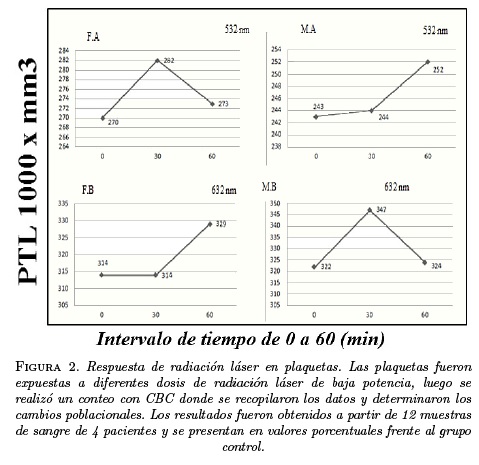
En cada intervalo de tiempo evaluado, la población de PTL radiadas con láser, aumentó en comparación con el grupo control. La figura 2 ilustra estos cambios inducidos por la influencia de la emisión láser de ambos punteros.
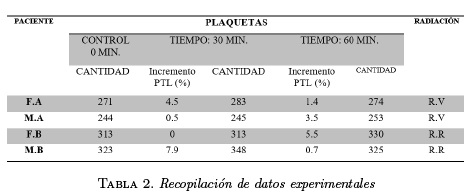
Como muestra la tabla 2, durante el intervalo de 30 minutos las PTL mostraron un incremento con R.V del 4.5 % y del 0.5 % y con R.R del 7.9%. La muestra F.B sobre la cual se emitió R.R se mantuvo constante respecto al grupo control. Igualmente, en el intervalo de 60 minutos, se registró una tendencia de aumento en la población de PTL con incrementos del 1.4% y 3.5% con R.V y de 5.5% y de 0.7% con R.R.
Discusión
Estudios previos han mostrado los efectos que contrae la radiación de baja potencia en sangre y en general en el organismo humano. La presente investigación aportó pruebas sobre el comportamiento de las plaquetas en sangre frente a la emisión estimulada de radiación de láser color verde y rojo. El resultado fue un aumento de población de PTL en 7 de las 12 muestras analizadas (Figura 2).
Hamblin [3], determina el tipo de radiación láser que produce alivio del dolor e inflamación en las articulaciones de ratones Kunming, indicando que el láser infrarrojo de λ = 810 nm, redujo en un 40% las células inflamatorias (neutrofilos, macrofagos, linfocitos y mastocitos), esperando convertirse en una terapia alternativa la cual sustituya el consumo de fármacos en la osteoartritis. Molina et al. [4], comunican los resultados del primer caso de cirugía de transfusión fetofetal realizado en el Hospital Nacional Essalud Huancayo Ramiro Priale, utilizando la técnica de fotocoagulación con láser de argán, concluyendo que la emisión de radiación láser sobre el tejido normalizo el fluido sanguíneo entre los fetos y permitió que sobrevivieran a la enfermedad. Pinazo et al. [5], observaron que la terapia con láser (fotocoagulación), y algunas nuevas técnicas anticoagulantes, son los tratamientos más efectivos para reducir la pérdida de la visión en los diabéticos, puesto que descongestiona los vasos coroideos. Alves et al. [6], concluyeron que el láser de λ = nm de 50 mW redujo significativamente el número de neutrófilos y monocitos presentes en lesiones articulares. Yanhong et al. [7], indicaron que el láser de He-Ne de 9 mW y 18 mW repararon la función del daño de membrana de los eritrocitos por acción de los radicales libres.
Estos resultados sugieren que la radiación de baja potencia genera cambios en las células sanguíneas sin importar la cantidad de muestras que sean evaluadas.
Conclusiones
Se presentó incremento en la población plaquetaria en siete de las ocho muestras del grupo de estudio (M.A2, F.A2, M.B2, M.A3, F.A3, M.B3, F.B3) respecto al grupo control, registrando cambios desde 0.5 % a 7.9 %.
Se demostró que la radiación láser de 532 nm y 632 nm, produce un incremento en la población plaquetaria de células sanguíneas humanas.
La muestra M.B2, sobre la cual fue emitida radiación con láser He-Ne (R.R) durante 30 minutos, aumento 7.9% la población de plaquetas existente, siendo la cifra más alta registrada en el experimento.
Agradecimientos
A la Universidad Manuela Beltrán sede Bogotá por el apoyo financiero para la realización de esta investigación; a la Ing. Diana Estefy Gutierrez Galvis, Vicerrectora de Investigaciones y a la Ing. Sara Margarita Segura Dueñas, Coordinadora de Investigación del programa de Ingeniería Biomédica de la UMB por el asesoramiento logístico en cada una de las etapas de este proyecto. A las directivas del laboratorio Fundemos IPS de la UMB en la ciudad de Bogotá por permitir el uso de sus equipos de laboratorio durante el proceso de experimentación.
Referencias
[1] J. Rodríguez and J. M. Virgos, Fundamentos de óptica ondulatoria (Universidad de Oviedo, 1999) pp. 37-40.
[2] F. W. Sears et al., Física universitaria: con física moderna (Pearson Educación, 2005) , Vol. 2, p. 1247.
[3] M. R. Hamblin, Arthritis Research & Therapy 15 (2013), 10.1186/ar4354.
[4] E. Molina et al., Rev. peru. ginecol. obstet. 58, 343 (2012).
[5] M. D. P. Duran and J. J. G. Medina, Av Diabetol. 24 (2008).
[6] A. C. A. Alves et al., Arthritis Research & Therapy 15 (2013), 10.1186/ar4296.
[7] C. Yanhong et al., Acta Biochim Biophys Sin. 39, 484 (2007).
[8] S. Centros de investigación Mindray, Analizador hematológico automático BC-5300, Mindray (2010).
How to Cite
APA
ACM
ACS
ABNT
Chicago
Harvard
IEEE
MLA
Turabian
Vancouver
Download Citation
License
Copyright (c) 2016 MOMENTO - Physics Journal

This work is licensed under a Creative Commons Attribution-NoDerivatives 4.0 International License.
Those authors who have publications with this journal, accept the following terms:
a. The authors will retain their copyright and will guarantee the publication of the first publication of their work, which will be subject to the Attribution-SinDerivar 4.0 International Creative Commons Attribution License that permits redistribution, commercial or non-commercial, As long as the Work circulates intact and unchanged, where it indicates its author and its first publication in this magazine.
b. Authors are encouraged to disseminate their work through the Internet (eg in institutional telematic files or on their website) before and during the sending process, which can produce interesting exchanges and increase appointments of the published work.