Correo Electrónico
 DNINFOA - SIA
 Bibliotecas
 Convocatorias
 Identidad U.N.


Published
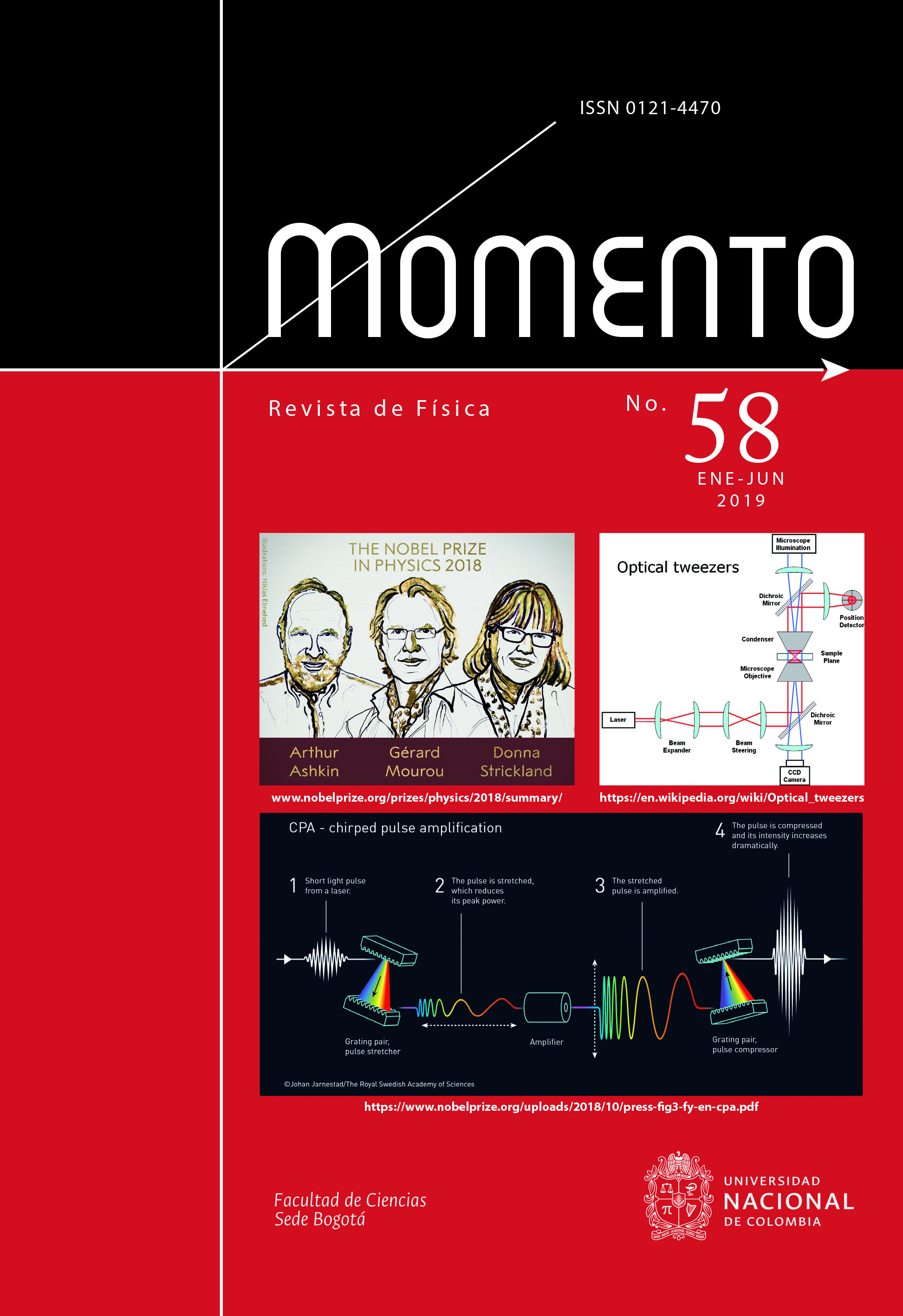
LA PARADOJA DE LA PÉRDIDA DE INFORMACIÓN DE LOS AGUJEROS NEGROS
THE BLACK HOLE INFORMATION LOSS PARADOX
DOI:
https://doi.org/10.15446/mo.n58.70378Keywords:
Agujeros negros, entropía de agujero negro, teoría de cuerdas, teoría de la información. (es)Black holes, Black holes entropy, string theory, theory of information. (en)
Downloads
A continuación, se hace una revisión de la paradoja de la pérdida de la información en los agujeros negros, mostrando su origen, su formulación, y las multiples soluciones que se han dado hasta la actualidad. Con lo anterior se pretende mostrar que una solución a esta paradoja será dada sólo cuando se tenga un conocimiento claro de lo que es la gravedad cuántica.
We present a concise revision of the information loss paradox for black holes, showing the origins, formulations and attempts to settle down the problem. Finally we argue what the solution is farthest to be achieved and is necessary a complete picture of the quantum gravity.
References
J. D. Bekenstein, Lett. Nuovo Cimento. 4, 737 (1972).
J. D. Bekenstein, Phys. Rev. D 7, 2333 (1973).
J. D. Bekenstein, Phys. Rev. D 9, 3292 (1974).
J. D. Bekenstein, Phys Rev D 12, 3077 (1975).
J. M. Bardeen, B. Carter, and S. W. Hawking, Comm. Math. Phys. 31, 161 (1973).
S. W. Hawking, Comm. Math. Phys. 43, 199 (1975).
S. Sorkin, Black holes and relativistic stars ((The university of Chicago Press, 1998).
S. W. Hawking, Phys. Rev. D 14, 2460 (1976).
W. I. Stephen Hawking, General relativity, an Einstein Centenary Survey ((Cambridge University Press, 1979).
S. Dain and M. E. Gabach-Clement, Living Reviews in Relativity 21, 5 (2018).
S. W. Hawking, Phys Rev D 13, 191 (1976).
S. M. Carroll, M. C. Johnson, and L. Randall, J High Energy Phys 2009, 109 (2009).
A. Strominger and C. Vafa, Phys Lett B 379, 99 (1996).
H. K. Kunduri and J. Lucietti, Living Rev Relativ 16, 8 (2013).
S. Coleman, J. Preskill, and F. Wilczek, Nucl Phys B 378, 175 (1992).
V. S. Mashkevich, “Conservative model of black hole and lifting of the information loss paradox,” (1997).
J. Preskill, “Do black holes destroy information?” (1992).
L. Susskind, “Some speculations about black hole entropy in string theory,” (1993).
G. T. Horowitz and D. Marolf, Phys Rev D 55, 3654 (1997).
G. T. Horowitz, “Quantum states of black holes,” (1997).
G. T. Horowitz and J. Maldacena, J High Energy Phys 2004, 008 (2004).
L. Susskind, Sci American 276, 52 (1997).
J. D. Bekenstein, Sci American 289, 58 (2003).
I. Klebanov and J. Maldacena, Phys Today 62 (2009).
L. Susskind, L. Thorlacius, and J. Uglum, Phys Rev D 48, 3743 (1993).
A. Almheiri, D. Marolf, J. Polchinski, and J. Sully, J High Energy Phys 2013, 62 (2013).
D. N. Page, “Black hole information,” (1995).
P. Kraus and F. Wilczek, Nucl Phys B 433, 403 (1995).
P. Kraus and F. Wilczek, Nuclear Physics B 437, 231 (1995).
M. K. Parikh and F. Wilczek, Phys. Rev. Lett. 85, 5042 (2000).
M. K. Parikh, “Energy conservation and hawking radiation,” (2004).
B. Zhang, Q. yu Cai, L. You, and M. sheng Zhan, Phys Lett B 675, 98 (2009).
S. M. Gil, Correlaciones estadísticas en la radiación Hawking, Tesis de maestría, Universidad Nacional de Colombia, Colombia (2012).
S. W. Hawking, Phys Rev D 72, 084013 (2005).
Z. Merali, Nature 496, 21 (2013).
S. W. Hawking, M. J. Perry, and A. Strominger, Phys Rev Lett 116, 231301 (2016).
H. Bond, M. G. J. V. der Burg, and A. W. K. Metzner, Proc Roy Soc Lond 269, 21 (1962).
R. K. Sachs and H. Bondi, Proc Roy Soc Lond 270, 103 (1962).
How to Cite
APA
ACM
ACS
ABNT
Chicago
Harvard
IEEE
MLA
Turabian
Vancouver
Download Citation
License
Copyright (c) 2019 MOMENTO

This work is licensed under a Creative Commons Attribution-NoDerivatives 4.0 International License.
Those authors who have publications with this journal, accept the following terms:
a. The authors will retain their copyright and will guarantee the publication of the first publication of their work, which will be subject to the Attribution-SinDerivar 4.0 International Creative Commons Attribution License that permits redistribution, commercial or non-commercial, As long as the Work circulates intact and unchanged, where it indicates its author and its first publication in this magazine.
b. Authors are encouraged to disseminate their work through the Internet (eg in institutional telematic files or on their website) before and during the sending process, which can produce interesting exchanges and increase appointments of the published work.